Pearson Edexcel · GCSE · History
Course version: 1HI0 · Version from Sept 2016
Key topic 1: Spain reaches the Americas, c1490–1512 - 3 Spanish claims in…
Full specification wording
Option P1: Key topic 1: Spain reaches the Americas, c1490–1512 - 3 Spanish claims in the Caribbean: The effects of Spanish settlement: treatment of Indigenous peoples, effects of smallpox.
The Spanish settlement in the Caribbean had devastating effects on the Indigenous Taino population.
Checked against the Pearson Edexcel 1HI0 specification (opens in a new tab) on .
- Point 2 of 3
- 3 key terms
Study notes
From the checked teaching notes for this specification point.
The idea
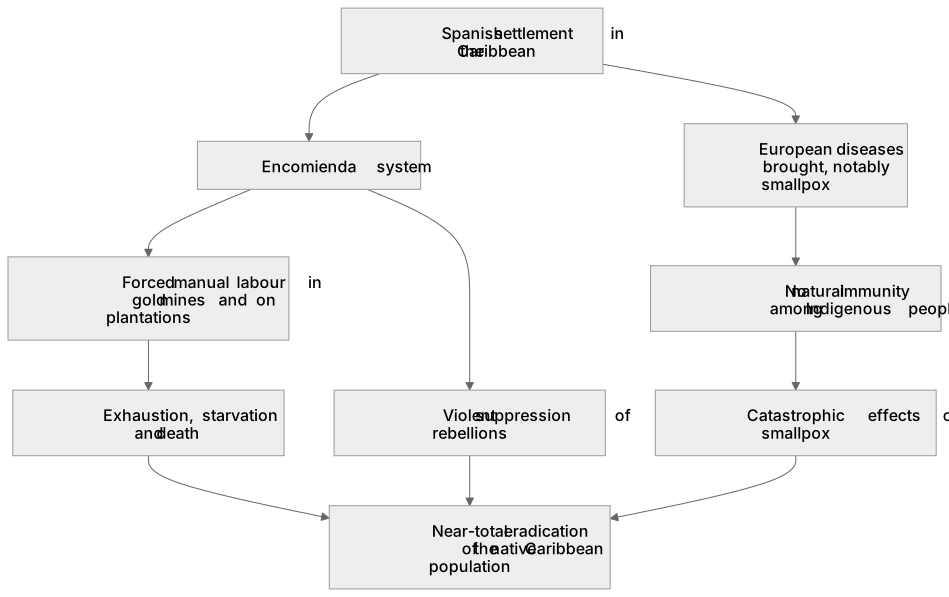
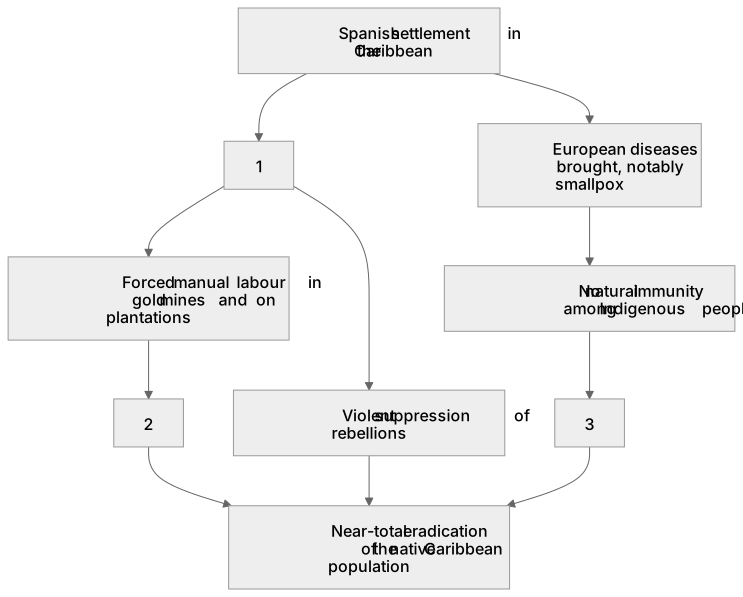
The Spanish settlement in the Caribbean had devastating effects on the Indigenous Taino population. The Spanish implemented the encomienda system, which forced Indigenous peoples into brutal manual labour in gold mines and on plantations, leading to widespread exhaustion, starvation, and death. Furthermore, the Spanish brought European diseases, most notably smallpox, to which the Indigenous population had no natural immunity. The effects of smallpox were catastrophic, causing massive demographic collapse. Combined with harsh treatment and violent suppression of rebellions, these factors led to the near-total eradication of the native Caribbean population within a few decades of Columbus's arrival.
What earns the marks
- Describe the harsh conditions of forced labour imposed on Indigenous peoples under the encomienda system.
- Explain the lack of Indigenous immunity to European diseases like smallpox.
- Analyse the demographic impact of smallpox and other diseases on the native population.
- Evaluate the combined effects of violence, overwork, and disease in causing the collapse of the Taino population.
Common mistakes and how to put them right
Stating that disease was the only cause of Indigenous population decline.
Put it right: Acknowledge that brutal forced labour, starvation, and violent suppression were also major contributing factors.
Claiming the Spanish intentionally used smallpox as a biological weapon in the Caribbean.
Put it right: The spread of smallpox was an unintentional consequence of contact, though its effects were devastating.
Referring to the Indigenous peoples generically without acknowledging specific groups.
Put it right: Use specific terms like the Taino when discussing the Indigenous peoples of the Caribbean.
Exam tips
- Ensure you can explain the dual impact of both physical mistreatment (encomienda) and biological factors (smallpox).
- Use specific terms like 'encomienda' to demonstrate precise historical knowledge of Spanish exploitation.
- When asked about the consequences of Spanish settlement, the demographic collapse of the Indigenous population is a crucial point to develop.
Try the lesson
The start of the Option P1: Key topic 1: Spain reaches the Americas, c1490–1512 - 3 Spanish claims in the Caribbean: The effects of Spanish settlement: treatment of Indigenous peoples, effects of smallpox. lesson, made from checked teaching notes for this specification point.
Have a go first
Which European disease had the most devastating effect on the Indigenous peoples of the Caribbean following Spanish settlement?
Listen
The Spanish settlement in the Caribbean had devastating effects on the Indigenous Taino population. The Spanish implemented the encomienda system, which forced Indigenous peoples into brutal manual labour in gold mines and on plantations, leading to widespread exhaustion, starvation, and death. Furthermore, the Spanish brought European diseases, most notably smallpox, to which the Indigenous population had no natural immunity. The effects of smallpox were catastrophic, causing massive demographic collapse. Combined with harsh treatment and violent suppression of rebellions, these factors led to the near-total eradication of the native Caribbean population within a few decades of Columbus's arrival. A strong answer earns marks for these points. Describe the harsh conditions of forced labour imposed on Indigenous peoples under the encomienda system. Explain the lack of Indigenous immunity to European diseases like smallpox. Analyse the demographic impact of smallpox and other diseases on the native population. Evaluate the combined effects of violence, overwork, and disease in causing the collapse of the Taino population. A common slip: Stating that disease was the only cause of Indigenous population decline. Instead, Acknowledge that brutal forced labour, starvation, and violent suppression were also major contributing factors. Exam tip: Ensure you can explain the dual impact of both physical mistreatment (encomienda) and biological factors (smallpox).
See it
Key words
Say what each word means before you turn the card.
Encomienda system
Try answering aloud or in your head before turning the card.
Smallpox
Try answering aloud or in your head before turning the card.
Taino
Try answering aloud or in your head before turning the card.
See every definition
- Encomienda system
- A system implemented by the Spanish that forced Indigenous peoples into brutal manual labour in gold mines and on plantations.
- Smallpox
- A European disease brought by the Spanish to which the Indigenous population had no natural immunity, causing catastrophic effects.
- Taino
- The Indigenous peoples of the Caribbean whose population was devastated by Spanish settlement.
Label the diagram
Some boxes have lost their names. Pick the right name for each number.
1Box 1
2Box 2
3Box 3
There is more to this lesson
The full lesson goes on to check your understanding and help you earn the marks. Create a free account to carry on, with your progress saved.
A week of Premium from your first lesson · Then the free plan continues · No card, no charge
Test your understanding of Option P1: Key topic 1: Spain reaches the Americas, c1490–1512 - 3 Spanish claims in the Caribbean: The effects of Spanish settlement: treatment of Indigenous peoples, effects of smallpox.
Active recall beats re-reading. Take an instant quiz now to test what you’ve learned and lock it into long-term memory.
A week of Premium from your first lesson · Then the free plan continues · No card, no charge