Pearson Edexcel · GCSE · History
Course version: 1HI0 · Version from Sept 2016
Key topic 1: Spain reaches the Americas, c1490–1512 - 3 Spanish claims in…
Full specification wording
Option P1: Key topic 1: Spain reaches the Americas, c1490–1512 - 3 Spanish claims in the Caribbean: Development of an imperial policy in relation to the Caribbean: the regulation of further exploration, the establishment of a monopoly on trade, the extension of Spanish authority and the use of slavery. The role of Catholic missionaries.
Spain developed a structured imperial policy to control the Caribbean.
Checked against the Pearson Edexcel 1HI0 specification (opens in a new tab) on .
- Point 3 of 3
- 4 key terms
Study notes
From the checked teaching notes for this specification point.
The idea
Spain developed a structured imperial policy to control the Caribbean. The Crown regulated exploration through royal licenses and established the Casa de Contratación (1503) to enforce a strict monopoly on trade, ensuring wealth flowed directly to Spain. Spanish authority was extended via royal governors like Ovando, replacing private enterprise with state control. To meet labour demands following the Indigenous population collapse, the Spanish initiated the use of enslaved Africans. Catholic missionaries played a complex role; while they facilitated religious conversion and cultural assimilation, figures like Montesinos and Las Casas actively protested the brutal treatment of Indigenous peoples under the encomienda system.
What earns the marks
- Explain the function of the Casa de Contratación in establishing a Spanish trade monopoly.
- Describe how the Spanish Crown extended its authority by appointing royal governors to replace Columbus.
- Identify the reasons for the introduction of enslaved Africans to the Caribbean, linking it to the decline of Indigenous labour.
- Analyse the dual role of Catholic missionaries in converting the native population and advocating for their rights.
Common mistakes and how to put them right
Assuming trade was free and open to all Spanish citizens.
Put it right: Trade was strictly monopolised by the Crown through the Casa de Contratación in Seville.
Believing all Catholic missionaries supported the abuse of Indigenous peoples.
Put it right: Missionaries like Bartolomé de las Casas were prominent critics of the encomienda system and defended Indigenous rights.
Confusing the enslavement of Indigenous peoples with the later introduction of enslaved Africans.
Put it right: Distinguish between the forced labour of natives (encomienda) and the subsequent importation of enslaved Africans due to native population decline.
Exam tips
- Link the establishment of the Casa de Contratación directly to the concept of a trade monopoly and imperial wealth.
- When discussing missionaries, highlight the tension between the Crown's economic goals and the moral objections raised by friars.
- Use the transition from Columbus to royal governors like Ovando as evidence of the extension of formal Spanish authority.
Try the lesson
The start of the Option P1: Key topic 1: Spain reaches the Americas, c1490–1512 - 3 Spanish claims in the Caribbean: Development of an imperial policy in relation to the Caribbean: the regulation of further exploration, the establishment of a monopoly on trade, the extension of Spanish authority and the use of slavery. The role of Catholic missionaries. lesson, made from checked teaching notes for this specification point.
Have a go first
Which institution was established by the Spanish Crown in 1503 to regulate trade and establish a monopoly in the Caribbean?
Listen
Spain developed a structured imperial policy to control the Caribbean. The Crown regulated exploration through royal licenses and established the Casa de Contratación (1503) to enforce a strict monopoly on trade, ensuring wealth flowed directly to Spain. Spanish authority was extended via royal governors like Ovando, replacing private enterprise with state control. To meet labour demands following the Indigenous population collapse, the Spanish initiated the use of enslaved Africans. Catholic missionaries played a complex role; while they facilitated religious conversion and cultural assimilation, figures like Montesinos and Las Casas actively protested the brutal treatment of Indigenous peoples under the encomienda system. A strong answer earns marks for these points. Explain the function of the Casa de Contratación in establishing a Spanish trade monopoly. Describe how the Spanish Crown extended its authority by appointing royal governors to replace Columbus. Identify the reasons for the introduction of enslaved Africans to the Caribbean, linking it to the decline of Indigenous labour. Analyse the dual role of Catholic missionaries in converting the native population and advocating for their rights. A common slip: Assuming trade was free and open to all Spanish citizens. Instead, Trade was strictly monopolised by the Crown through the Casa de Contratación in Seville. Exam tip: Link the establishment of the Casa de Contratación directly to the concept of a trade monopoly and imperial wealth.
See it

Key words
Say what each word means before you turn the card.
Imperial administration and control
Try answering aloud or in your head before turning the card.
Economic monopoly and trade
Try answering aloud or in your head before turning the card.
Religion and morality
Try answering aloud or in your head before turning the card.
Slavery and forced labour
Try answering aloud or in your head before turning the card.
See every definition
- Imperial administration and control
- Spain developed a structured imperial policy to control the Caribbean, regulating exploration through royal licenses and extending Spanish authority via royal governors.
- Economic monopoly and trade
- The Crown established the Casa de Contratación in 1503 to enforce a strict monopoly on trade, ensuring wealth flowed directly to Spain.
- Religion and morality
- Catholic missionaries facilitated religious conversion and cultural assimilation, while figures like Montesinos and Las Casas protested the brutal treatment of Indigenous peoples.
- Slavery and forced labour
- Following the Indigenous population collapse, the Spanish initiated the use of enslaved Africans to meet labour demands.
Label the diagram
Some boxes have lost their names. Pick the right name for each number.
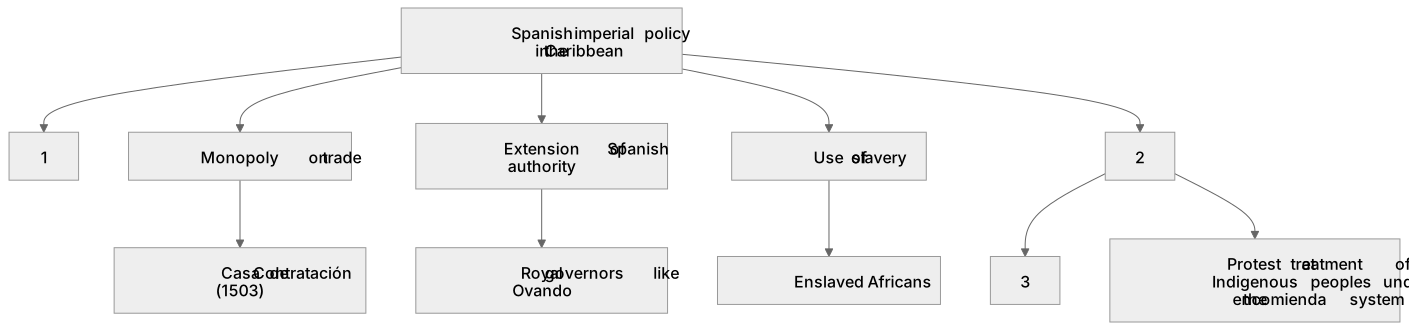
1Box 1
2Box 2
3Box 3
There is more to this lesson
The full lesson goes on to check your understanding and help you earn the marks. Create a free account to carry on, with your progress saved.
A week of Premium from your first lesson · Then the free plan continues · No card, no charge
Test your understanding of Option P1: Key topic 1: Spain reaches the Americas, c1490–1512 - 3 Spanish claims in the Caribbean: Development of an imperial policy in relation to the Caribbean: the regulation of further exploration, the establishment of a monopoly on trade, the extension of Spanish authority and the use of slavery. The role of Catholic missionaries.
Active recall beats re-reading. Take an instant quiz now to test what you’ve learned and lock it into long-term memory.
A week of Premium from your first lesson · Then the free plan continues · No card, no charge