Pearson Edexcel · GCSE · History
Course version: 1HI0 · Version from Sept 2016
Key topic 2: The conquistadors, 1513–c1528 - 2 The conquest of Mexico:…
Full specification wording
Option P1: Key topic 2: The conquistadors, 1513–c1528 - 2 The conquest of Mexico: Cortes’s expedition to Mexico in 1519.
Hernán Cortés launched his expedition to Mexico in 1519, defying the direct orders of the Governor of Cuba, Diego Velázquez.
Checked against the Pearson Edexcel 1HI0 specification (opens in a new tab) on .
- Point 1 of 3
- 4 key terms
Study notes
From the checked teaching notes for this specification point.
The idea
Hernán Cortés launched his expedition to Mexico in 1519, defying the direct orders of the Governor of Cuba, Diego Velázquez. Landing on the Yucatán Peninsula with approximately 600 men, horses, and artillery, Cortés demonstrated ruthless ambition. He established the settlement of Veracruz to legitimise his command directly under King Charles I, bypassing Velázquez. To prevent desertion and force his men to commit to the conquest, Cortés famously scuttled his own ships. He also acquired crucial translators, notably La Malinche (Doña Marina), whose linguistic skills and cultural knowledge were vital for gathering intelligence and forging alliances with indigenous groups hostile to the Aztec Empire.
What earns the marks
- Cortés departed for Mexico in 1519 in direct defiance of Governor Velázquez's orders, making the expedition an act of mutiny.
- He founded the town of Veracruz to create a legal loophole, placing himself directly under the authority of the Spanish King.
- Cortés scuttled his fleet to eliminate the possibility of retreat and force his soldiers to commit entirely to the campaign.
- The acquisition of translators, particularly La Malinche, provided Cortés with essential intelligence and diplomatic leverage.
Common mistakes and how to put them right
Stating that Cortés had official permission for the conquest.
Put it right: He explicitly defied the Governor of Cuba to launch the expedition.
Claiming that Cortés 'burned' his ships.
Put it right: Historical evidence indicates he scuttled (sank) them to prevent his men from returning to Cuba.
Overlooking the role of indigenous translators.
Put it right: Without La Malinche, Cortés could not have communicated or formed crucial alliances.
Exam tips
- Highlight Cortés's political manoeuvring at Veracruz as evidence of his cunning and understanding of Spanish law.
- Explain how scuttling the ships demonstrated Cortés's absolute commitment and leadership style.
- Discuss La Malinche not just as a translator, but as a vital strategic advisor who understood indigenous politics.
Try the lesson
The start of the Option P1: Key topic 2: The conquistadors, 1513–c1528 - 2 The conquest of Mexico: Cortes’s expedition to Mexico in 1519. lesson, made from checked teaching notes for this specification point.
Have a go first
Which Spanish colony served as the starting point for Hernán Cortés's expedition to Mexico in 1519?
Listen
Hernán Cortés launched his expedition to Mexico in 1519, defying the direct orders of the Governor of Cuba, Diego Velázquez. Landing on the Yucatán Peninsula with approximately 600 men, horses, and artillery, Cortés demonstrated ruthless ambition. He established the settlement of Veracruz to legitimise his command directly under King Charles I, bypassing Velázquez. To prevent desertion and force his men to commit to the conquest, Cortés famously scuttled his own ships. He also acquired crucial translators, notably La Malinche (Doña Marina), whose linguistic skills and cultural knowledge were vital for gathering intelligence and forging alliances with indigenous groups hostile to the Aztec Empire. A strong answer earns marks for these points. Cortés departed for Mexico in 1519 in direct defiance of Governor Velázquez's orders, making the expedition an act of mutiny. He founded the town of Veracruz to create a legal loophole, placing himself directly under the authority of the Spanish King. Cortés scuttled his fleet to eliminate the possibility of retreat and force his soldiers to commit entirely to the campaign. The acquisition of translators, particularly La Malinche, provided Cortés with essential intelligence and diplomatic leverage. Exam tip: Highlight Cortés's political manoeuvring at Veracruz as evidence of his cunning and understanding of Spanish law.
See it
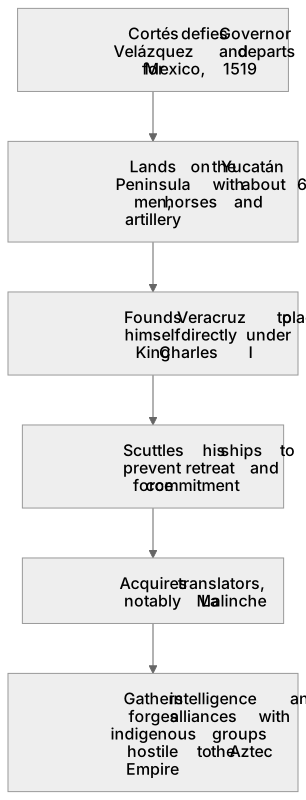
Put it in order
Put these steps in the order they happen.
- 1. Founds Veracruz to place himself directly under King Charles I
- 2. Lands on the Yucatán Peninsula with about 600 men, horses and artillery
- 3. Cortés defies Governor Velázquez and departs for Mexico, 1519
- 4. Gathers intelligence and forges alliances with indigenous groups hostile to the Aztec Empire
- 5. Acquires translators, notably La Malinche
- 6. Scuttles his ships to prevent retreat and force commitment
Key words
Say what each word means before you turn the card.
Mutiny and authority
Try answering aloud or in your head before turning the card.
Strategic leadership
Try answering aloud or in your head before turning the card.
Cross-cultural communication
Try answering aloud or in your head before turning the card.
Military commitment
Try answering aloud or in your head before turning the card.
See every definition
- Mutiny and authority
- Cortés departed for Mexico in 1519 in direct defiance of Governor Velázquez's orders, making the expedition an act of mutiny.
- Strategic leadership
- Cortés scuttled his fleet to eliminate the possibility of retreat and force his soldiers to commit entirely to the campaign.
- Cross-cultural communication
- The acquisition of translators, particularly La Malinche, provided Cortés with essential intelligence and diplomatic leverage.
- Military commitment
- Scuttling the ships demonstrated Cortés's absolute commitment and leadership style.
Label the diagram
Some boxes have lost their names. Pick the right name for each number.
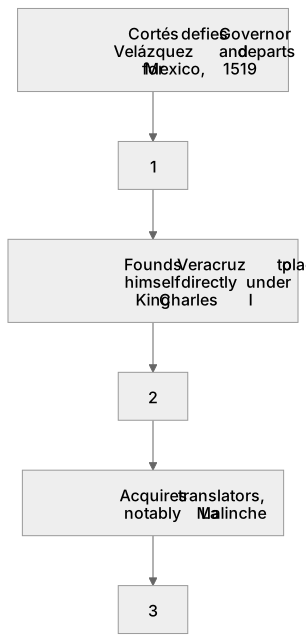
1Box 1
2Box 2
3Box 3
There is more to this lesson
The full lesson goes on to check your understanding and help you earn the marks. Create a free account to carry on, with your progress saved.
A week of Premium from your first lesson · Then the free plan continues · No card, no charge
Test your understanding of Option P1: Key topic 2: The conquistadors, 1513–c1528 - 2 The conquest of Mexico: Cortes’s expedition to Mexico in 1519.
Active recall beats re-reading. Take an instant quiz now to test what you’ve learned and lock it into long-term memory.
A week of Premium from your first lesson · Then the free plan continues · No card, no charge