Pearson Edexcel · GCSE · History
Course version: 1HI0 · Version from Sept 2016
Key topic 2: The conquistadors, 1513–c1528 - 2 The conquest of Mexico: Key…
Full specification wording
Option P1: Key topic 2: The conquistadors, 1513–c1528 - 2 The conquest of Mexico: Key events of the Spanish conquest of Mexico; the role of Montezuma, the war between Aztecs and Tlaxcalans.
The Spanish conquest of Mexico hinged on exploiting existing indigenous conflicts, notably the war between the Aztecs and the Tlaxcalans.
Checked against the Pearson Edexcel 1HI0 specification (opens in a new tab) on .
- Point 2 of 3
- 3 key terms
Study notes
From the checked teaching notes for this specification point.
The idea
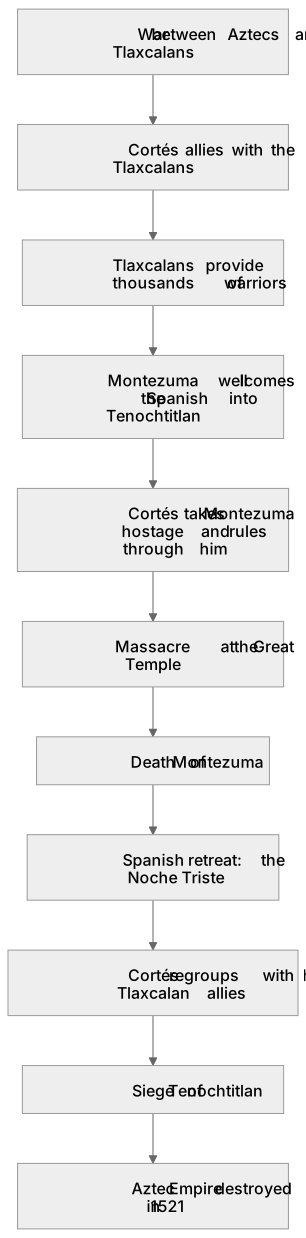
The Spanish conquest of Mexico hinged on exploiting existing indigenous conflicts, notably the war between the Aztecs and the Tlaxcalans. Cortés forged a crucial alliance with the Tlaxcalans, who provided thousands of warriors to supplement his small Spanish force. Upon reaching Tenochtitlan, Emperor Montezuma II initially welcomed the Spanish, a fatal decision that allowed Cortés to take him hostage and rule through him. Key events include the massacre at the Great Temple, the death of Montezuma, and the disastrous Spanish retreat during the 'Night of Sorrows' (Noche Triste). Cortés subsequently regrouped with his Tlaxcalan allies, besieged Tenochtitlan, and finally destroyed the Aztec Empire in 1521.
What earns the marks
- The ongoing enmity between the Aztecs and the Tlaxcalans allowed Cortés to secure a massive indigenous allied army.
- Montezuma II's initial decision to welcome the Spanish into Tenochtitlan enabled Cortés to take the Emperor hostage.
- The Spanish suffered a severe defeat and heavy casualties during their retreat from the city on the Noche Triste.
- The final victory in 1521 was achieved through a prolonged siege of Tenochtitlan, heavily reliant on Tlaxcalan support and the impact of smallpox.
Common mistakes and how to put them right
Believing the Spanish defeated the Aztecs entirely on their own.
Put it right: The Tlaxcalan alliance was the decisive military factor.
Oversimplifying Montezuma's actions as mere cowardice.
Put it right: His decisions were rooted in complex religious and diplomatic considerations.
Confusing the Noche Triste with the final Spanish victory.
Put it right: The Noche Triste was a major Spanish defeat that forced them to regroup.
Exam tips
- Always integrate the role of the Tlaxcalans when explaining why a small force of Spaniards was able to topple a massive empire.
- Analyse Montezuma's captivity as a major turning point that destabilised Aztec leadership.
- Use the events of the Noche Triste to demonstrate that the Spanish conquest was fiercely contested and not inevitable.
Try the lesson
The start of the Option P1: Key topic 2: The conquistadors, 1513–c1528 - 2 The conquest of Mexico: Key events of the Spanish conquest of Mexico; the role of Montezuma, the war between Aztecs and Tlaxcalans. lesson, made from checked teaching notes for this specification point.
Have a go first
Which powerful indigenous group formed a crucial military alliance with the Spanish against the Aztecs?
Listen
The Spanish conquest of Mexico hinged on exploiting existing indigenous conflicts, notably the war between the Aztecs and the Tlaxcalans. Cortés forged a crucial alliance with the Tlaxcalans, who provided thousands of warriors to supplement his small Spanish force. Upon reaching Tenochtitlan, Emperor Montezuma II initially welcomed the Spanish, a fatal decision that allowed Cortés to take him hostage and rule through him. Key events include the massacre at the Great Temple, the death of Montezuma, and the disastrous Spanish retreat during the 'Night of Sorrows' (Noche Triste). Cortés subsequently regrouped with his Tlaxcalan allies, besieged Tenochtitlan, and finally destroyed the Aztec Empire in 1521. A strong answer earns marks for these points. The ongoing enmity between the Aztecs and the Tlaxcalans allowed Cortés to secure a massive indigenous allied army. Montezuma II's initial decision to welcome the Spanish into Tenochtitlan enabled Cortés to take the Emperor hostage. The Spanish suffered a severe defeat and heavy casualties during their retreat from the city on the Noche Triste. The final victory in 1521 was achieved through a prolonged siege of Tenochtitlan, heavily reliant on Tlaxcalan support and the impact of smallpox. Exam tip: Always integrate the role of the Tlaxcalans when explaining why a small force of Spaniards was able to topple a massive empire.
See it
Key words
Say what each word means before you turn the card.
Indigenous alliances
Try answering aloud or in your head before turning the card.
Leadership and captivity
Try answering aloud or in your head before turning the card.
Siege warfare
Try answering aloud or in your head before turning the card.
See every definition
- Indigenous alliances
- Cortés forged a crucial alliance with the Tlaxcalans, who provided thousands of warriors to supplement his small Spanish force.
- Leadership and captivity
- Montezuma II's initial decision to welcome the Spanish into Tenochtitlan enabled Cortés to take the Emperor hostage and rule through him.
- Siege warfare
- The final victory in 1521 was achieved through a prolonged siege of Tenochtitlan, heavily reliant on Tlaxcalan support and the impact of smallpox.
Label the diagram
Some boxes have lost their names. Pick the right name for each number.
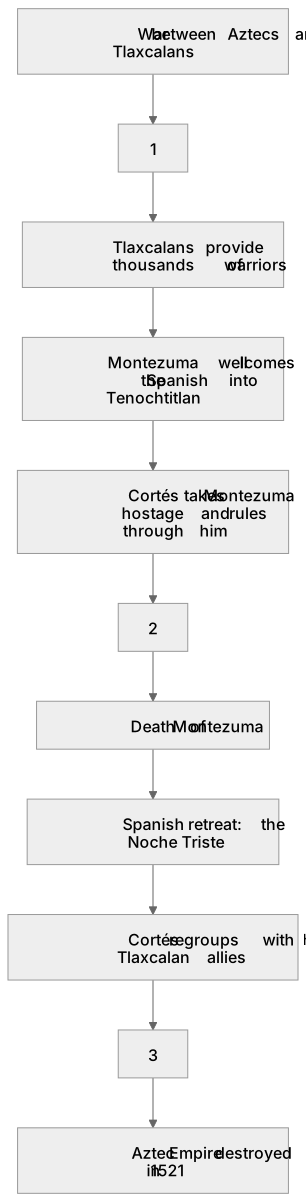
1Box 1
2Box 2
3Box 3
There is more to this lesson
The full lesson goes on to check your understanding and help you earn the marks. Create a free account to carry on, with your progress saved.
A week of Premium from your first lesson · Then the free plan continues · No card, no charge
Test your understanding of Option P1: Key topic 2: The conquistadors, 1513–c1528 - 2 The conquest of Mexico: Key events of the Spanish conquest of Mexico; the role of Montezuma, the war between Aztecs and Tlaxcalans.
Active recall beats re-reading. Take an instant quiz now to test what you’ve learned and lock it into long-term memory.
A week of Premium from your first lesson · Then the free plan continues · No card, no charge