Pearson Edexcel · GCSE · History
Course version: 1HI0 · Version from Sept 2016
Key topic 2: The conquistadors, 1513–c1528 - 2 The conquest of Mexico: The…
Full specification wording
Option P1: Key topic 2: The conquistadors, 1513–c1528 - 2 The conquest of Mexico: The capture of Tenochtitlan and the Aztec surrender.
The capture of Tenochtitlan in August 1521 marked the culmination of the Spanish conquest of the Aztec Empire.
Checked against the Pearson Edexcel 1HI0 specification (opens in a new tab) on .
- Point 3 of 3
- 4 key terms
Study notes
From the checked teaching notes for this specification point.
The idea
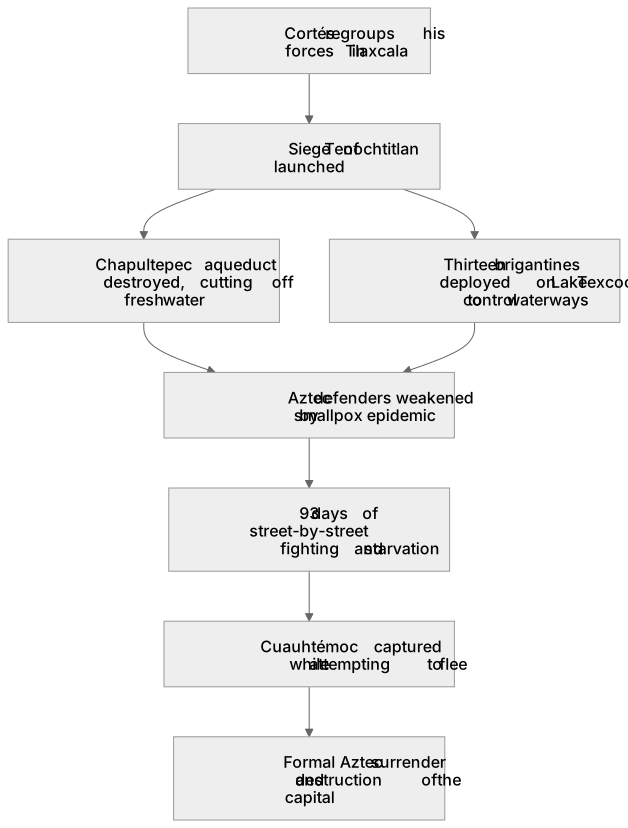
The capture of Tenochtitlan in August 1521 marked the culmination of the Spanish conquest of the Aztec Empire. Hernán Cortés regrouped his forces in Tlaxcala and launched a meticulously planned siege. He cut off the city's fresh water supply by destroying the Chapultepec aqueduct and deployed thirteen purpose-built brigantines on Lake Texcoco to control the waterways, preventing Aztec resupply. The defenders, severely weakened by a devastating smallpox epidemic, fought fiercely under their new emperor, Cuauhtémoc. After 93 days of brutal street-by-street fighting and starvation, the city fell. Cuauhtémoc was captured while attempting to flee, leading to the formal Aztec surrender and the complete destruction of their capital.
What earns the marks
- Identify the role of Tlaxcalan allies in supporting the Spanish siege.
- Explain the strategic importance of the brigantines on Lake Texcoco.
- Describe the impact of the smallpox epidemic on the Aztec defenders' ability to resist.
- Detail the tactics used by Cortés, such as cutting off the aqueduct and blockading causeways.
- Note the capture of Cuauhtémoc as the definitive moment of Aztec surrender.
Common mistakes and how to put them right
Claiming the Spanish captured the city solely due to superior weaponry.
Put it right: Emphasise that disease, indigenous allies, and siege tactics were equally critical factors.
Confusing Moctezuma II with Cuauhtémoc during the final siege.
Put it right: State clearly that Cuauhtémoc was the Aztec leader during the final defence and surrender of Tenochtitlan.
Stating the capture happened quickly after the Spanish arrived.
Put it right: Explain that the final capture occurred in August 1521 after a prolonged 93-day siege, following the earlier Spanish expulsion.
Exam tips
- When evaluating the reasons for the Aztec defeat, ensure you balance Spanish military tactics with the devastating impact of smallpox.
- Use specific details, such as the construction of the brigantines, to demonstrate precise knowledge of the siege.
- Link the capture of the city directly to the collapse of the wider Aztec Empire to show an understanding of consequences.
Try the lesson
The start of the Option P1: Key topic 2: The conquistadors, 1513–c1528 - 2 The conquest of Mexico: The capture of Tenochtitlan and the Aztec surrender. lesson, made from checked teaching notes for this specification point.
Have a go first
Which of the following methods was primarily used by Hernán Cortés to finally capture the city of Tenochtitlan in 1521?
Listen
The capture of Tenochtitlan in August 1521 marked the culmination of the Spanish conquest of the Aztec Empire. Hernán Cortés regrouped his forces in Tlaxcala and launched a meticulously planned siege. He cut off the city's fresh water supply by destroying the Chapultepec aqueduct and deployed thirteen purpose-built brigantines on Lake Texcoco to control the waterways, preventing Aztec resupply. The defenders, severely weakened by a devastating smallpox epidemic, fought fiercely under their new emperor, Cuauhtémoc. After 93 days of brutal street-by-street fighting and starvation, the city fell. Cuauhtémoc was captured while attempting to flee, leading to the formal Aztec surrender and the complete destruction of their capital. A strong answer earns marks for these points. Identify the role of Tlaxcalan allies in supporting the Spanish siege. Explain the strategic importance of the brigantines on Lake Texcoco. Describe the impact of the smallpox epidemic on the Aztec defenders' ability to resist. Detail the tactics used by Cortés, such as cutting off the aqueduct and blockading causeways. A common slip: Claiming the Spanish captured the city solely due to superior weaponry. Instead, Emphasise that disease, indigenous allies, and siege tactics were equally critical factors. Exam tip: When evaluating the reasons for the Aztec defeat, ensure you balance Spanish military tactics with the devastating impact of smallpox.
See it
Key words
Say what each word means before you turn the card.
Brigantines
Try answering aloud or in your head before turning the card.
Smallpox epidemic
Try answering aloud or in your head before turning the card.
Cuauhtémoc
Try answering aloud or in your head before turning the card.
Tlaxcalan allies
Try answering aloud or in your head before turning the card.
See every definition
- Brigantines
- Purpose-built vessels deployed by Cortés on Lake Texcoco to control the waterways and prevent Aztec resupply.
- Smallpox epidemic
- A devastating outbreak that severely weakened the Aztec defenders during the siege.
- Cuauhtémoc
- The new emperor under whom the defenders fought fiercely, captured while attempting to flee, leading to the formal Aztec surrender.
- Tlaxcalan allies
- Indigenous supporters whose role was to support the Spanish siege after Cortés regrouped his forces in Tlaxcala.
Label the diagram
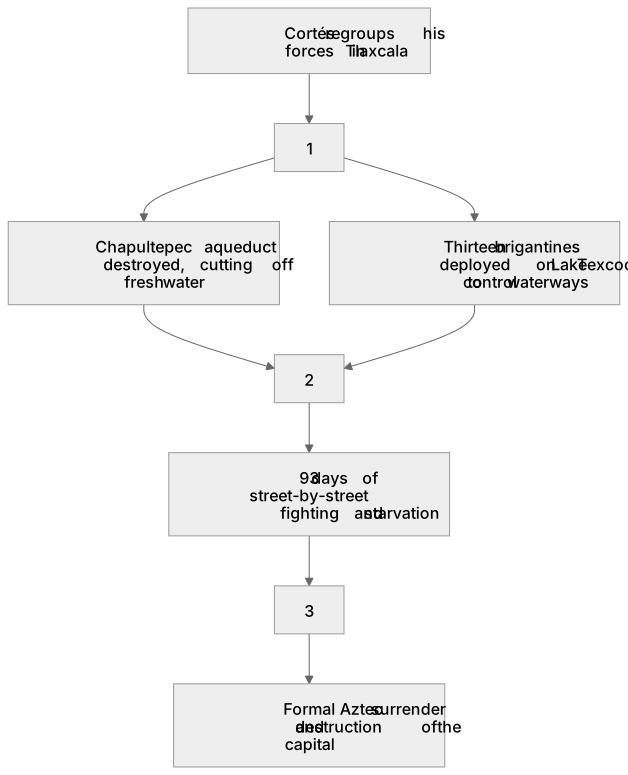
Some boxes have lost their names. Pick the right name for each number.
1Box 1
2Box 2
3Box 3
There is more to this lesson
The full lesson goes on to check your understanding and help you earn the marks. Create a free account to carry on, with your progress saved.
A week of Premium from your first lesson · Then the free plan continues · No card, no charge
Test your understanding of Option P1: Key topic 2: The conquistadors, 1513–c1528 - 2 The conquest of Mexico: The capture of Tenochtitlan and the Aztec surrender.
Active recall beats re-reading. Take an instant quiz now to test what you’ve learned and lock it into long-term memory.
A week of Premium from your first lesson · Then the free plan continues · No card, no charge