Pearson Edexcel · GCSE · History
Course version: 1HI0 · Version from Sept 2016
Key topic 3: The Spanish Empire c1528–c1555 - 1 Pizarro and the conquest…
Full specification wording
Option P1: Key topic 3: The Spanish Empire c1528–c1555 - 1 Pizarro and the conquest of the Incas: Contact with the Incas (1528); the significance of the death of Huayna Capac.
In 1528, Francisco Pizarro made initial contact with the Inca Empire during his second expedition, discovering a wealthy civilisation at Tumbes.
Checked against the Pearson Edexcel 1HI0 specification (opens in a new tab) on .
- Point 1 of 3
- 4 key terms
Study notes
From the checked teaching notes for this specification point.
The idea
In 1528, Francisco Pizarro made initial contact with the Inca Empire during his second expedition, discovering a wealthy civilisation at Tumbes. This contact confirmed rumours of vast riches, motivating Pizarro to return to Spain to secure royal permission for conquest. Concurrently, the Inca Emperor Huayna Capac died suddenly, likely from European diseases like smallpox. His death was highly significant as it created a power vacuum and a succession crisis. Huayna Capac had not clearly designated an heir, leading to a bitter civil war between his sons, Atahuallpa and Huascar. This internal conflict severely weakened the Inca Empire just as the Spanish were preparing their invasion, making the subsequent conquest possible.
What earns the marks
- Identify 1528 as the year of initial Spanish contact with the Incas at Tumbes.
- Explain how the discovery of Inca wealth motivated Pizarro's quest for royal approval.
- Describe the cause of Huayna Capac's death, linking it to European diseases.
- Analyse the significance of Huayna Capac's death in triggering a succession crisis.
- Evaluate how the resulting civil war between Atahuallpa and Huascar weakened the Inca Empire prior to the Spanish invasion.
Common mistakes and how to put them right
Stating Pizarro conquered the Incas in 1528.
Put it right: Pizarro only made initial contact in 1528; the actual conquest began later in 1532.
Claiming Huayna Capac was killed in battle by the Spanish.
Put it right: Huayna Capac died of disease, likely smallpox, before the Spanish invasion force arrived.
Ignoring the succession crisis.
Put it right: Link Huayna Capac's death to the resulting civil war between his sons, which was crucial for Spanish success.
Exam tips
- When discussing the significance of Huayna Capac's death, focus on the resulting instability and civil war rather than just the disease itself.
- Use the 1528 contact to explain Pizarro's motivation and his ability to secure the Capitulación de Toledo from the Spanish Crown.
- Link the introduction of European diseases to the broader impact of Spanish exploration on indigenous populations.
Try the lesson
The start of the Option P1: Key topic 3: The Spanish Empire c1528–c1555 - 1 Pizarro and the conquest of the Incas: Contact with the Incas (1528); the significance of the death of Huayna Capac. lesson, made from checked teaching notes for this specification point.
Have a go first
What was the immediate political consequence of the death of the Inca ruler Huayna Capac around 1528?
Listen
In 1528, Francisco Pizarro made initial contact with the Inca Empire during his second expedition, discovering a wealthy civilisation at Tumbes. This contact confirmed rumours of vast riches, motivating Pizarro to return to Spain to secure royal permission for conquest. Concurrently, the Inca Emperor Huayna Capac died suddenly, likely from European diseases like smallpox. His death was highly significant as it created a power vacuum and a succession crisis. Huayna Capac had not clearly designated an heir, leading to a bitter civil war between his sons, Atahuallpa and Huascar. This internal conflict severely weakened the Inca Empire just as the Spanish were preparing their invasion, making the subsequent conquest possible. A strong answer earns marks for these points. Identify 1528 as the year of initial Spanish contact with the Incas at Tumbes. Explain how the discovery of Inca wealth motivated Pizarro's quest for royal approval. Describe the cause of Huayna Capac's death, linking it to European diseases. Analyse the significance of Huayna Capac's death in triggering a succession crisis. A common slip: Stating Pizarro conquered the Incas in 1528. Instead, Pizarro only made initial contact in 1528; the actual conquest began later in 1532. Exam tip: When discussing the significance of Huayna Capac's death, focus on the resulting instability and civil war rather than just the disease itself.
See it
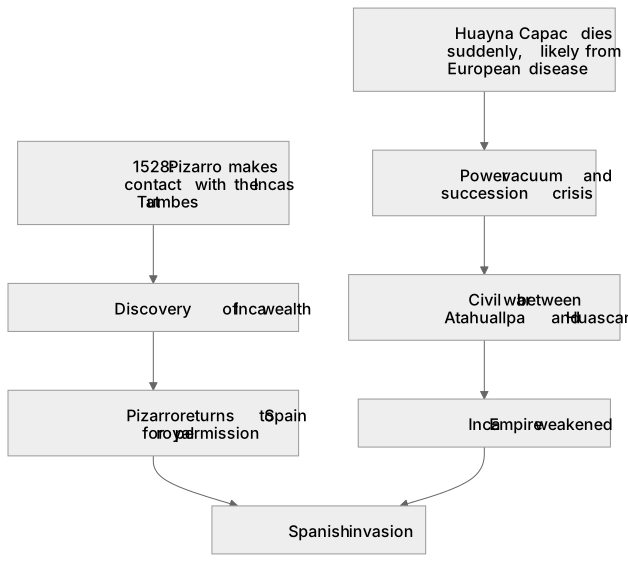
Key words
Say what each word means before you turn the card.
Exploration and discovery
Try answering aloud or in your head before turning the card.
Impact of disease
Try answering aloud or in your head before turning the card.
Political instability
Try answering aloud or in your head before turning the card.
Motivation for conquest
Try answering aloud or in your head before turning the card.
See every definition
- Exploration and discovery
- Pizarro's second expedition made initial contact with the Inca Empire at Tumbes, confirming rumours of vast riches.
- Impact of disease
- Huayna Capac died suddenly, likely from European diseases like smallpox, before the Spanish invasion force arrived.
- Political instability
- The Emperor's death created a power vacuum and a succession crisis, leading to a bitter civil war between his sons.
- Motivation for conquest
- Contact confirmed rumours of vast riches, motivating Pizarro to return to Spain to secure royal permission for conquest.
Label the diagram
Some boxes have lost their names. Pick the right name for each number.
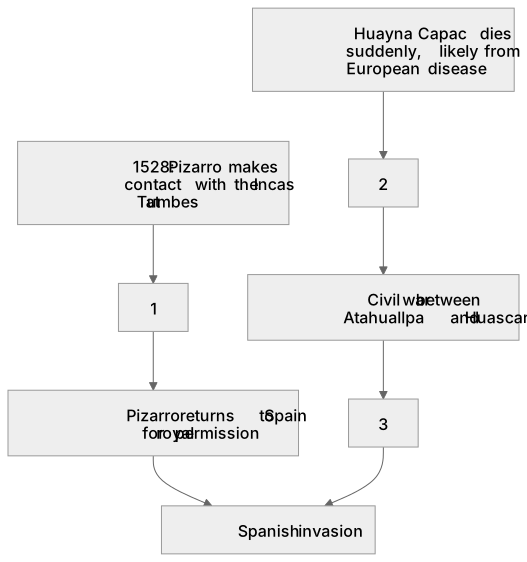
1Box 1
2Box 2
3Box 3
There is more to this lesson
The full lesson goes on to check your understanding and help you earn the marks. Create a free account to carry on, with your progress saved.
A week of Premium from your first lesson · Then the free plan continues · No card, no charge
Test your understanding of Option P1: Key topic 3: The Spanish Empire c1528–c1555 - 1 Pizarro and the conquest of the Incas: Contact with the Incas (1528); the significance of the death of Huayna Capac.
Active recall beats re-reading. Take an instant quiz now to test what you’ve learned and lock it into long-term memory.
A week of Premium from your first lesson · Then the free plan continues · No card, no charge