Pearson Edexcel · GCSE · History
Course version: 1HI0 · Version from Sept 2016
Key topic 3: The Spanish Empire c1528–c1555 - 1 Pizarro and the conquest…
Full specification wording
Option P1: Key topic 3: The Spanish Empire c1528–c1555 - 1 Pizarro and the conquest of the Incas: The voyage of Pizarro (1530), and the significance of the war between Atahuallpa and Huascar.
Francisco Pizarro began his third voyage in 1530 with royal permission to conquer Peru.
Checked against the Pearson Edexcel 1HI0 specification (opens in a new tab) on .
- Point 2 of 3
Study notes
From the checked teaching notes for this specification point.
The idea
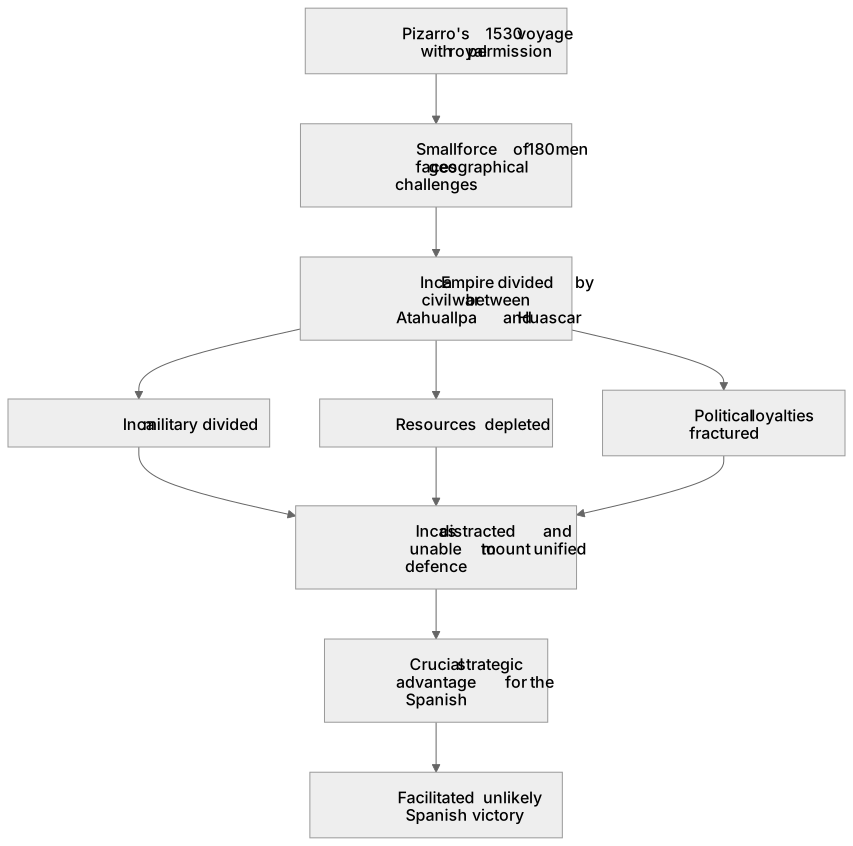
Francisco Pizarro began his third voyage in 1530 with royal permission to conquer Peru. His small force of 180 men faced immense geographical challenges but benefited from perfect timing. They found the Inca Empire devastated by a civil war between half-brothers Atahuallpa and Huascar. The significance of this war was profound: it divided the Inca military, depleted resources, and fractured political loyalties. Although Atahuallpa had recently defeated Huascar, his forces were exhausted and the empire remained deeply divided. This internal strife meant the Incas were distracted and unable to mount a unified defence against Pizarro, providing the Spanish with a crucial strategic advantage that facilitated their unlikely victory.
What earns the marks
- Detail the purpose and scale of Pizarro's 1530 voyage to Peru.
- Explain the causes of the civil war between Atahuallpa and Huascar.
- Analyse how the civil war depleted Inca military strength and resources.
- Evaluate the significance of the divided Inca loyalties in aiding the Spanish conquest.
- Connect the timing of Pizarro's arrival to the immediate aftermath of Atahuallpa's victory over Huascar.
Common mistakes and how to put them right
Stating Pizarro brought a massive army in 1530.
Put it right: Pizarro's force was very small, consisting of only about 180 men and 37 horses.
Confusing the victor of the civil war.
Put it right: Atahuallpa defeated Huascar, not the other way around, and was the emperor when Pizarro arrived.
Treating the civil war as a minor skirmish.
Put it right: Emphasise that it was a devastating conflict that fundamentally weakened the empire's ability to resist invasion.
Exam tips
- Use the civil war to explain why a small Spanish force could conquer a massive empire.
- Highlight the contrast between the unified Spanish objective and the fractured Inca state.
- Remember to explicitly state the significance of the war, rather than just narrating the events.
Try the lesson
The start of the Option P1: Key topic 3: The Spanish Empire c1528–c1555 - 1 Pizarro and the conquest of the Incas: The voyage of Pizarro (1530), and the significance of the war between Atahuallpa and Huascar. lesson, made from checked teaching notes for this specification point.
Have a go first
Which two individuals fought a civil war for control of the Inca Empire shortly before Francisco Pizarro's expedition arrived in 1530?
Listen
Francisco Pizarro began his third voyage in 1530 with royal permission to conquer Peru. His small force of 180 men faced immense geographical challenges but benefited from perfect timing. They found the Inca Empire devastated by a civil war between half-brothers Atahuallpa and Huascar. The significance of this war was profound: it divided the Inca military, depleted resources, and fractured political loyalties. Although Atahuallpa had recently defeated Huascar, his forces were exhausted and the empire remained deeply divided. This internal strife meant the Incas were distracted and unable to mount a unified defence against Pizarro, providing the Spanish with a crucial strategic advantage that facilitated their unlikely victory. A strong answer earns marks for these points. Detail the purpose and scale of Pizarro's 1530 voyage to Peru. Explain the causes of the civil war between Atahuallpa and Huascar. Analyse how the civil war depleted Inca military strength and resources. Evaluate the significance of the divided Inca loyalties in aiding the Spanish conquest. A common slip: Stating Pizarro brought a massive army in 1530. Instead, Pizarro's force was very small, consisting of only about 180 men and 37 horses. Exam tip: Use the civil war to explain why a small Spanish force could conquer a massive empire.
See it
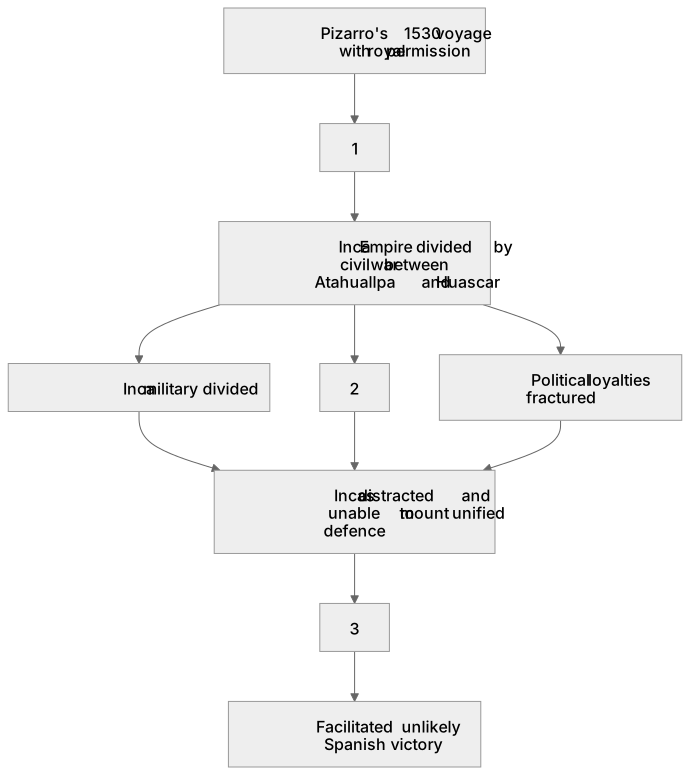
Label the diagram
Some boxes have lost their names. Pick the right name for each number.
1Box 1
2Box 2
3Box 3
There is more to this lesson
The full lesson goes on to check your understanding and help you earn the marks. Create a free account to carry on, with your progress saved.
A week of Premium from your first lesson · Then the free plan continues · No card, no charge
Test your understanding of Option P1: Key topic 3: The Spanish Empire c1528–c1555 - 1 Pizarro and the conquest of the Incas: The voyage of Pizarro (1530), and the significance of the war between Atahuallpa and Huascar.
Active recall beats re-reading. Take an instant quiz now to test what you’ve learned and lock it into long-term memory.
A week of Premium from your first lesson · Then the free plan continues · No card, no charge