Pearson Edexcel · GCSE · History
Course version: 1HI0 · Version from Sept 2016
Key topic 1: British settlement in North America, 1713–41 - 2 Slavery in…
Full specification wording
Option P2: Key topic 1: British settlement in North America, 1713–41 - 2 Slavery in North America: The impact of slavery on the development of tobacco and rice plantations.
Slavery was the fundamental economic engine driving the rapid expansion of tobacco and rice plantations in British North America between 1713 and 1741.
Checked against the Pearson Edexcel 1HI0 specification (opens in a new tab) on .
- Point 2 of 3
- 4 key terms
Study notes
From the checked teaching notes for this specification point.
The idea
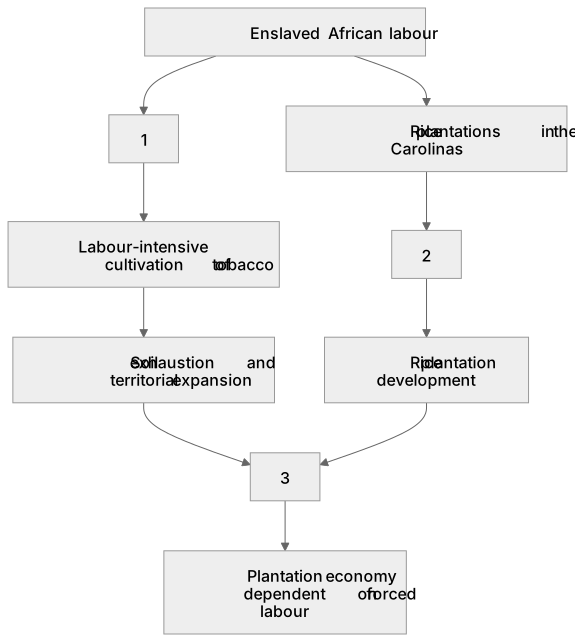
Slavery was the fundamental economic engine driving the rapid expansion of tobacco and rice plantations in British North America between 1713 and 1741. In the Chesapeake region (Virginia and Maryland), enslaved labour enabled the mass cultivation of tobacco, a highly profitable but labour-intensive cash crop that quickly exhausted soil, necessitating constant territorial expansion. Further south in the Carolinas, the development of rice plantations relied heavily on the specific agricultural expertise and physical endurance of enslaved West Africans, who were already familiar with rice cultivation. The brutal exploitation of enslaved people transformed these colonies into immensely wealthy agricultural powerhouses, cementing a plantation economy entirely dependent on forced labour.
What earns the marks
- Explain how enslaved labour provided the massive workforce required for the labour-intensive cultivation of tobacco in the Chesapeake colonies.
- Describe the role of enslaved West Africans in bringing essential agricultural knowledge and skills for growing rice in the Carolinas.
- Analyse how the profitability of tobacco and rice plantations drove the expansion of the transatlantic slave trade and the importation of more enslaved people.
- Evaluate the economic transformation of the southern colonies into wealthy, export-driven plantation economies entirely reliant on chattel slavery.
Common mistakes and how to put them right
Claiming that European indentured servants were the main workforce on 18th-century plantations.
Put it right by stating that by 1713, enslaved Africans had largely replaced indentured servants as the primary labour force.
Ignoring the specific skills of enslaved people.
Put it right by highlighting that West Africans brought crucial knowledge of rice cultivation to the Carolinas, not just unskilled physical labour.
Confusing the geography of the crops.
Put it right by specifying that tobacco was primarily grown in the Chesapeake (Virginia and Maryland) while rice was dominant in the Carolinas.
Exam tips
- Use specific regional examples, such as Virginia for tobacco and South Carolina for rice, to demonstrate precise historical knowledge.
- Emphasise the connection between the specific demands of the crops (e.g., the harsh, swampy conditions of rice fields) and the increasing reliance on enslaved labour.
- When discussing 'impact', ensure you cover both the economic growth of the plantations and the human cost to the enslaved people.
Try the lesson
The start of the Option P2: Key topic 1: British settlement in North America, 1713–41 - 2 Slavery in North America: The impact of slavery on the development of tobacco and rice plantations. lesson, made from checked teaching notes for this specification point.
Have a go first
Which crop's rapid expansion in the Carolinas during the early 18th century was heavily dependent on the specific agricultural knowledge of enslaved West Africans?
Listen
Slavery was the fundamental economic engine driving the rapid expansion of tobacco and rice plantations in British North America between 1713 and 1741. In the Chesapeake region (Virginia and Maryland), enslaved labour enabled the mass cultivation of tobacco, a highly profitable but labour-intensive cash crop that quickly exhausted soil, necessitating constant territorial expansion. Further south in the Carolinas, the development of rice plantations relied heavily on the specific agricultural expertise and physical endurance of enslaved West Africans, who were already familiar with rice cultivation. The brutal exploitation of enslaved people transformed these colonies into immensely wealthy agricultural powerhouses, cementing a plantation economy entirely dependent on forced labour. A strong answer earns marks for these points. Explain how enslaved labour provided the massive workforce required for the labour-intensive cultivation of tobacco in the Chesapeake colonies. Describe the role of enslaved West Africans in bringing essential agricultural knowledge and skills for growing rice in the Carolinas. Analyse how the profitability of tobacco and rice plantations drove the expansion of the transatlantic slave trade and the importation of more enslaved people. Evaluate the economic transformation of the southern colonies into wealthy, export-driven plantation economies entirely reliant on chattel slavery. A common slip: Claiming that European indentured servants were the main workforce on 18th-century plantations. Instead, stating that by 1713, enslaved Africans had largely replaced indentured servants as the primary labour force. Exam tip: Use specific regional examples, such as Virginia for tobacco and South Carolina for rice, to demonstrate precise historical knowledge.
See it
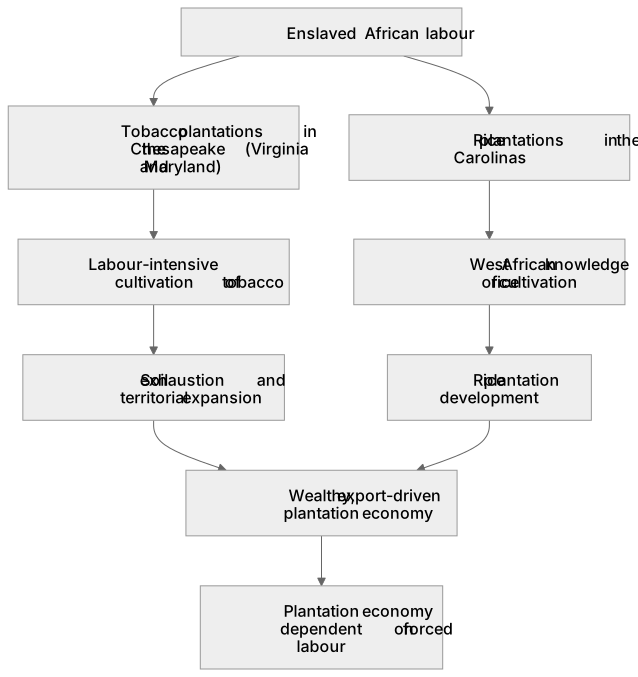
Key words
Say what each word means before you turn the card.
Economic development
Try answering aloud or in your head before turning the card.
Exploitation and forced labour
Try answering aloud or in your head before turning the card.
Agricultural expansion
Try answering aloud or in your head before turning the card.
Colonial wealth
Try answering aloud or in your head before turning the card.
See every definition
- Economic development
- The transformation of the southern colonies into wealthy, export-driven plantation economies entirely reliant on chattel slavery.
- Exploitation and forced labour
- The brutal use of enslaved people as the workforce on plantations, which became entirely dependent on forced labour.
- Agricultural expansion
- The constant territorial expansion necessitated by tobacco cultivation, a labour-intensive cash crop that quickly exhausted soil.
- Colonial wealth
- The immense wealth of the colonies, transformed into agricultural powerhouses by the exploitation of enslaved people.
Label the diagram
Some boxes have lost their names. Pick the right name for each number.
1Box 1
2Box 2
3Box 3
There is more to this lesson
The full lesson goes on to check your understanding and help you earn the marks. Create a free account to carry on, with your progress saved.
A week of Premium from your first lesson · Then the free plan continues · No card, no charge
Test your understanding of Option P2: Key topic 1: British settlement in North America, 1713–41 - 2 Slavery in North America: The impact of slavery on the development of tobacco and rice plantations.
Active recall beats re-reading. Take an instant quiz now to test what you’ve learned and lock it into long-term memory.
A week of Premium from your first lesson · Then the free plan continues · No card, no charge