Pearson Edexcel · GCSE · History
Course version: 1HI0 · Version from Sept 2016
Key topic 1: British settlement in North America, 1713–41 - 2 Slavery in…
Full specification wording
Option P2: Key topic 1: British settlement in North America, 1713–41 - 2 Slavery in North America: The transatlantic slave trade and ‘Atlantic trade triangle’.
The transatlantic slave trade was a brutal system integral to the 'Atlantic trade triangle', connecting Europe, Africa, and the Americas.
Checked against the Pearson Edexcel 1HI0 specification (opens in a new tab) on .
- Point 1 of 3
Study notes
From the checked teaching notes for this specification point.
The idea
The transatlantic slave trade was a brutal system integral to the 'Atlantic trade triangle', connecting Europe, Africa, and the Americas. First, British manufactured goods, such as textiles and firearms, were shipped to West Africa and traded for enslaved people. Second, the 'Middle Passage' transported these enslaved Africans across the Atlantic to the Americas under horrific conditions, where survivors were sold to plantation owners. Finally, raw materials produced by enslaved labour, including tobacco and sugar, were shipped back to Britain for processing and sale. This interconnected system fuelled the economic growth of the British Empire while devastating African societies and establishing chattel slavery in North America.
What earns the marks
- Define the 'Atlantic trade triangle' and identify its three main geographical points: Europe, Africa, and the Americas.
- Describe the goods exchanged at each stage of the triangle, such as manufactured goods, enslaved people, and raw materials.
- Explain the horrific conditions and purpose of the 'Middle Passage' within the context of the transatlantic slave trade.
- Analyse the economic interdependence created by the trade triangle and its role in driving the plantation economy of North America.
Common mistakes and how to put them right
Describing the trade triangle as a simple two-way exchange.
Put it right: Clearly outlining the three distinct legs of the journey and the specific goods carried on each.
Confusing the goods exported from Africa with those exported from the Americas.
Put it right by stating that Africa primarily exported enslaved people, while the Americas exported raw materials like tobacco.
Treating the slave trade as separate from the broader economy.
Put it right by explaining that the transatlantic slave trade was the foundational engine of the entire Atlantic trade triangle.
Exam tips
- Memorise the specific goods traded on each leg of the triangle to provide precise and accurate descriptions.
- Use the term 'Middle Passage' explicitly when discussing the transportation of enslaved Africans across the Atlantic.
- Connect the demand for raw materials in Britain to the increasing demand for enslaved labour on North American plantations.
Try the lesson
The start of the Option P2: Key topic 1: British settlement in North America, 1713–41 - 2 Slavery in North America: The transatlantic slave trade and ‘Atlantic trade triangle’. lesson, made from checked teaching notes for this specification point.
Have a go first
Which of the following best describes the 'Middle Passage' within the Atlantic trade triangle?
Listen
The transatlantic slave trade was a brutal system integral to the 'Atlantic trade triangle', connecting Europe, Africa, and the Americas. First, British manufactured goods, such as textiles and firearms, were shipped to West Africa and traded for enslaved people. Second, the 'Middle Passage' transported these enslaved Africans across the Atlantic to the Americas under horrific conditions, where survivors were sold to plantation owners. Finally, raw materials produced by enslaved labour, including tobacco and sugar, were shipped back to Britain for processing and sale. This interconnected system fuelled the economic growth of the British Empire while devastating African societies and establishing chattel slavery in North America. A strong answer earns marks for these points. Define the 'Atlantic trade triangle' and identify its three main geographical points: Europe, Africa, and the Americas. Describe the goods exchanged at each stage of the triangle, such as manufactured goods, enslaved people, and raw materials. Explain the horrific conditions and purpose of the 'Middle Passage' within the context of the transatlantic slave trade. Analyse the economic interdependence created by the trade triangle and its role in driving the plantation economy of North America. A common slip: Describing the trade triangle as a simple two-way exchange. Instead, clearly outlining the three distinct legs of the journey and the specific goods carried on each. Exam tip: Memorise the specific goods traded on each leg of the triangle to provide precise and accurate descriptions.
See it
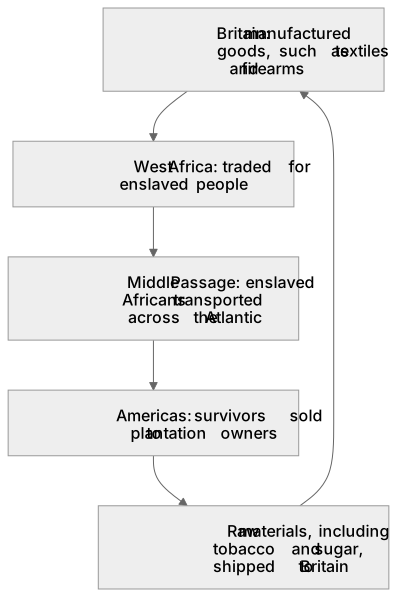
Label the diagram
Some boxes have lost their names. Pick the right name for each number.
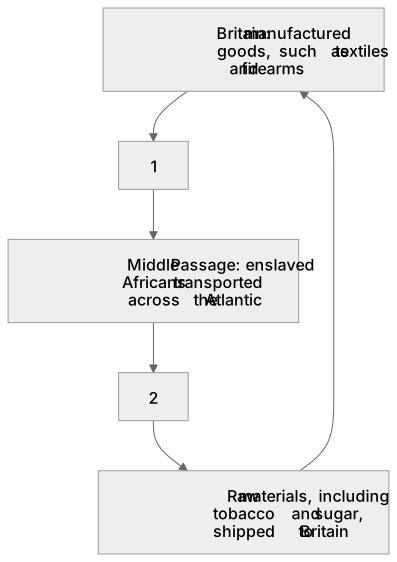
1Box 1
2Box 2
There is more to this lesson
The full lesson goes on to check your understanding and help you earn the marks. Create a free account to carry on, with your progress saved.
A week of Premium from your first lesson · Then the free plan continues · No card, no charge
Test your understanding of Option P2: Key topic 1: British settlement in North America, 1713–41 - 2 Slavery in North America: The transatlantic slave trade and ‘Atlantic trade triangle’.
Active recall beats re-reading. Take an instant quiz now to test what you’ve learned and lock it into long-term memory.
A week of Premium from your first lesson · Then the free plan continues · No card, no charge