Pearson Edexcel · GCSE · History
Course version: 1HI0 · Version from Sept 2016
Key topic 1: British settlement in North America, 1713–41 - 3 Problems…
Full specification wording
Option P2: Key topic 1: British settlement in North America, 1713–41 - 3 Problems within the colonies: Slave revolts in the Carolinas: the Stono Rebellion (1739); the significance of Spain’s decision to protect runaways in Florida.
The Stono Rebellion (1739) in South Carolina was the largest slave revolt in the British colonies, highlighting intense resistance to enslavement.
Checked against the Pearson Edexcel 1HI0 specification (opens in a new tab) on .
- Point 1 of 3
Study notes
From the checked teaching notes for this specification point.
The idea
The Stono Rebellion (1739) in South Carolina was the largest slave revolt in the British colonies, highlighting intense resistance to enslavement. Led by Jemmy, a group of enslaved Africans seized weapons, killed white colonists, and marched south towards Spanish Florida, before being defeated by a militia. A crucial catalyst for this revolt was Spain's strategic decision to offer freedom and protection to runaways who reached Florida and converted to Catholicism. This policy, aimed at destabilising rival British colonies, provided a powerful incentive for enslaved people in the Carolinas to escape. The rebellion's aftermath led to the Negro Act of 1740, which drastically restricted enslaved people's lives to prevent future uprisings.
What earns the marks
- Describe the events of the Stono Rebellion (1739), including the leadership of Jemmy, the seizure of weapons, and the march towards Florida.
- Explain the significance of Spain's 1733 decree offering freedom to runaway slaves who reached Florida, acting as a major pull factor for the rebellion.
- Analyse how the Spanish policy was a deliberate geopolitical strategy to weaken the economy and security of the neighbouring British colonies.
- Evaluate the consequences of the Stono Rebellion, specifically the passing of the harsh Negro Act of 1740 in South Carolina to tighten control over enslaved people.
Common mistakes and how to put them right
Confusing the destination of the rebels.
Put it right by stating they were heading south to Spanish Florida, not north to free states (which did not exist yet).
Believing the Stono Rebellion was successful.
Put it right by explaining that the rebels were intercepted and defeated by a white militia, resulting in executions.
Overlooking the Spanish motivation.
Put it right by noting that Spain protected runaways primarily to undermine British colonial power, not out of humanitarian concern.
Exam tips
- Clearly link Spain's policy in Florida to the specific motivations and geographical direction of the Stono Rebellion.
- Use the Stono Rebellion as a prime example of active resistance by enslaved people against the brutal plantation system.
- Mention the Negro Act of 1740 as the direct legislative consequence of the rebellion, demonstrating an understanding of cause and effect.
Try the lesson
The start of the Option P2: Key topic 1: British settlement in North America, 1713–41 - 3 Problems within the colonies: Slave revolts in the Carolinas: the Stono Rebellion (1739); the significance of Spain’s decision to protect runaways in Florida. lesson, made from checked teaching notes for this specification point.
Have a go first
Which European power controlled Florida in 1739 and offered freedom to enslaved people who ran away from the British colonies?
Listen
The Stono Rebellion (1739) in South Carolina was the largest slave revolt in the British colonies, highlighting intense resistance to enslavement. Led by Jemmy, a group of enslaved Africans seized weapons, killed white colonists, and marched south towards Spanish Florida, before being defeated by a militia. A crucial catalyst for this revolt was Spain's strategic decision to offer freedom and protection to runaways who reached Florida and converted to Catholicism. This policy, aimed at destabilising rival British colonies, provided a powerful incentive for enslaved people in the Carolinas to escape. The rebellion's aftermath led to the Negro Act of 1740, which drastically restricted enslaved people's lives to prevent future uprisings. A strong answer earns marks for these points. Describe the events of the Stono Rebellion (1739), including the leadership of Jemmy, the seizure of weapons, and the march towards Florida. Explain the significance of Spain's 1733 decree offering freedom to runaway slaves who reached Florida, acting as a major pull factor for the rebellion. Analyse how the Spanish policy was a deliberate geopolitical strategy to weaken the economy and security of the neighbouring British colonies. Evaluate the consequences of the Stono Rebellion, specifically the passing of the harsh Negro Act of 1740 in South Carolina to tighten control over enslaved people. A common slip: Confusing the destination of the rebels. Instead, stating they were heading south to Spanish Florida, not north to free states (which did not exist yet). Exam tip: Clearly link Spain's policy in Florida to the specific motivations and geographical direction of the Stono Rebellion.
See it
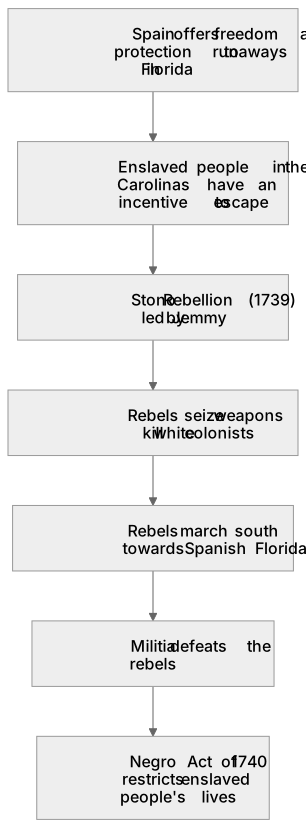
Put it in order
Put these steps in the order they happen.
- 1. Negro Act of 1740 restricts enslaved people's lives
- 2. Militia defeats the rebels
- 3. Stono Rebellion (1739) led by Jemmy
- 4. Rebels march south towards Spanish Florida
- 5. Spain offers freedom and protection to runaways in Florida
- 6. Enslaved people in the Carolinas have an incentive to escape
- 7. Rebels seize weapons and kill white colonists
Label the diagram
Some boxes have lost their names. Pick the right name for each number.
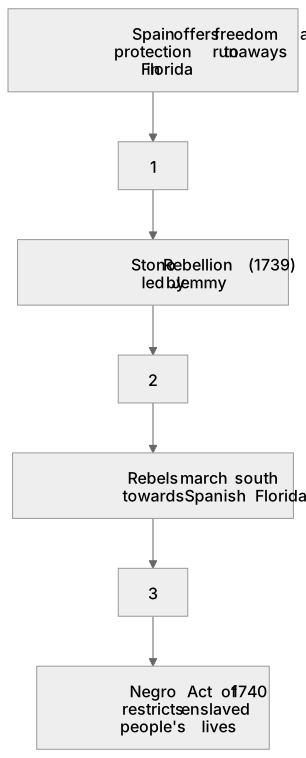
1Box 1
2Box 2
3Box 3
There is more to this lesson
The full lesson goes on to check your understanding and help you earn the marks. Create a free account to carry on, with your progress saved.
A week of Premium from your first lesson · Then the free plan continues · No card, no charge
Test your understanding of Option P2: Key topic 1: British settlement in North America, 1713–41 - 3 Problems within the colonies: Slave revolts in the Carolinas: the Stono Rebellion (1739); the significance of Spain’s decision to protect runaways in Florida.
Active recall beats re-reading. Take an instant quiz now to test what you’ve learned and lock it into long-term memory.
A week of Premium from your first lesson · Then the free plan continues · No card, no charge