Pearson Edexcel · GCSE · History
Course version: 1HI0 · Version from Sept 2016
Key topic 1: British settlement in North America, 1713–41 - 3 Problems…
Full specification wording
Option P2: Key topic 1: British settlement in North America, 1713–41 - 3 Problems within the colonies: The New York Conspiracy (1741).
The New York Conspiracy of 1741 highlights the extreme paranoia regarding slave revolts in urban colonial settings.
Checked against the Pearson Edexcel 1HI0 specification (opens in a new tab) on .
- Point 2 of 3
- 4 key terms
Study notes
From the checked teaching notes for this specification point.
The idea
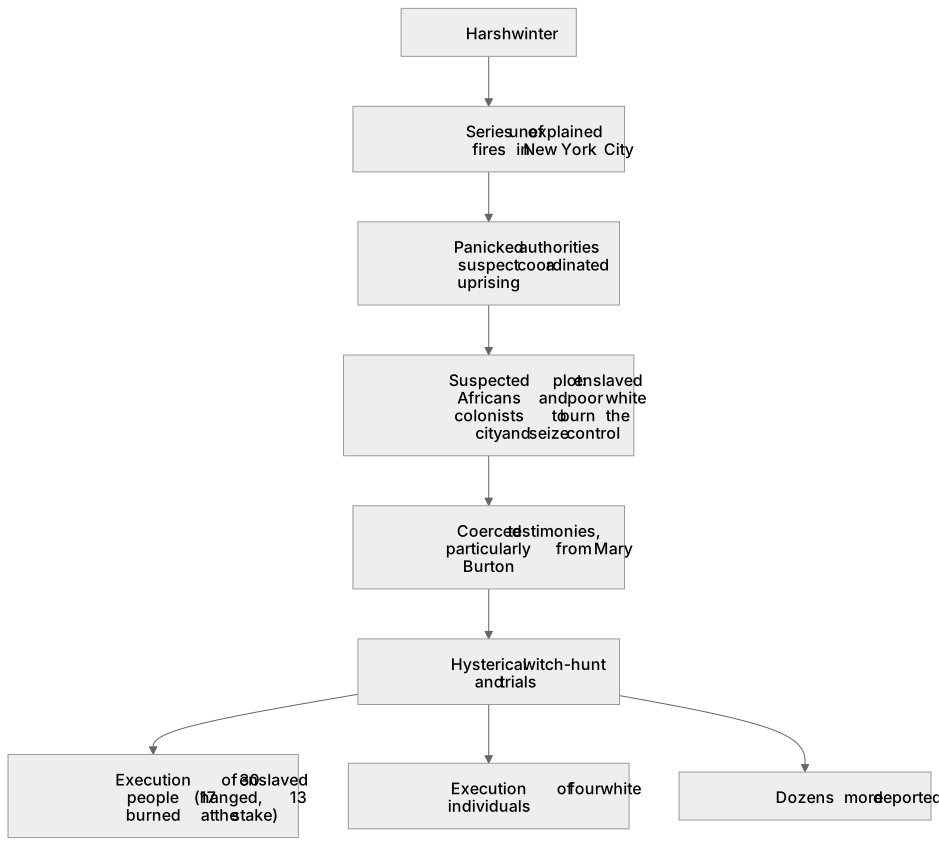
The New York Conspiracy of 1741 highlights the extreme paranoia regarding slave revolts in urban colonial settings. Following a harsh winter and a series of unexplained fires in New York City, panicked authorities suspected a coordinated uprising by enslaved Africans and poor white colonists to burn the city and seize control. Based largely on coerced testimonies, particularly from an indentured servant named Mary Burton, a hysterical witch-hunt ensued. The trials resulted in the execution of exactly 30 enslaved people (17 hanged, 13 burned at the stake) and four white individuals, with dozens more deported. This event underscores the deep racial tensions, the pervasive fear of insurrections, and the fragility of social order in densely populated British colonial cities.
What earns the marks
- Describe the context of the 1741 New York Conspiracy, including the series of fires and the underlying economic tensions following a harsh winter.
- Explain the nature of the suspected plot, which authorities believed was a joint rebellion by enslaved Africans and poor white colonists to destroy the city.
- Analyse the flawed judicial process, highlighting the use of coerced confessions and unreliable witnesses like Mary Burton to secure convictions.
- Evaluate the brutal consequences of the panic, noting the execution of exactly 30 enslaved people and four white individuals, alongside numerous deportations.
Common mistakes and how to put them right
Assuming the conspiracy was a proven, well-organised rebellion.
Put it right by emphasising that historians debate whether a plot actually existed, and the trials were driven by panic and coerced testimony.
Believing only enslaved people were accused.
Put it right by noting that poor white colonists, including a Catholic priest, were also implicated and executed, reflecting broader class and religious fears.
Confusing it with a plantation revolt.
Put it right by specifying that this was an urban panic in New York City, demonstrating that fears of uprising were not limited to the rural South.
Exam tips
- Compare the New York Conspiracy to the Stono Rebellion to contrast an actual armed uprising with an urban panic based on suspicion and fear.
- Highlight the role of Mary Burton's testimony to illustrate how the legal system was manipulated by hysteria and the promise of rewards.
Try the lesson
The start of the Option P2: Key topic 1: British settlement in North America, 1713–41 - 3 Problems within the colonies: The New York Conspiracy (1741). lesson, made from checked teaching notes for this specification point.
Have a go first
The New York Conspiracy of 1741 was a suspected plot involving which two groups allegedly working together to burn down the city?
Listen
The New York Conspiracy of 1741 highlights the extreme paranoia regarding slave revolts in urban colonial settings. Following a harsh winter and a series of unexplained fires in New York City, panicked authorities suspected a coordinated uprising by enslaved Africans and poor white colonists to burn the city and seize control. Based largely on coerced testimonies, particularly from an indentured servant named Mary Burton, a hysterical witch-hunt ensued. The trials resulted in the execution of exactly 30 enslaved people (17 hanged, 13 burned at the stake) and four white individuals, with dozens more deported. This event underscores the deep racial tensions, the pervasive fear of insurrections, and the fragility of social order in densely populated British colonial cities. A strong answer earns marks for these points. Describe the context of the 1741 New York Conspiracy, including the series of fires and the underlying economic tensions following a harsh winter. Explain the nature of the suspected plot, which authorities believed was a joint rebellion by enslaved Africans and poor white colonists to destroy the city. Analyse the flawed judicial process, highlighting the use of coerced confessions and unreliable witnesses like Mary Burton to secure convictions. Evaluate the brutal consequences of the panic, noting the execution of exactly 30 enslaved people and four white individuals, alongside numerous deportations. A common slip: Assuming the conspiracy was a proven, well-organised rebellion. Instead, emphasising that historians debate whether a plot actually existed, and the trials were driven by panic and coerced testimony. Exam tip: Compare the New York Conspiracy to the Stono Rebellion to contrast an actual armed uprising with an urban panic based on suspicion and fear.
See it
Key words
Say what each word means before you turn the card.
Urban tension and paranoia
Try answering aloud or in your head before turning the card.
Justice and the legal system
Try answering aloud or in your head before turning the card.
Racial and class conflict
Try answering aloud or in your head before turning the card.
Fear of rebellion
Try answering aloud or in your head before turning the card.
See every definition
- Urban tension and paranoia
- Extreme paranoia regarding slave revolts in urban colonial settings, seen when panicked authorities suspected a coordinated uprising in New York City.
- Justice and the legal system
- A flawed judicial process in which coerced confessions and unreliable witnesses were used to secure convictions during the trials.
- Racial and class conflict
- Deep racial tensions and broader class and religious fears, reflected in the implication of enslaved Africans and poor white colonists, including a Catholic priest.
- Fear of rebellion
- A pervasive fear of insurrections and the fragility of social order in densely populated British colonial cities.
Label the diagram
Some boxes have lost their names. Pick the right name for each number.

1Box 1
2Box 2
3Box 3
There is more to this lesson
The full lesson goes on to check your understanding and help you earn the marks. Create a free account to carry on, with your progress saved.
A week of Premium from your first lesson · Then the free plan continues · No card, no charge
Test your understanding of Option P2: Key topic 1: British settlement in North America, 1713–41 - 3 Problems within the colonies: The New York Conspiracy (1741).
Active recall beats re-reading. Take an instant quiz now to test what you’ve learned and lock it into long-term memory.
A week of Premium from your first lesson · Then the free plan continues · No card, no charge