Pearson Edexcel · GCSE · History
Course version: 1HI0 · Version from Sept 2016
Key topic 1: The origins of the Cold War, 1941–58 - 1 Early tension…
Full specification wording
Option P4: Key topic 1: The origins of the Cold War, 1941–58 - 1 Early tension between East and West: The Grand Alliance. The outcomes of the Tehran, Yalta and Potsdam conferences.
The Grand Alliance was a marriage of convenience between the USA, USSR, and Britain to defeat Nazi Germany, but ideological differences soon fractured it.
Checked against the Pearson Edexcel 1HI0 specification (opens in a new tab) on .
- Point 1 of 3
Study notes
From the checked teaching notes for this specification point.
The idea
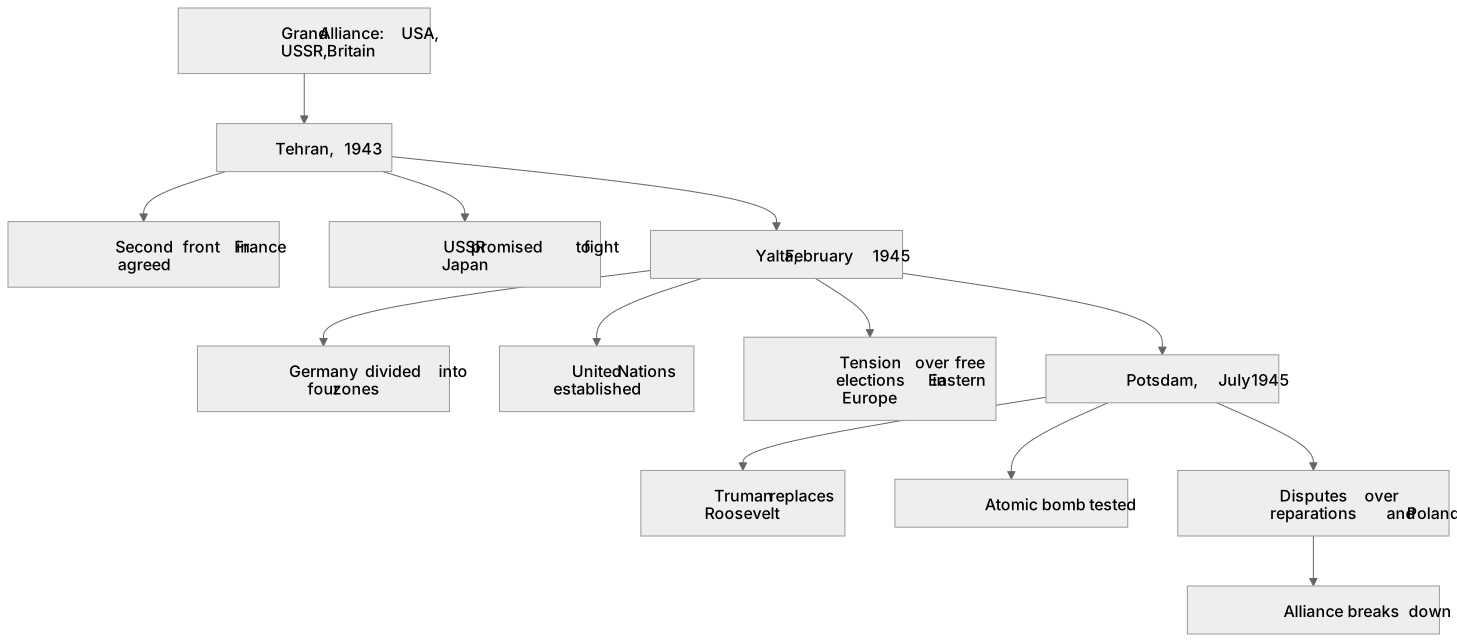
The Grand Alliance was a marriage of convenience between the USA, USSR, and Britain to defeat Nazi Germany, but ideological differences soon fractured it. At the Tehran Conference (1943), relations were positive; the Allies agreed to open a second front in France and the USSR promised to fight Japan. By Yalta (February 1945), they agreed to divide Germany into four zones and establish the United Nations, though tensions simmered over the promise of free elections in Eastern Europe. At Potsdam (July 1945), the Alliance broke down. With Truman replacing Roosevelt and the USA successfully testing the atomic bomb, trust evaporated. Disagreements over German reparations and Soviet control of Poland marked the onset of the Cold War.
What earns the marks
- Define the Grand Alliance as a pragmatic wartime coalition that masked deep ideological divisions between capitalism and communism.
- Identify the key outcomes of Tehran (1943), including the agreement to open a second front in Western Europe to relieve pressure on the USSR.
- Explain the agreements made at Yalta (1945), such as the four-power division of Germany and Berlin, and the Declaration on Liberated Europe.
- Analyse the breakdown of relations at Potsdam (1945), driven by leadership changes (Truman's hardline stance), the atomic bomb, and disputes over reparations and Poland.
Common mistakes and how to put them right
Confusing the agreements of Yalta and Potsdam.
Put it right: The division of Germany was agreed at Yalta, but the specific details and disputes over reparations occurred at Potsdam.
Assuming the atomic bomb was dropped before Potsdam.
Put it right: The bomb was successfully tested just before Potsdam, giving Truman a diplomatic edge, but dropped on Japan after the conference.
Stating that Churchill, Roosevelt, and Stalin attended all three conferences.
Put it right: Roosevelt died and was replaced by Truman for Potsdam, while Churchill was replaced mid-conference by Attlee.
Exam tips
- Create a timeline of the three conferences to clearly track how relations deteriorated from cooperation at Tehran to open hostility at Potsdam.
- Emphasise the impact of personality changes at Potsdam; Truman's anti-communist stance significantly altered the diplomatic dynamic compared to Roosevelt.
- Use the issue of Poland as a continuous thread to demonstrate growing Soviet-Western tension across the conferences.
Try the lesson
The start of the Option P4: Key topic 1: The origins of the Cold War, 1941–58 - 1 Early tension between East and West: The Grand Alliance. The outcomes of the Tehran, Yalta and Potsdam conferences. lesson, made from checked teaching notes for this specification point.
Have a go first
Which three leaders represented the Grand Alliance at the Yalta Conference in February 1945?
Listen
The Grand Alliance was a marriage of convenience between the USA, USSR, and Britain to defeat Nazi Germany, but ideological differences soon fractured it. At the Tehran Conference (1943), relations were positive; the Allies agreed to open a second front in France and the USSR promised to fight Japan. By Yalta (February 1945), they agreed to divide Germany into four zones and establish the United Nations, though tensions simmered over the promise of free elections in Eastern Europe. At Potsdam (July 1945), the Alliance broke down. With Truman replacing Roosevelt and the USA successfully testing the atomic bomb, trust evaporated. Disagreements over German reparations and Soviet control of Poland marked the onset of the Cold War. A strong answer earns marks for these points. Define the Grand Alliance as a pragmatic wartime coalition that masked deep ideological divisions between capitalism and communism. Identify the key outcomes of Tehran (1943), including the agreement to open a second front in Western Europe to relieve pressure on the USSR. Explain the agreements made at Yalta (1945), such as the four-power division of Germany and Berlin, and the Declaration on Liberated Europe. Analyse the breakdown of relations at Potsdam (1945), driven by leadership changes (Truman's hardline stance), the atomic bomb, and disputes over reparations and Poland. A common slip: Confusing the agreements of Yalta and Potsdam. Instead, the division of Germany was agreed at Yalta, but the specific details and disputes over reparations occurred at Potsdam. Exam tip: Create a timeline of the three conferences to clearly track how relations deteriorated from cooperation at Tehran to open hostility at Potsdam.
See it
Watch it explained
What is the one idea the video explains? Say it in a sentence.
Read the described scene instead
The Grand Alliance brought the USA, the USSR and Britain together to defeat Nazi Germany. It was a pragmatic wartime coalition, not a friendship. Beneath the unity lay a deep ideological division between capitalism and communism. That division would soon fracture the Alliance. The USA and Britain represented capitalist democracies. The USSR was a communist state led by Stalin. These systems had different views of government, economy and security. The Alliance could cooperate against Hitler, but those differences shaped how each side trusted the other. At Tehran in 1943, relations were positive. The Allies agreed to open a second front in France. This would relieve pressure on the USSR. The USSR also promised to fight Japan. These agreements showed the Alliance still working together. By Yalta in February 1945, the Allies agreed to divide Germany into four zones and to establish the United Nations. They also issued the Declaration on Liberated Europe, promising free elections in Eastern Europe. Yet tensions simmered over that promise, because Stalin's intentions were uncertain. At Potsdam in July 1945, the Alliance broke down. Roosevelt had died and Truman replaced him with a harder line. The USA had successfully tested the atomic bomb just before the conference, giving Truman a diplomatic edge. Disagreements over German reparations and Soviet control of Poland marked the onset of the Cold War. A common mistake is confusing Yalta and Potsdam. The division of Germany was agreed at Yalta, but specific details and disputes over reparations came at Potsdam. Another error is saying the atomic bomb was dropped before Potsdam. It was tested just before, but dropped on Japan after the conference. Also, Churchill, Roosevelt and Stalin did not attend all three conferences. Roosevelt died before Potsdam, and Churchill was replaced mid-conference by Attlee. So the conferences trace a clear deterioration. Tehran in 1943 showed cooperation. Yalta in February 1945 produced agreements but left tension over Eastern Europe. Potsdam in July 1945 exposed open hostility. The issue of Poland runs through these meetings, showing how Soviet-Western tension grew.
Label the diagram
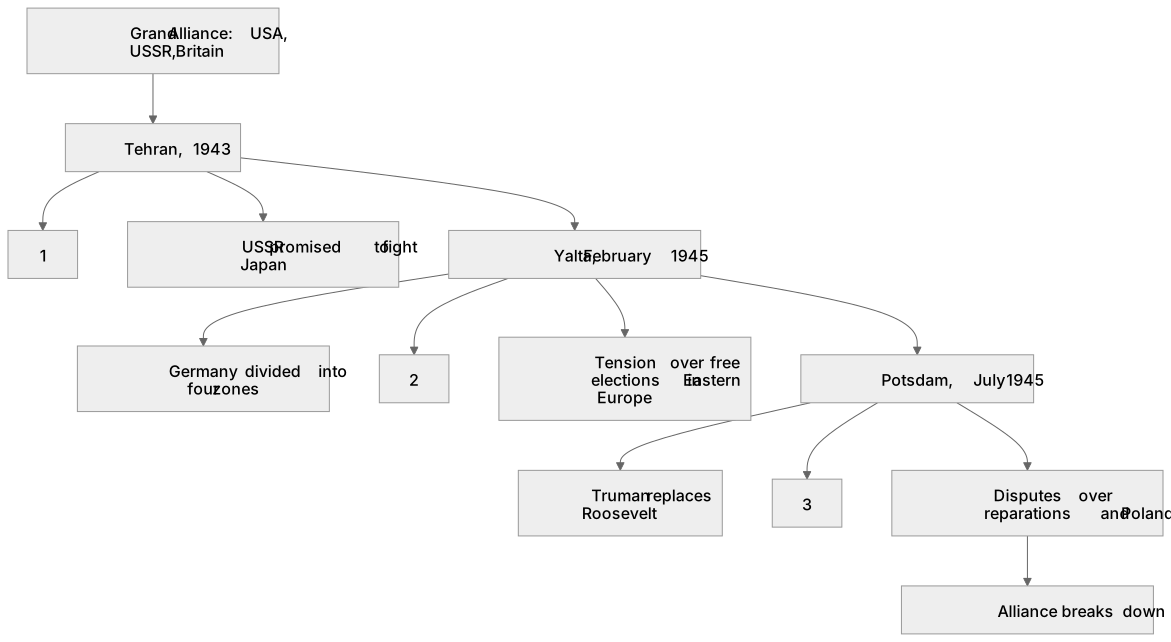
Some boxes have lost their names. Pick the right name for each number.
1Box 1
2Box 2
3Box 3
There is more to this lesson
The full lesson goes on to check your understanding and help you earn the marks. Create a free account to carry on, with your progress saved.
A week of Premium from your first lesson · Then the free plan continues · No card, no charge
Test your understanding of Option P4: Key topic 1: The origins of the Cold War, 1941–58 - 1 Early tension between East and West: The Grand Alliance. The outcomes of the Tehran, Yalta and Potsdam conferences.
Active recall beats re-reading. Take an instant quiz now to test what you’ve learned and lock it into long-term memory.
A week of Premium from your first lesson · Then the free plan continues · No card, no charge