Pearson Edexcel · GCSE · History
Course version: 1HI0 · Version from Sept 2016
Key topic 1: The origins of the Cold War, 1941–58 - 1 Early tension…
Full specification wording
Option P4: Key topic 1: The origins of the Cold War, 1941–58 - 1 Early tension between East and West: The ideological differences between the superpowers and the attitudes of Stalin, Truman and Churchill.
The Cold War's origins lie in the fundamental ideological divide between the capitalist United States and the communist Soviet Union.
Checked against the Pearson Edexcel 1HI0 specification (opens in a new tab) on .
- Point 2 of 3
- 3 key terms
Study notes
From the checked teaching notes for this specification point.
The idea
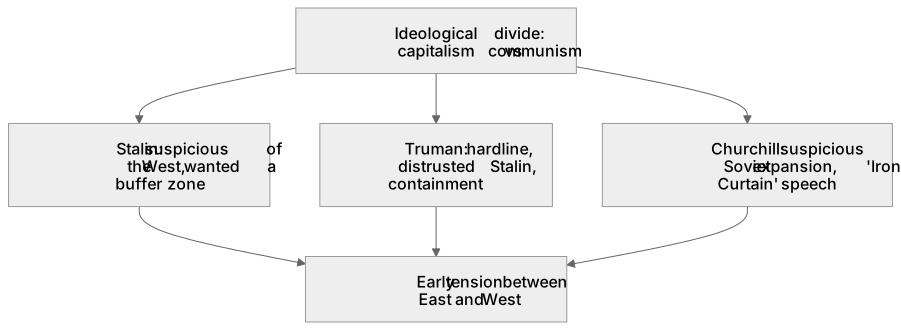
The Cold War's origins lie in the fundamental ideological divide between the capitalist United States and the communist Soviet Union. Capitalism championed private enterprise and individual liberty, whereas communism prioritised state ownership and collective equality. This clash was exacerbated by the attitudes of key leaders. Stalin was deeply suspicious of the West and obsessed with securing a Soviet buffer zone to prevent future invasions. Truman, adopting a tougher stance than Roosevelt, viewed Soviet expansion as a direct threat to global democracy. Meanwhile, Churchill, even after losing office, remained highly influential, famously warning of an 'iron curtain' descending across Europe. This reflected his deep distrust of Soviet intentions and his desire for a strong Anglo-American alliance.
What earns the marks
- Identify the core ideological differences: US capitalism (free elections, private property) versus Soviet communism (one-party state, state-owned economy).
- Explain Stalin's attitude: driven by a desire for security and a buffer zone in Eastern Europe following devastating losses in the Second World War.
- Explain Truman's attitude: characterised by a hardline approach, distrust of Stalin, and a commitment to containing communism.
- Explain Churchill's attitude: highly suspicious of Soviet expansionism, famously articulating the division of Europe in his 1946 'Iron Curtain' speech.
Common mistakes and how to put them right
Claiming Truman and Roosevelt had the same attitude towards Stalin.
Put it right: Emphasise that Truman was significantly more anti-communist and confrontational than Roosevelt.
Stating Churchill was Prime Minister throughout the early Cold War.
Put it right: Note that Churchill lost the 1945 election but remained a highly influential figure, notably delivering his Iron Curtain speech as a private citizen.
Describing the ideological conflict merely as a military rivalry.
Put it right: Define the conflict as a fundamental clash of political (democracy vs dictatorship) and economic (capitalism vs communism) systems.
Exam tips
- Use the specific terms 'capitalism' and 'communism' rather than just 'American' and 'Russian' when discussing ideological differences.
- When analysing the breakdown of the Grand Alliance, explicitly link the leaders' personal attitudes to their respective national ideologies.
- Reference Churchill's 'Iron Curtain' speech as a key turning point in Western attitudes towards the Soviet Union.
Try the lesson
The start of the Option P4: Key topic 1: The origins of the Cold War, 1941–58 - 1 Early tension between East and West: The ideological differences between the superpowers and the attitudes of Stalin, Truman and Churchill. lesson, made from checked teaching notes for this specification point.
Have a go first
Which of the following best describes a fundamental ideological difference between the USA and the Soviet Union after the Second World War?
Listen
The Cold War's origins lie in the fundamental ideological divide between the capitalist United States and the communist Soviet Union. Capitalism championed private enterprise and individual liberty, whereas communism prioritised state ownership and collective equality. This clash was exacerbated by the attitudes of key leaders. Stalin was deeply suspicious of the West and obsessed with securing a Soviet buffer zone to prevent future invasions. Truman, adopting a tougher stance than Roosevelt, viewed Soviet expansion as a direct threat to global democracy. Meanwhile, Churchill, even after losing office, remained highly influential, famously warning of an 'iron curtain' descending across Europe. This reflected his deep distrust of Soviet intentions and his desire for a strong Anglo-American alliance. A strong answer earns marks for these points. Identify the core ideological differences: US capitalism (free elections, private property) versus Soviet communism (one-party state, state-owned economy). Explain Stalin's attitude: driven by a desire for security and a buffer zone in Eastern Europe following devastating losses in the Second World War. Explain Truman's attitude: characterised by a hardline approach, distrust of Stalin, and a commitment to containing communism. Explain Churchill's attitude: highly suspicious of Soviet expansionism, famously articulating the division of Europe in his 1946 'Iron Curtain' speech. A common slip: Claiming Truman and Roosevelt had the same attitude towards Stalin. Instead, Emphasise that Truman was significantly more anti-communist and confrontational than Roosevelt. Exam tip: Use the specific terms 'capitalism' and 'communism' rather than just 'American' and 'Russian' when discussing ideological differences.
See it
Watch it explained
What is the one idea the video explains? Say it in a sentence.
Read the described scene instead
The origins of the Cold War lie in a fundamental divide between the capitalist United States and the communist Soviet Union. Capitalism championed private enterprise and individual liberty. Communism prioritised state ownership and collective equality. This was not merely a military rivalry; it was a clash of political and economic systems. The ideological divide was worsened by the attitudes of key leaders. Stalin was deeply suspicious of the West and wanted a Soviet buffer zone to prevent future invasions after devastating losses in the Second World War. Truman took a tougher stance than Roosevelt, viewing Soviet expansion as a threat to democracy. Churchill, although no longer Prime Minister after 1945, remained influential and distrusted Soviet intentions. Stalin's attitude was shaped by security. The Soviet Union had suffered devastating losses in the Second World War. Stalin wanted a buffer zone in Eastern Europe to prevent future invasions. He was deeply suspicious of the West. This helps explain Soviet actions in Eastern Europe. Truman's attitude was more confrontational than Roosevelt's. He distrusted Stalin and viewed Soviet expansion as a direct threat to global democracy. His approach was hardline and committed to containing communism. A common mistake is to claim Truman and Roosevelt had the same attitude towards Stalin. The source stresses that Truman was significantly more anti-communist than Roosevelt. Churchill distrusted Soviet intentions and wanted a strong Anglo-American alliance. He lost the 1945 election, so he was not Prime Minister throughout the early Cold War. In his 1946 Iron Curtain speech, he warned of an iron curtain descending across Europe. The speech articulated an existing division; it did not cause that division. It reflected Western distrust and became a key turning point in Western attitudes. Early tension came from ideology, leadership and superpower rivalry. Capitalism and communism offered opposing political and economic systems. Stalin sought security and a buffer zone. Truman was harder-line than Roosevelt and wanted to contain communism. Churchill warned of the Iron Curtain but did not create Europe's division. Diplomacy within the Grand Alliance broke down as attitudes hardened. Use the terms capitalism and communism, and link each leader's attitude to their national ideology.
Key words
Say what each word means before you turn the card.
Capitalism
Try answering aloud or in your head before turning the card.
Communism
Try answering aloud or in your head before turning the card.
Superpower rivalry
Try answering aloud or in your head before turning the card.
See every definition
- Capitalism
- A system that championed private enterprise and individual liberty, with free elections and private property.
- Communism
- A system that prioritised state ownership and collective equality, with a one-party state and state-owned economy.
- Superpower rivalry
- Tension between the superpowers, exacerbated by the attitudes of key leaders such as Stalin, Truman and Churchill.
Label the diagram
Some boxes have lost their names. Pick the right name for each number.
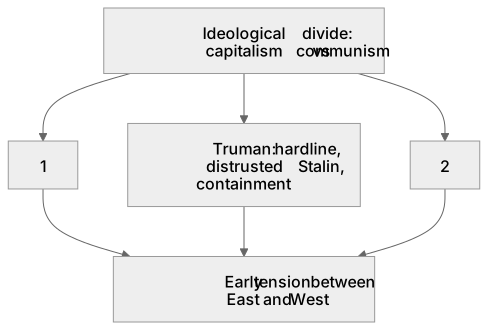
1Box 1
2Box 2
There is more to this lesson
The full lesson goes on to check your understanding and help you earn the marks. Create a free account to carry on, with your progress saved.
A week of Premium from your first lesson · Then the free plan continues · No card, no charge
Test your understanding of Option P4: Key topic 1: The origins of the Cold War, 1941–58 - 1 Early tension between East and West: The ideological differences between the superpowers and the attitudes of Stalin, Truman and Churchill.
Active recall beats re-reading. Take an instant quiz now to test what you’ve learned and lock it into long-term memory.
A week of Premium from your first lesson · Then the free plan continues · No card, no charge