Pearson Edexcel · GCSE · History
Course version: 1HI0 · Version from Sept 2016
Key topic 1: The origins of the Cold War, 1941–58 - 3 The Cold War…
Full specification wording
Option P4: Key topic 1: The origins of the Cold War, 1941–58 - 3 The Cold War intensifies: Events in 1956 leading to the Hungarian Uprising, and Khrushchev’s response.
In 1956, Khrushchev's 'Secret Speech' denouncing Stalin's brutality encouraged reformist hopes across Eastern Europe.
Checked against the Pearson Edexcel 1HI0 specification (opens in a new tab) on .
- Point 2 of 3
Study notes
From the checked teaching notes for this specification point.
The idea
In 1956, Khrushchev's 'Secret Speech' denouncing Stalin's brutality encouraged reformist hopes across Eastern Europe. In Hungary, resentment over Soviet control, the oppressive secret police (AVH), and poor living standards erupted into mass protests in October. The hardline leader Rákosi had been replaced by Ernő Gerő in July, but unrest continued. During the October uprising, the moderate Imre Nagy became Prime Minister. Nagy proposed radical reforms, including leaving the Warsaw Pact and holding free elections. Soviet forces initially intervened on 24 October but withdrew. However, Khrushchev viewed leaving the Warsaw Pact as an unacceptable threat to Soviet security. On 4 November 1956, he responded ruthlessly, sending 1,000 Soviet tanks into Budapest to crush the uprising, resulting in thousands of Hungarian deaths and Nagy's execution.
What earns the marks
- Identify Khrushchev's policy of de-Stalinisation as a catalyst for unrest in Hungary.
- Detail the domestic grievances in Hungary, including poverty and the brutality of the AVH secret police.
- Outline Imre Nagy's proposed reforms, specifically the intention to withdraw from the Warsaw Pact.
- Describe Khrushchev's military response, including the initial intervention on 24 October, the withdrawal, and the massive reinvasion of Budapest by Soviet tanks on 4 November.
Common mistakes and how to put them right
Stating that Nagy wanted to introduce a fully capitalist system.
Put it right: Nagy remained a communist but wanted a reformed, independent version of communism with multi-party elections.
Claiming Khrushchev only sent troops in once after Nagy's Warsaw Pact announcement.
Put it right: Soviet forces initially entered Budapest on 24 October 1956 to restore order, withdrew, and then reinvaded on 4 November.
Confusing the Hungarian Uprising with the Prague Spring.
Put it right: Ensure details like Imre Nagy and the year 1956 are strictly applied to Hungary, not Czechoslovakia (1968).
Exam tips
- Highlight Nagy's decision to leave the Warsaw Pact as the critical turning point that triggered the second Soviet invasion.
- Use specific details, such as the toppling of Stalin's statue in Budapest, to illustrate the anti-Soviet sentiment.
Try the lesson
The start of the Option P4: Key topic 1: The origins of the Cold War, 1941–58 - 3 The Cold War intensifies: Events in 1956 leading to the Hungarian Uprising, and Khrushchev’s response. lesson, made from checked teaching notes for this specification point.
Have a go first
Which reform proposed by Imre Nagy in 1956 was most unacceptable to the Soviet Union?
Listen
In 1956, Khrushchev's 'Secret Speech' denouncing Stalin's brutality encouraged reformist hopes across Eastern Europe. In Hungary, resentment over Soviet control, the oppressive secret police (AVH), and poor living standards erupted into mass protests in October. The hardline leader Rákosi had been replaced by Ernő Gerő in July, but unrest continued. During the October uprising, the moderate Imre Nagy became Prime Minister. Nagy proposed radical reforms, including leaving the Warsaw Pact and holding free elections. Soviet forces initially intervened on 24 October but withdrew. However, Khrushchev viewed leaving the Warsaw Pact as an unacceptable threat to Soviet security. On 4 November 1956, he responded ruthlessly, sending 1,000 Soviet tanks into Budapest to crush the uprising, resulting in thousands of Hungarian deaths and Nagy's execution. A strong answer earns marks for these points. Identify Khrushchev's policy of de-Stalinisation as a catalyst for unrest in Hungary. Detail the domestic grievances in Hungary, including poverty and the brutality of the AVH secret police. Outline Imre Nagy's proposed reforms, specifically the intention to withdraw from the Warsaw Pact. Describe Khrushchev's military response, including the initial intervention on 24 October, the withdrawal, and the massive reinvasion of Budapest by Soviet tanks on 4 November. A common slip: Stating that Nagy wanted to introduce a fully capitalist system. Instead, Nagy remained a communist but wanted a reformed, independent version of communism with multi-party elections. Exam tip: Highlight Nagy's decision to leave the Warsaw Pact as the critical turning point that triggered the second Soviet invasion.
See it
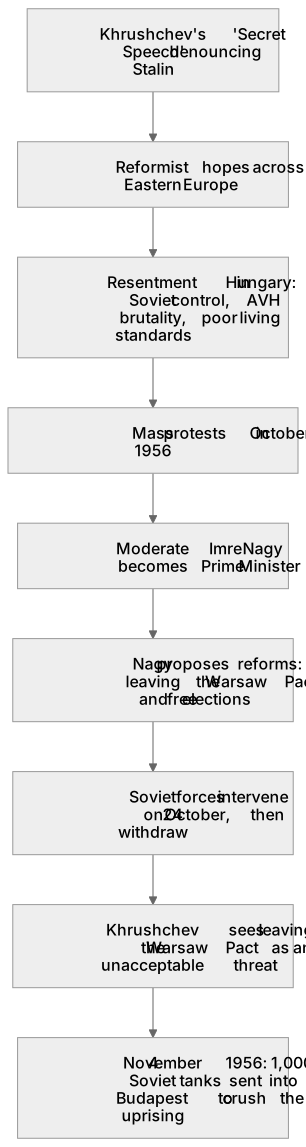
Label the diagram
Some boxes have lost their names. Pick the right name for each number.
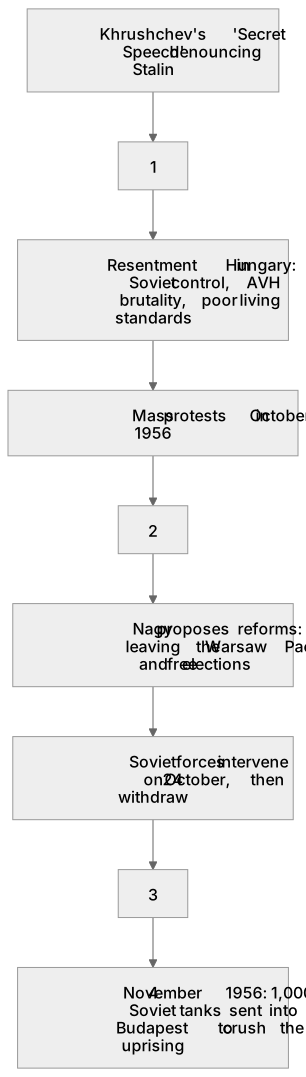
1Box 1
2Box 2
3Box 3
There is more to this lesson
The full lesson goes on to check your understanding and help you earn the marks. Create a free account to carry on, with your progress saved.
A week of Premium from your first lesson · Then the free plan continues · No card, no charge
Test your understanding of Option P4: Key topic 1: The origins of the Cold War, 1941–58 - 3 The Cold War intensifies: Events in 1956 leading to the Hungarian Uprising, and Khrushchev’s response.
Active recall beats re-reading. Take an instant quiz now to test what you’ve learned and lock it into long-term memory.
A week of Premium from your first lesson · Then the free plan continues · No card, no charge