Pearson Edexcel · GCSE · History
Course version: 1HI0 · Version from Sept 2016
Key topic 1: The origins of the Cold War, 1941–58 - 3 The Cold War…
Full specification wording
Option P4: Key topic 1: The origins of the Cold War, 1941–58 - 3 The Cold War intensifies: The significance of the arms race. The formation of the Warsaw Pact.
The arms race was a defining feature of the Cold War, driven by the desire for military superiority and deterrence.
Checked against the Pearson Edexcel 1HI0 specification (opens in a new tab) on .
- Point 1 of 3
- 4 key terms
Study notes
From the checked teaching notes for this specification point.
The idea
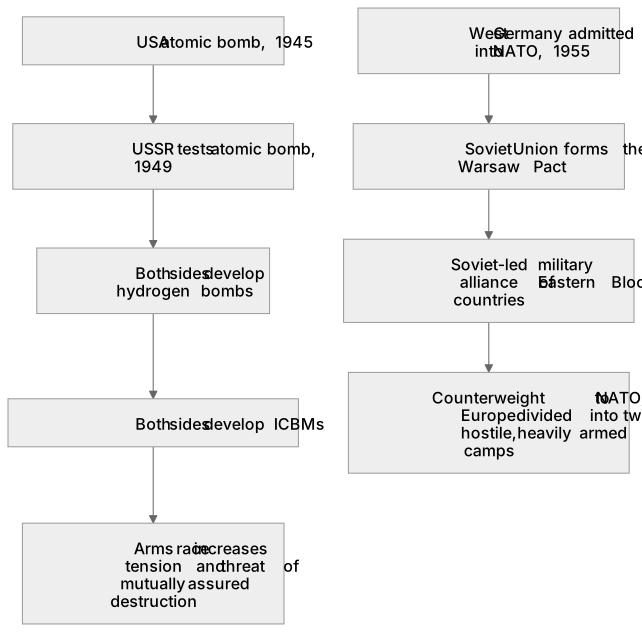
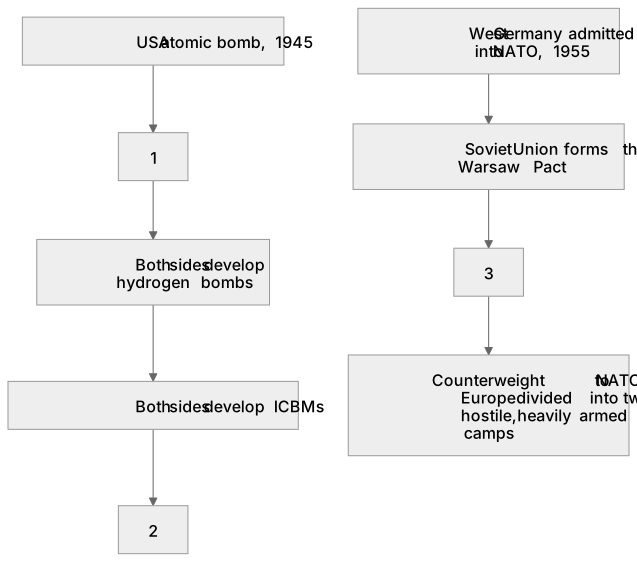
The arms race was a defining feature of the Cold War, driven by the desire for military superiority and deterrence. It began with the USA's atomic monopoly in 1945, but escalated rapidly after the USSR tested its first atomic bomb in 1949. Both sides subsequently developed devastating hydrogen bombs and intercontinental ballistic missiles (ICBMs). This competition significantly increased global tension and the threat of mutually assured destruction. In 1955, following West Germany's admission into NATO, the Soviet Union formed the Warsaw Pact. This military alliance of Eastern Bloc countries served as a direct counterweight to NATO, formalising the military division of Europe into two hostile, heavily armed camps.
What earns the marks
- Trace the escalation of the arms race from atomic bombs to hydrogen bombs and ICBMs.
- Explain how the arms race increased international tensions and established the concept of deterrence.
- Identify the admission of West Germany into NATO in 1955 as the immediate trigger for the Warsaw Pact.
- Describe the Warsaw Pact as a Soviet-led military alliance that consolidated control over Eastern Europe.
Common mistakes and how to put them right
Believing the Warsaw Pact was formed at the same time as NATO.
Put it right: NATO was formed in 1949, whereas the Warsaw Pact was created six years later in 1955.
Stating that the USSR developed the atomic bomb first.
Put it right: The USA developed the first atomic bomb in 1945; the USSR successfully tested theirs in 1949.
Assuming the arms race only involved nuclear weapons.
Put it right: While nuclear weapons were central, the arms race also included conventional forces and delivery systems like ICBMs.
Exam tips
- In a narrative account, ensure you sequence the development of weapons correctly (e.g., A-bomb, then H-bomb, then ICBMs).
- When discussing the Warsaw Pact, explicitly link its creation to the rearmament of West Germany and its entry into NATO.
- Use the term 'deterrence' to explain why both sides stockpiled weapons without actually using them in direct conflict.
Try the lesson
The start of the Option P4: Key topic 1: The origins of the Cold War, 1941–58 - 3 The Cold War intensifies: The significance of the arms race. The formation of the Warsaw Pact. lesson, made from checked teaching notes for this specification point.
Have a go first
Which event prompted the Soviet Union to form the Warsaw Pact in 1955?
Listen
The arms race was a defining feature of the Cold War, driven by the desire for military superiority and deterrence. It began with the USA's atomic monopoly in 1945, but escalated rapidly after the USSR tested its first atomic bomb in 1949. Both sides subsequently developed devastating hydrogen bombs and intercontinental ballistic missiles (ICBMs). This competition significantly increased global tension and the threat of mutually assured destruction. In 1955, following West Germany's admission into NATO, the Soviet Union formed the Warsaw Pact. This military alliance of Eastern Bloc countries served as a direct counterweight to NATO, formalising the military division of Europe into two hostile, heavily armed camps. A strong answer earns marks for these points. Trace the escalation of the arms race from atomic bombs to hydrogen bombs and ICBMs. Explain how the arms race increased international tensions and established the concept of deterrence. Identify the admission of West Germany into NATO in 1955 as the immediate trigger for the Warsaw Pact. Describe the Warsaw Pact as a Soviet-led military alliance that consolidated control over Eastern Europe. A common slip: Believing the Warsaw Pact was formed at the same time as NATO. Instead, NATO was formed in 1949, whereas the Warsaw Pact was created six years later in 1955. Exam tip: In a narrative account, ensure you sequence the development of weapons correctly (e.g., A-bomb, then H-bomb, then ICBMs).
See it
Put the events in order
Put these events in the order they happened, earliest first.
- 1. The USA developed the first atomic bomb
- 2. The Soviet Union formed the Warsaw Pact
- 3. The USSR successfully tested their atomic bomb
Key words
Say what each word means before you turn the card.
Deterrence
Try answering aloud or in your head before turning the card.
Warsaw Pact
Try answering aloud or in your head before turning the card.
Arms race
Try answering aloud or in your head before turning the card.
ICBMs
Try answering aloud or in your head before turning the card.
See every definition
- Deterrence
- The concept by which both sides stockpiled weapons without actually using them in direct conflict, established as the arms race increased international tensions.
- Warsaw Pact
- A Soviet-led military alliance of Eastern Bloc countries, formed in 1955 following West Germany's admission into NATO, serving as a direct counterweight to NATO.
- Arms race
- A defining feature of the Cold War, driven by the desire for military superiority and deterrence, which escalated from atomic bombs to hydrogen bombs and ICBMs.
- ICBMs
- Intercontinental ballistic missiles, developed by both sides alongside devastating hydrogen bombs, forming part of the arms race.
Label the diagram
Some boxes have lost their names. Pick the right name for each number.
1Box 1
2Box 2
3Box 3
There is more to this lesson
The full lesson goes on to check your understanding and help you earn the marks. Create a free account to carry on, with your progress saved.
A week of Premium from your first lesson · Then the free plan continues · No card, no charge
Test your understanding of Option P4: Key topic 1: The origins of the Cold War, 1941–58 - 3 The Cold War intensifies: The significance of the arms race. The formation of the Warsaw Pact.
Active recall beats re-reading. Take an instant quiz now to test what you’ve learned and lock it into long-term memory.
A week of Premium from your first lesson · Then the free plan continues · No card, no charge