Pearson Edexcel · GCSE · History
Course version: 1HI0 · Version from Sept 2016
Key topic 2: Cold War crises, 1958–70 - 1 Increased tension between East…
Full specification wording
Option P4: Key topic 2: Cold War crises, 1958–70 - 1 Increased tension between East and West: Opposition in Czechoslovakia to Soviet control: the Prague Spring.
In 1968, opposition to strict Soviet control in Czechoslovakia culminated in the Prague Spring, a period of political liberalisation led by Alexander Dubček.
Checked against the Pearson Edexcel 1HI0 specification (opens in a new tab) on .
- Point 3 of 3
Study notes
From the checked teaching notes for this specification point.
The idea
In 1968, opposition to strict Soviet control in Czechoslovakia culminated in the Prague Spring, a period of political liberalisation led by Alexander Dubček. Dubček proposed 'socialism with a human face', introducing reforms that reduced state censorship, allowed greater freedom of speech, and eased travel restrictions. While Dubček assured Moscow that Czechoslovakia would remain in the Warsaw Pact, Soviet leader Brezhnev feared these reforms would undermine communist control across Eastern Europe. The Prague Spring represented a significant ideological challenge to Soviet dominance, demonstrating deep-seated popular opposition to hardline communist rule and prompting the USSR to prepare a military response to restore orthodox control.
What earns the marks
- Identify the economic and political grievances that led to opposition to Soviet control in Czechoslovakia.
- Describe Alexander Dubček's appointment and his philosophy of 'socialism with a human face'.
- Detail the specific reforms of the Prague Spring, such as the abolition of censorship and increased freedom of speech.
- Explain why the Soviet Union viewed the Prague Spring as a threat to the Warsaw Pact and communist control in Eastern Europe.
Common mistakes and how to put them right
Confusing the Prague Spring with the Hungarian Uprising.
Put it right: Dubček wanted to remain in the Warsaw Pact (Prague Spring, 1968), whereas Nagy wanted to leave it (Hungarian Uprising, 1956).
Stating that the Prague Spring aimed to introduce capitalism.
Put it right: Emphasise that Dubček remained a committed communist who wanted to reform the system, not replace it with capitalism.
Believing the Prague Spring involved violent rebellion against the Soviets.
Put it right: Describe the Prague Spring as a period of peaceful political reform and liberalisation initiated by the government itself.
Exam tips
- Contrast Dubček's approach to the Warsaw Pact with Imre Nagy's approach in Hungary to highlight why the Soviets still felt threatened.
- Use the phrase 'socialism with a human face' to demonstrate precise knowledge of Dubček's ideological goals.
- Focus on the removal of censorship as a key reform that alarmed Moscow, as it allowed open criticism of communism.
Try the lesson
The start of the Option P4: Key topic 2: Cold War crises, 1958–70 - 1 Increased tension between East and West: Opposition in Czechoslovakia to Soviet control: the Prague Spring. lesson, made from checked teaching notes for this specification point.
Have a go first
Who was the leader of the Czechoslovak Communist Party during the period of reforms known as the Prague Spring in 1968?
Listen
In 1968, opposition to strict Soviet control in Czechoslovakia culminated in the Prague Spring, a period of political liberalisation led by Alexander Dubček. Dubček proposed 'socialism with a human face', introducing reforms that reduced state censorship, allowed greater freedom of speech, and eased travel restrictions. While Dubček assured Moscow that Czechoslovakia would remain in the Warsaw Pact, Soviet leader Brezhnev feared these reforms would undermine communist control across Eastern Europe. The Prague Spring represented a significant ideological challenge to Soviet dominance, demonstrating deep-seated popular opposition to hardline communist rule and prompting the USSR to prepare a military response to restore orthodox control. A strong answer earns marks for these points. Identify the economic and political grievances that led to opposition to Soviet control in Czechoslovakia. Describe Alexander Dubček's appointment and his philosophy of 'socialism with a human face'. Detail the specific reforms of the Prague Spring, such as the abolition of censorship and increased freedom of speech. Explain why the Soviet Union viewed the Prague Spring as a threat to the Warsaw Pact and communist control in Eastern Europe. A common slip: Confusing the Prague Spring with the Hungarian Uprising. Instead, Dubček wanted to remain in the Warsaw Pact (Prague Spring, 1968), whereas Nagy wanted to leave it (Hungarian Uprising, 1956). Exam tip: Contrast Dubček's approach to the Warsaw Pact with Imre Nagy's approach in Hungary to highlight why the Soviets still felt threatened.
See it
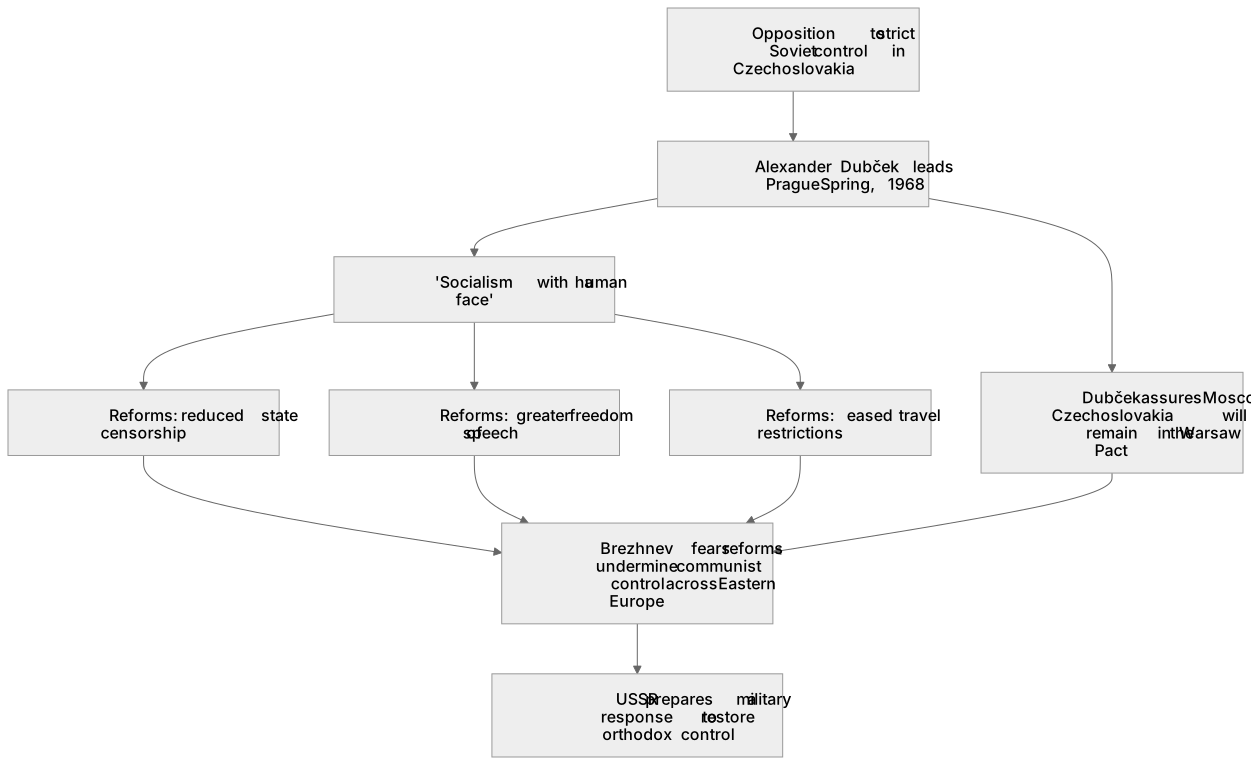
Label the diagram
Some boxes have lost their names. Pick the right name for each number.
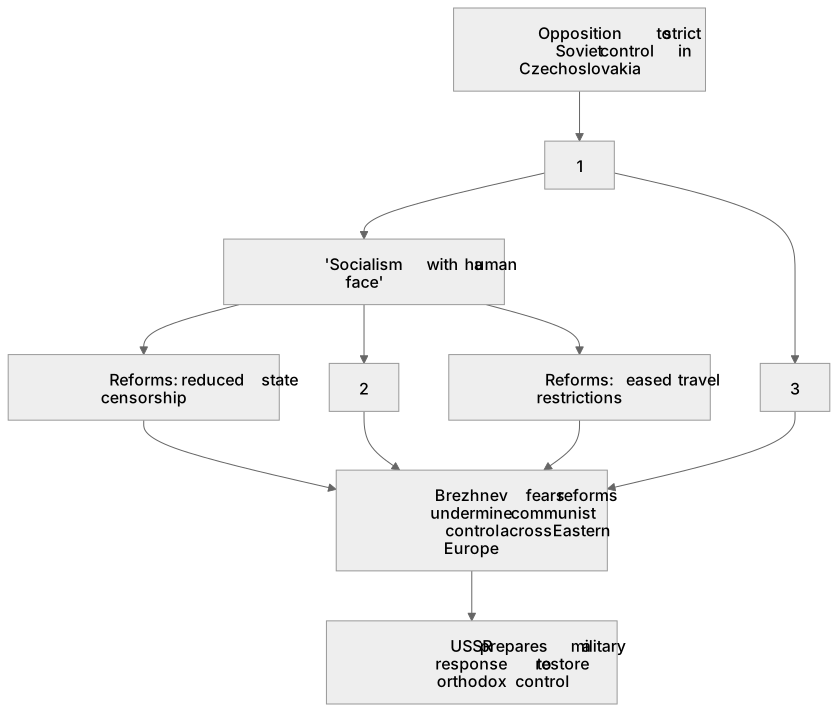
1Box 1
2Box 2
3Box 3
There is more to this lesson
The full lesson goes on to check your understanding and help you earn the marks. Create a free account to carry on, with your progress saved.
A week of Premium from your first lesson · Then the free plan continues · No card, no charge
Test your understanding of Option P4: Key topic 2: Cold War crises, 1958–70 - 1 Increased tension between East and West: Opposition in Czechoslovakia to Soviet control: the Prague Spring.
Active recall beats re-reading. Take an instant quiz now to test what you’ve learned and lock it into long-term memory.
A week of Premium from your first lesson · Then the free plan continues · No card, no charge