Pearson Edexcel · GCSE · History
Course version: 1HI0 · Version from Sept 2016
Key topic 2: Cold War crises, 1958–70 - 1 Increased tension between East…
Full specification wording
Option P4: Key topic 2: Cold War crises, 1958–70 - 1 Increased tension between East and West: The impact of the Cuban Revolution on relations with the USA and the Soviet Union, including the refusal of the USA to recognise Castro’s government and the closer relations with the Soviet Union. The significance of the Bay of Pigs incident.
Fidel Castro's 1959 Cuban Revolution overthrew the US-backed dictator Batista, severely damaging US-Cuban relations.
Checked against the Pearson Edexcel 1HI0 specification (opens in a new tab) on .
- Point 2 of 3
- 4 key terms
Study notes
From the checked teaching notes for this specification point.
The idea
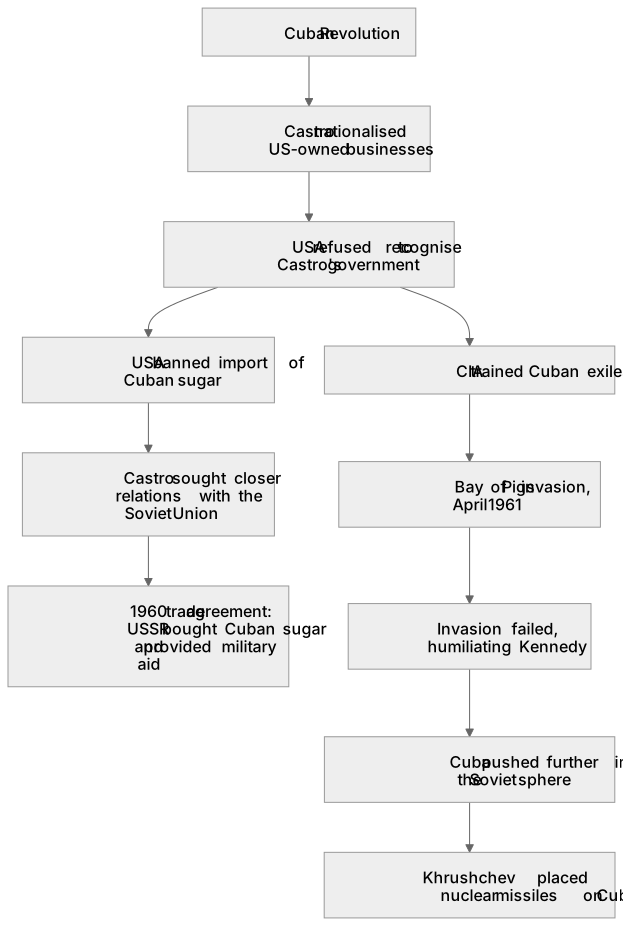
Fidel Castro's 1959 Cuban Revolution overthrew the US-backed dictator Batista, severely damaging US-Cuban relations. When Castro nationalised US-owned businesses, the USA refused to recognise his government and banned the import of Cuban sugar. In response, Castro sought closer relations with the Soviet Union, signing a 1960 trade agreement where the USSR bought Cuban sugar and provided military aid. To overthrow Castro, the CIA trained Cuban exiles for the April 1961 Bay of Pigs invasion. The invasion was a disastrous failure, humiliating President Kennedy and pushing Cuba further into the Soviet sphere. Its significance lies in cementing the Soviet-Cuban alliance, leading directly to Khrushchev placing nuclear missiles on Cuba.
What earns the marks
- Explain how Castro's nationalisation of American businesses led the USA to refuse recognition and impose economic sanctions.
- Describe the economic and military agreements formed between Cuba and the Soviet Union following the deterioration of US-Cuban relations.
- Detail the events of the Bay of Pigs incident, including the CIA's role in training Cuban exiles.
- Analyse the significance of the Bay of Pigs failure in strengthening Castro's position and cementing the Soviet-Cuban alliance.
Common mistakes and how to put them right
Claiming that Castro was a Soviet puppet from the beginning of the revolution.
Put it right: Clarify that Castro initially sought good relations with the USA but turned to the USSR after the USA refused to recognise his government and imposed sanctions.
Stating that US military forces directly invaded Cuba during the Bay of Pigs.
Put it right: Specify that the invasion was carried out by CIA-trained Cuban exiles, not official US military personnel.
Confusing the Bay of Pigs incident with the Cuban Missile Crisis.
Put it right: Treat the Bay of Pigs (April 1961) as a precursor and cause of the Cuban Missile Crisis (October 1962).
Exam tips
- Explicitly link the failure of the Bay of Pigs to Khrushchev's decision to place nuclear missiles in Cuba.
- Use the US refusal to buy Cuban sugar as a concrete example of economic retaliation.
- When evaluating significance, focus on how the Bay of Pigs humiliated Kennedy and emboldened Khrushchev.
Try the lesson
The start of the Option P4: Key topic 2: Cold War crises, 1958–70 - 1 Increased tension between East and West: The impact of the Cuban Revolution on relations with the USA and the Soviet Union, including the refusal of the USA to recognise Castro’s government and the closer relations with the Soviet Union. The significance of the Bay of Pigs incident. lesson, made from checked teaching notes for this specification point.
Have a go first
What was the primary objective of the Bay of Pigs invasion launched in April 1961?
Listen
Fidel Castro's 1959 Cuban Revolution overthrew the US-backed dictator Batista, severely damaging US-Cuban relations. When Castro nationalised US-owned businesses, the USA refused to recognise his government and banned the import of Cuban sugar. In response, Castro sought closer relations with the Soviet Union, signing a 1960 trade agreement where the USSR bought Cuban sugar and provided military aid. To overthrow Castro, the CIA trained Cuban exiles for the April 1961 Bay of Pigs invasion. The invasion was a disastrous failure, humiliating President Kennedy and pushing Cuba further into the Soviet sphere. Its significance lies in cementing the Soviet-Cuban alliance, leading directly to Khrushchev placing nuclear missiles on Cuba. A strong answer earns marks for these points. Explain how Castro's nationalisation of American businesses led the USA to refuse recognition and impose economic sanctions. Describe the economic and military agreements formed between Cuba and the Soviet Union following the deterioration of US-Cuban relations. Detail the events of the Bay of Pigs incident, including the CIA's role in training Cuban exiles. Analyse the significance of the Bay of Pigs failure in strengthening Castro's position and cementing the Soviet-Cuban alliance. A common slip: Claiming that Castro was a Soviet puppet from the beginning of the revolution. Instead, Clarify that Castro initially sought good relations with the USA but turned to the USSR after the USA refused to recognise his government and imposed sanctions. Exam tip: Explicitly link the failure of the Bay of Pigs to Khrushchev's decision to place nuclear missiles in Cuba.
See it
Put the events in order
Put these events in the order they happened, earliest first.
- 1. Castro's Cuban Revolution overthrew the US-backed dictator Batista
- 2. The Bay of Pigs invasion took place
- 3. Cuba and the Soviet Union signed a trade agreement
Key words
Say what each word means before you turn the card.
Bay of Pigs incident
Try answering aloud or in your head before turning the card.
nationalisation
Try answering aloud or in your head before turning the card.
Cuban Revolution
Try answering aloud or in your head before turning the card.
Soviet-Cuban alliance
Try answering aloud or in your head before turning the card.
See every definition
- Bay of Pigs incident
- The April 1961 invasion in which the CIA trained Cuban exiles to overthrow Castro, which failed disastrously and humiliated President Kennedy.
- nationalisation
- Castro's takeover of US-owned businesses, which led the USA to refuse to recognise his government and ban the import of Cuban sugar.
- Cuban Revolution
- Fidel Castro's 1959 overthrow of the US-backed dictator Batista, which severely damaged US-Cuban relations.
- Soviet-Cuban alliance
- Closer relations in which the USSR bought Cuban sugar and provided military aid under a 1960 trade agreement, cemented by the Bay of Pigs failure.
Label the diagram
Some boxes have lost their names. Pick the right name for each number.
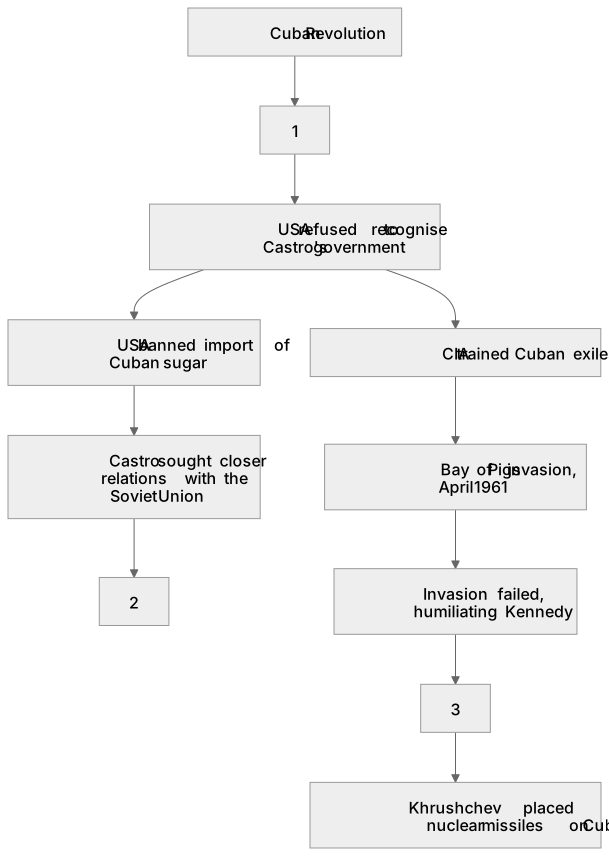
1Box 1
2Box 2
3Box 3
There is more to this lesson
The full lesson goes on to check your understanding and help you earn the marks. Create a free account to carry on, with your progress saved.
A week of Premium from your first lesson · Then the free plan continues · No card, no charge
Test your understanding of Option P4: Key topic 2: Cold War crises, 1958–70 - 1 Increased tension between East and West: The impact of the Cuban Revolution on relations with the USA and the Soviet Union, including the refusal of the USA to recognise Castro’s government and the closer relations with the Soviet Union. The significance of the Bay of Pigs incident.
Active recall beats re-reading. Take an instant quiz now to test what you’ve learned and lock it into long-term memory.
A week of Premium from your first lesson · Then the free plan continues · No card, no charge