Pearson Edexcel · GCSE · History
Course version: 1HI0 · Version from Sept 2016
Key topic 2: Cold War crises, 1958–70 - 2 Cold War crises: The Brezhnev…
Full specification wording
Option P4: Key topic 2: Cold War crises, 1958–70 - 2 Cold War crises: The Brezhnev Doctrine and the re-establishment of Soviet control in Czechoslovakia.
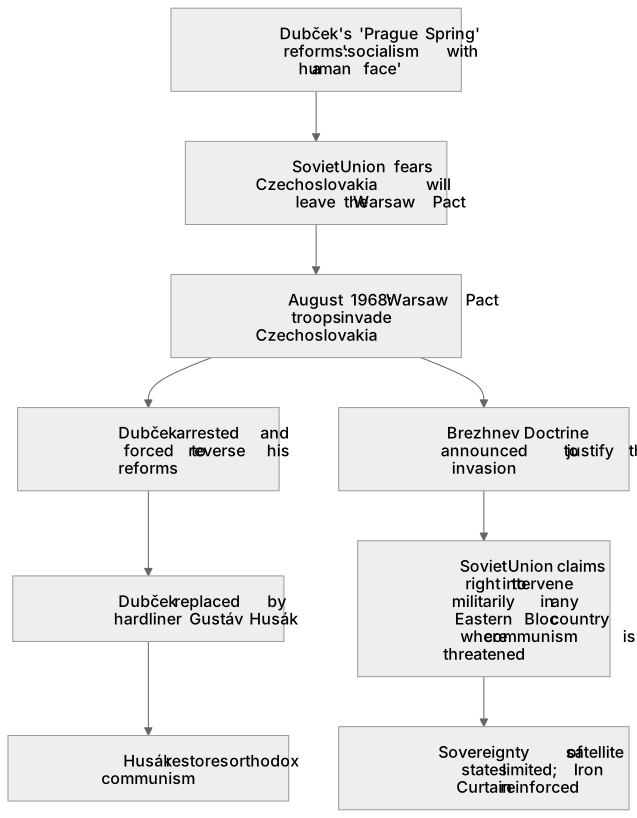
Following Alexander Dubček's 'Prague Spring' reforms in 1968, which introduced 'socialism with a human face', the Soviet Union feared Czechoslovakia would leave the Warsaw Pact.
Checked against the Pearson Edexcel 1HI0 specification (opens in a new tab) on .
- Point 3 of 3
- 3 key terms
Study notes
From the checked teaching notes for this specification point.
The idea
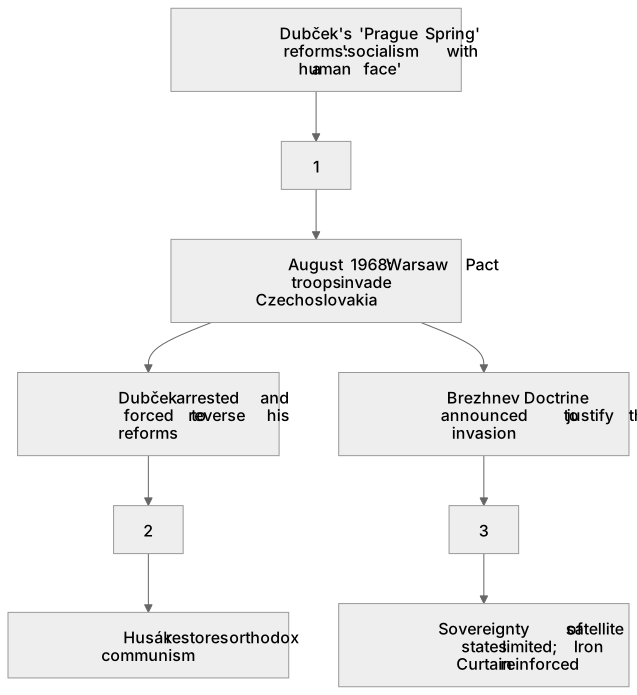
Following Alexander Dubček's 'Prague Spring' reforms in 1968, which introduced 'socialism with a human face', the Soviet Union feared Czechoslovakia would leave the Warsaw Pact. In August 1968, Warsaw Pact troops invaded Czechoslovakia to re-establish strict Soviet control. Dubček was arrested, forced to reverse his reforms, and eventually replaced by the hardliner Gustáv Husák, who restored orthodox communism. To justify the invasion, Soviet leader Leonid Brezhnev announced the Brezhnev Doctrine. This policy stated that the Soviet Union had the right to intervene militarily in any Eastern Bloc country where communism was threatened, effectively limiting the sovereignty of satellite states and reinforcing the Iron Curtain.
What earns the marks
- Explain the trigger for Soviet intervention: Dubček's Prague Spring reforms threatening Warsaw Pact unity.
- Describe the invasion: 500,000 Warsaw Pact troops entering Czechoslovakia in August 1968 to crush the reforms.
- Detail the re-establishment of control: Dubček's arrest, the reversal of reforms, and his replacement by Gustáv Husák.
- Define the Brezhnev Doctrine: the Soviet assertion of the right to intervene in any Warsaw Pact country to protect communism.
Common mistakes and how to put them right
Confusing the 1968 Czechoslovakian invasion with the 1956 Hungarian Uprising.
Put it right: Czechoslovakia involved Dubček and the Brezhnev Doctrine, while Hungary involved Nagy.
Stating that the US intervened militarily to help Czechoslovakia.
Put it right: The US condemned the invasion but took no military action due to the risk of war.
Believing the Brezhnev Doctrine was announced before the invasion.
Put it right: It was formulated retrospectively to justify the military action.
Exam tips
- Link the Brezhnev Doctrine directly to the concept of limited sovereignty for Soviet satellite states.
- When explaining the consequences of the Prague Spring, ensure you mention both the immediate military crackdown and the long-term ideological justification (Brezhnev Doctrine).
- Contrast Dubček's 'socialism with a human face' with the strict orthodox communism enforced by Husák.
Try the lesson
The start of the Option P4: Key topic 2: Cold War crises, 1958–70 - 2 Cold War crises: The Brezhnev Doctrine and the re-establishment of Soviet control in Czechoslovakia. lesson, made from checked teaching notes for this specification point.
Have a go first
What was the main principle of the Brezhnev Doctrine, which was announced by the Soviet leader in 1968?
Listen
Following Alexander Dubček's 'Prague Spring' reforms in 1968, which introduced 'socialism with a human face', the Soviet Union feared Czechoslovakia would leave the Warsaw Pact. In August 1968, Warsaw Pact troops invaded Czechoslovakia to re-establish strict Soviet control. Dubček was arrested, forced to reverse his reforms, and eventually replaced by the hardliner Gustáv Husák, who restored orthodox communism. To justify the invasion, Soviet leader Leonid Brezhnev announced the Brezhnev Doctrine. This policy stated that the Soviet Union had the right to intervene militarily in any Eastern Bloc country where communism was threatened, effectively limiting the sovereignty of satellite states and reinforcing the Iron Curtain. A strong answer earns marks for these points. Explain the trigger for Soviet intervention: Dubček's Prague Spring reforms threatening Warsaw Pact unity. Describe the invasion: 500,000 Warsaw Pact troops entering Czechoslovakia in August 1968 to crush the reforms. Detail the re-establishment of control: Dubček's arrest, the reversal of reforms, and his replacement by Gustáv Husák. Define the Brezhnev Doctrine: the Soviet assertion of the right to intervene in any Warsaw Pact country to protect communism. Exam tip: Link the Brezhnev Doctrine directly to the concept of limited sovereignty for Soviet satellite states.
See it
Key words
Say what each word means before you turn the card.
Brezhnev Doctrine
Try answering aloud or in your head before turning the card.
Prague Spring
Try answering aloud or in your head before turning the card.
Orthodox communism
Try answering aloud or in your head before turning the card.
See every definition
- Brezhnev Doctrine
- Policy stating the Soviet Union had the right to intervene militarily in any Eastern Bloc country where communism was threatened.
- Prague Spring
- Alexander Dubček's reforms in 1968, which introduced 'socialism with a human face'.
- Orthodox communism
- Strict communism restored by Gustáv Husák after Dubček's reforms were reversed.
Label the diagram
Some boxes have lost their names. Pick the right name for each number.
1Box 1
2Box 2
3Box 3
There is more to this lesson
The full lesson goes on to check your understanding and help you earn the marks. Create a free account to carry on, with your progress saved.
A week of Premium from your first lesson · Then the free plan continues · No card, no charge
Test your understanding of Option P4: Key topic 2: Cold War crises, 1958–70 - 2 Cold War crises: The Brezhnev Doctrine and the re-establishment of Soviet control in Czechoslovakia.
Active recall beats re-reading. Take an instant quiz now to test what you’ve learned and lock it into long-term memory.
A week of Premium from your first lesson · Then the free plan continues · No card, no charge