Pearson Edexcel · GCSE · History
Course version: 1HI0 · Version from Sept 2016
Key topic 2: Cold War crises, 1958–70 - 2 Cold War crises: The events of…
Full specification wording
Option P4: Key topic 2: Cold War crises, 1958–70 - 2 Cold War crises: The events of the Cuban Missile Crisis.
The Cuban Missile Crisis (October 1962) was a thirteen-day confrontation between the USA and the Soviet Union, triggered by the discovery of Soviet nuclear missile sites in Cuba.
Checked against the Pearson Edexcel 1HI0 specification (opens in a new tab) on .
- Point 2 of 3
Study notes
From the checked teaching notes for this specification point.
The idea
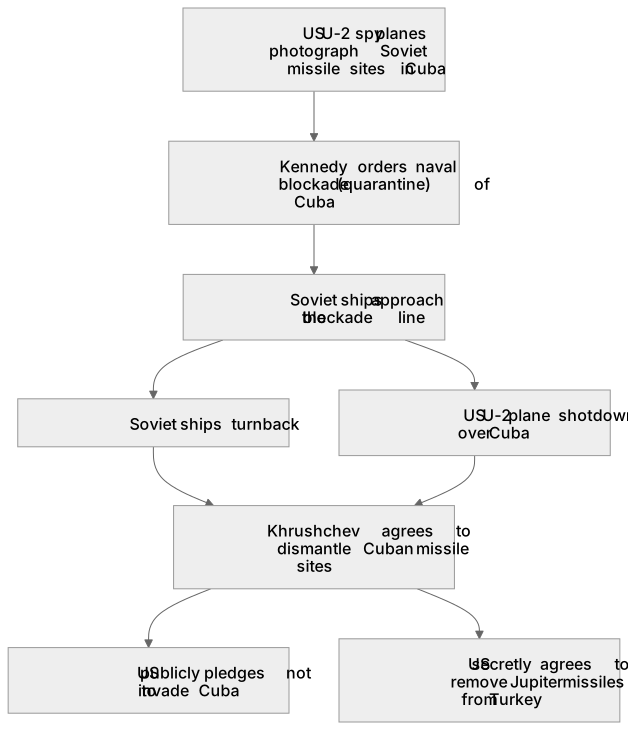
The Cuban Missile Crisis (October 1962) was a thirteen-day confrontation between the USA and the Soviet Union, triggered by the discovery of Soviet nuclear missile sites in Cuba. Following the failed Bay of Pigs invasion, Khrushchev sought to protect Cuba and balance the US missile presence in Turkey. Kennedy responded by ordering a naval blockade (or 'quarantine') of Cuba to prevent further Soviet shipments. Tensions peaked when Soviet ships approached the blockade line and a US U-2 spy plane was shot down over Cuba. The crisis was resolved when Khrushchev agreed to dismantle the Cuban missile sites in exchange for a public US pledge not to invade Cuba and a secret agreement to remove US Jupiter missiles from Turkey.
What earns the marks
- Identify the trigger: US U-2 spy planes photographing Soviet missile sites in Cuba in October 1962.
- Explain Kennedy's response: implementing a naval blockade (quarantine) rather than an airstrike or invasion.
- Describe the climax: Soviet ships turning back at the blockade line and the shooting down of a US U-2 plane.
- Detail the resolution: Khrushchev's agreement to remove missiles from Cuba in exchange for the US promising not to invade Cuba and secretly removing missiles from Turkey.
Common mistakes and how to put them right
Stating that the US invaded Cuba during the crisis.
Put it right: The invasion was the earlier Bay of Pigs incident, whereas the crisis involved a naval blockade.
Believing the US publicly agreed to remove missiles from Turkey.
Put it right: This agreement was kept strictly secret at the time to protect Kennedy's reputation.
Confusing the Cuban Missile Crisis with the Berlin Crisis.
Put it right: Ensure events like the blockade are specifically linked to Cuba and the Caribbean.
Exam tips
- Use a timeline approach to structure narrative accounts of the thirteen days, highlighting the escalation and de-escalation.
- When discussing the importance of the crisis, focus on how close the world came to nuclear war and how this forced both leaders to compromise.
- Clearly distinguish between the public and secret terms of the final agreement between Kennedy and Khrushchev.
Try the lesson
The start of the Option P4: Key topic 2: Cold War crises, 1958–70 - 2 Cold War crises: The events of the Cuban Missile Crisis. lesson, made from checked teaching notes for this specification point.
Have a go first
What action did President John F. Kennedy take in October 1962 to prevent more Soviet missiles from reaching Cuba?
Listen
The Cuban Missile Crisis (October 1962) was a thirteen-day confrontation between the USA and the Soviet Union, triggered by the discovery of Soviet nuclear missile sites in Cuba. Following the failed Bay of Pigs invasion, Khrushchev sought to protect Cuba and balance the US missile presence in Turkey. Kennedy responded by ordering a naval blockade (or 'quarantine') of Cuba to prevent further Soviet shipments. Tensions peaked when Soviet ships approached the blockade line and a US U-2 spy plane was shot down over Cuba. The crisis was resolved when Khrushchev agreed to dismantle the Cuban missile sites in exchange for a public US pledge not to invade Cuba and a secret agreement to remove US Jupiter missiles from Turkey. A strong answer earns marks for these points. Identify the trigger: US U-2 spy planes photographing Soviet missile sites in Cuba in October 1962. Explain Kennedy's response: implementing a naval blockade (quarantine) rather than an airstrike or invasion. Describe the climax: Soviet ships turning back at the blockade line and the shooting down of a US U-2 plane. Detail the resolution: Khrushchev's agreement to remove missiles from Cuba in exchange for the US promising not to invade Cuba and secretly removing missiles from Turkey. Exam tip: Use a timeline approach to structure narrative accounts of the thirteen days, highlighting the escalation and de-escalation.
See it
Label the diagram
Some boxes have lost their names. Pick the right name for each number.
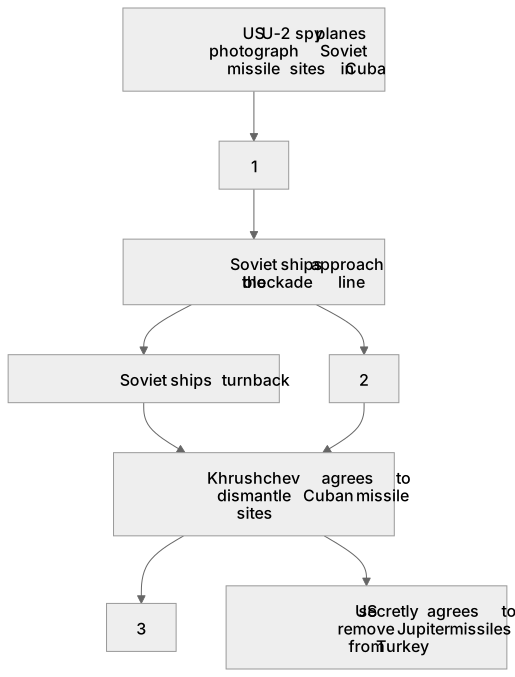
1Box 1
2Box 2
3Box 3
There is more to this lesson
The full lesson goes on to check your understanding and help you earn the marks. Create a free account to carry on, with your progress saved.
A week of Premium from your first lesson · Then the free plan continues · No card, no charge
Test your understanding of Option P4: Key topic 2: Cold War crises, 1958–70 - 2 Cold War crises: The events of the Cuban Missile Crisis.
Active recall beats re-reading. Take an instant quiz now to test what you’ve learned and lock it into long-term memory.
A week of Premium from your first lesson · Then the free plan continues · No card, no charge