Pearson Edexcel · GCSE · History
Course version: 1HI0 · Version from Sept 2016
Key topic 2: Cold War crises, 1958–70 - 3 Reaction to crisis: Impact of…
Full specification wording
Option P4: Key topic 2: Cold War crises, 1958–70 - 3 Reaction to crisis: Impact of the construction of the Berlin Wall on US-Soviet relations. Kennedy’s visit to West Berlin in 1963.
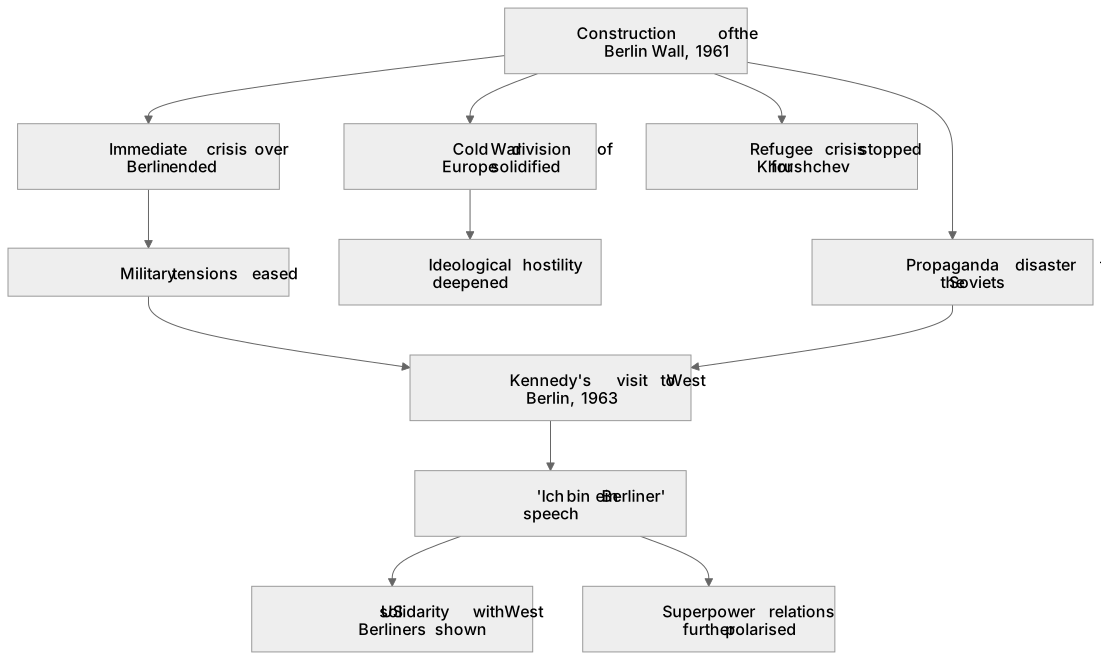
The construction of the Berlin Wall in 1961 significantly impacted US-Soviet relations, ending the immediate crisis over Berlin but solidifying the Cold War division of Europe.
Checked against the Pearson Edexcel 1HI0 specification (opens in a new tab) on .
- Point 1 of 3
- 2 key terms
Study notes
From the checked teaching notes for this specification point.
The idea
The construction of the Berlin Wall in 1961 significantly impacted US-Soviet relations, ending the immediate crisis over Berlin but solidifying the Cold War division of Europe. For Khrushchev, it stopped the refugee crisis, though it was a propaganda disaster showing communism had to imprison its people. For Kennedy, a wall was preferable to a war, easing military tensions while allowing the US to condemn Soviet oppression. In 1963, Kennedy visited West Berlin, delivering his famous 'Ich bin ein Berliner' speech. This visit demonstrated unwavering US solidarity with West Berliners, boosted morale, and reinforced the American commitment to defending freedom against communist expansion, further polarising superpower relations.
What earns the marks
- Explain the dual impact of the Wall: it reduced the immediate threat of nuclear war over Berlin but physically cemented the ideological divide.
- Identify the propaganda victory for the US: the Wall demonstrated that the Soviet system had to build a barrier to keep its citizens from fleeing.
- Describe Kennedy's 1963 visit: his tour of West Berlin and the delivery of the 'Ich bin ein Berliner' speech to a massive crowd.
- Analyse the significance of Kennedy's visit: it reassured West Berliners of US protection and publicly challenged Soviet authoritarianism.
Common mistakes and how to put them right
Claiming the Berlin Wall improved US-Soviet relations.
Put it right: While it prevented immediate war, it deepened ideological hostility and mistrust.
Confusing the Berlin Blockade (1948-49) with the Berlin Wall (1961).
Put it right: Ensure you focus on the physical barrier and refugee crisis for the 1960s context.
Stating Kennedy threatened to tear down the wall in 1963.
Put it right: His speech offered solidarity and highlighted the failures of communism, but he accepted the Wall's existence to avoid war.
Exam tips
- Use Kennedy's phrase 'a wall is a hell of a lot better than a war' to illustrate the pragmatic US reaction to the crisis.
- When discussing consequences, balance the reduction in immediate military tension with the increase in ideological propaganda.
- Highlight how Kennedy's 1963 visit served as a powerful symbol of the Truman Doctrine in action.
Try the lesson
The start of the Option P4: Key topic 2: Cold War crises, 1958–70 - 3 Reaction to crisis: Impact of the construction of the Berlin Wall on US-Soviet relations. Kennedy’s visit to West Berlin in 1963. lesson, made from checked teaching notes for this specification point.
Have a go first
What famous phrase did President Kennedy use during his visit to West Berlin in 1963 to show American solidarity with the city?
Listen
The construction of the Berlin Wall in 1961 significantly impacted US-Soviet relations, ending the immediate crisis over Berlin but solidifying the Cold War division of Europe. For Khrushchev, it stopped the refugee crisis, though it was a propaganda disaster showing communism had to imprison its people. For Kennedy, a wall was preferable to a war, easing military tensions while allowing the US to condemn Soviet oppression. In 1963, Kennedy visited West Berlin, delivering his famous 'Ich bin ein Berliner' speech. This visit demonstrated unwavering US solidarity with West Berliners, boosted morale, and reinforced the American commitment to defending freedom against communist expansion, further polarising superpower relations. A strong answer earns marks for these points. Explain the dual impact of the Wall: it reduced the immediate threat of nuclear war over Berlin but physically cemented the ideological divide. Identify the propaganda victory for the US: the Wall demonstrated that the Soviet system had to build a barrier to keep its citizens from fleeing. Describe Kennedy's 1963 visit: his tour of West Berlin and the delivery of the 'Ich bin ein Berliner' speech to a massive crowd. Analyse the significance of Kennedy's visit: it reassured West Berliners of US protection and publicly challenged Soviet authoritarianism. Exam tip: Use Kennedy's phrase 'a wall is a hell of a lot better than a war' to illustrate the pragmatic US reaction to the crisis.
See it
Key words
Say what each word means before you turn the card.
Ideological division
Try answering aloud or in your head before turning the card.
Superpower relations
Try answering aloud or in your head before turning the card.
See every definition
- Ideological division
- The Cold War split of Europe, which the Wall physically cemented even as it reduced the immediate threat of nuclear war over Berlin.
- Superpower relations
- US-Soviet ties that the Wall further polarised, deepening ideological hostility and mistrust despite easing military tensions.
Label the diagram
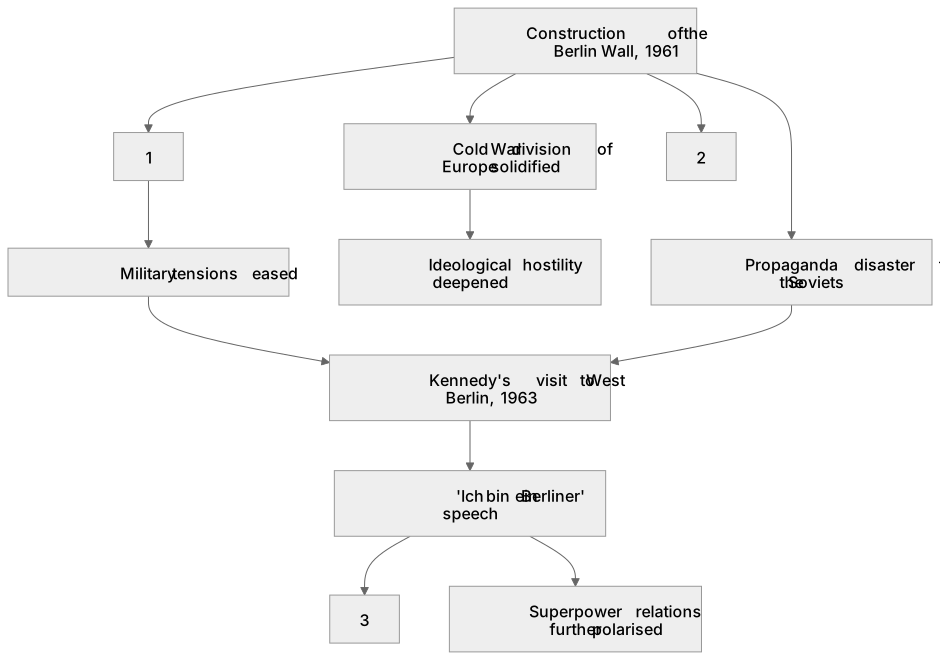
Some boxes have lost their names. Pick the right name for each number.
1Box 1
2Box 2
3Box 3
There is more to this lesson
The full lesson goes on to check your understanding and help you earn the marks. Create a free account to carry on, with your progress saved.
A week of Premium from your first lesson · Then the free plan continues · No card, no charge
Test your understanding of Option P4: Key topic 2: Cold War crises, 1958–70 - 3 Reaction to crisis: Impact of the construction of the Berlin Wall on US-Soviet relations. Kennedy’s visit to West Berlin in 1963.
Active recall beats re-reading. Take an instant quiz now to test what you’ve learned and lock it into long-term memory.
A week of Premium from your first lesson · Then the free plan continues · No card, no charge