Pearson Edexcel · GCSE · History
Course version: 1HI0 · Version from Sept 2016
Key topic 2: Cold War crises, 1958–70 - 3 Reaction to crisis: The…
Full specification wording
Option P4: Key topic 2: Cold War crises, 1958–70 - 3 Reaction to crisis: The consequences of the Cuban Missile Crisis, including the ‘hotline’. Attempts at arms control: the Limited Test Ban Treaty (1963); the Outer Space Treaty (1967); and the Nuclear Non-Proliferation Treaty (1968).
The Cuban Missile Crisis terrified both superpowers, leading to a period of détente and significant attempts at arms control.
Checked against the Pearson Edexcel 1HI0 specification (opens in a new tab) on .
- Point 2 of 3
- 4 key terms
Study notes
From the checked teaching notes for this specification point.
The idea
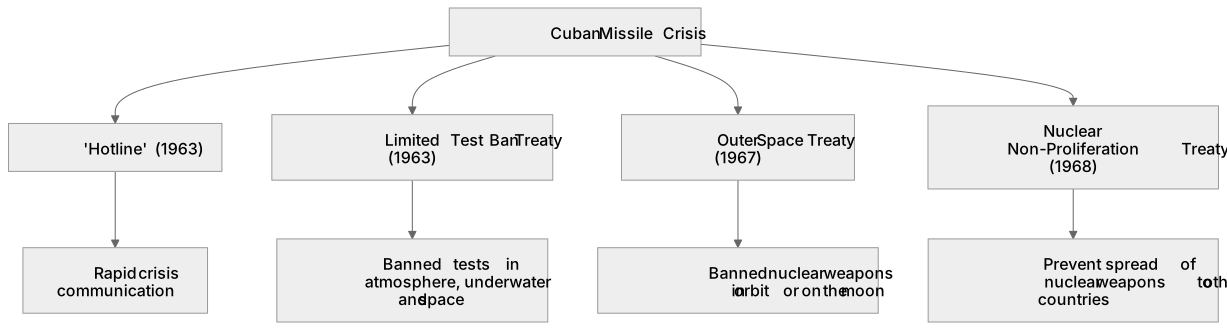
The Cuban Missile Crisis terrified both superpowers, leading to a period of détente and significant attempts at arms control. A direct communications link, the 'hotline', was established in 1963 between Washington and Moscow to prevent future misunderstandings. This was followed by the Limited Test Ban Treaty (1963), which prohibited nuclear weapons testing in the atmosphere, outer space, and underwater, aiming to reduce radioactive fallout. The Outer Space Treaty (1967) forbade the placement of weapons of mass destruction in orbit or on celestial bodies, keeping space demilitarised. Finally, the Nuclear Non-Proliferation Treaty (1968) sought to prevent the spread of nuclear weapons to other countries, restricting the nuclear club.
What earns the marks
- Identify the 'hotline' (1963) as a direct teleprinter link between the Kremlin and the White House to facilitate rapid crisis communication.
- Explain the Limited Test Ban Treaty (1963): banning nuclear tests in the atmosphere, underwater, and in space to limit environmental damage and arms development.
- Describe the Outer Space Treaty (1967): preventing the militarisation of space by banning nuclear weapons in orbit or on the moon.
- Detail the Nuclear Non-Proliferation Treaty (1968): an agreement where nuclear states promised not to share technology, and non-nuclear states agreed not to develop it.
Common mistakes and how to put them right
Confusing the Limited Test Ban Treaty with a complete ban on nuclear weapons.
Put it right: It only banned testing in specific environments, allowing underground tests to continue.
Stating the 'hotline' was a red telephone.
Put it right: It was originally a secure teleprinter link, as voice communication could be misinterpreted.
Mixing up the dates and specific terms of the three treaties.
Put it right: Ensure the Test Ban (1963), Outer Space (1967), and Non-Proliferation (1968) treaties are distinct.
Exam tips
- Group these consequences under the theme of 'reducing the risk of nuclear war' when answering questions about the impact of the Cuban Missile Crisis.
- Be precise with the terms of each treaty; for example, specify that the Non-Proliferation Treaty aimed to stop the spread of weapons to new countries.
- Use these treaties as evidence of a shift from brinkmanship towards early détente in US-Soviet relations.
Try the lesson
The start of the Option P4: Key topic 2: Cold War crises, 1958–70 - 3 Reaction to crisis: The consequences of the Cuban Missile Crisis, including the ‘hotline’. Attempts at arms control: the Limited Test Ban Treaty (1963); the Outer Space Treaty (1967); and the Nuclear Non-Proliferation Treaty (1968). lesson, made from checked teaching notes for this specification point.
Have a go first
What was the purpose of the 'hotline' established between Washington and Moscow in 1963?
Listen
The Cuban Missile Crisis terrified both superpowers, leading to a period of détente and significant attempts at arms control. A direct communications link, the 'hotline', was established in 1963 between Washington and Moscow to prevent future misunderstandings. This was followed by the Limited Test Ban Treaty (1963), which prohibited nuclear weapons testing in the atmosphere, outer space, and underwater, aiming to reduce radioactive fallout. The Outer Space Treaty (1967) forbade the placement of weapons of mass destruction in orbit or on celestial bodies, keeping space demilitarised. Finally, the Nuclear Non-Proliferation Treaty (1968) sought to prevent the spread of nuclear weapons to other countries, restricting the nuclear club. A strong answer earns marks for these points. Identify the 'hotline' (1963) as a direct teleprinter link between the Kremlin and the White House to facilitate rapid crisis communication. Explain the Limited Test Ban Treaty (1963): banning nuclear tests in the atmosphere, underwater, and in space to limit environmental damage and arms development. Describe the Outer Space Treaty (1967): preventing the militarisation of space by banning nuclear weapons in orbit or on the moon. Detail the Nuclear Non-Proliferation Treaty (1968): an agreement where nuclear states promised not to share technology, and non-nuclear states agreed not to develop it. Exam tip: Group these consequences under the theme of 'reducing the risk of nuclear war' when answering questions about the impact of the Cuban Missile Crisis.
See it
Put the events in order
Put these events in the order they happened, earliest first.
- 1. The 'hotline' was established between Washington and Moscow
- 2. The Nuclear Non-Proliferation Treaty sought to prevent the spread of nuclear weapons
- 3. The Outer Space Treaty forbade weapons of mass destruction in orbit
Key words
Say what each word means before you turn the card.
Arms control
Try answering aloud or in your head before turning the card.
Détente
Try answering aloud or in your head before turning the card.
Hotline
Try answering aloud or in your head before turning the card.
Nuclear Non-Proliferation Treaty
Try answering aloud or in your head before turning the card.
See every definition
- Arms control
- Attempts to limit weapons, seen in the Limited Test Ban Treaty, the Outer Space Treaty and the Nuclear Non-Proliferation Treaty.
- Détente
- A period of eased tension between the superpowers that followed the Cuban Missile Crisis.
- Hotline
- A direct communications link established in 1963 between Washington and Moscow to prevent future misunderstandings.
- Nuclear Non-Proliferation Treaty
- A 1968 agreement seeking to prevent the spread of nuclear weapons to other countries, restricting the nuclear club.
Label the diagram
Some boxes have lost their names. Pick the right name for each number.
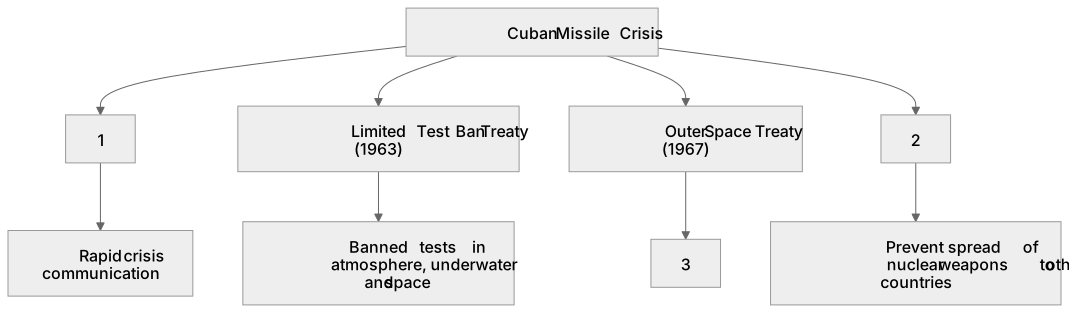
1Box 1
2Box 2
3Box 3
There is more to this lesson
The full lesson goes on to check your understanding and help you earn the marks. Create a free account to carry on, with your progress saved.
A week of Premium from your first lesson · Then the free plan continues · No card, no charge
Test your understanding of Option P4: Key topic 2: Cold War crises, 1958–70 - 3 Reaction to crisis: The consequences of the Cuban Missile Crisis, including the ‘hotline’. Attempts at arms control: the Limited Test Ban Treaty (1963); the Outer Space Treaty (1967); and the Nuclear Non-Proliferation Treaty (1968).
Active recall beats re-reading. Take an instant quiz now to test what you’ve learned and lock it into long-term memory.
A week of Premium from your first lesson · Then the free plan continues · No card, no charge