Pearson Edexcel · GCSE · History
Course version: 1HI0 · Version from Sept 2016
Key topic 2: Cold War crises, 1958–70 - 3 Reaction to crisis:…
Full specification wording
Option P4: Key topic 2: Cold War crises, 1958–70 - 3 Reaction to crisis: International reaction to Soviet measures in Czechoslovakia.
The international reaction to the 1968 Soviet invasion of Czechoslovakia was characterised by widespread condemnation but limited direct action.
Checked against the Pearson Edexcel 1HI0 specification (opens in a new tab) on .
- Point 3 of 3
- 3 key terms
Study notes
From the checked teaching notes for this specification point.
The idea
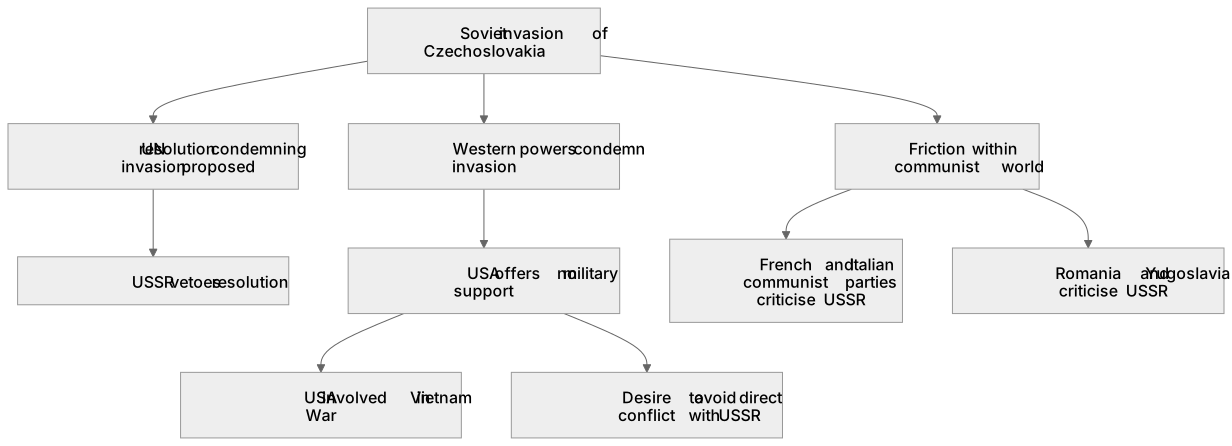
The international reaction to the 1968 Soviet invasion of Czechoslovakia was characterised by widespread condemnation but limited direct action. Western powers, including the USA, strongly protested the suppression of the Prague Spring and introduced a UN resolution condemning the invasion, which the USSR vetoed. However, the USA was bogged down in Vietnam and unwilling to risk military confrontation in the Soviet sphere. Crucially, the invasion caused friction within the communist world. Western European communist parties, such as those in Italy and France, publicly criticised the Soviet actions, showing growing independence from Moscow. Furthermore, Romania and Yugoslavia also voiced their disapproval. This demonstrated the limits of Soviet authority and highlighted growing divisions within global communism.
What earns the marks
- The USA and other Western nations verbally condemned the invasion but offered no military support to Czechoslovakia.
- The USA's lack of intervention was partly due to its ongoing involvement in the Vietnam War and a desire to avoid direct conflict with the USSR.
- A United Nations resolution condemning the Soviet actions was proposed but inevitably vetoed by the Soviet Union.
- The invasion caused friction in the communist world, with communist parties in France and Italy criticising the Soviet Union's actions.
- Communist leaders in Romania and Yugoslavia openly criticised the Soviet Union's use of force against a fellow Warsaw Pact member.
Common mistakes and how to put them right
Stating that the USA sent troops to help Czechoslovakia.
Put it right: The USA only offered verbal condemnation and did not intervene militarily.
Claiming that the French and Italian communist parties completely severed ties with Moscow in 1968.
Put it right: They strongly criticised the invasion, which showed growing independence, but they did not formally break away at this time.
Believing the UN took decisive action.
Put it right: The UN attempted to pass a resolution but it was vetoed by the USSR, rendering the UN powerless.
Exam tips
- When explaining the consequences of the invasion, ensure you discuss the impact on both East-West relations and relations within the communist bloc.
- Link the lack of US intervention to the broader context of the Cold War, specifically the doctrine of mutually assured destruction and the Vietnam War.
Try the lesson
The start of the Option P4: Key topic 2: Cold War crises, 1958–70 - 3 Reaction to crisis: International reaction to Soviet measures in Czechoslovakia. lesson, made from checked teaching notes for this specification point.
Have a go first
What was the primary reaction of the United States to the Soviet invasion of Czechoslovakia in 1968?
Listen
The international reaction to the 1968 Soviet invasion of Czechoslovakia was characterised by widespread condemnation but limited direct action. Western powers, including the USA, strongly protested the suppression of the Prague Spring and introduced a UN resolution condemning the invasion, which the USSR vetoed. However, the USA was bogged down in Vietnam and unwilling to risk military confrontation in the Soviet sphere. Crucially, the invasion caused friction within the communist world. Western European communist parties, such as those in Italy and France, publicly criticised the Soviet actions, showing growing independence from Moscow. Furthermore, Romania and Yugoslavia also voiced their disapproval. This demonstrated the limits of Soviet authority and highlighted growing divisions within global communism. A strong answer earns marks for these points. The USA and other Western nations verbally condemned the invasion but offered no military support to Czechoslovakia. The USA's lack of intervention was partly due to its ongoing involvement in the Vietnam War and a desire to avoid direct conflict with the USSR. A United Nations resolution condemning the Soviet actions was proposed but inevitably vetoed by the Soviet Union. The invasion caused friction in the communist world, with communist parties in France and Italy criticising the Soviet Union's actions. A common slip: Stating that the USA sent troops to help Czechoslovakia. Instead, The USA only offered verbal condemnation and did not intervene militarily. Exam tip: When explaining the consequences of the invasion, ensure you discuss the impact on both East-West relations and relations within the communist bloc.
See it
Key words
Say what each word means before you turn the card.
Superpower relations
Try answering aloud or in your head before turning the card.
Ideological divisions
Try answering aloud or in your head before turning the card.
The role of the United Nations
Try answering aloud or in your head before turning the card.
See every definition
- Superpower relations
- The relations between the superpowers, which the note says were affected by the invasion alongside relations within the communist bloc.
- Ideological divisions
- Growing divisions within global communism, shown by communist parties in France and Italy criticising Soviet actions and by Romania and Yugoslavia voicing disapproval.
- The role of the United Nations
- A resolution condemning the Soviet actions was proposed but vetoed by the Soviet Union, rendering the UN powerless.
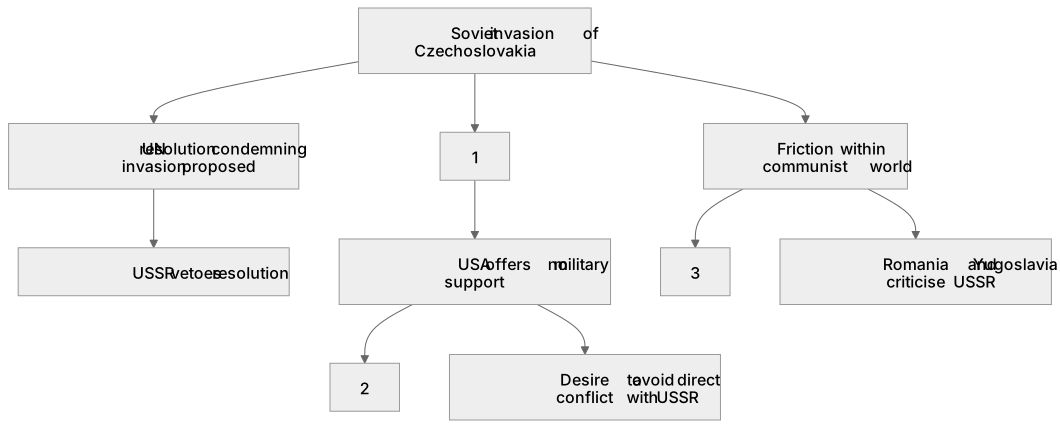
Label the diagram
Some boxes have lost their names. Pick the right name for each number.
1Box 1
2Box 2
3Box 3
There is more to this lesson
The full lesson goes on to check your understanding and help you earn the marks. Create a free account to carry on, with your progress saved.
A week of Premium from your first lesson · Then the free plan continues · No card, no charge
Test your understanding of Option P4: Key topic 2: Cold War crises, 1958–70 - 3 Reaction to crisis: International reaction to Soviet measures in Czechoslovakia.
Active recall beats re-reading. Take an instant quiz now to test what you’ve learned and lock it into long-term memory.
A week of Premium from your first lesson · Then the free plan continues · No card, no charge