Pearson Edexcel · GCSE · History
Course version: 1HI0 · Version from Sept 2016
Key topic 3: Attempts at a solution, 1974–95 - 1 Diplomatic negotiations:…
Full specification wording
Option P5: Key topic 3: Attempts at a solution, 1974–95 - 1 Diplomatic negotiations: The significance of the oil crisis and the involvement of the USA and the USSR.
The 1973 oil crisis was a pivotal moment when OAPEC used oil as a political weapon, embargoing exports to nations supporting Israel, notably the USA.
Checked against the Pearson Edexcel 1HI0 specification (opens in a new tab) on .
- Point 1 of 3
- 3 key terms
Study notes
From the checked teaching notes for this specification point.
The idea
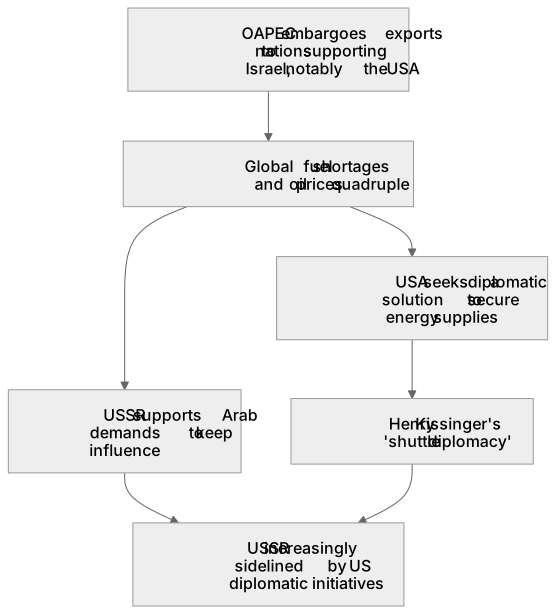
The 1973 oil crisis was a pivotal moment when OAPEC used oil as a political weapon, embargoing exports to nations supporting Israel, notably the USA. This caused global fuel shortages, quadrupled oil prices, and demonstrated the immense economic leverage of Arab states. The crisis forced the USA to actively seek a diplomatic solution to the Arab-Israeli conflict to secure energy supplies, leading to Henry Kissinger's 'shuttle diplomacy'. Meanwhile, the USSR sought to maintain its influence among Arab states by supporting their demands, though it was increasingly sidelined by US diplomatic initiatives. The superpower involvement highlighted Cold War dynamics in the Middle East, where regional stability became crucial to global economic security.
What earns the marks
- Explain the cause of the oil crisis: OAPEC's embargo against countries supporting Israel during the Yom Kippur War.
- Describe the economic impact, including the quadrupling of global oil prices and severe fuel shortages in the West.
- Analyse how the crisis motivated the USA to engage in 'shuttle diplomacy' to broker peace and restore oil flow.
- Evaluate the USSR's role in attempting to retain influence in the Arab world while being marginalised by US peace efforts.
Common mistakes and how to put them right
Confusing OPEC with OAPEC.
Put it right: The embargo was specifically initiated by OAPEC (the Organization of Arab Petroleum Exporting Countries), which is a separate organisation from OPEC and includes Arab states that are not OPEC members.
Stating the USSR orchestrated the oil embargo.
Put it right: The embargo was an independent action by Arab oil-producing states, though the USSR politically supported the pressure on the West.
Assuming the oil crisis prevented US support for Israel.
Put it right: The USA continued to support Israel but was forced to become a more active mediator to resolve the underlying conflict and end the embargo.
Exam tips
- Use the term 'oil weapon' to describe how Arab states leveraged their economic resources for political goals.
- Link the oil crisis directly to the increase in US diplomatic intervention, specifically mentioning Henry Kissinger.
- Contrast the proactive diplomatic role of the USA with the increasingly reactive position of the USSR in the region post-1973.
Try the lesson
The start of the Option P5: Key topic 3: Attempts at a solution, 1974–95 - 1 Diplomatic negotiations: The significance of the oil crisis and the involvement of the USA and the USSR. lesson, made from checked teaching notes for this specification point.
Have a go first
During the 1973 Arab-Israeli War, how did the involvement of the USA and the USSR contribute to the outbreak of the oil crisis?
Listen
The 1973 oil crisis was a pivotal moment when OAPEC used oil as a political weapon, embargoing exports to nations supporting Israel, notably the USA. This caused global fuel shortages, quadrupled oil prices, and demonstrated the immense economic leverage of Arab states. The crisis forced the USA to actively seek a diplomatic solution to the Arab-Israeli conflict to secure energy supplies, leading to Henry Kissinger's 'shuttle diplomacy'. Meanwhile, the USSR sought to maintain its influence among Arab states by supporting their demands, though it was increasingly sidelined by US diplomatic initiatives. The superpower involvement highlighted Cold War dynamics in the Middle East, where regional stability became crucial to global economic security. A strong answer earns marks for these points. Explain the cause of the oil crisis: OAPEC's embargo against countries supporting Israel during the Yom Kippur War. Describe the economic impact, including the quadrupling of global oil prices and severe fuel shortages in the West. Analyse how the crisis motivated the USA to engage in 'shuttle diplomacy' to broker peace and restore oil flow. Evaluate the USSR's role in attempting to retain influence in the Arab world while being marginalised by US peace efforts. A common slip: Confusing OPEC with OAPEC. Instead, The embargo was specifically initiated by OAPEC (the Organization of Arab Petroleum Exporting Countries), which is a separate organisation from OPEC and includes Arab states that are not OPEC members. Exam tip: Use the term 'oil weapon' to describe how Arab states leveraged their economic resources for political goals.
See it
Key words
Say what each word means before you turn the card.
Oil weapon
Try answering aloud or in your head before turning the card.
OAPEC
Try answering aloud or in your head before turning the card.
Shuttle diplomacy
Try answering aloud or in your head before turning the card.
See every definition
- Oil weapon
- The use by Arab states of their economic resources, through an oil embargo, to achieve political goals.
- OAPEC
- The Organization of Arab Petroleum Exporting Countries, which initiated the embargo against countries supporting Israel.
- Shuttle diplomacy
- Henry Kissinger's diplomatic effort through which the USA actively sought a solution to the Arab-Israeli conflict to secure energy supplies.
Label the diagram
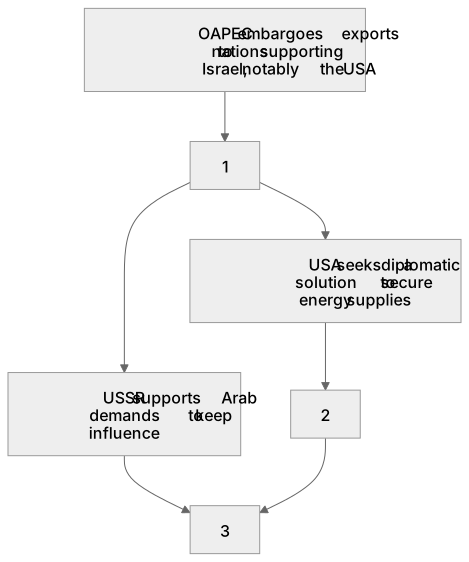
Some boxes have lost their names. Pick the right name for each number.
1Box 1
2Box 2
3Box 3
There is more to this lesson
The full lesson goes on to check your understanding and help you earn the marks. Create a free account to carry on, with your progress saved.
A week of Premium from your first lesson · Then the free plan continues · No card, no charge
Test your understanding of Option P5: Key topic 3: Attempts at a solution, 1974–95 - 1 Diplomatic negotiations: The significance of the oil crisis and the involvement of the USA and the USSR.
Active recall beats re-reading. Take an instant quiz now to test what you’ve learned and lock it into long-term memory.
A week of Premium from your first lesson · Then the free plan continues · No card, no charge