AQA · GCSE · Italian
Theme 1: Identity and culture
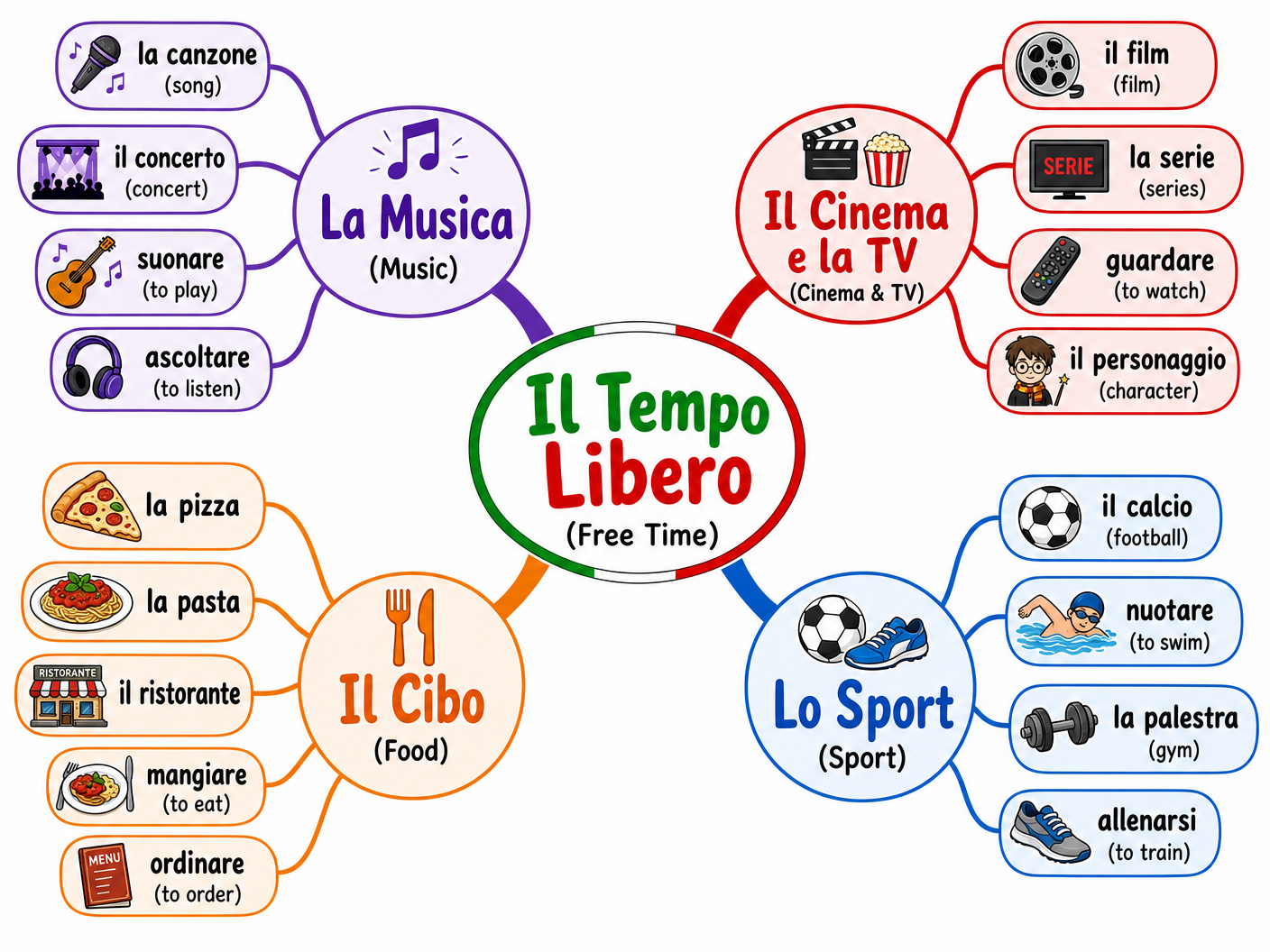
This topic covers free-time activities: music, cinema and TV, food and eating out, and sport. You'll need to master three tenses (present, past, future) and give justified opinions to succeed across all four skills: listening, speaking, reading, and writing.
- 11 min read
- 4 worked examples
- 6 practice questions
- 8 key terms
Study Notes
Overview
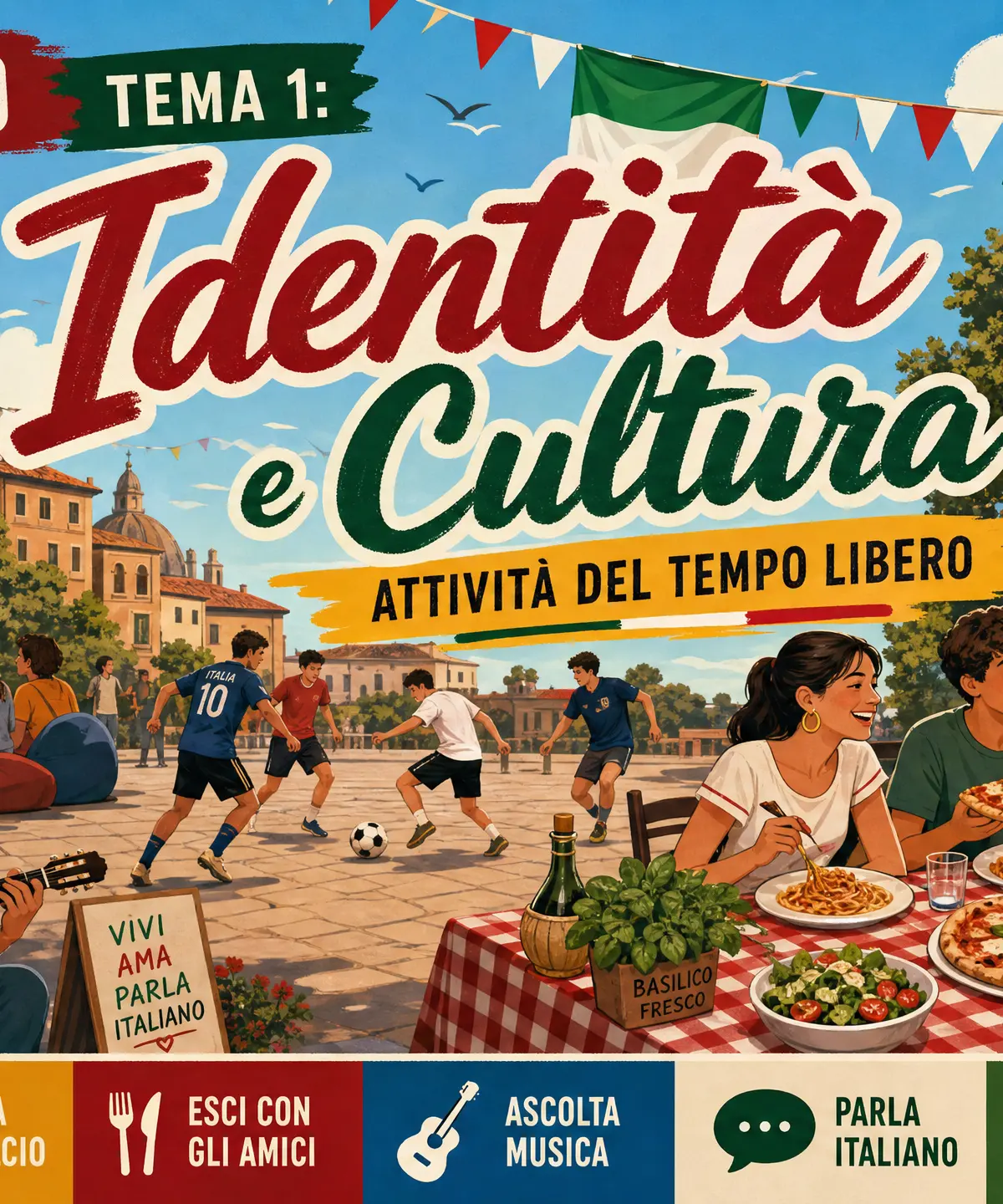
This topic, Identity and Culture: Free-Time Activities, is a core part of the GCSE Italian specification. It covers four key sub-themes: music, cinema and TV, food and eating out, and sport. This topic is guaranteed to appear across all four papers (Listening, Speaking, Reading, and Writing). Examiners use this topic to test your ability to narrate events coherently, express justified opinions, and use a variety of tenses and vocabulary.
Listen to our comprehensive revision podcast for this topic:

📖 Essential Vocabulary
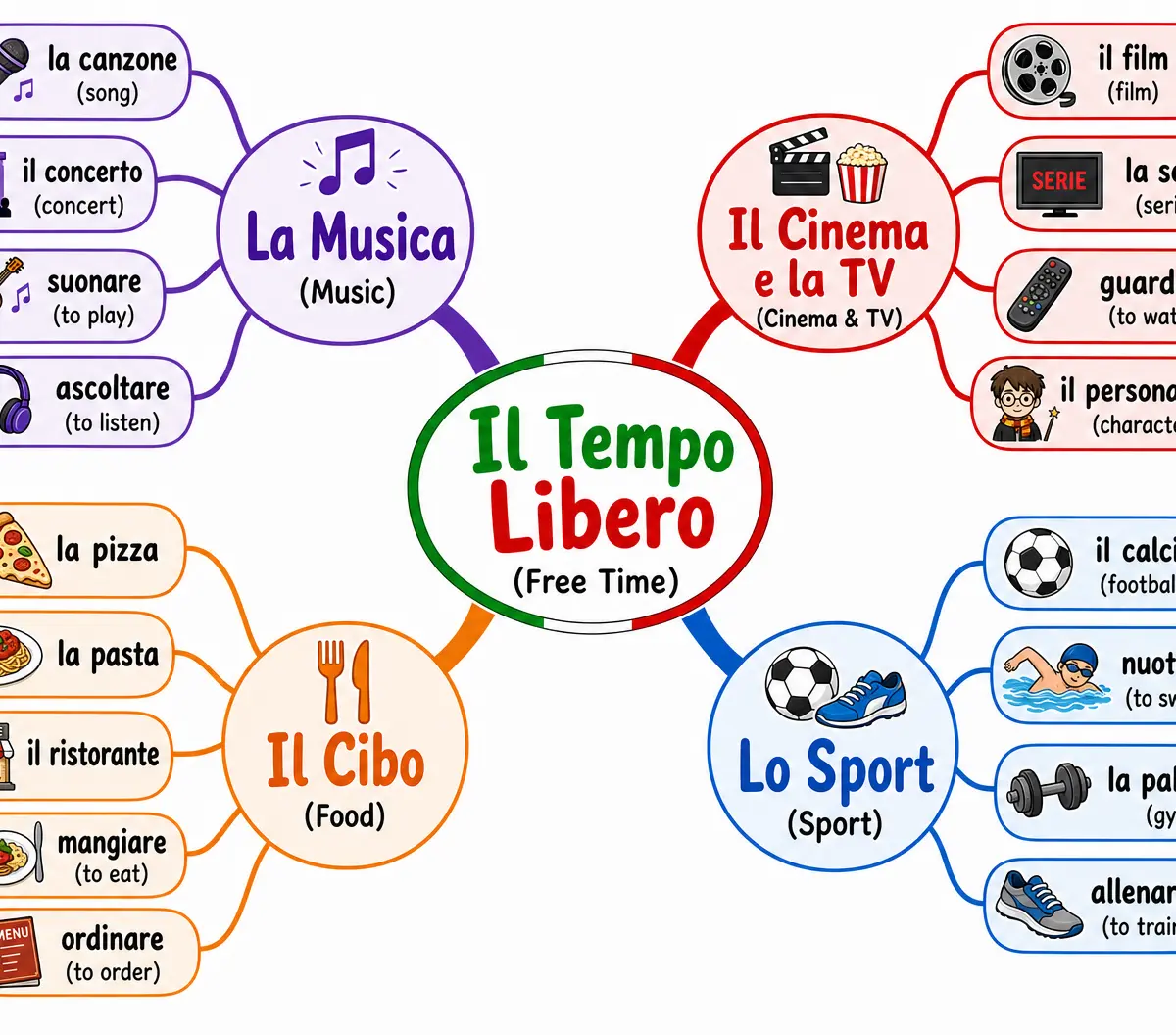
Tier 1 — Foundation Core
| Italian | English | Gender | Example Sentence |
|---|---|---|---|
| la musica | music | f | Ascolto la musica ogni giorno. |
| la canzone | song | f | Questa è la mia canzone preferita. |
| il cinema | cinema | m | Vado al cinema il sabato. |
| il film | film | m | Guardo un film comico. |
| la televisione / la TV | television / TV | f | Guardo la TV la sera. |
| il cibo | food | m | Il cibo italiano è delizioso. |
| il ristorante | restaurant | m | Mangiamo al ristorante. |
| la pizza | pizza | f | Prendo una pizza margherita. |
| lo sport | sport | m | Faccio molto sport. |
| il calcio | football | m | Gioco a calcio nel parco. |
| la palestra | gym | f | Vado in palestra. |
| la partita | match/game | f | La partita inizia alle otto. |
| il fine settimana | weekend | m | Il fine settimana esco con gli amici. |
| l'amico / l'amica | friend | m/f | Esco con un amico. |
| il tempo libero | free time | m | Nel mio tempo libero leggo. |
Tier 2 — Higher Tier
| Italian | English | Gender | Example Sentence |
|---|---|---|---|
| il regista / la regista | director | m/f | Il regista ha vinto un premio. |
| la trama | plot | f | La trama del film era avvincente. |
| la colonna sonora | soundtrack | f | La colonna sonora è molto emozionante. |
| l'allenamento | training | m | L'allenamento è stato faticoso. |
| mantenersi in forma | to keep fit | - | Faccio sport per mantenermi in forma. |
| lo schermo | screen | m | Il film era sul grande schermo. |
| i sottotitoli | subtitles | m (pl) | Preferisco i film con i sottotitoli. |
| l'abbonamento | subscription | m | Ho un abbonamento in palestra. |
| il torneo | tournament | m | La mia squadra ha vinto il torneo. |
| il capolavoro | masterpiece | m | Questo libro è un capolavoro. |
High-Frequency Words & Phrases
| Phrase | English | Usage Context |
|---|---|---|
| secondo me | in my opinion | Introducing an opinion |
| a mio parere | in my opinion | Introducing an opinion (alternative) |
| perché | because | Justifying an opinion |
| tuttavia | however | Adding contrast |
| d'altra parte | on the other hand | Adding contrast |
| di solito | usually | Describing routine |
| qualche volta | sometimes | Describing routine |
| il prossimo fine settimana | next weekend | Future tense trigger |
| il fine settimana scorso | last weekend | Past tense trigger |
| mi piacerebbe | I would like | Conditional (higher tier) |
📝 Grammar Focus
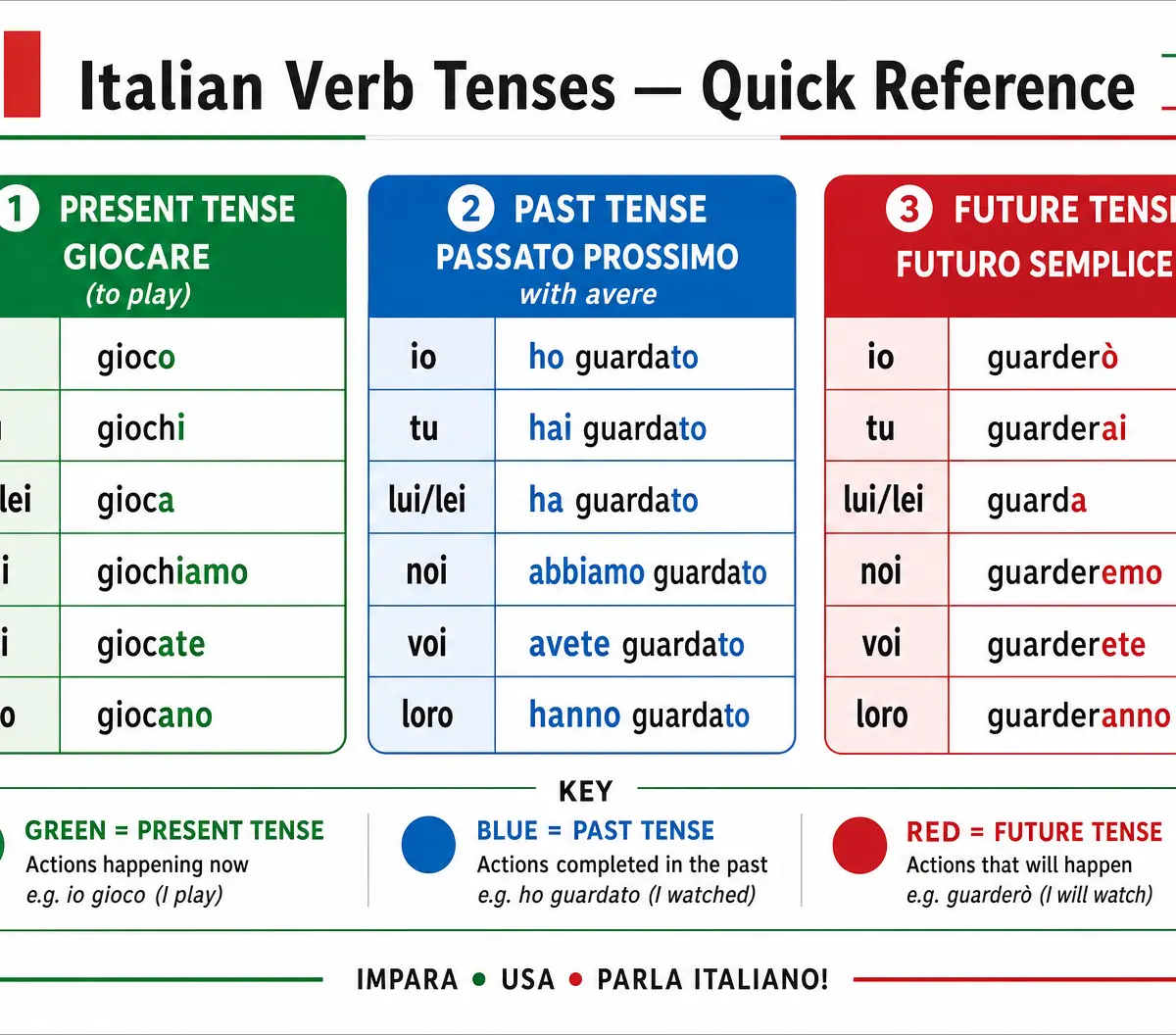
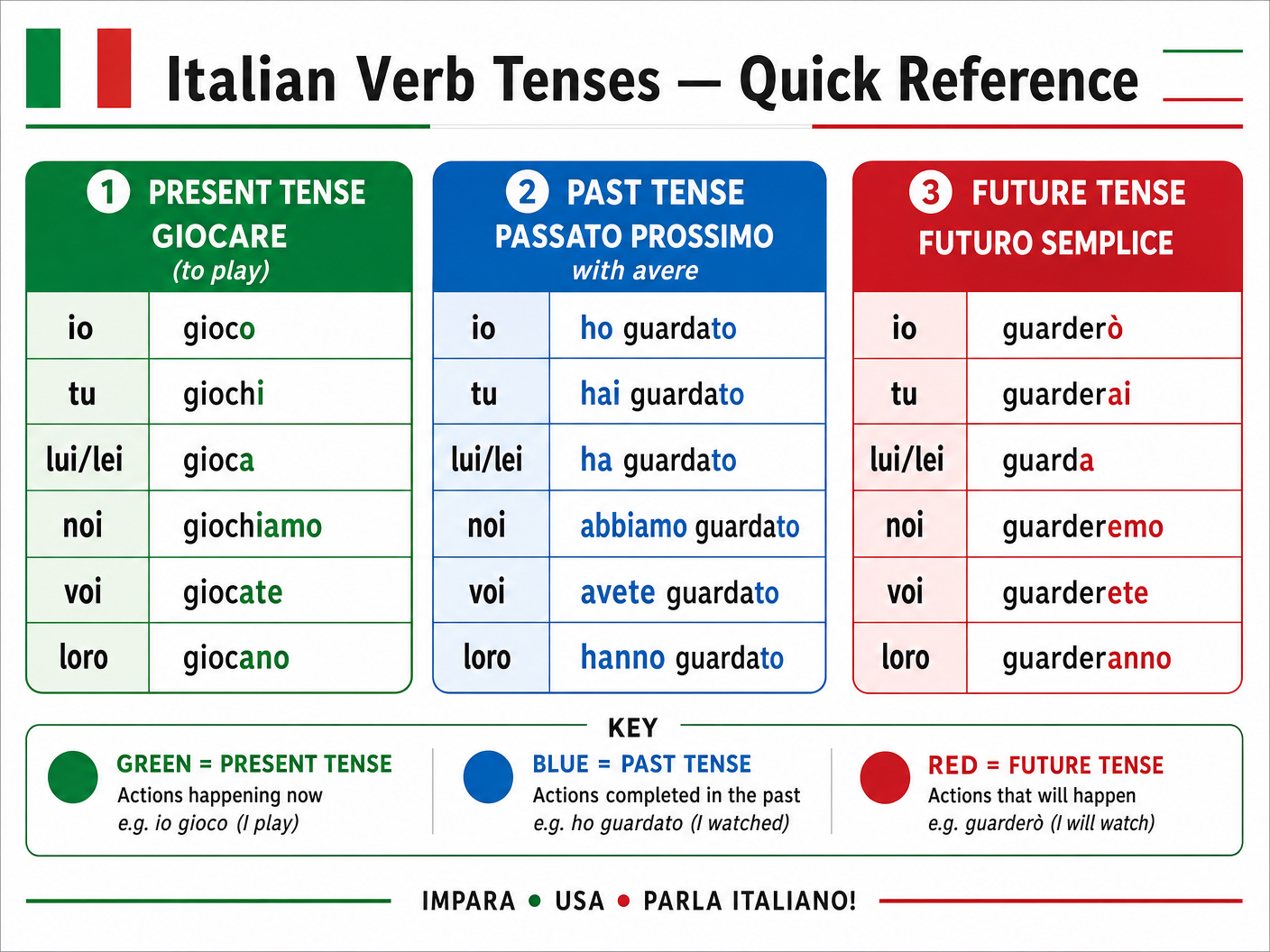
Key Structure 1: Il Presente (Present Tense)
When to use it: To describe actions happening now or routines (e.g., "I play football on Saturdays").
Conjugation Table: Giocare (to play a sport)
| Subject | Verb Form | English |
|---|---|---|
| io | gioco | I play |
| tu | giochi | you play |
| lui/lei | gioca | he/she plays |
| noi | giochiamo | we play |
| voi | giocate | you (pl) play |
| loro | giocano | they play |
Irregulars to learn: fare (to do/make - io faccio), andare (to go - io vado), uscire (to go out - io esco).
Key Structure 2: Il Passato Prossimo (Perfect Tense)
When to use it: To describe completed actions in the past (e.g., "I watched a film last night").
Conjugation Table: Guardare (to watch) - using avere
| Subject | Verb Form | English |
|---|---|---|
| io | ho guardato | I watched |
| tu | hai guardato | you watched |
| lui/lei | ha guardato | he/she watched |
| noi | abbiamo guardato | we watched |
| voi | avete guardato | you (pl) watched |
| loro | hanno guardato | they watched |
Irregulars to learn: Past participles like fatto (fare), letto (leggere), visto (vedere). Remember verbs taking essere (like andare, uscire) need agreement: sono andato/a.
Key Structure 3: Il Futuro Semplice (Future Tense)
When to use it: To describe actions that will happen (e.g., "I will go to the cinema").
Conjugation Table: Mangiare (to eat)
| Subject | Verb Form | English |
|---|---|---|
| io | mangerò | I will eat |
| tu | mangerai | you will eat |
| lui/lei | mangerà | he/she will eat |
| noi | mangeremo | we will eat |
| voi | mangerete | you (pl) will eat |
| loro | mangeranno | they will eat |
Irregulars to learn: andare (andrò), fare (farò), vedere (vedrò).
🎧 Listening Skills
What to Expect
You will hear announcements, conversations, and interviews about free-time activities. Questions may be multiple choice, matching, or short answers in English.
Listening Strategies
- Read questions first: Use the reading time to predict vocabulary you might hear.
- Listen for cognates: Words like il concerto or la televisione are easy wins.
- Watch for negatives: "Non mi piace il calcio" means they don't like football.
Common Listening Traps
- False Friends: Sensibile means sensitive, not sensible. Attuale means current, not actual.
- Time markers: Pay attention to ieri (yesterday) vs domani (tomorrow) as they change the meaning entirely.
🗣️ Speaking Skills
Role Play Scenarios
Scenario 1: Buying cinema tickets
- You: Vorrei due biglietti per il film delle otto, per favore. (I would like two tickets for the 8 o'clock film, please.)
- Examiner: Che tipo di film è?
- You: È un film d'azione. (It's an action film.)
Scenario 2: Ordering in a restaurant
- Examiner: Cosa prende come primo piatto?
- You: Prendo gli spaghetti al pomodoro, per favore. (I'll have the spaghetti with tomato sauce, please.)
Photo Card Practice
Model Photo Card Response (A family eating at a restaurant):
- Qu 1 (Description): Nella foto ci sono quattro persone in un ristorante. Mangiano la pizza. (In the photo there are four people in a restaurant. They are eating pizza.)
- Qu 2 (Opinion): Secondo me, il cibo italiano è delizioso perché mi piace molto la pasta. (In my opinion, Italian food is delicious because I really like pasta.)
- Qu 3 (Related topic): Di solito, mangio a casa con la mia famiglia, ma il sabato usciamo. (Usually, I eat at home with my family, but on Saturdays we go out.)
- Qu 4 (Past/Future): Il fine settimana scorso sono andato in un ristorante cinese. (Last weekend I went to a Chinese restaurant.)
- Qu 5 (Unpredictable): Preferisco mangiare al ristorante perché non devo cucinare! (I prefer eating at a restaurant because I don't have to cook!)
General Conversation Questions
| Question (Italian) | Model Answer | English Translation |
|---|---|---|
| Cosa fai nel tuo tempo libero? | Nel mio tempo libero mi piace ascoltare la musica e giocare a calcio con i miei amici perché è divertente. | What do you do in your free time? / In my free time I like to listen to music and play football with my friends because it's fun. |
| Che tipo di musica preferisci? | Preferisco la musica pop perché le canzoni sono molto orecchiabili. Il mio cantante preferito è... | What type of music do you prefer? / I prefer pop music because the songs are very catchy. My favourite singer is... |
| Sei sportivo/a? | Sì, sono abbastanza sportivo/a. Gioco a tennis due volte alla settimana per mantenermi in forma. | Are you sporty? / Yes, I am quite sporty. I play tennis twice a week to keep fit. |
| Parlami dell'ultimo film che hai visto. | Ieri sera ho guardato un film d'azione al cinema. La trama era avvincente ma gli effetti speciali erano terribili. | Tell me about the last film you saw. / Last night I watched an action film at the cinema. The plot was gripping but the special effects were terrible. |
| Cosa farai il prossimo fine settimana? | Il prossimo fine settimana andrò in centro con i miei amici e mangeremo una pizza. Sarà fantastico! | What will you do next weekend? / Next weekend I will go to the town centre with my friends and we will eat a pizza. It will be fantastic! |
✍️ Writing Skills
Translation Practice
English → Italian:
| English | Italian | Key Grammar |
|---|---|---|
| I listen to music. | Ascolto la musica. | Present tense, definite article |
| We play football on Saturdays. | Giochiamo a calcio il sabato. | Present tense (noi), preposition 'a' |
| Last weekend I went to the cinema. | Il fine settimana scorso sono andato/a al cinema. | Passato prossimo with 'essere' |
| I like pizza because it is delicious. | Mi piace la pizza perché è deliziosa. | Opinion + justification + adjective agreement |
| Next year I will watch more films. | L'anno prossimo guarderò più film. | Future tense |
Extended Writing
**Model 90-word response (Foundation):**Nel mio tempo libero, mi piace molto fare sport. Di solito, gioco a calcio con i miei amici il sabato mattina. Secondo me, il calcio è molto divertente. Mi piace anche ascoltare la musica in camera mia. Il fine settimana scorso, sono andato al cinema con la mia famiglia e abbiamo guardato un film comico. È stato fantastico! Il prossimo fine settimana, andrò al ristorante per il compleanno di mio fratello. Mangerò una grande pizza margherita.
**Model 150-word response (Higher):**Il tempo libero è molto importante per me per rilassarmi dopo la scuola. Sono una persona molto sportiva, quindi gioco a tennis tre volte alla settimana per mantenermi in forma. A mio parere, lo sport è essenziale per la salute.
Inoltre, sono un grande appassionato di cinema. Preferisco i film d'azione perché la trama è sempre avvincente, anche se a volte gli effetti speciali sono esagerati. Il fine settimana scorso, sono andato al cinema in centro con i miei migliori amici. Abbiamo visto l'ultimo film di James Bond e poi abbiamo cenato in un ristorante italiano. Ho mangiato un piatto di spaghetti ai frutti di mare che era veramente delizioso.
Il prossimo fine settimana sarà più tranquillo. Resterò a casa, guarderò una serie televisiva su Netflix e farò i compiti. Se avrò tempo, mi piacerebbe anche leggere un buon libro.
Writing Checklist
- ✅ Three tenses used accurately (Present, Past, Future)?
- ✅ Opinions given with justifications (perché, poiché)?
- ✅ Connectives and conjunctions used (tuttavia, inoltre, ma)?
- ✅ Adjective agreements correct (gender and number)?
📚 Reading Skills
Key Strategies
- Skim for gist: Read the text quickly to understand the general topic before looking at the questions.
- Use context: If you don't know a word, look at the words around it to guess the meaning.
- Check the question language: Ensure you answer in the correct language (English or Italian) as specified.
False Friends & Tricky Words
| Word | Looks Like | Actually Means |
|---|---|---|
| la camera | camera | bedroom |
| la firma | firm | signature |
| il parente | parent | relative |
| sensibile | sensible | sensitive |
| attuale | actual | current |
🌍 Cultural Knowledge
In Italy, food and eating out is a significant cultural event. Meals are often long, social occasions meant to be shared with family and friends (la famiglia e gli amici). The structure of an Italian meal is unique: it typically includes l'antipasto (starter), il primo (usually pasta or rice), il secondo (meat or fish) with a contorno (side dish), followed by il dolce (dessert) and il caffè (espresso). Knowing this structure is excellent for role plays. Furthermore, football (il calcio) is practically a religion in Italy, and knowing terms like la squadra (team) and il tifoso (fan) adds authenticity to your speaking and writing.
Visual Resources
2 diagrams and illustrations
Interactive Diagrams
1 interactive diagram to visualise key concepts
Conceptual Flow Outline
MFL exam approach by skill
Worked Examples
4 worked examples — open one to explore the question and available guidance.
Practice Questions
Test your understanding — click to reveal model answers
Writing: Scrivi un'email al tuo amico italiano parlando del tuo tempo libero. (Write about 90 words). Include: cosa fai di solito, uno sport che ti piace, cosa hai fatto il fine settimana scorso, cosa farai il prossimo fine settimana.
Hint: Ensure you cover all four bullet points and use present, past, and future tenses.
Speaking: Rispondi alla domanda: Ti piace guardare la televisione?
Hint: Give an opinion, justify it, and add a detail (like what you watch or who with).
Translation: Translate into Italian: 'I like Italian food because it is delicious. Yesterday I ate a pizza.'
Hint: Watch out for the past tense of 'to eat'.
Reading: Leggi il testo: 'Non sopporto la musica classica, è troppo noiosa. Preferisco di gran lunga la musica pop.' Che tipo di musica non piace alla persona?
Hint: Look for the negative opinion phrase.
Listening: Ascolta: 'Domani andrò in palestra per due ore.' Quando andrà in palestra?
Hint: Listen for the time word at the start.
Writing (Higher): Write about 150 words on the topic of cinema and TV. Include your opinions on different genres, a recent visit to the cinema, and your viewing habits.
Hint: Use complex structures like 'sebbene' (although) and ensure perfect adjective agreements.