AQA · A-Level · Law
Course version: AQA-A-Level-Law · Version from Mar 2026
Tort
Occupiers’ liability is the part of Tort that asks a deceptively simple question: when someone is hurt on premises, who had control and what protection was owed? In an exam, the decisive first step is to classify the entrant as a visitor or a trespasser, then apply the correct Act with precise statutory language.
- 10 min read
- 3 worked examples
- 5 practice questions
- 9 key terms
Check what you remember
Read the wording for your board, then hide it and explain Premises in your own words. Rough notes are fine. This is a self-check, with no mark or grade.
Reference: AQA
Land or any fixed or movable structure to which occupiers’ liability may apply.
Study Notes

Overview
Occupiers’ liability is the statutory part of Tort law that controls responsibility for injury caused by dangers on premises. It matters because a claimant might be a welcome customer, a child visiting a friend, a specialist contractor, or someone who entered without permission. Their legal status changes the applicable Act and the standard of care. The Occupiers’ Liability Act 1957 applies to lawful visitors; the Occupiers’ Liability Act 1984 applies to people other than visitors, usually trespassers. In each scenario, candidates must identify the occupier, classify the entrant, state the correct statutory test, apply the facts, consider any defence, and reach a qualified conclusion.
This topic links directly to negligence, especially the ideas of reasonable care, breach, causation and defences. It also links to vicarious liability where an employee creates a danger at a business premises. The most common assessment style is a problem question such as: “Advise A whether B is liable.” Short questions may ask candidates to define an occupier, state the duty to a child visitor, or list the three conditions in the 1984 Act. Because the board is unknown, the practice mark allocations below are board-neutral GCSE-style guidance; always follow the wording and timings on your own paper.
Key Concepts
1. Start with the premises, the occupier and the entrant
“Premises” is wider than a house. It can include land, a shop, a school, a sports centre, a construction site, a vehicle or another structure. The first legal question is not “Who owns it?” but “Who had sufficient control over it?” In Wheat v E Lacon & Co Ltd (1966), the House of Lords treated sufficient control as the key to being an occupier; ownership is not essential, and more than one person may be an occupier at once.4
Use this examiner-friendly opening: “X is likely to be an occupier because X had a sufficient degree of control over the relevant area and could have taken steps to remove, repair, fence, warn about or manage the danger.” This gains credit because it attaches the rule to facts. A landlord, tenant, business manager and local authority can each be an occupier if the facts show control.
Next, decide the claimant’s status. Permission may be express, for example an invited party guest, or implied, for example a shopper entering a shop during business hours. A person can begin as a visitor but become a trespasser by entering a prohibited area or staying after permission has ended. The classification is not just a label: it selects the Act and changes the duty.
| Entrant | Typical example | Act | Core exam question |
|---|---|---|---|
| Lawful visitor | Shopper, invited guest, ticket-holder, worker with permission | 1957 Act | Were they reasonably safe for the permitted purpose? |
| Trespasser / person other than a visitor | Person climbing a locked fence or entering an out-of-bounds area | 1984 Act | Do the three conditions in s.1(3) create a duty? |

2. Lawful visitors: the Occupiers’ Liability Act 1957
Section 2(1) calls the duty owed to visitors the common duty of care. Section 2(2) defines it as taking such care as is reasonable in all the circumstances to see that the visitor is reasonably safe when using the premises for the purpose for which they were invited or permitted to be there.1 The phrase is deliberately not “completely safe”. The occupier is not an insurer against every accident. Marks are awarded for explaining that the standard is reasonable care in the circumstances.
Apply the purpose carefully. A shopper invited to use an aisle is not necessarily permitted to climb into a staff-only warehouse. Similarly, a guest invited into a garden might exceed permission by entering a clearly barred roof area. If permission is exceeded, pause and reassess whether the claimant has become a trespasser.
The word reasonable requires a balancing exercise. A court considers the seriousness and likelihood of the risk, how easily a precaution could have been taken, what the occupier knew or ought reasonably to have known, and the characteristics of the visitor. A loose carpet by a busy staircase may require repair or a clear barrier. A minor, obvious unevenness in an outdoor path may not. Do not simply write “there was an injury, therefore there was a breach”: injury alone does not prove a breach.
3. Visitor adjustments that examiners reward
Section 2(3)(a) says an occupier must be prepared for children to be less careful than adults.1 In a scenario involving a child, candidates should ask whether the danger was attractive as well as dangerous, whether it was readily accessible, whether the child could understand the risk and whether supervision would reasonably be expected. The memorable word is allurement: something a child may be drawn towards despite danger. A pile of unstable building materials beside an open playground creates a stronger case for precautions than an ordinary danger an adult would avoid.
Section 2(3)(b) provides a different adjustment for skilled visitors. An occupier may expect a person exercising their calling, such as a qualified electrician, to appreciate and guard against special risks ordinarily connected with that job, so far as the occupier leaves them free to do so.1 The key word is ordinary. An electrician may be expected to manage ordinary electrical risks; they are not automatically expected to discover a concealed and unusual structural defect that the occupier knew about.
4. Warnings and independent contractors
A warning does not automatically remove liability. Section 2(4)(a) provides that a warning only protects the occupier if, in all the circumstances, it was enough to enable the visitor to be reasonably safe.1 Apply its quality: Was it prominent, understandable, placed before the danger, and sufficient for the claimant’s age and circumstances? A tiny sign after the hazard, or an inaccessible warning to a young child, is unlikely to earn the occupier much credit.
Where a danger results from work carried out by an independent contractor, section 2(4)(b) may protect the occupier. The occupier must have acted reasonably in entrusting the work to the contractor, checked the contractor was competent and, where appropriate, taken reasonable steps to ensure the work was properly completed.1 The required inspection depends on the work. A lay occupier may reasonably hire a reputable specialist for technical electrical work; they cannot ignore obvious poor workmanship that a basic check would reveal.
5. Trespassers: the Occupiers’ Liability Act 1984
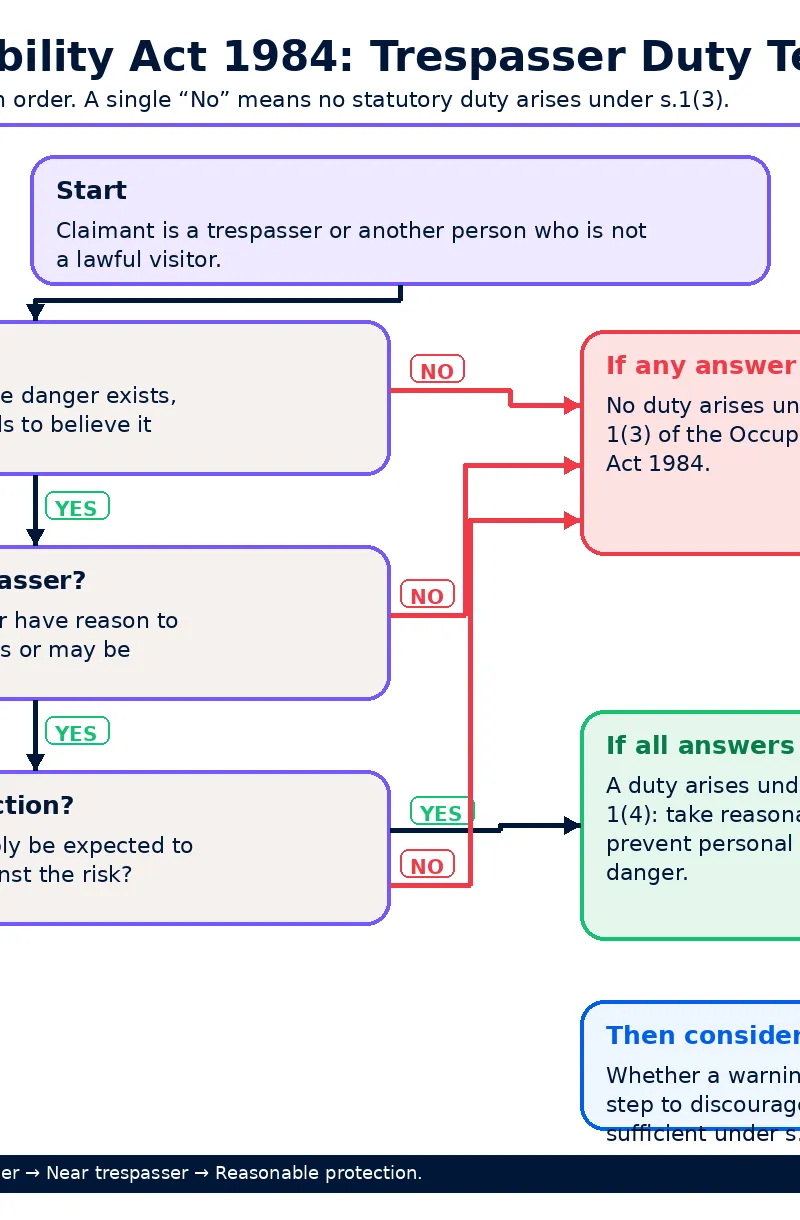
The 1984 Act is narrower. It concerns persons other than visitors and covers personal injury or death, not loss of or damage to property.2 A duty is not automatic simply because someone is hurt while trespassing. Under section 1(3), candidates must work through all three gateway conditions:
| Gateway under s.1(3) | What to apply to the facts |
|---|---|
| Danger known? | Did the occupier know the danger existed, or have reasonable grounds to believe it did? |
| Trespasser foreseeable? | Did the occupier know, or have reason to believe, the claimant was or might be near that danger? |
| Protection reasonable? | In all the circumstances, could the occupier reasonably be expected to give some protection? |
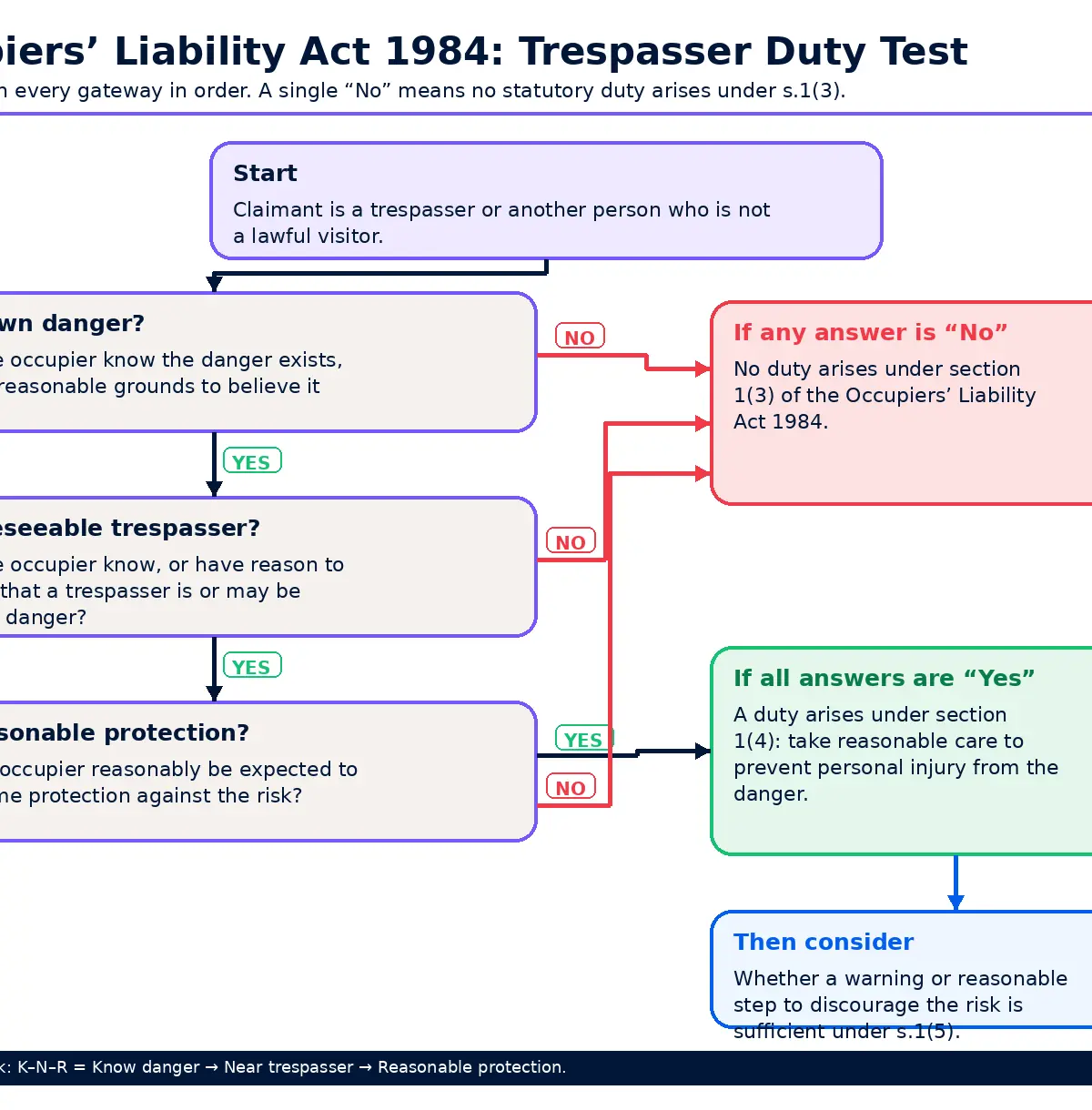
If all three gateways are met, section 1(4) requires reasonable care to see that the trespasser does not suffer injury from the danger.2 Under section 1(5), a reasonable warning or a reasonable step to discourage people from taking the risk may discharge the duty.2 A locked gate and prominent sign may therefore be relevant, but evaluate whether they are realistically effective in the actual facts.
In Tomlinson v Congleton Borough Council (2003), the House of Lords stressed that occupiers are not required to eliminate obvious, inherent risks created by a claimant’s voluntary activity. The judgment distinguished risks arising from the state of the premises from risks arising because a person chooses to act dangerously, and emphasised the balance between likelihood, seriousness, cost of precautions and social value.3 Use this case only where the facts involve an obvious danger or a voluntarily assumed activity. Do not use it as a shortcut to say that occupiers never owe trespassers a duty.
6. Defences: consent and contributory negligence
Volenti non fit injuria means “to a willing person, no injury is done”. Under section 2(5) of the 1957 Act and section 1(6) of the 1984 Act, no duty is owed for risks willingly accepted by the entrant.1 2 The occupier must show real knowledge of the specific risk and a voluntary decision to accept it. A warning sign can help prove this, but a sign is not magical: it must be seen, understood and relevant to the actual danger.
Contributory negligence is different. The claimant may still succeed, but damages can be reduced to the extent the court considers just and equitable to reflect the claimant’s share of responsibility.5 In a scenario, write: “Even if X establishes breach, damages may be reduced for contributory negligence because X ignored a visible barrier / acted carelessly / failed to take reasonable care for their own safety.” This distinguishes a partial reduction from the complete defence of volenti.
Mathematical/Scientific Relationships
There are no mathematical formulae in this topic. Your reliable relationship is a legal sequence:
**Control → Status → Act → Statutory test → Breach → Defence → Conclusion.**For a 5–6 mark scenario, use IRAC. State the Issue (visitor or trespasser); state the Rule (correct Act and section); Apply every key fact; then give a conditional Conclusion. This sequence prevents candidates from naming rules without earning application marks.
Practical Applications
In everyday life, a supermarket manager who knows about a leaking refrigerator must decide whether to clean, cordon off or warn customers. A school must consider that younger pupils may not recognise risks as adults would. A landowner with an abandoned quarry must assess whether local children regularly enter, whether the danger is known, and whether a fence, repair or warning is reasonable. In every example, the legal question is not “Could an accident happen?” but “What reasonable protection was owed to this particular entrant against this particular danger?”
References
Visual Resources
2 diagrams and illustrations

Interactive Diagrams
2 interactive diagrams to visualise key concepts
Conceptual Flow Outline
Exam sequence: status determines the statute, then facts determine breach and any defence.
Conceptual Flow Outline
All three statutory gateways must be satisfied before a duty is owed to a trespasser.
Worked Examples
3 worked examples — open one to explore the question and available guidance.
Practice Questions
Try the question, then reveal an answer plan or example response
State the legal test used to identify an occupier. (2 marks)
Hint: Think control, not ownership.
Explain the extra duty owed to a child visitor under the Occupiers’ Liability Act 1957. (3 marks)
Hint: Use the phrase “less careful than adults”.
Marcus ignores a “Danger: Keep Out” sign and climbs a locked gate into a scrapyard at night. He cuts himself on sharp metal. Explain whether the occupier is likely to owe Marcus a duty. (5 marks)
Hint: Marcus is a trespasser: test all three s.1(3) gateways, then address the sign and gate.
A qualified electrician is asked to repair ordinary exposed wiring in a shop. He receives an electric shock while doing so. Explain how s.2(3)(b) may affect the shop owner’s liability. (4 marks)
Hint: What can an occupier usually expect a skilled worker to understand?
Compare volenti with contributory negligence in an occupiers’ liability claim. (4 marks)
Hint: One can defeat the claim; the other normally reduces damages.
Exam technique
How to turn what you know into marks
How to approach the question
Underline the words showing permission, control, the danger, the occupier’s knowledge, warnings, the claimant’s conduct and any specialist/child status. Then work through C-S-A-B-D: Control, Status, Act, Breach, Defence.
How to structure your answer
For 2–3 marks, give the legal rule plus one fact. For 4–6 marks, use IRAC with separate sentences for each statutory condition. For an evaluative answer, give a balanced conclusion beginning “X is likely, but this could change if…”.
Timing
Use roughly 1–1.25 minutes per mark unless your paper instructs otherwise; allow 6–7 minutes for a 6-mark scenario and leave a minute to check the conclusion.
Common pitfalls
- Using the 1957 Act simply because the claimant was injured. Avoid this by deciding whether the claimant had permission before naming an Act.
- Writing that a warning automatically defeats a claim. Avoid this by testing whether it was enough to make the entrant reasonably safe.
- Listing all three 1984 Act conditions without applying each one to a fact. Use “because” after every legal point.
- Calling contributory negligence “consent”. Avoid this by remembering: volenti can defeat the claim; contributory negligence normally reduces damages.
What the command words want
- Compare
- Make direct links: “Unlike a visitor under the 1957 Act, a trespasser under the 1984 Act must first satisfy…”
- Explain
- Use a rule–because–therefore chain. Each because should connect a legal test to a scenario fact.
- Describe
- Set out features of the rule in logical order, using statutory vocabulary such as “reasonably safe” and “sufficient control”.
- Evaluate
- Give arguments for and against liability, then make a supported, conditional judgment.
- State/Give
- Give one precise legal fact or term. Do not add an uncertain explanation that contradicts it.
- Apply/Advise
- Identify the claimant’s status, name the Act and section, then use the specific facts rather than offering a generic definition.
Watch or listen (optional)
Test your understanding of Tort
Active recall beats re-reading. Take an instant quiz now to test what you’ve learned and lock it into long-term memory.
7 days Premium · Then the free plan continues · No card, no charge