AQA · A-Level · Mathematics
Overarching themes
Master the language of mathematics! This overarching theme covers how to communicate mathematically, use precise notation, construct logical arguments, and write watertight proofs—essential skills that unlock top marks across every paper.
- 4 min read
- 3 worked examples
- 5 practice questions
- 6 key terms
Study Notes
Overview
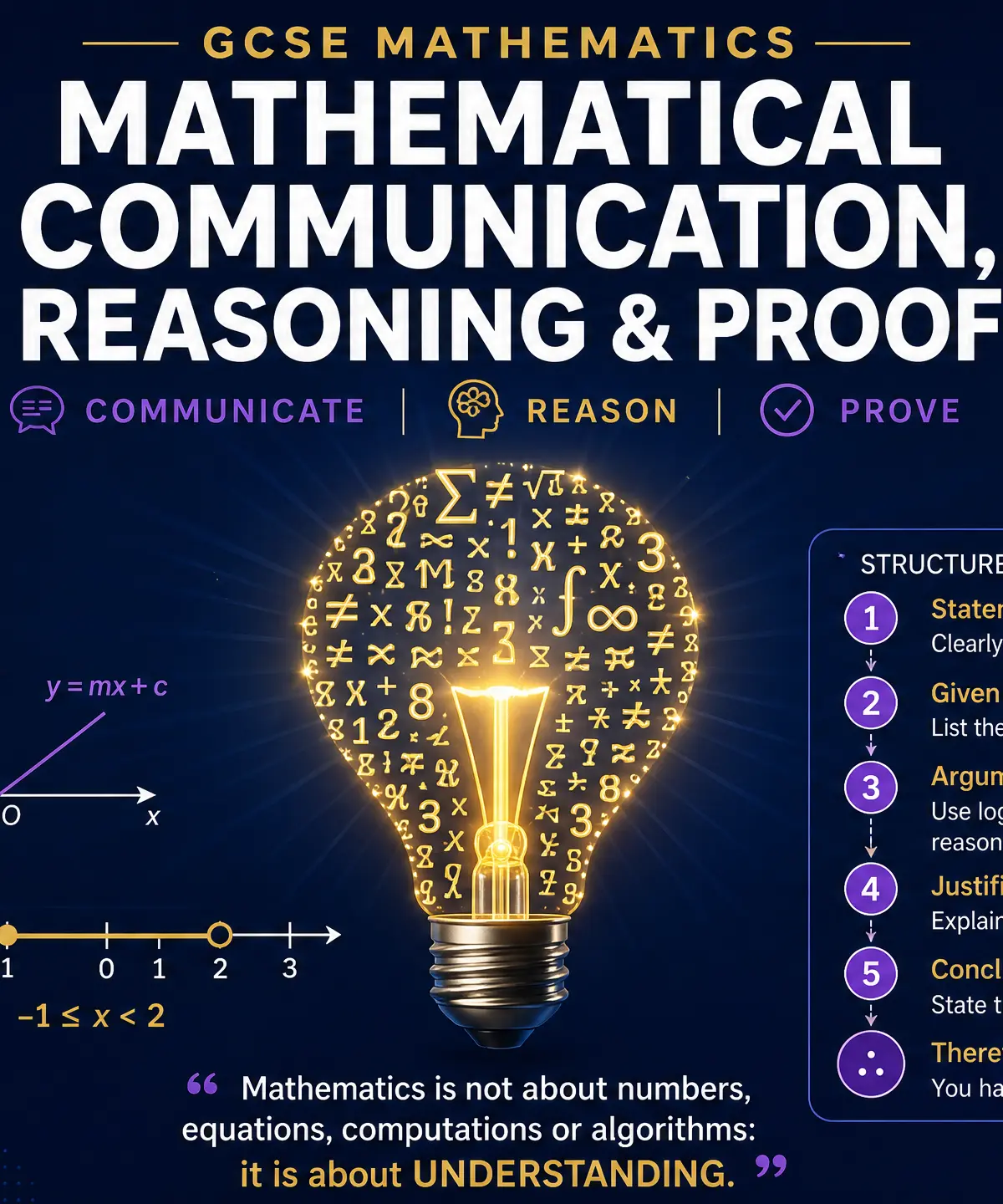
Mathematical Communication, Reasoning, and Proof (Topic 3.1) is not just an isolated topic; it is the fundamental framework of mathematics. It is about learning to 'speak' maths fluently. In your GCSE exams, examiners don't just look for the correct final answer—they look at how you got there. This theme tests your ability to use correct notation, form logical deductions, and prove that a statement is true for all cases.
Why is this important? Because whether you are solving algebraic equations, analyzing geometric shapes, or calculating probabilities, you must communicate your reasoning clearly. Poor notation or skipped logical steps will cost you marks, even if your final answer is right. Typical exam questions might ask you to 'Prove algebraically that...', 'Show that...', or 'Identify the error in the student's working.'
Key Concepts
Concept 1: Set Notation and Symbols
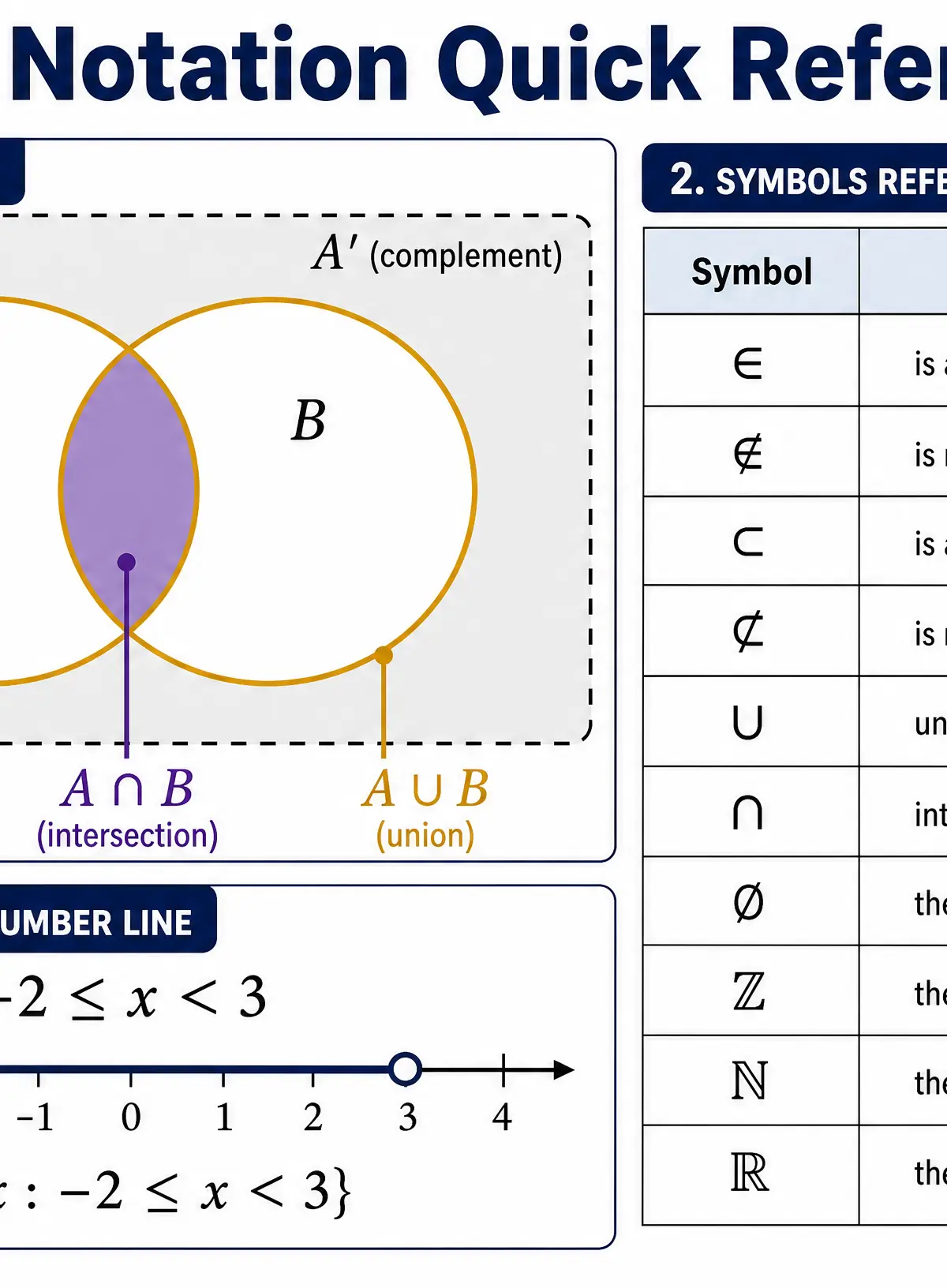
Set notation is a precise way to group numbers or objects. Think of a set as a club, and the elements as the members of that club.
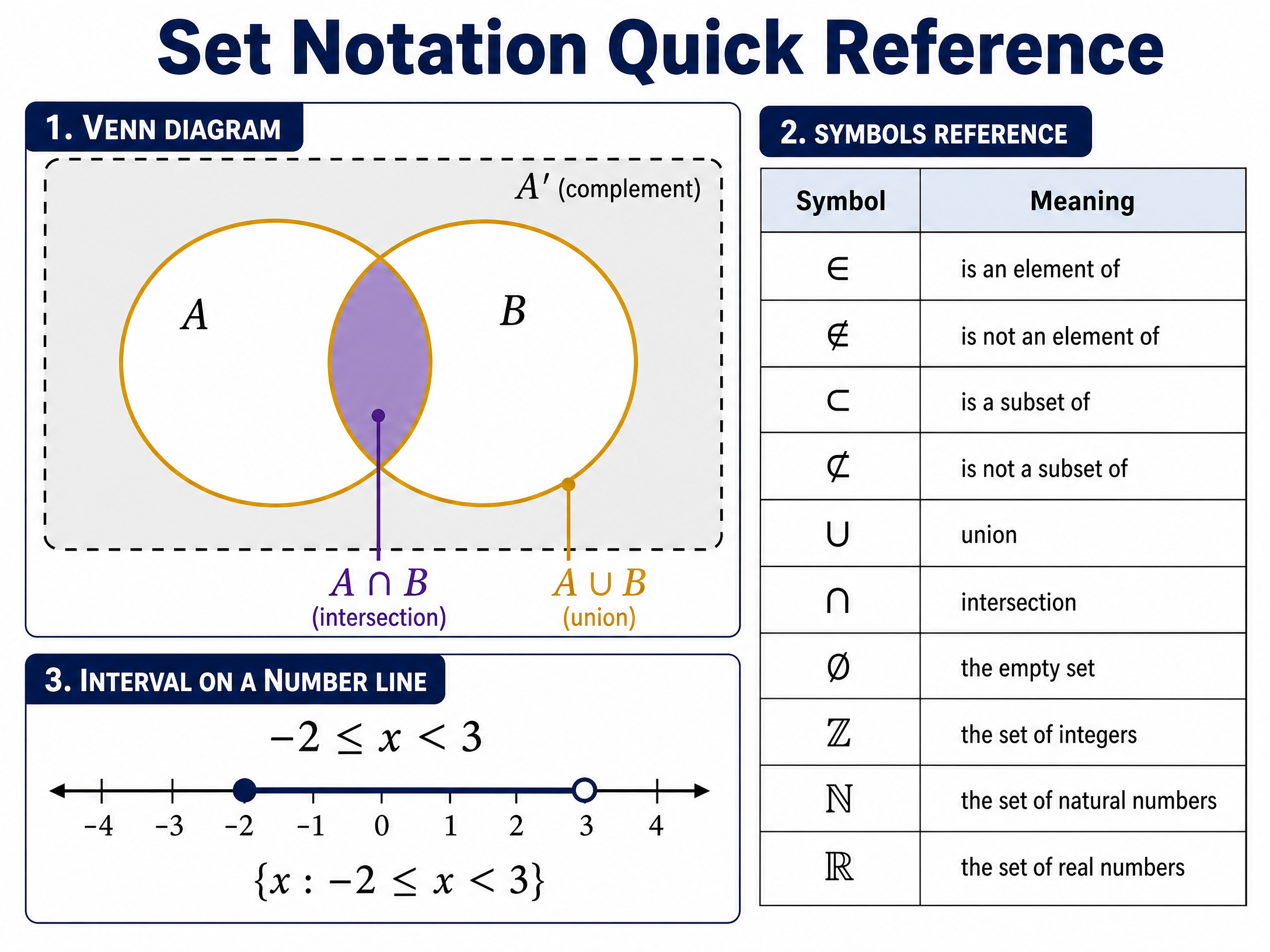
- Intersection (∩): The 'AND' operator. Elements must be in both sets. Like a crossroads, it's where the two paths overlap.
- Union (∪): The 'OR' operator. Elements can be in either set, or both. Like a marriage union, it brings everyone together.
- Complement (A'): The 'NOT' operator. Everything outside the specified set.
- Element of (∈): Shows membership. E.g., 3 \in {1, 2, 3, 4}.
Example: If Set A = {even numbers} and Set B = {prime numbers}, then A ∩ B = {2}, because 2 is the only number that is both even AND prime.
Concept 2: Inequalities on a Number Line
Communicating ranges of values correctly is crucial. When writing inequalities, pay close attention to whether the boundary value is included.
- < or > (Strict inequalities): The boundary is NOT included. Shown as an open circle on a number line.
- ≤ or ≥ (Inclusive inequalities): The boundary IS included. Shown as a filled dot on a number line.
Example: The set {x : -2 \leq x < 3} includes -2, -1, 0, 1, and 2, but NOT 3.
Concept 3: Domain and Range
When working with functions, you must understand what can go in and what can come out.
- Domain: The set of all possible input values (x-values) for a function.
- Range: The set of all possible output values (y-values) that result from the domain.
Why does this matter? Some functions 'break' if you put the wrong number in. For example, in the function f(x) = \frac{1}{x}, you cannot divide by zero. Therefore, x = 0 is excluded from the domain.
Concept 4: Mathematical Proof
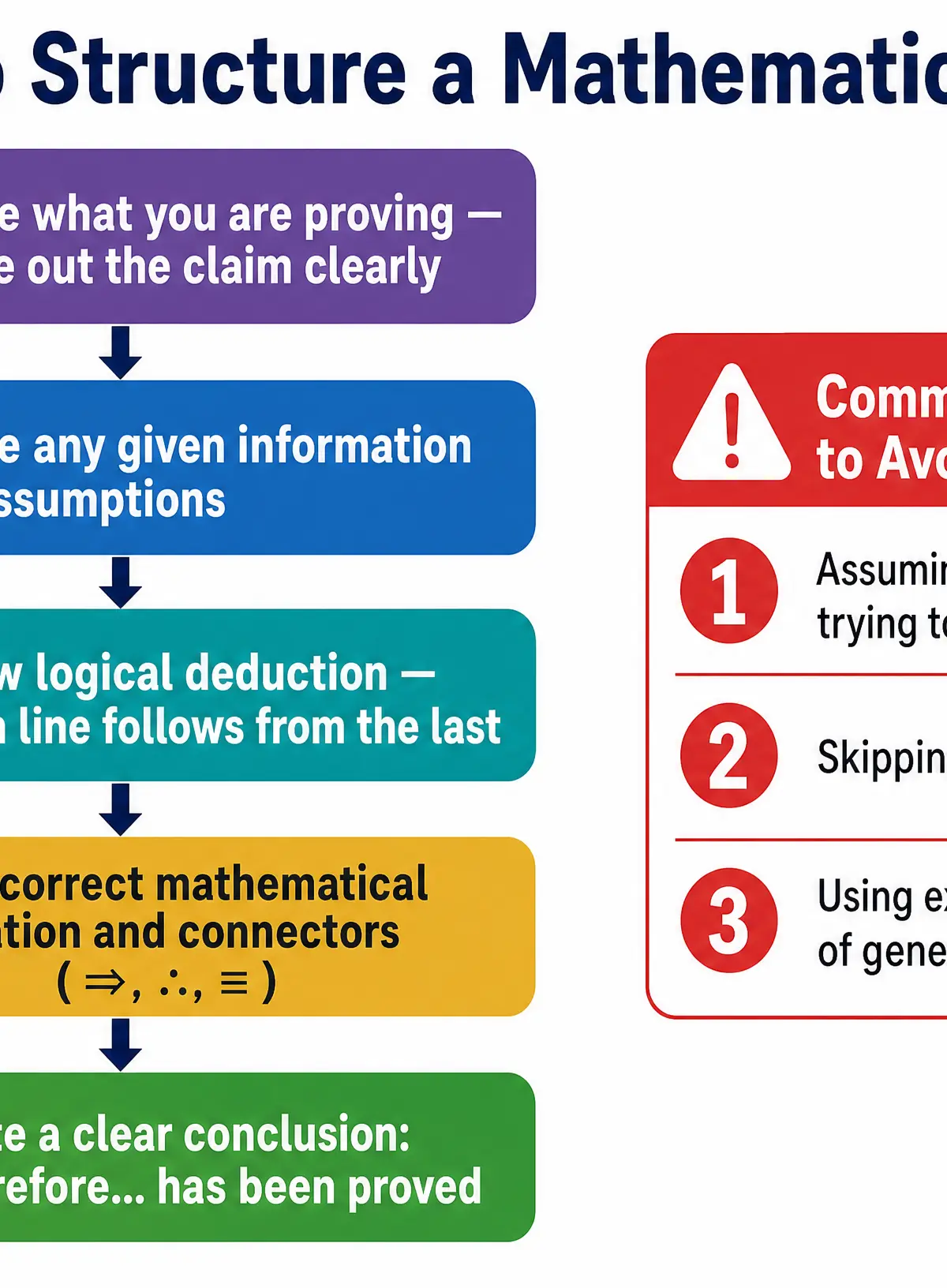
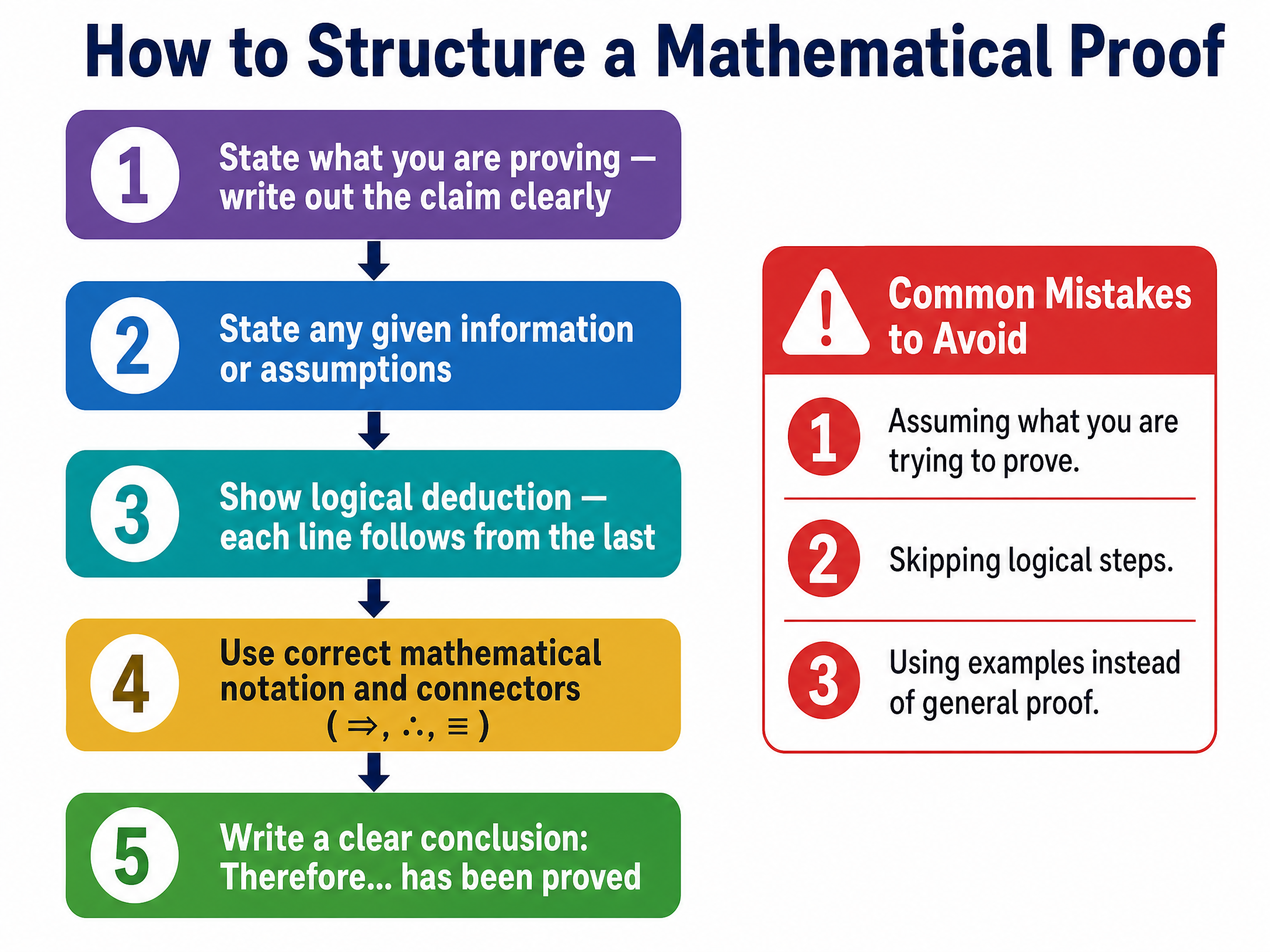
A proof is a logical argument showing that a statement is universally true. You cannot just use examples to prove a general statement.
- Proof by Deduction: Starting from known facts and using logical steps to reach a conclusion.
- Proof by Exhaustion: Checking every single possible case (only works if there is a small, finite number of cases).
- Disproof by Counterexample: Finding just ONE example where the statement is false to prove the whole statement is not universally true.
Mathematical Relationships
When writing proofs, use algebraic representations for general numbers:
- Any integer: n
- Any even number: 2n
- Any odd number: 2n + 1 or 2n - 1
- Consecutive integers: n, n+1, n+2
- Consecutive even numbers: 2n, 2n+2, 2n+4
Practical Applications
Listen to our deep-dive podcast episode on Mathematical Communication and Proof for expert tips and a quick-fire recall quiz!
Visual Resources
2 diagrams and illustrations
Interactive Diagrams
2 interactive diagrams to visualise key concepts
Conceptual Flow Outline
Decision tree for choosing the correct proof method in an exam.
Conceptual Flow Outline
Visualising Domain and Range using the Function Machine model.
Worked Examples
3 worked examples — open one to explore the question and available guidance.
Practice Questions
Test your understanding — click to reveal model answers
Prove algebraically that the difference between the squares of any two consecutive integers is equal to the sum of the two integers.
Hint: Let the smaller integer be n. What is the next integer? Square both of them and subtract the smaller from the larger.
Given that \xi = {1, 2, 3, 4, 5, 6, 7, 8, 9, 10}, A = {even numbers}, and B = {multiples of 3}. List the members of the set A \cap B.
Hint: First list all the members of A, then list all the members of B. Which numbers appear in both lists?
Show the inequality -3 < x \leq 2 on a number line.
Hint: Pay attention to which inequality symbol is strict (<) and which is inclusive (≤). How do you draw the circles?
State the domain of the function g(x) = \frac{5}{2x - 8}.
Hint: What value makes the denominator equal to zero? That value must be excluded from the domain.
Disprove the statement: 'The sum of two prime numbers is always an even number.'
Hint: You only need to find one pair of prime numbers that add up to an odd number. Think about the very first prime number.