AQA · A-Level · Mathematics
Course version: 7357 · Version from Sept 2017
Overarching themes
AQA A-Level Mathematics 7357 section 3.1 is the exam-wide toolkit for showing clear reasoning, solving unfamiliar problems and building sensible mathematical models. Mastering OT1, OT2 and OT3 turns a correct calculation into an answer that can earn AO1, AO2 and AO3 credit across pure mathematics, statistics and mechanics.
- 11 min read
- 3 worked examples
- 5 practice questions
- 10 key terms
Check what you remember
Read the wording for your board, then hide it and explain Mathematical model in your own words. Rough notes are fine. This is a self-check, with no mark or grade.
Reference: AQA
A simplified mathematical representation of a real-world situation, constructed or selected to explore, predict or explain aspects of that situation.
Study Notes

Overview
AQA A-Level Mathematics 7357 section 3.1 Overarching themes is not a self-contained chapter with one formula to memorise. It is the set of examinable habits that candidates must apply across every content area, from algebra and calculus to statistics and mechanics. The three themes are OT1 mathematical argument, language and proof, OT2 mathematical problem solving and OT3 mathematical modelling. They matter because AQA assesses not only whether a calculation is correct, but whether the method is valid, the notation is precise and the answer has been interpreted in its original context.
In every A-Level paper, candidates sit a 2-hour, 100-mark written examination. A question may begin as a graph, a table, a diagram or a real-world paragraph rather than an obvious equation. The marks frequently lie in the decisions around the calculation: defining variables, choosing a representation, stating assumptions, communicating reasoning and evaluating limitations. Treat section 3.1 as the toolkit that makes all other topics accessible. It links directly to proof, numerical methods, statistics, mechanics, functions and calculus.
Key Concepts
Concept 1: OT1, mathematical argument, language and proof
A mathematical argument is a connected chain of statements in which every step is justified. It is not a page of calculations with an answer at the bottom. AQA expects candidates to construct and present arguments using diagrams, sketches, logical deduction, precise symbols and correct mathematical vocabulary. The official content specifically includes the distinction between a constant, coefficient, expression, equation, function, identity, index, term and variable.
The most important precision habit is to make each symbol say exactly what it means. Write = only when the expressions on each side are equal. Use ≈ for an approximation. Use ⇒ when one line logically follows from the preceding line. An equation is true for particular value(s) of a variable, whereas an identity is true for every permitted value. For instance, 2x + 1 = 7 has the solution x = 3, while (x + 1)^2 = x^2 + 2x + 1 is an identity.
A proof establishes a general statement. Checking five numerical cases can build confidence, but it cannot prove a claim for all integers. In a direct proof, define a general object, manipulate it using valid mathematics, identify the required form and state the conclusion. In a proof involving an odd integer, write n = 2k + 1 where k ∈ ℤ, rather than writing an arbitrary example such as 7. This transforms a claim about every odd integer into a result about any integer k.
Functions are another frequent source of imprecision. A function gives exactly one output for each input in its domain. Always consider the domain before cancelling, dividing or using a square root. For f(x) = 1/(x - 4), the model or function is not defined at x = 4. For a context, that excluded input might be physically impossible or simply outside the model’s useful range. Credit is given for constraints when they affect validity.
Example: To show that x^2 - 9 factorises, write x^2 - 9 = x^2 - 3^2 = (x - 3)(x + 3). This uses the difference-of-two-squares identity. Do not write (x - 3)(x + 3) = 0 unless the question has an equation x^2 - 9 = 0 to solve.
Concept 2: OT2, mathematical problem solving
Problem solving starts before the calculation. AQA requires candidates to recognise underlying mathematical structure, simplify and abstract appropriately, construct extended arguments from unstructured information, interpret solutions, evaluate limitations, use numerical methods where needed, and use diagrams. In practice, the question may conceal a familiar structure behind a new setting.
Use the SCOPE cycle:
- Specify what is being asked, the unknowns and any conditions.
- Collect only the information that matters, including units.
- Organise and process using an equation, diagram, graph, table, function or numerical method.
- Present a clear mathematical result with working.
- Explain what that result means and whether it is sensible.
The word “simplify” is important. Simplifying does not mean ignoring inconvenient information without comment. It means retaining the features necessary for the question and turning them into a solvable representation. In a mechanics problem, a force diagram can expose directions and components. In a statistics question, a probability tree or table can stop events being confused. In a function problem, a sketch can reveal a restricted domain or a possible number of roots.
When no exact algebraic solution is available, numerical methods can locate a solution to a stated accuracy. A good answer shows the equation or function being solved, a method such as iteration or a graph, and a conclusion with the requested accuracy. It then evaluates the output. If a numerical root is 1.832..., writing 1.83 is suitable only if it meets the required accuracy and the context does not require an integer, positive value or domain restriction.

Why this works: diagrams, sketches and variable definitions reduce working-memory load. They make relationships visible so that candidates can choose a method, rather than trying disconnected operations until something works.
Concept 3: OT3, mathematical modelling
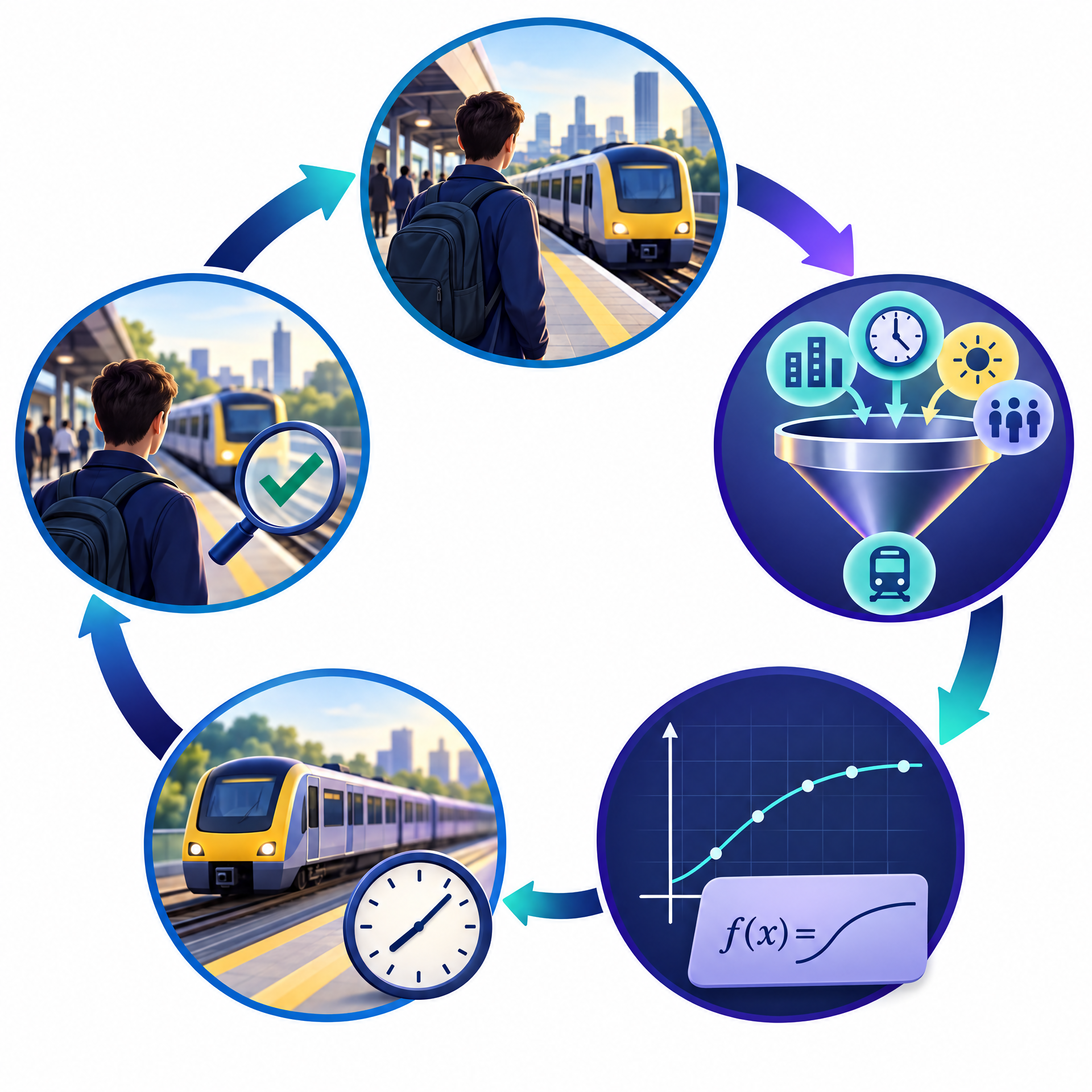
A mathematical model is a simplified mathematical representation of a real situation. AQA requires candidates to translate a context into a model using simplifying assumptions, use the model with suitable inputs, interpret the output in the original context, evaluate its appropriateness and understand how to refine it. This is the theme most likely to turn a correct number into a complete, high-mark answer.
The modelling cycle is: context → assumptions → model → outputs → interpretation → evaluation/refinement. Begin by choosing variables with units. State assumptions explicitly before using them. For example, a model for travel time might assume a constant speed, no delays and a direct route. These are not decorative sentences. They identify the conditions under which the answer can be trusted.
An assumption should be specific, relevant and usable. “Assume conditions are ideal” is too vague for strong credit. “Assume the vehicle travels at a constant speed of 40 km h⁻¹ and does not stop” is testable and tells the examiner why a linear distance-time model is being used. Likewise, “Assume customer arrivals are evenly spaced” justifies a constant-rate model, but may be weak during a lunch-time rush.
Use a model only with suitable inputs. A line fitted to weekday sales may not validly predict a holiday season. A quadratic trajectory model may describe a projectile only while air resistance is negligible. A probability model based on independent events fails if one event changes the chance of another. Model validity therefore depends on assumptions and the range in which it is applied.

Interpretation returns the mathematics to the real world. If a model produces t = -2, it may be a valid algebraic root but an impossible time after the experiment began. If a model gives 37.6 people, a candidate must decide whether 38 is a sensible practical prediction and state that it is an estimate. Include units and name the quantity: “The model predicts approximately 38 customers in the queue at 13:00”, not merely “37.6”.
Evaluation is a reasoned judgement, not the automatic phrase “the model is unrealistic”. Use this three-part structure: limitation → effect → refinement. For example: “The model assumes a constant arrival rate. At lunch, arrivals are likely to increase, so it may underestimate the queue. Use separate arrival-rate parameters for morning, lunch and afternoon data.” A more complex model is justified only when the improvement is useful and the extra inputs can realistically be obtained.
Concept 4: Communication and the assessment objectives
The three themes align closely with AQA’s assessment objectives. AO1 credits accurate recall and standard techniques. AO2 credits reasoning, interpretation and mathematical communication. AO3 credits solving problems in mathematics and in context, including model construction and evaluation. Across the qualification, AQA specifies approximate weightings of 50% AO1, 25% AO2 and 25% AO3. This is why a bare calculator answer leaves substantial credit unclaimed.
For a 4-mark modelling question, the mark pattern often includes a valid assumption or model, correct use of it, interpretation and an evaluation point. Exact allocation depends on the question and mark scheme, but candidates should make every stage visible. For a 6-mark “prove” question, marks are typically earned through a general definition, valid transformations, a key justified observation and a precise conclusion. Do not hide reasoning in your head.
Mathematical Relationships
There is no formula unique to section 3.1. The theme is about selecting, using and communicating the appropriate formula from the detailed topic being assessed. The formulae and identities needed therefore depend on the model: for example, distance = speed × time in a constant-speed model, F = ma in mechanics, a probability rule in statistics or a function in algebra.
Formula status: no additional formula must be memorised specifically for 3.1. Candidates must know which relevant relationships are permitted by the AQA formulae booklet and which identities or definitions must be recalled. In every application, define symbols and units before substitution. A useful general representation is:
output = mathematical process(inputs, parameters, assumptions)
Here, inputs are observed or supplied values, parameters are fixed values within the model and assumptions are conditions that make the simplified relationship appropriate. Changing an assumption can change the model even when the formula is unchanged.
Practical Applications
Overarching themes make mathematics useful beyond the classroom. A logistics firm can model delivery time from distance, average speed and loading time. A sports analyst can use a statistical model to estimate scoring probabilities. An engineer can use a force diagram and a model of motion. A public-health analyst can model growth or decay. In each case, the mathematics is powerful because it strips away some detail. It can also mislead if the stripped-away detail matters.
A strong practical response therefore asks three questions: What is the purpose of the model? Which assumptions make it manageable? What evidence would show that it is no longer adequate? For a short-term rough forecast, a simple linear model may be appropriate. For a safety-critical decision, a candidate should demand more data, clearer uncertainty and a more carefully checked model.
Examiner’s final check
Before moving on, reread every extended answer. Have you defined variables? Is every equality or approximation valid? Have you used the relevant units? Have you interpreted a result in context? If the question asks to evaluate, have you named a limitation, explained its likely effect and proposed a meaningful refinement? These habits make your solution accessible to the examiner and protect every available method, reasoning and communication mark.
Audio revision
Listen once for the full explanation, then pause at the recall quiz to answer aloud before the tutor supplies the response.
Visual Resources
2 diagrams and illustrations

Interactive Diagrams
2 interactive diagrams to visualise key concepts
Conceptual Flow Outline
The OT3 modelling cycle. The return arrow matters: evaluation may require revised assumptions or a refined model.
Conceptual Flow Outline
The OT2 problem-solving cycle. A solution may require a revised representation rather than more calculations of the same type.
Worked Examples
3 worked examples — open one to explore the question and available guidance.
Practice Questions
Try the question, then reveal an answer plan or example response
A model for the mass m grams of water in a container after t minutes is m = 500 − 12t. State the domain for t if the model is used until the container is empty, and interpret the coefficient −12. [3 marks]
Hint: Set the mass equal to zero to find the final permitted time, then read the coefficient with its units.
Explain why checking that n² − n is even for n = 1, 2, 3 and 4 does not prove it is even for every integer n. Then give a proof. [4 marks]
Hint: Use n(n − 1) and think about consecutive integers.
The temperature T °C of a drink is modelled by T = 80e^(−0.12t) + 20, where t is in minutes. Calculate T when t = 10 and interpret the 20 in the model. [4 marks]
Hint: Substitute t = 10 before rounding. Ask what temperature the exponential term tends towards.
A school predicts daily canteen takings using S = 240 + 18n, where n is the number of school days after 1 September. Give one assumption, one reason why the model may become unreliable by December, and one refinement. [5 marks]
Hint: Your answer needs a limitation, its likely effect and a change that addresses that limitation.
A function f(x) = x³ − 3x − 1 is used to model a quantity over the interval 1 ≤ x ≤ 2. Show that f(x) = 0 has a root in this interval. Explain why a numerical method may be used to find the root, and state one check required before interpreting it in context. [6 marks]
Hint: Evaluate f at both endpoints and use continuity. Then distinguish an approximate mathematical root from a contextual answer.
Exam technique
How to turn what you know into marks
How to approach the question
Underline the command word, identify the quantities and units, choose a representation before calculating, show the linked reasoning, then return to the original context. In a model, use AIMS. In a proof, use Define, Transform, Justify, Conclude.
How to structure your answer
For 1–2 marks, give the requested value, fact or assumption precisely. For 3–4 marks, show the method and a contextual interpretation. For 5–6 marks, write a linked argument with definitions, valid transformations, explanation and a final judgement or conclusion.
Timing
Each A-Level paper is 2 hours for 100 marks, so plan about 1.2 minutes per mark. A 6-mark question should normally receive about 7 minutes, including a final context and accuracy check.
Common pitfalls
- Writing a mathematically correct number with no units or interpretation. Avoid this by ending every context question with a full sentence naming the quantity.
- Stating a vague modelling assumption such as ‘conditions are ideal’. Replace it with a specific, testable condition and note when it may fail.
- Treating several numerical examples as a proof. Define a general integer or variable and show why the result follows for all permitted values.
- Using a model outside the range represented by the data. State the range and explain why extrapolation may be unreliable.
- Rounding before the required stage. Keep calculator values until the final answer and state the requested accuracy.
What the command words want
- Compare
- Give both a similarity and a difference using comparable mathematical quantities, not just descriptive words.
- Explain
- Link a mathematical fact to its consequence using ‘because’. In context, explain the effect of the assumption or condition.
- Describe
- Set out what happens or what changes, using the variables, graph features or mathematical terms supplied.
- Evaluate
- Make a reasoned judgement. For a model, give a strength or limitation, its likely effect on the output, then a justified refinement where appropriate.
- Calculate
- Name or select the relationship, substitute carefully, show enough working for method credit, and finish with a sensible unit or accuracy.
- Show/Prove
- Write a general, linked argument. Define variables, use valid transformations, justify the key step and state the required conclusion exactly.
- State/Give
- Answer directly using exact notation, a value, a condition or a short mathematical sentence. Do not add unsupported explanation.
Watch or listen (optional)
Test your understanding of Overarching themes
Active recall beats re-reading. Take an instant quiz now to test what you’ve learned and lock it into long-term memory.
7 days Premium · Then the free plan continues · No card, no charge