AQA · A-Level · Mathematics
Course version: 7357 · Version from Sept 2017
Overarching themes
Overarching themes are the mathematical habits assessed across every AQA A-level Mathematics paper: argue precisely, identify structure, and judge whether an answer works in the real world. Mastering OT1–OT3 turns correct calculations into complete, examiner-creditworthy solutions, particularly on the reasoning and problem-solving marks that distinguish strong candidates.
- 11 min read
- 3 worked examples
- 5 practice questions
- 8 key terms
Check what you remember
Read the wording for your board, then hide it and explain Mathematical argument in your own words. Rough notes are fine. This is a self-check, with no mark or grade.
Reference: AQA
A connected sequence of valid mathematical statements in which each conclusion follows logically from previous information, definitions or established results.
Study Notes

Overview
AQA A-level Mathematics 3.1 Overarching themes is the set of thinking habits that runs through every pure, statistics and mechanics question. It has three strands: OT1 mathematical argument, language and proof, OT2 mathematical problem solving, and OT3 mathematical modelling. This is not content that appears only in a labelled question. It is assessed whenever candidates must decide on a method, explain a conclusion, use notation precisely, or judge whether an answer makes sense.
The prize is significant. AQA allocates approximately 25% of the qualification to AO2, reasoning, interpretation and communication, and approximately 25% to AO3, problem solving in and beyond mathematics. In a two-hour, 100-mark paper, a sound working target is one minute per mark. Overarching-theme marks often sit in the final sentence of a question, not in a new calculation. A correct number without an appropriate unit, context, assumption or accuracy comment can therefore be incomplete.
Typical exam prompts include show that, hence, prove, justify, verify, model, interpret, comment on, and explain why. Read these as instructions about the form of your answer, not as decoration. The method may be familiar, but the mark is awarded only when the method is communicated and evaluated in the form required.
Key Concepts
OT1: Mathematical argument, language and proof
A mathematical argument is a chain of connected, valid statements. It is stronger than a sequence of calculations because a reader can see why one line leads to the next. Start by defining a variable or identifying the object under discussion. Then use correct notation, a legitimate algebraic or graphical step, and a short logical connector such as therefore, since, because, hence, or for all.
Candidates should distinguish carefully between an equation and an identity. An equation is true for specific value or values, such as (x^2-4=0). An identity is true for every allowed value, such as (x^2-4\equiv(x-2)(x+2)). The symbol (\equiv) therefore has a different job from (=). Similarly, afunction assigns exactly one output to each permitted input. State its domain where it matters, then interpret its range from the mathematical or contextual restriction.
Proof requires a general argument. Checking several cases, plotting a graph, or obtaining a calculator answer may suggest a result, but none proves it for all permitted cases. In a direct proof, begin with the givens and deduce the desired result. In proof by contradiction, assume the negation of the statement, obtain an impossibility, then reject that assumption. In proof by exhaustion, show every possible case. Credit is given for the visible logical bridge, not merely the final assertion.
Use diagrams and sketches as reasoning tools. A curve sketch can show the likely number and location of roots. A sign diagram can control inequalities. In mechanics, a clear force diagram establishes the directions and forces used in the equation. Label only what you need, but label it accurately. A diagram that is then ignored earns little; a diagram that justifies a range or a direction supports the argument.
Examiner habit: when you divide by an expression, square both sides, take a logarithm, or select a root, state the condition that makes the step valid. For example: “As (t\geq0), reject (t=-3.1).” This short phrase often distinguishes a mathematical answer from a contextual answer.
OT2: Mathematical problem solving
Problem solving begins before calculation. First recognise the underlying structure, then simplify or abstract the situation. Ask four questions: What changes? What is fixed? What relationship is described? What representation will expose it? A changing quantity may indicate differentiation, integration or a recurrence. Repeated percentage change may indicate a geometric sequence or an exponential model. A shortest route may need coordinate geometry, vectors or optimisation. A data claim may need probability, a distribution or a hypothesis test.
The AQA problem-solving cycle is a reliable framework:
- Specify the problem and the required output, including units and restrictions.
- Collect relevant data, definitions, formulae, assumptions and diagram information.
- Process by simplifying, rearranging, calculating or selecting a method.
- Represent the structure through algebra, a graph, a table, a tree, a sketch or a force diagram.
- Interpret the result in the original context, then evaluate whether refinement is needed.
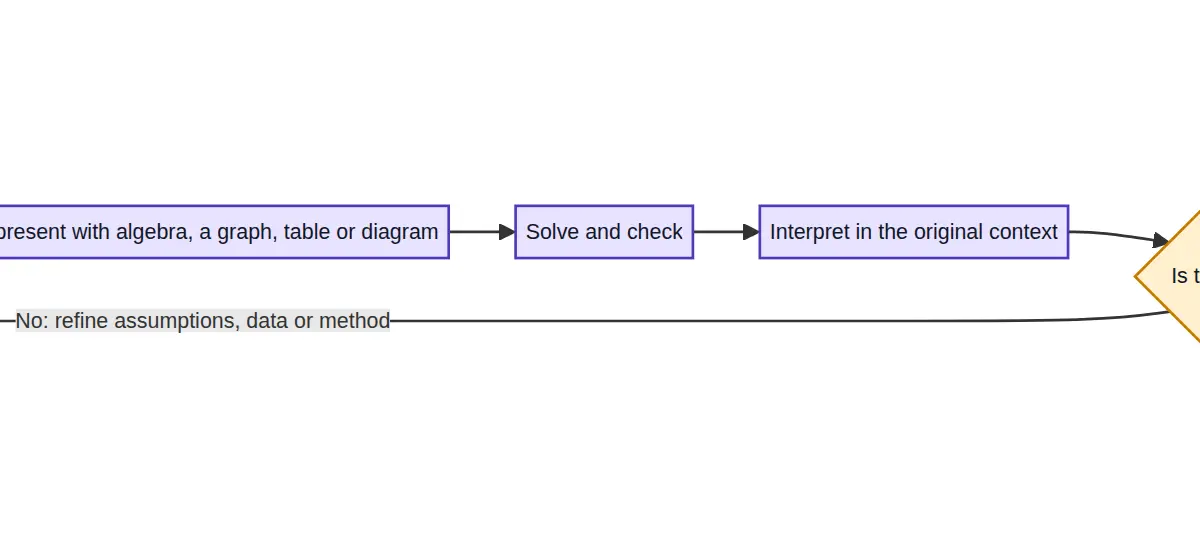
A strong solution may loop back. If the root is outside the meaningful interval, the model predicts an impossible count, or the numerical accuracy is insufficient, refine the inputs, assumptions, range or method. This is not failure. It is the evaluation stage required by OT2.6.
For unstructured questions, use the memory routine SCOPE: State what is sought; Choose variables with units; Organise information into a useful equation, graph, table or diagram; Perform a justified method; Explain the result and its reliability. It prevents the common error of starting to calculate before deciding what the calculation represents.
Numerical methods are part of this theme. Some equations cannot be solved analytically in the required form. A numerical method then gives an approximation, not an exact solution. State the method and the reason it is appropriate. Preserve accuracy in intermediate work, then justify the final rounding. For a bisection or change-of-sign argument, use a continuous function and show function values of opposite sign at the interval endpoints. For an iterative method, use a suitable starting value and sufficient iterations, then comment if the values fail to settle.
Accuracy is evidence-based. A calculator display does not, by itself, prove a value correct to three decimal places. Show an interval whose endpoints both round to the answer, an error bound, or stable consecutive iterations as appropriate. Then check whether another root, starting value or contextual restriction could alter the conclusion.
OT3: Mathematical modelling
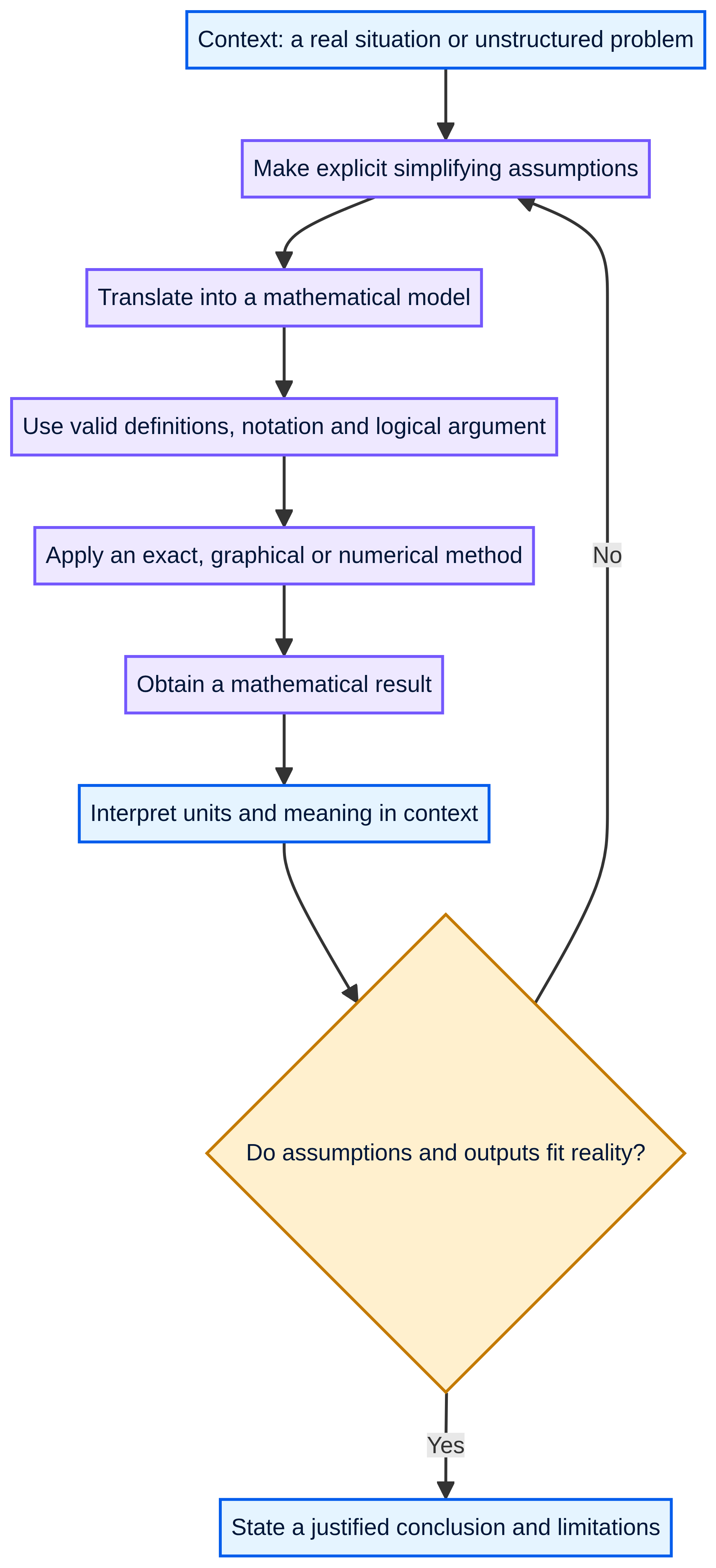
A mathematical model is a deliberately simplified representation of a real situation. Modelling has five moves: translate the context, make assumptions, use a mathematical relationship, interpret the output, then evaluate and refine. Every move matters.
Begin by choosing variables, units, inputs, outputs and relationships. If (t) is time, declare whether it is in seconds, minutes or years. If (x) counts groups of ten products, state that explicitly. Translate the words of the context into mathematical constraints such as (x\geq0), an interval, a probability between zero and one, or an integer condition.
Next, state simplifying assumptions. A projectile model may assume constant gravitational acceleration and negligible air resistance. A statistical model may assume a random sample or independent trials. A population model may assume a constant growth rate over a short period. An assumption is not a weakness. It is a condition under which the conclusion is valid. Marks are awarded for a relevant assumption and for a realistic limitation, not for a generic phrase such as “the model may be inaccurate”.
Use inputs that fit the model, then translate the output back into the original setting. A negative time, 1.6 customers or a probability of 1.12 is not simply a strange answer to copy down. It signals that the range, units, input or model is unsuitable. State the meaningful conclusion, including a sensible degree of precision. For a count, explain the decision about rounding. For a continuous variable, use units. For a forecast, state that it is a prediction rather than a certainty.
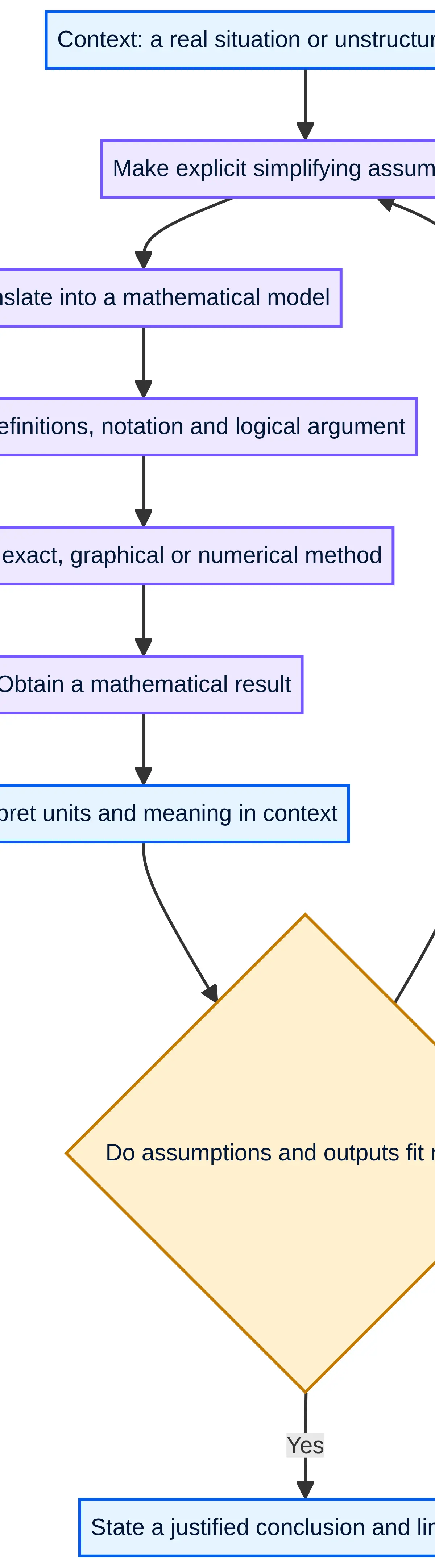
Finish by evaluating. Does the predicted result agree broadly with reality? Are the assumptions acceptable over the stated range? Were measurement errors, outliers, air resistance, changing rates, sampling bias or external influences ignored? Suggest a specific refinement when one is available, for example using a piecewise model, collecting more representative data, restricting the range, or incorporating air resistance. “The model is limited because it assumes a constant rate of change, which may not hold over a long period” is a creditworthy comment because it identifies both the assumption and its consequence.
Use MINT to remember the loop: Model the context, Identify assumptions, Number-crunch with suitable inputs, Translate and test the output.
Mathematical Relationships and Formula Status
There is no formula that belongs solely to 3.1. It is a skills section applied across the A-level course, so candidates select relationships from the linked topic rather than learn a new formula sheet. The following relationships frequently appear in overarching-theme questions:
- (f(a)f(b)<0), with (f) continuous, supports the conclusion that a root lies between (a) and (b). Must understand and use when justifying a numerical interval.
- (x_{n+1}=x_n-\dfrac{f(x_n)}{f'(x_n)}) is the Newton–Raphson iteration.Must recall when the numerical-method question requires it; retain unrounded calculator values until the final answer.
- (\dfrac{dP}{dx}=0) locates stationary points in an optimisation model, while the sign of (\dfrac{d^2P}{dx^2}) classifies them when applicable.Must select from differentiation content, then interpret the value of (x) in its stated units.
- A model relationship, for example (P(x)=-2x^2+120x-800), has no meaning until the variables, units, allowed range and assumptions are defined. Not a formula to memorise; it is an example of translation and interpretation.
The important memory point is not a new equation. It is formula, condition, context. Every formula needs a reason for use, a check that its conditions apply, and a conclusion in the language of the problem.
Graph, Diagram and Data Skills
Use a sketch before solving when it helps reveal the structure. Mark intercepts, asymptotes, turning points or a restricted interval if you use them. For a numerical root, graphing can locate an interval but does not by itself prove the root to a requested accuracy. For modelling, a scatter graph may reveal curvature, an outlier or a changing spread that makes a linear model inappropriate. For mechanics, begin with an isolated particle diagram, show the chosen positive direction and label forces; do not mix a distance-time sketch with a force diagram.
There are no Foundation and Higher tiers at A-level. There are also no topic-specific unit conversions to memorise for 3.1. However, unit discipline is essential: convert before substituting, keep compound units visible, and interpret the output with the unit of the original question. A value of 0.4 may be 0.4 seconds, 0.4 kilometres, 0.4 newtons or a probability. The number alone is incomplete.
Practical Applications
These themes make mathematics usable beyond the exam. An engineer models a bridge load, declares a safety factor, calculates a stress and judges whether assumptions about load distribution are reasonable. A retailer models demand, uses a forecast and evaluates whether a one-off promotion has distorted the data. A public-health analyst interprets a confidence interval or hypothesis test without claiming that a sample proves a universal conclusion. In each case, the mathematics supplies a result, but argument, problem solving and modelling make the result trustworthy.
10-minute revision podcast
Last-minute mark-winning checklist
Before finalising any extended answer, use PAUSE: Put the problem into variables; Apply a justified method; Use the answer in context; Scrutinise assumptions and accuracy; Explain the conclusion. This is especially valuable in 4–6 mark questions where candidates frequently earn the method marks but lose the final interpretation or evaluation mark.
Visual Resources
2 diagrams and illustrations

Interactive Diagrams
2 interactive diagrams to visualise key concepts
Conceptual Flow Outline
The AQA mathematical problem-solving cycle: evaluation can return the candidate to an earlier stage.
Conceptual Flow Outline
Argument, modelling and evaluation work together in a complete contextual solution.
Worked Examples
3 worked examples — open one to explore the question and available guidance.
Practice Questions
Try the question, then reveal an answer plan or example response
State one relevant assumption for a model of a projectile's flight that uses constant gravitational acceleration and no resistive force. Explain one limitation of that assumption. [3 marks]
Hint: Name an aspect of the real flight that the model deliberately ignores, then explain when that omission matters.
Explain why checking (n=1,2,3) is not a proof that (n^2+n) is even for every positive integer (n). [3 marks]
Hint: Focus on the difference between selected examples and all possible positive integers.
Let (f(x)=x^3-x-1). Show that (f(x)=0) has a root in the interval ((1,2)). [4 marks]
Hint: Evaluate the function at both endpoints and use continuity.
A tank is modelled by (V(t)=1200-15t), where (V) is the volume in litres and (t) is time in minutes. State the domain for which the model is physically meaningful. Interpret the value of (t) when the tank is empty, and give one limitation. [4 marks]
Hint: Volume cannot be negative. Solve \(V(t)=0\), then relate the answer to the stated units.
A student uses Newton–Raphson iteration for (f(x)=\cos x-x) and obtains the consecutive values 0.739086, 0.739085 and 0.739085. State a suitable approximation to the root, explain why it is plausible, and give one reason why a candidate should still consider the starting value. [5 marks]
Hint: Use the stable digits, then comment on convergence and the method's dependence on a sensible initial estimate.
Exam technique
How to turn what you know into marks
How to approach the question
Read to the end of a multi-part question before calculating. Identify the object, units, domain or realistic range, then decide whether the task is proof, modelling, an exact method, a graphical method or a numerical method. Write a chain with logical signposts. Finish by checking feasibility, units, precision, assumptions and the wording of the command.
How to structure your answer
For 1–2 marks, give the requested value, notation or brief reason precisely. For 3–4 marks, define any function or variable, show the decisive method and write the conclusion. For 5–6 marks, add assumptions, a diagram or representation where useful, a justified choice of method, a clearly sequenced argument, a contextual interpretation and an evaluation of accuracy or limitations.
Timing
AQA A-level Mathematics papers are 2 hours and 100 marks. Target approximately 1 minute per mark, retaining a short final checking window. A 6-mark reasoning, modelling or numerical-method question should normally receive about 6 minutes.
Common pitfalls
- Giving only a calculator value. Avoid this by adding the unit, the contextual meaning and, where relevant, the basis for the stated accuracy.
- Testing examples in a proof question. Avoid this by using a general variable and an argument that covers every permitted case.
- Forgetting that a variable is measured in groups, minutes or another unit. Avoid this by defining the variable in words before substituting values.
- Calling a model inaccurate without stating the assumption and its consequence. Avoid this by writing ‘This assumes ..., so ... may be unreliable when ...’.
- Rounding intermediate numerical-method values. Avoid this by retaining calculator precision until the final justified rounding step.
What the command words want
- Show
- Present enough intermediate algebra, numerical evidence or logical reasoning for the examiner to follow and verify the stated result.
- Hence
- Use the result from the preceding part as a starting point. Do not restart an unrelated method or discard a value supplied for use.
- Model
- Define variables and units, state simplifying assumptions, build or apply the relationship, then interpret and evaluate the output.
- Prove
- Give a general logical argument. Examples, a graph or a calculator check may motivate the claim but do not prove it.
- Verify
- Substitute or check the specified result against the required equation, condition or relationship, showing the equality or condition is met.
- State/Give
- Provide the requested value, term, interval or assumption concisely, with correct notation and units where applicable.
- Explain/Justify
- Link a mathematical fact to a conclusion using because, since or therefore. Name the condition that makes the method valid.
- Interpret/Comment
- Translate the result into the original situation. Discuss units, practical meaning, accuracy, assumptions or limitations as the wording demands.
Watch or listen (optional)
Test your understanding of Overarching themes
Active recall beats re-reading. Take an instant quiz now to test what you’ve learned and lock it into long-term memory.
7 days Premium · Then the free plan continues · No card, no charge