AQA · GCSE · Mathematics
Course version: 8300 · Version from Sept 2015
Properties and constructions
Geometry marks often depend on a tiny detail: the middle angle letter, a matching tick or the word regular. Master the vocabulary, triangle labels, symmetry tests and drawing conventions in AQA G1 so your diagrams communicate exactly what the examiner needs.
- Point 1 of 15
- 12 min read
- 3 worked examples
- 6 practice questions
- 4 key terms
Study Notes
Overview
This guide covers AQA GCSE Mathematics 8300, 3.4.1 G1: Properties and constructions. It is Basic Foundation content, so it is assessed at both Foundation and Higher tier; there is no Higher-only G1 content. Your job is to use precise geometric language, read and label diagrams accurately, recognise symmetry, and turn a written description into a clear drawing. These are small skills with a large payoff: they help you communicate the exact shape you mean before later geometry questions ask you to calculate or reason from it. 1
Think like an examiner-friendly candidate: name the feature, show the marking convention, and label only what the question needs. A diagram supports your mathematics, but a neat-looking sketch does not replace a stated reason or a requested measurement. In the examination there are three 90-minute, 80-mark papers, giving an average of 1.125 minutes per mark. Aim to spend about one minute per mark, then use the remaining time to check labels, symbols and units. 2 The questions and mark allocations in this guide are illustrative, not an official AQA scheme.
Key Concepts
1. Points, lines and surfaces
A point identifies an exact position. Geometrically it has no size, even though you show it with a tiny dot and a capital letter such as A. A line is straight and extends without end in both directions. A line segment is the finite part between two endpoints, for example AB. A ray starts at one point and extends for ever in one direction. Do not call every straight stroke a line: a side of a drawn rectangle is normally a segment.
A vertex is a corner where segments meet. An edge is a line segment on the boundary of a 3D solid. A plane is a perfectly flat surface continuing without end in every direction. A flat floor is a useful model of a plane, but it is only an idealisation because a real floor is bounded and not perfectly flat. A face is the bounded flat portion of a plane that forms part of a solid, such as one square face of a cube. This is a named synoptic link to 3D shape properties in G12, not a need to study solids here. 1
2. Parallel, perpendicular and diagram markings
Parallel lines lie in the same plane, stay the same perpendicular distance apart and never meet, however far they extend. Mark matching parallel segments with matching arrow marks. Perpendicular lines meet at a right angle. A right angle is exactly 90°, shown with a small square at the corner, not a curved angle arc. Matching tick marks on sides mean equal lengths; matching arrow marks mean parallel directions. Never conflate these markings.
3. Polygons and regularity
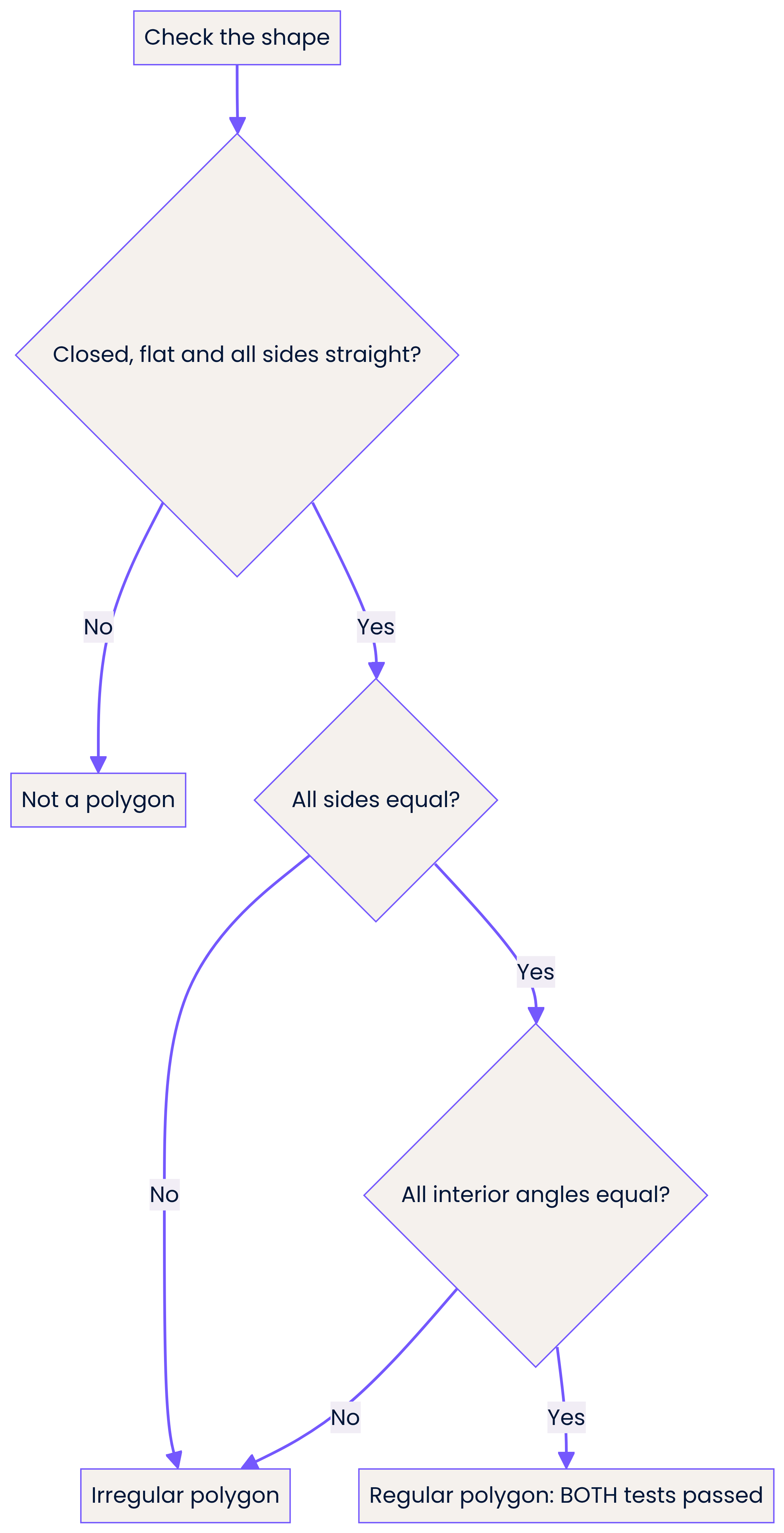
A polygon is a closed, flat shape made only from straight line segments. A triangle has three sides, while a pentagon has five. A regular polygon has all sides equal and all interior angles equal. A regular pentagon is therefore both equilateral and equiangular. A circle is not a polygon because its boundary is curved.
4. Triangle labelling conventions
 Open full-size image (opens in a new tab)
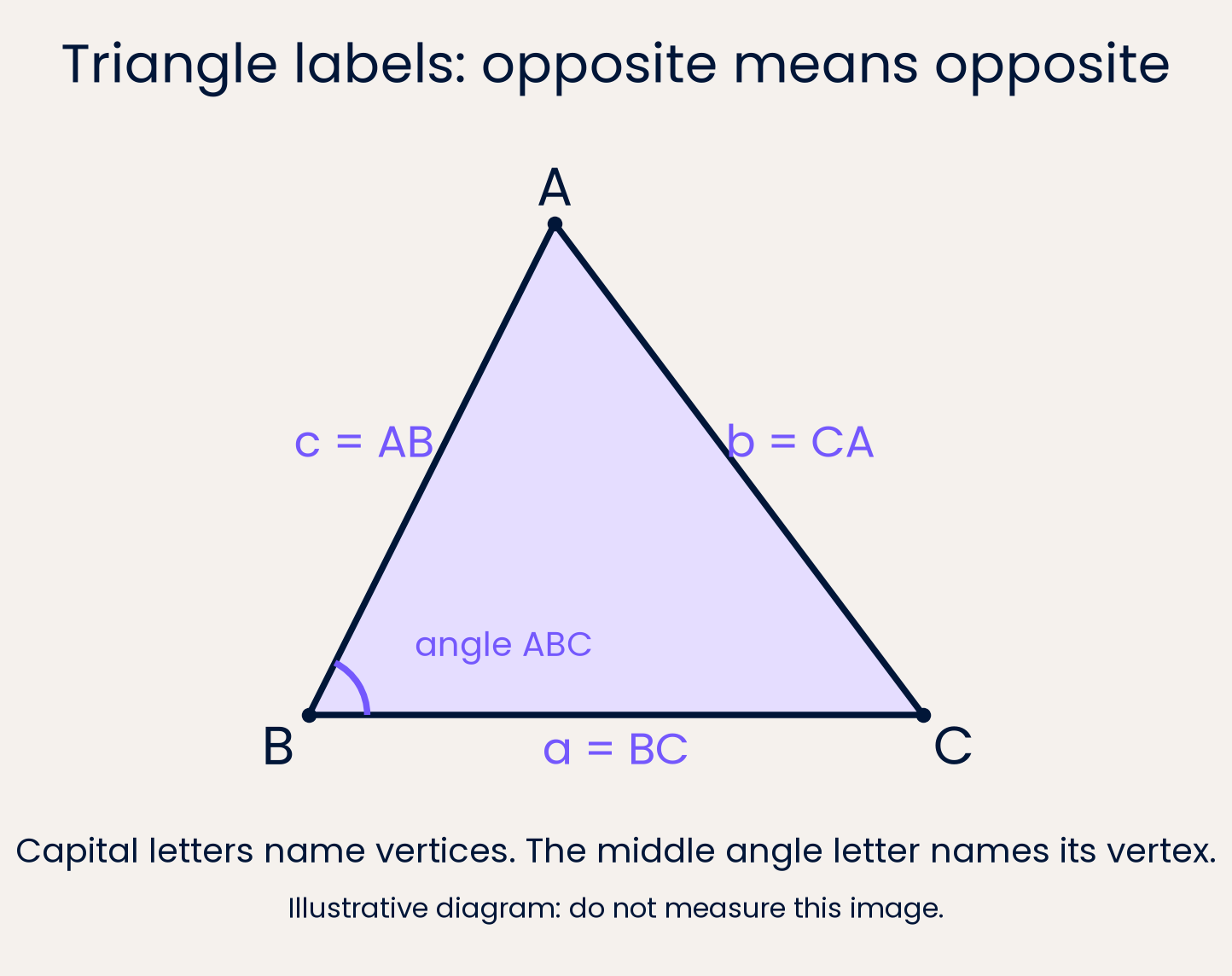
Triangle notation follows a reliable convention. AB = BA: the order of the endpoints does not change the length of a side. Angle ABC has vertex B, the middle letter. The notation △ABC means triangle ABC, with the capital vertex names read around its boundary. In triangle ABC, the conventional lower-case opposite-side labels are a = BC, b = CA and c = AB. These lower-case labels are optional unless the question uses them. Use capital letters for vertices and do not quietly move a label to a different corner.
Microexample: if AB = AC, put the same tick mark on AB and AC. It says those two segments have equal length. It does not say they are parallel or that an angle is equal.
Retrieval check: In angle PQR, which letter names the vertex? Why is it not P?
5. Reflection and rotation symmetry
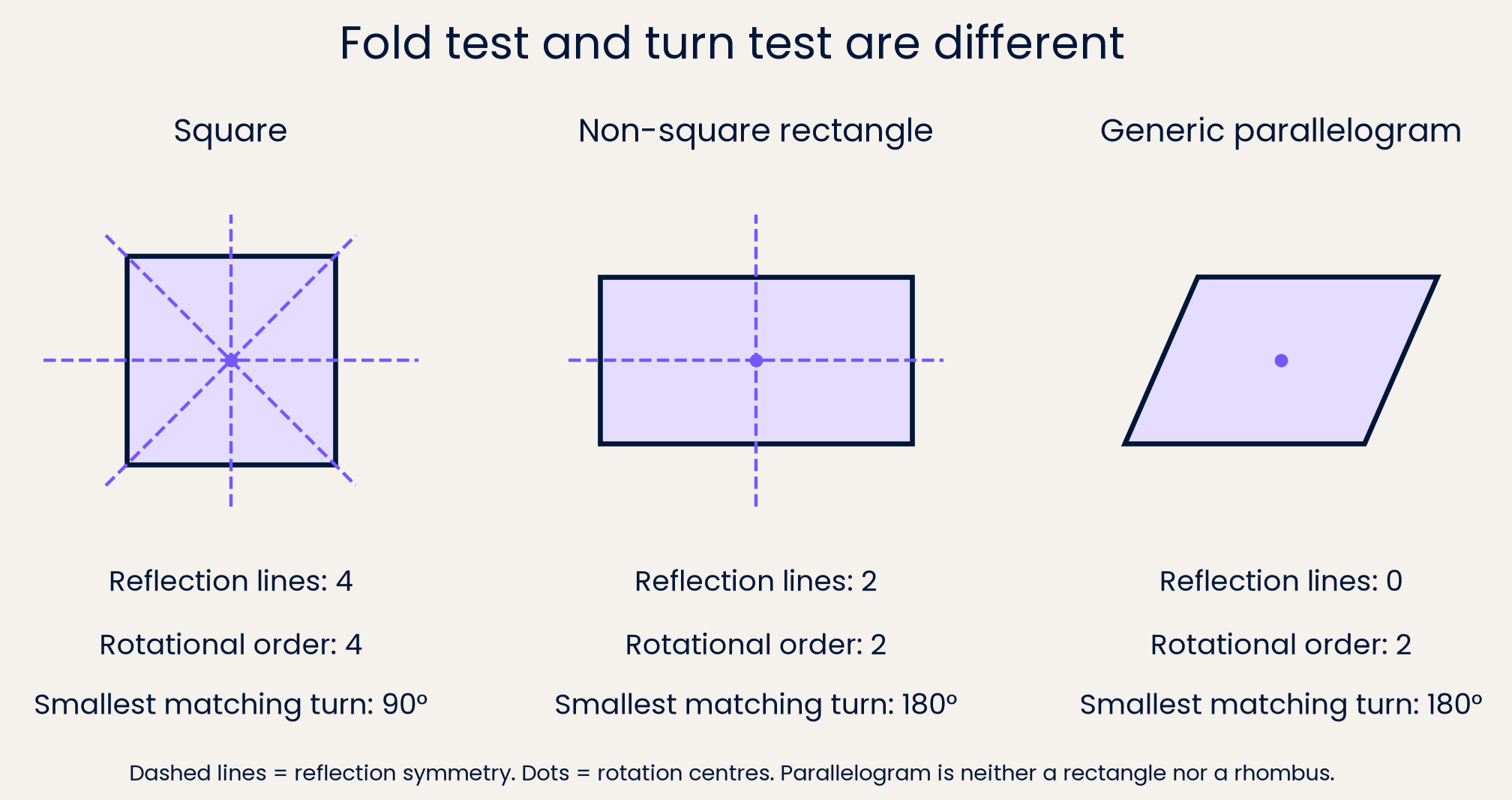
Symmetry is about transformations that leave the shape looking unchanged. A line of reflection symmetry splits a shape into mirror-image halves. Folding along that line would make the halves coincide. Rotational symmetry means the shape matches its original position after a turn of less than 360° about a centre. The order is the number of times it matches in one complete 360° turn, including the return at 360°. A shape with no non-trivial matching turn has rotational symmetry of order 1.
 Open full-size image (opens in a new tab)
Labels and incidental marks do not count when deciding a shape's symmetry, unless the question states that they are part of the figure. Imagine moving or turning the page rather than trusting the direction in which the diagram was printed. A square remains a square after a rotation. Its bounding box may look diagonal, but a diagonal of that box is not automatically a line of symmetry.
The following reference set is particularly useful. A generic parallelogram that is neither a rectangle nor a rhombus has 0 lines of reflection symmetry and rotational symmetry of order 2. A rectangle that is not a square has 2 lines and order 2. A square has 4 lines and order 4. An equilateral triangle has 3 lines and order 3. A regular pentagon has 5 lines and order 5. A scalene triangle has 0 lines and order 1. A non-square rhombus has 2 lines and order 2. A non-equilateral isosceles triangle has 1 line and order 1.
There is a useful triangle-only test: if all three angles of a triangle are equal, all three sides are equal, so the triangle is equilateral. The converse is also true. Do not overgeneralise that test to quadrilaterals: a rhombus has equal sides but need not have equal angles, and a rectangle has equal angles but need not have equal sides. Among quadrilaterals, only a square has both properties.
Mathematical Relationships
Must memorise
These are facts and definitions to recall, not promises about a formula sheet.
- A right angle measures 90°. One full turn measures 360°.
- If a shape has rotational symmetry of order k, then k matching positions are counted in a full turn, including the 360° return. The smallest positive matching angle is 360° ÷ k, except that for order 1 there is no non-trivial turn below 360°.
- Equivalently, k = 360° ÷ the smallest positive matching angle. Exclude 360° when looking for a smallest non-trivial turn, but include it when counting the order.
- A regular n-gon has n lines of reflection symmetry and rotational symmetry of order n, where n ≥ 3. Thus a regular hexagon has order 6 and its smallest matching turn is 60°.
The number of reflection lines is not generally linked to rotational order. An isosceles triangle can have one reflection line but rotational order 1; a non-square rhombus has two of each. List the properties separately instead of guessing one from the other.
 Open full-size image (opens in a new tab)
Microexample: a regular octagon has order 8, so 360 ÷ 8 = 45. It matches every 45°. This uses rotation symmetry, not the polygon angle-sum rules, which belong to the named G3 synoptic link and are not developed here.
Why? A 180° turn of a generic parallelogram puts each vertex onto the opposite vertex, so it has order 2. Why does a reflection usually fail?
What if? One side of a claimed regular hexagon is longer than the others. Can it be regular? State the definition that settles it.
Practical Applications
Drawing from a written description
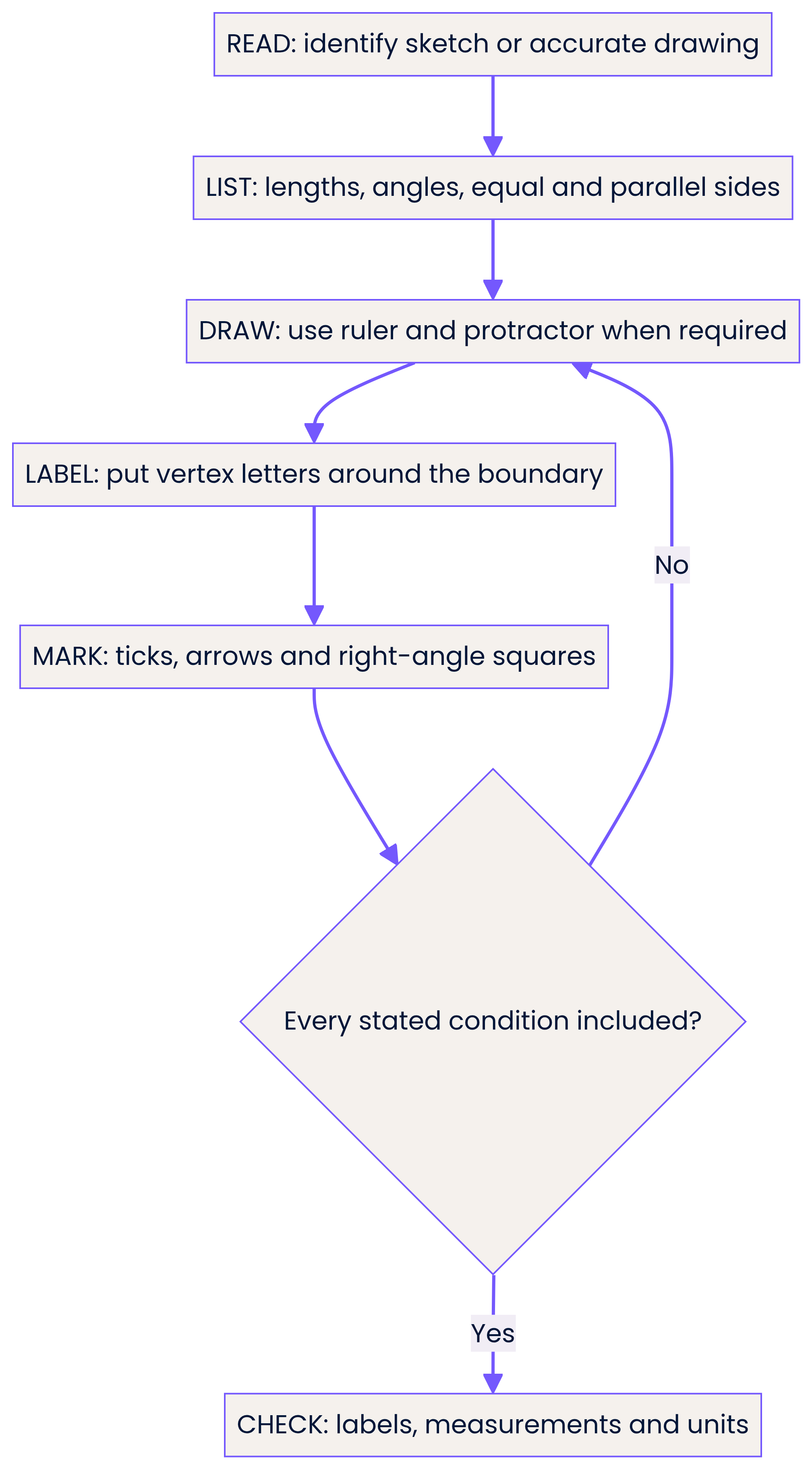
Written descriptions often package several facts at once. Start by translating each phrase into a mark or label, then draw. For example: “Draw rectangle ABCD, 6 cm by 4 cm, with consecutive vertices” means travel around the boundary A, B, C, D, not across it. If AB is the 6 cm side and BC is the 4 cm side, then AB is parallel to CD, AD is parallel to BC, and angle ABC is 90°. Use a ruler to make AB = 6 cm, a protractor or right-angle check to set the direction, then complete the 4 cm side and label the corners.
 Open full-size image (opens in a new tab)
A portable diagram or an image on a screen is not a measurement source. Draw the stated dimensions yourself and use the written information, not pixels or a screen ruler. If the same rectangle is given by coordinates, A(0,0), B(6,0), C(6,4), D(0,4), connect those points in that order. This is a diagram-reading connection to coordinate geometry, G11; it does not require a data-plotting task.
Keep units straight. 1 cm = 10 mm and 1 m = 100 cm. These are length conversions, so do not square them unless you are converting area, which is outside this G1 focus. A 6 cm by 4 cm rectangle has side lengths in centimetres, even if you first mark 60 mm and 40 mm on a ruler.
Know the command word before you begin. Draw asks for an accurate depiction. Sketch asks you to show the important features, so a careful freehand diagram may be enough. Construct also means draw accurately, and if compasses are instructed, show the construction arcs and lines. Formal ruler-and-compass constructions are G2, so this guide does not teach their methods. State means write the required information. Give a reason needs calculation and/or written evidence. Compare asks you to find or identify values and say which is smaller, larger or otherwise relevant. Evaluate, Higher Tier only as a command word, means identify an incorrect part of a method, calculation or claim, or explain why it must be correct. It is not an essay asking for balanced opinions. 3
This is a mathematics drawing exercise using a ruler or protractor when appropriate. It is not a GCSE Maths required science practical. Do not import laboratory conventions: focus on accurate geometry, clear labels and the information requested.
Microexample: “Sketch an isosceles triangle with one vertical line of symmetry.” Draw the symmetric pair of equal sloping sides, mark them with equal ticks, and draw a vertical dashed symmetry line. Do not add a right-angle square unless it is given.
Retrieval check: Which convention represents two equal sides, and which represents two parallel sides?
What if? A description says “triangle ABC with AB = AC”. Where should the equal ticks go, and which vertex is the apex if the triangle is not equilateral?
The three full worked examples are in the worked_examples field of this guide. The miniature examples here are deliberately small: use them to rehearse a definition, a symbol and a decision quickly, then practise full written descriptions on paper.
Listen
Listen once with this page closed. Then pause after each key word and retrieve its definition: point, line segment, ray, vertex, plane, face, parallel, perpendicular, regular polygon, reflection symmetry and rotational order. On a second listen, draw a quick symbol beside each: a dot, arrows, a right-angle square, equal ticks, parallel arrows or a dashed mirror line. Finally, explain aloud why a rectangle that is not a square has order 2 but a scalene triangle has order 1. Speaking the distinction helps prevent symmetry facts from becoming a memorised, mixed-up list.
Authentic Marking Context
The published AQA June 2023 Foundation Paper 1 mark scheme awards B1 at question 2(d) for a 7 cm by 3 cm rectangle, with the guidance to mark intention. Its glossary describes B marks as independent of method, M marks as method marks and A marks as accuracy marks following a correct method. This is a real example of a drawing mark, not a universal rule about how many marks a drawing receives. The original practice questions below deliberately combine skills and use their own stated teaching allocations. No fixed measurement tolerance is invented here. 4
References
Try the lesson
The start of the Properties and constructions lesson, made from checked teaching notes for this specification point.
Have a go first
A triangle has three vertices labelled P, Q and R. Which notation correctly names the angle at vertex Q?
Listen
This row covers the vocabulary and drawing conventions of geometry. You must use terms precisely: a point has position but no size; a line has length but no width; a vertex is a corner where edges meet; an edge is a line segment joining two vertices; a plane is a flat surface. Parallel lines never meet, perpendicular lines meet at a right angle of 90°, and a right angle is marked with a small square. A polygon is a closed plane figure with straight sides; a regular polygon has all sides equal and all angles equal. Polygons may have reflection symmetry, rotation symmetry, or both. You also use standard conventions for labelling triangles: vertices are named with capital letters, and the side opposite angle A is side a, with angles marked clearly. Finally, you draw an accurate diagram from a written description, choosing sensible labels and including the stated features. A strong answer earns marks for these points. Uses conventional geometric terms correctly, including point, line, vertex, edge, plane, parallel, perpendicular and right angle. Identifies and names polygons, including regular polygons and polygons with reflection symmetry, rotation symmetry or both. Applies standard labelling conventions to triangles, matching capital-letter vertices with the opposite sides. Draws a diagram that matches a written description, including all stated features such as parallel sides, right angles or equal sides. A common slip: Treating a vertex and an edge as the same thing. Instead, a vertex is a point where edges meet, while an edge is a line segment joining two vertices. Exam tip: Annotate diagrams with the given information, such as right-angle squares and parallel arrows, before answering.
Watch it explained
What is the one idea the video explains? Say it in a sentence.
Read the described scene instead
Geometry needs precise vocabulary. In this lesson, you will use conventional terms for points, lines, vertices, edges, planes, parallel and perpendicular lines, right angles, polygons and symmetry. You will also apply standard triangle labelling and draw a diagram from a written description. Start with the basic objects. A point has position but no size. A line has length but no width. A vertex is a corner where edges meet, and an edge is a line segment joining two vertices. A plane is a flat surface. Parallel lines never meet. Perpendicular lines meet at a right angle of ninety degrees. A right angle is marked with a small square. These conventions let you read and annotate diagrams accurately. A polygon is a closed plane figure with straight sides. A regular polygon has all sides equal and all angles equal. Polygons may have reflection symmetry, rotation symmetry, or both. A parallelogram has rotation symmetry but no reflection symmetry. Here is a triangle with vertices A, B and C. Pause to think: which side is side a? The side opposite angle A is side a. Side b is opposite angle B, and side c is opposite angle C. Mark angles clearly and use capital letters for vertices. Watch for these common mistakes. A vertex is not an edge: a vertex is a point where edges meet. A rectangle is not a regular polygon unless it is a square, because regular polygons need all sides and all angles equal. Side a must be opposite angle A. And a parallelogram shows rotation symmetry without reflection symmetry. Recall the precise terms: point, line, vertex, edge and plane. Parallel lines never meet; perpendicular lines meet at a right angle. A regular polygon has equal sides and equal angles. Use capital-letter vertices and opposite-side labels for triangles. Annotate diagrams with right-angle squares and parallel arrows, and choose an accurate drawing when asked.
Key words
Say what each word means before you turn the card.
Point
Try answering aloud or in your head before turning the card.
Line
Try answering aloud or in your head before turning the card.
Vertex
Try answering aloud or in your head before turning the card.
Edge
Try answering aloud or in your head before turning the card.
See every definition
- Point
- A point has position but no size.
- Line
- A line has length but no width.
- Vertex
- A vertex is a corner where edges meet.
- Edge
- An edge is a line segment joining two vertices.
There is more to this lesson
The full lesson goes on to check your understanding and help you earn the marks. Create a free account to carry on, with your progress saved.
A week of Premium from your first lesson · Then the free plan continues · No card, no charge
Interactive Diagrams
2 interactive diagrams to visualise key concepts
Conceptual Flow Outline
Decision path for identifying a polygon and checking both requirements for regularity.
Conceptual Flow Outline
Turn a written description into a checked and correctly labelled geometric drawing.
Worked Examples
3 worked examples — open one to explore the question and available guidance.
Practice Questions
Try the question, then reveal an answer plan or example response
State the geometric term for (a) a corner, (b) a segment joining adjacent vertices on a solid, and (c) an infinite flat surface. [3 marks]
Hint: Think point, boundary segment, then surface.
Explain why a non-square rhombus is not a regular polygon. [2 marks]
Hint: A regular polygon must pass two tests, not just one.
In triangle PQR, use the conventional opposite-side labels. State (a) side p, (b) side r, and (c) the vertex of angle RPQ. [3 marks]
Hint: The lower-case side is opposite its matching capital letter; the angle vertex is the middle letter.
For a rectangle that is not a square, state (a) the number of reflection-symmetry lines, (b) its rotational order, and (c) its smallest positive matching rotation angle. [3 marks]
Hint: Test a diagonal reflection and a quarter-turn before deciding.
Sketch a non-equilateral isosceles triangle ABC with A above the base BC and AB = AC. Label the vertices, mark the equal sides, and draw its only line of reflection symmetry. [4 marks]
Hint: The symmetry line joins the apex to the midpoint of the opposite side.
A candidate claims, “Every polygon with rotational order 2 has two lines of reflection symmetry.” Is the claim correct? Give a counterexample and state both of its symmetry properties. [3 marks]
Hint: Consider a parallelogram that is neither a rectangle nor a rhombus.
Ready to test yourself interactively?
Active recall beats reading alone. Answer questions on Properties and constructions with instant AI scoring and mark scheme guidance.
A week of Premium from your first lesson · Then the free plan continues · No card, no charge
Exam technique
How to turn what you know into marks
How to approach the question
Read the command word and every condition. Underline labels, lengths, equalities, parallel pairs and angle information. Decide whether an accurate drawing or a sketch is required. Answer each part, then check the final diagram or statement against the original description.
How to structure your answer
For a 1-mark state item, give the precise requested term or value. For several independent parts, label each answer. For a calculation, show the formula and substitution before the answer with degrees where needed. For an explanation, give the decision and the mathematical reason. For a drawing, include the shape, measured features where requested, consecutive labels and all requested markings. Marks do not automatically equal the number of sentences.
Timing
Each AQA paper gives 90 minutes for 80 marks: 1.125 minutes per mark overall. Work at about 1 minute per mark to reserve checking time. Suggested working budgets: 3 marks = 3 minutes; 4 marks = 4 minutes; 6 marks = 6 minutes. These are strategies, not official per-question time limits.
Common pitfalls
- Confusing a vertex with an edge: a vertex is a point; an edge is a segment.
- Calling equal sides alone regular: equal interior angles are also required.
- Putting a beside A: side a must be opposite A.
- Using a diagonal as a symmetry line of a non-square rectangle: it does not map the whole shape onto itself.
- Giving rotational order 0: only a full-turn match means order 1.
- Assuming every parallelogram has no reflection lines: rhombi and rectangles are exceptions.
- Using ticks for parallel sides: use matching arrows instead.
- Measuring a not-to-scale or resized image: use the stated information unless instructed to measure.
What the command words want
- Draw
- Give an accurate depiction. Measure stated lengths and angles where required.
- Sketch
- Show and identify the important features; scale accuracy is not required unless specified.
- Compare
- Find or identify the requested quantities and state the relevant relationship; do not default to a generic similarities-and-differences essay.
- Explain
- Connect the conclusion to a relevant fact, for example “not regular because the side lengths are not all equal”.
- Describe
- Use precise mathematical terminology. For a shape, identify the requested side, angle or symmetry properties.
- Evaluate
- AQA labels evaluating a mathematical method or claim as a Higher-tier command. Identify what is incorrect or explain why the claim must be correct. This does not make the underlying G1 geometry Higher-only.
- Construct
- Draw accurately. If compasses are instructed, show the arcs and construction lines. Full compass methods are G2, outside this guide.
- Label/Mark
- Place the requested letters, values or symbols on the correct features.
- State/Give
- Write the required information concisely. If the instruction is “Give a reason”, include mathematical evidence, not just a conclusion.
- Calculate/Work out
- Show the mathematical calculation, such as 360° ÷ order, and include degrees for an angle.
Test your understanding of Properties and constructions
Active recall beats re-reading. Take an instant quiz now to test what you’ve learned and lock it into long-term memory.
A week of Premium from your first lesson · Then the free plan continues · No card, no charge