AQA · GCSE · Mathematics
Course version: 8300 · Version from Sept 2015
Apply and prove the standard circle theorems concerning angles, radii,…
Full specification wording
Properties and constructions: apply and prove the standard circle theorems concerning angles, radii, tangents and chords, and use them to prove related results (Higher tier only)
Circle diagrams become manageable when you know which arc, radius or chord controls each angle. Master all eight AQA Higher circle theorems, then use precise reasons, algebra and congruence to turn calculations and general proofs into marks.
- Point 13 of 15
- 12 min read
- 5 worked examples
- 6 practice questions
- 14 key terms
Study Notes
Overview
A complicated circle diagram is usually several familiar facts layered together. Your task is to identify the relevant arc, add helpful radii, and turn each angle or length into a justified step. AQA GCSE Mathematics 8300 places this topic in 3.4.1, G10: Higher tier only, including applying and proving the standard circle theorems and using them to prove related results. Circle vocabulary and basic angle facts are prerequisite knowledge, not all Higher-only content. 1
Candidates may be asked to work out an angle, form an equation, calculate a chord or tangent length, explain a statement, or prove a relationship. A diagram may need an extra radius before its structure becomes visible. This connects directly to isosceles triangles, congruence, Pythagoras, trigonometry and algebra. A correct theorem matters more than how the drawing appears: exam diagrams are not necessarily to scale.
Read actively. After each theorem, cover its explanation and state both the rule and the conditions needed to use it. Then attempt a question before revealing the model answer. The worked-example marks below are original, indicative teaching allocations, not official AQA mark schemes. Actual credit depends on the question and its published scheme.
Key Concepts
Start with the diagram, not the number
An angle named ∠ACB has its vertex at C; its arms lead to A and B. The arc it subtends is the arc AB not containing C. Trace those endpoints before selecting a theorem. Mark the centre O, any stated diameter, and each tangent's point of contact. Join O to relevant circumference points: all those radii have equal length.
Use precise reasons such as “base angles of an isosceles triangle are equal” rather than “it looks symmetrical”. A line must be identified as a tangent, or established as one, before tangent results can be used. A chord is a diameter only if it passes through the centre.
1. Angle at the centre: double, on the same arc
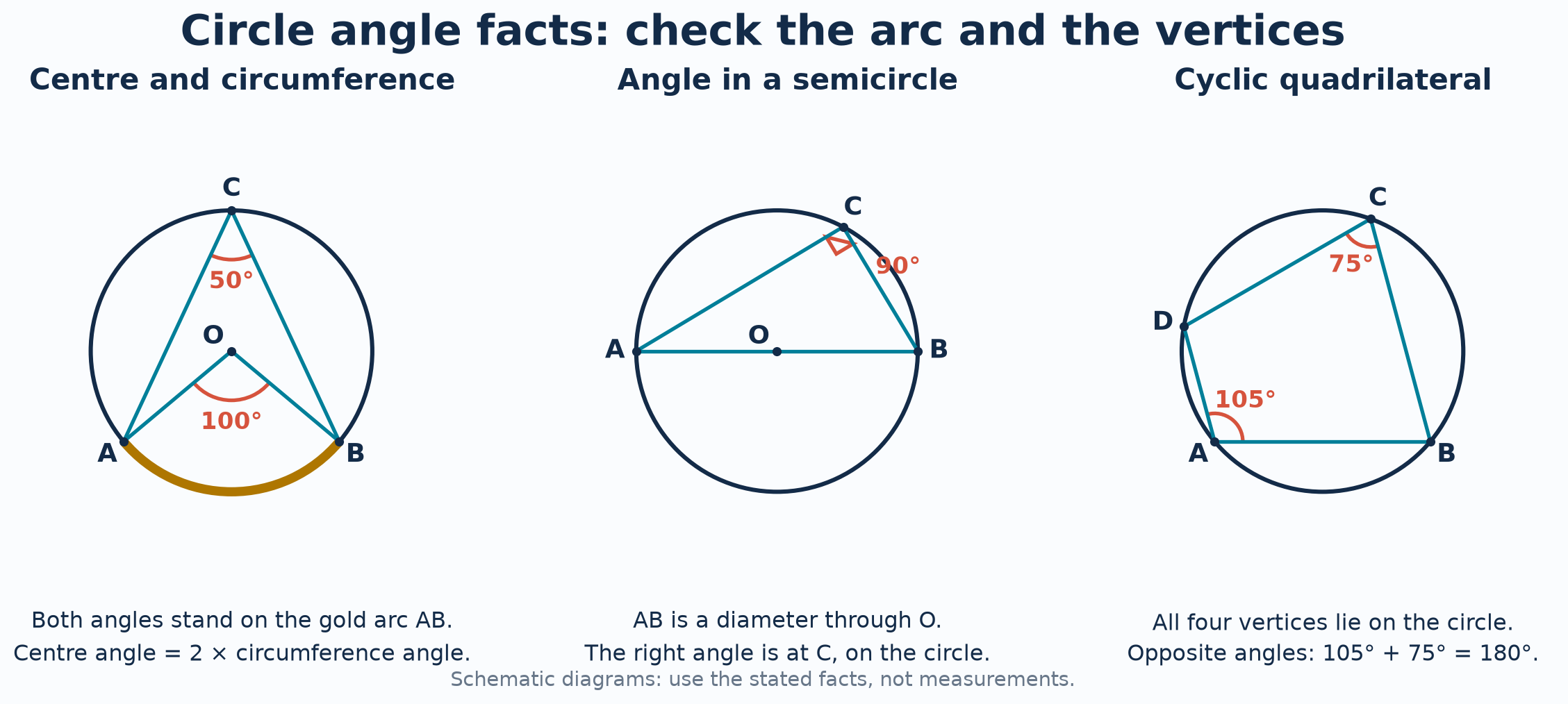
Theorem: the angle subtended by an arc at the centre is twice the angle subtended by the same arc at the circumference. If θ is the matching centre angle and β the circumference angle, θ = 2β.
Example: ∠ACB = 50° gives the corresponding ∠AOB = 100°. If ∠ACB = 120°, the matching centre angle is reflex: 240°. Using the smaller 120° centre angle would select the wrong arc.
Why it works: join OA, OB and OC. In the configuration where OC lies inside ∠ACB, let ∠ACO = a and ∠OCB = b. Equal radii make triangles AOC and BOC isosceles, so ∠AOC = 180° − 2a and ∠BOC = 180° − 2b. The remaining angle around O is θ = 360° − (180° − 2a) − (180° − 2b) = 2(a + b). Since β = a + b, θ = 2β.
For the other configurations, extend CO to a diameter CD. The exterior angle ∠AOD is twice ∠ACO, and ∠BOD is twice ∠BCO. Add these component angles when OD lies between OA and OB; subtract when they lie on the same side. Select the central sweep belonging to the arc that excludes C. This handles the outside-centre configurations without assuming the pictured case is universal.
2. Angle in a semicircle: ninety at the circumference
Theorem: an angle subtended by a diameter at the circumference is 90°.
Proof: diameter AB gives a 180° angle at O. The centre theorem makes the corresponding circumference angle 180° ÷ 2 = 90°.
Example: if AB is a diameter and ∠CAB = 32°, then ∠ACB = 90° and ∠ABC = 180° − 90° − 32° = 58°. Name both the semicircle theorem and the triangle angle sum.
 Open full-size image (opens in a new tab)
3. Angles in the same segment: equal views of one chord
Theorem: angles subtended by the same chord at points on the circumference in the same segment are equal. For C and D on the same side of chord AB, ∠ACB = ∠ADB.
Proof: both are half the same centre angle, so they are equal. Moving C along its arc preserves the angle, provided C does not reach A or B.
Example: ∠ACB = 47° gives ∠ADB = 47°. If D moves to the other side of AB, this equality no longer follows. In the resulting cyclic quadrilateral, the opposite angles instead sum to 180°.
4. Cyclic quadrilateral: opposite angles supplement
Theorem: opposite interior angles of a cyclic quadrilateral add to 180°. All four vertices must lie on one circle. For A, B, C, D in order, ∠DAB + ∠BCD = 180°.
Proof: the arcs intercepted by these opposite angles together form the full 360° circle. Each circumference angle is half its corresponding arc's centre angle, so their sum is 360° ÷ 2 = 180°.
Example: ∠DAB = 105° gives ∠BCD = 75°. Do not subtract an adjacent angle unless another stated relationship permits it.
A related result is that an exterior angle equals the opposite interior angle. If AB is extended through B to E, ∠CBE = 180° − ∠ABC = ∠ADC. The first equality uses angles on a straight line; the second uses opposite cyclic angles.
5. Tangent and radius: perpendicular at contact
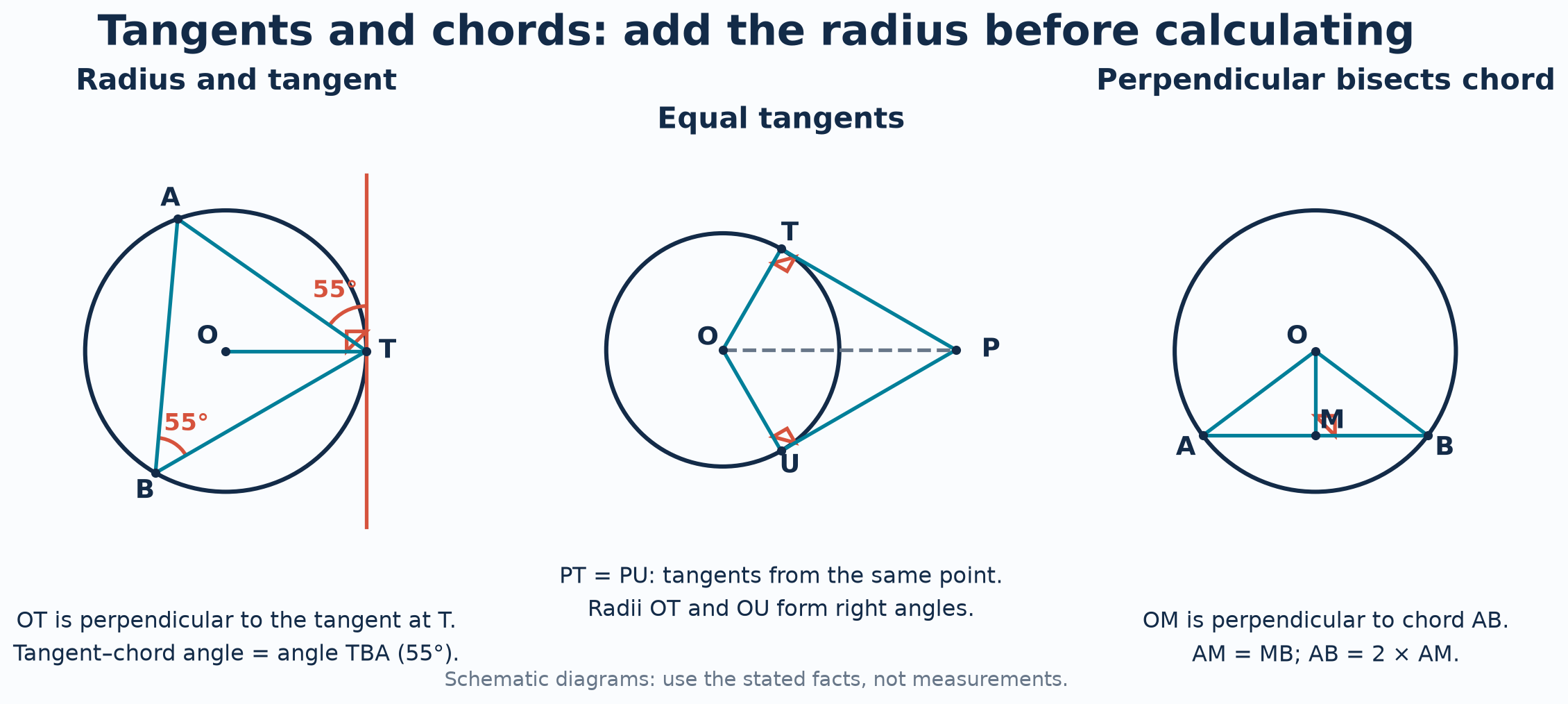
Theorem: a tangent is perpendicular to the radius at its point of contact T. Thus OT makes 90° with the tangent, not necessarily with a chord through T.
Why this must hold: let H be the foot of the perpendicular from O to the tangent line. If H ≠ T, then OH < OT = r. A line whose distance from O is less than r cuts the circle twice: Pythagoras gives two points on the line, on either side of H, each at distance √(r² − OH²) from H. This contradicts tangency. Therefore H = T and OT is perpendicular to the tangent.
Example: if OP = 10 cm and OT = 6 cm, where PT is tangent, triangle OTP is right-angled at T. Hence PT = √(10² − 6²) = 8 cm.
6. Equal tangents: same external point
Theorem: tangent segments PT and PU drawn from the same external point P have equal lengths.
Proof: join OP, OT and OU. The triangles OTP and OUP are right-angled at T and U. OT = OU because they are radii; OP is their common hypotenuse. They are congruent by RHS: right angle, hypotenuse, side. Corresponding sides give PT = PU.
Example: if PT = 3x + 1 and PU = 5x − 9, then 3x + 1 = 5x − 9, so x = 5 and both lengths are 16 units. Equal tangent lengths also make triangle PTU isosceles. Congruence shows OP bisects ∠TPU, but this must not be assumed merely from a symmetric-looking sketch.
 Open full-size image (opens in a new tab)
7. Centre perpendicular: halves a chord
Theorem: a perpendicular from the centre to a chord bisects the chord. If OM ⟂ AB, then AM = MB.
Proof: triangles OMA and OMB are right-angled at M, have equal hypotenuses OA and OB, and share OM. RHS congruence gives AM = MB. If AB passes through O, its halves are simply equal radii.
Example: with radius 13 cm and OM = 5 cm, AM² = 13² − 5² = 144, so AM = 12 cm and AB = 24 cm. Candidates commonly earn the Pythagoras credit but lose the final answer by reporting only half the chord.
The converse also holds: joining the centre to a non-diameter chord's midpoint gives a perpendicular. Prove it using SSS congruence; the two equal adjacent angles on AB total 180°, so each is 90°.
8. Alternate segment: tangent to chord, then across the circle
Theorem: the angle between a tangent and a chord through the point of contact equals the angle subtended by that chord in the alternate segment. Trace the chord's endpoints to identify the corresponding circumference angle. Choose the segment opposite the tangent angle's region, not simply the nearest triangle.
Example: the 55° angle between the tangent at T and chord TA in the diagram equals ∠TBA = 55°.
Proof: for a non-diameter chord AT, let the minor centre angle ∠AOT = θ. Equal radii give ∠OAT = ∠ATO = (180° − θ)/2. The acute angle t between chord AT and the appropriate tangent ray is t = 90° − (180° − θ)/2 = θ/2. A circumference angle on the major arc AT also equals θ/2 by the centre theorem. The obtuse tangent angle is 180° − θ/2 and matches a circumference angle on the minor arc, which subtends the reflex centre angle 360° − θ. If AT is a diameter, both relevant angles are 90°.
Mathematical Relationships and Formula-Sheet Status
The following statuses refer to AQA's 2027 Higher formula sheet, checked against the official insert. Circle theorems are not printed there. The sheet supplies some calculation formulas, but selecting the correct geometry remains the candidate's task. 2
Must memorise: circle relationships. θ = 2β for the same arc; ∠ACB = 90° when AB is a diameter; ∠ACB = ∠ADB in the same segment; opposite cyclic angles A + C = 180°; radius ⟂ tangent; PT = PU for tangents from P; AM = MB when OM ⟂ chord AB; and tangent–chord angle = matching alternate-segment angle. Letters name angles or lengths in the stated configuration, not universal labels.
Must memorise: supporting relationships. Triangle angles total 180°; quadrilateral angles total 360°; angles on a straight line total 180°; angles around a point total 360°. Isosceles base angles are equal. Diameter d = 2r. For radius r, centre-to-chord distance h and full chord L, L = 2√(r² − h²). For tangent length t and centre-to-external-point distance s, t = √(s² − r²). The latter two are useful derived relationships: you can reconstruct them using the provided Pythagoras formula rather than memorising separate shortcuts.
Given on formula sheet: a² + b² = c², where c is the hypotenuse; sin x = opposite/hypotenuse, cos x = adjacent/hypotenuse, tan x = opposite/adjacent; circumference C = 2πr = πd; circle area A = πr². Broader synoptic questions may use the supplied sine rule a/sin A = b/sin B = c/sin C, cosine rule a² = b² + c² − 2bc cos A, or triangle area = ½ab sin C.
Must memorise or derive for synoptic questions: arc length = (θ/360°) × 2πr and sector area = (θ/360°) × πr². These fractions-of-a-circle formulas are not printed on the insert. Here θ is a centre angle in degrees.
Angles use degrees; set a calculator to degree mode for GCSE trigonometry. Convert lengths to one unit before squaring: 50 mm = 5 cm, not 50 cm. Also 1 cm² = 100 mm². Radians are not required for this topic.
Exam Technique: What Earns Credit
Use angle, calculation, reason when reasoning is requested: “∠ACB = 90°, angle in a semicircle; ∠ABC = 180° − 90° − 32° = 58°, angles in a triangle.” For a proof, start with the givens, introduce letters, justify each equality, and finish with the required statement. Do not assume the result you are proving.
A genuine example is AQA June 2024, 8300/1H, Q22: one accepted route awards M1 for establishing a radius–tangent right angle, M1dep for the ensuing angle calculation, and A1 for 78°. Other methods are accepted. The scheme also explicitly allows the correct answer 78 for full credit, so it would be misleading to claim written reasons are compulsory in every calculation question. Follow the actual instructions. 3
Each AQA paper lasts 90 minutes for 80 marks: approximately 68 seconds per mark overall. A 3-mark example merits roughly 3–4 minutes; a 6-mark proof roughly 6–7 minutes. These are planning guides, not official per-question limits. This topic can appear on any Higher paper. 4
Practical Applications and Diagram Skills
Tangency helps explain why a straight belt leaving a circular pulley is perpendicular to the radius at contact. Chord bisection helps locate the centre of a circular object: construct perpendicular bisectors of two non-parallel chords; their intersection is the centre. These applications reinforce perpendicularity and congruence rather than replace proof.
There is no required practical for this Mathematics topic. Ruler-and-compass work belongs to related construction content. Measuring a sketch may help exploration, but it cannot establish an exact angle or a general theorem. No statistical graph plotting is required here; read vertices, arcs and marked right angles accurately. A coordinate extension can use the perpendicularity of a tangent and radius.
Listen, Recall and Connect
The ten-minute podcast has an introduction, five minutes of core concepts, two minutes of exam tips, a one-minute recall quiz, and a one-minute summary. Close the text during the quiz. Afterwards, explain why a radius creates an isosceles triangle and why a centre perpendicular gives only half a chord. Repeat the missed prompts tomorrow and several days later; check answers only after a genuine attempt.
References
Check what you remember
Read the wording for your board, then hide it and explain Circle in your own words. Rough notes are fine. This is a self-check, with no mark or grade.
Reference: AQA
The set of points in a plane at a fixed distance from a fixed point, the centre.
Interactive Diagrams
2 interactive diagrams to visualise key concepts
Conceptual Flow Outline
A first-pass problem-solving checklist, not an exclusive choice tree: after any first theorem, return to the diagram and check the other available facts.
Conceptual Flow Outline
How the proofs connect. For chord bisection the right angle is a given centre-to-chord perpendicular; for equal tangents it comes from the tangent–radius theorem.
Worked Examples
5 worked examples — open one to explore the question and available guidance.
Practice Questions
Try the question, then reveal an answer plan or example response
Original practice, 3 marks. C and D lie in the same segment of chord AB. ∠ACB = 3x + 8 degrees and ∠ADB = 5x − 14 degrees. Work out x and the common angle. Give a reason for your equation.
Hint: Foundation here means introductory difficulty within this Higher-only topic, not Foundation-tier assessment. Both angles stand on chord AB from the same side.
Original practice, 3 marks. ABCD is a cyclic quadrilateral, with vertices in that order. ∠DAB = 4x + 10 degrees and ∠BCD = 2x + 20 degrees. Calculate x and ∠DAB. Give the circle-theorem reason.
Hint: A and C are opposite vertices.
Original practice, 3 marks. PT is tangent to a circle at T. The centre is O, OP = 17 cm and OT = 8 cm. Calculate PT, showing your working.
Hint: Add the radius and identify the hypotenuse.
Original practice, 4 marks. A circle has radius 10 cm. OM is perpendicular to chord AB at M and AB = 16 cm. Calculate OM. Give reasons and show working.
Hint: The right triangle contains half of AB.
Original practice, 4 marks. A tangent at T and chord TA make an acute angle of 61°. B lies in the corresponding alternate segment. In triangle ATB, ∠TAB = 47°. Work out ∠TBA and ∠ATB. Give reasons.
Hint: The tangent angle corresponds to the angle whose arms end at T and A.
Original practice, 6 marks. PT and PU are tangents to a circle with centre O at distinct points T and U. Prove that PT = PU and that OP bisects ∠TPU. You may use tangent–radius perpendicularity and triangle congruence, but do not assume equal tangents.
Hint: Compare triangles OTP and OUP by RHS, then identify corresponding sides and angles.
Ready to test yourself interactively?
Active recall beats reading alone. Answer questions on Properties and constructions: apply and prove the standard circle theorems concerning angles, radii, tangents and chords, and use them to prove related results (Higher tier only) with instant AI scoring and mark scheme guidance.
A week of Premium from your first lesson · Then the free plan continues · No card, no charge
Exam technique
How to turn what you know into marks
How to approach the question
Read the required angle or length and the command word. Mark given facts, identify the relevant arc, and add useful radii. Work backwards from the target if the next theorem is unclear. Combine circle facts with triangle angles, congruence, algebra or Pythagoras. Check whether your answer is minor or reflex, a half-chord or full chord, and whether the question requests reasons.
How to structure your answer
For short calculations, give the requested value and show relevant working when instructed. For 3–4 marks, make each meaningful theorem or calculation visible. For longer proofs, define letters, state equalities and reasons, and explicitly reach the required conclusion. Marks are not automatically one per written line. The genuine AQA June 2024 8300/1H Q22 scheme illustrates M1, M1dep and A1, and also permits the correct answer alone there; do not generalise that exception to proof questions.
Timing
AQA papers have 80 marks in 90 minutes, approximately 68 seconds per mark overall. Plan roughly 3–4 minutes for 3 marks and 6–7 minutes for 6 marks, adjusting for difficulty and checking. These are revision pacing guides, not official per-question limits.
Common pitfalls
- Doubling using the wrong arc: trace both endpoints and choose the arc not containing the circumference vertex.
- Reporting a reflex centre angle when the minor angle is requested: subtract the reflex angle from 360°.
- Saying opposite cyclic angles are equal: their sum is 180°; same-segment angles are the equal pair.
- Assuming a line is a tangent or diameter from appearance: use the stated facts or establish the required property.
- Reporting half a chord: a centre perpendicular gives AM, but the full chord is 2AM.
- Using the theorem being proved as a reason: build the argument from other established facts.
- Using a numerical example as a proof: introduce letters and show the result follows for the stated general configuration.
- Mixing millimetres with centimetres inside Pythagoras: convert all lengths first.
What the command words want
- Prove
- Give a logical general argument. Define letters if needed, justify each step, and do not assume the conclusion.
- Compare
- If asked to compare two angles or lengths, establish their relationship mathematically, for example equal or supplementary. Do not force an essay-style similarities-and-differences answer onto an angle question.
- Explain
- Connect the conclusion to a valid fact: for example, the base angles are equal because the two sides are radii of the same circle.
- Describe
- Describe the stated geometrical feature precisely, such as a radius perpendicular to a tangent. This is less central here than work out or prove.
- Evaluate
- In Mathematics, evaluate normally means find the value of an expression, not weigh both sides of an argument. It is not the main command word for circle proofs.
- Show that
- Derive the supplied result from the givens. Because the answer is already supplied, copying it is not evidence of a method.
- State/Give
- Provide the requested value, fact or theorem concisely. If asked for a reason, state the mathematical reason rather than only the number.
- Give reasons
- Name each theorem or supporting angle fact where used. Avoid vague explanations such as circle rule or it looks equal.
- Calculate/Work out
- Find the requested angle or length. Show working when instructed; label units and name reasons when requested. Use a calculator only on an allowed paper.
Watch or listen (optional)
Test your understanding of Properties and constructions: apply and prove the standard circle theorems concerning angles, radii, tangents and chords, and use them to prove related results (Higher tier only)
Active recall beats re-reading. Take an instant quiz now to test what you’ve learned and lock it into long-term memory.
A week of Premium from your first lesson · Then the free plan continues · No card, no charge