AQA · GCSE · Mathematics
Course version: 8300 · Version from Sept 2015
Use ratio notation, including reduction to simplest form
Full specification wording
Ratio, proportion and rates of change: use ratio notation, including reduction to simplest form
Ratio notation compares quantities of the same kind using a colon, for example 3 : 5.
Checked against the AQA 8300 specification (opens in a new tab) on .
- Point 5 of 21
- 2 key terms
Study notes
From the checked teaching notes for this specification point.
The idea
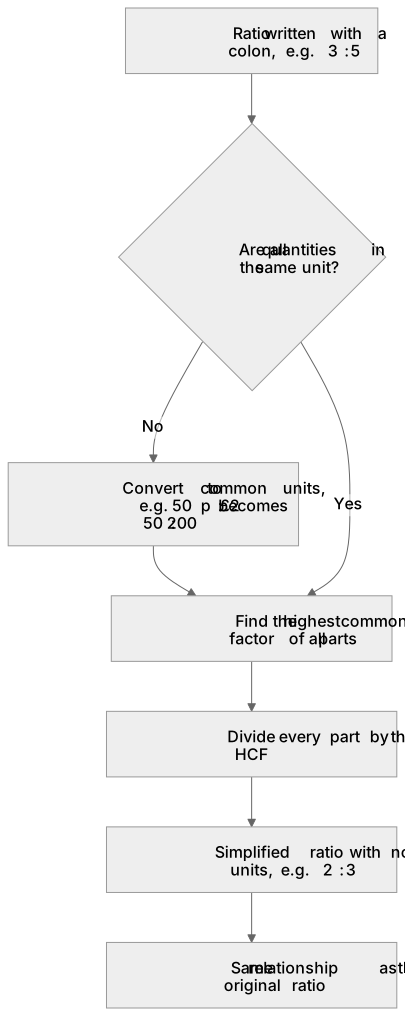
Ratio notation compares quantities of the same kind using a colon, for example 3 : 5. To reduce a ratio to simplest form, divide every part by the highest common factor of all the parts. For instance, 12 : 18 has HCF 6, so it reduces to 2 : 3. A ratio such as 4 : 6 : 10 reduces by 2 to 2 : 3 : 5. Units must match before simplifying; if they differ, convert first, for example 50 p : £2 becomes 50 : 200, then 1 : 4. Ratios have no units in their final form. A ratio written as a fraction, such as 3/5, can be read as the ratio 3 : 5 only when the whole is split into 5 equal parts. Simplifying does not change the relationship between the quantities, only the size of the numbers used to express it.
What earns the marks
- Write a ratio using a colon between the quantities, for example 3 : 5.
- Reduce a ratio by dividing all parts by their highest common factor.
- Convert to common units before simplifying when the quantities are measured in different units.
- Recognise that a simplified ratio represents the same relationship as the original ratio.
- Express a ratio in the form 1 : n or n : 1 when a unitary comparison is required.
Common mistakes and how to put them right
Subtracting instead of dividing when simplifying.
Put it right: Divide both parts by the HCF, giving 2 : 3.
Simplifying only one part of the ratio.
Put it right: Divide every part by the same factor, giving 2 : 3.
Leaving different units in the ratio.
Put it right: Convert to the same unit first, giving 50 : 200, then 1 : 4.
Exam tips
- Check that all quantities in the ratio are in the same unit before you simplify.
- Find the highest common factor of all parts, not just the first two, when the ratio has three or more parts.
- Write the simplified ratio with a colon and no units, and check that multiplying back gives the original quantities.
Try the lesson
The start of the Ratio, proportion and rates of change: use ratio notation, including reduction to simplest form lesson, made from checked teaching notes for this specification point.
Have a go first
A fruit bowl contains 6 apples and 9 oranges. Write the ratio of apples to oranges in its simplest form.
Listen
Ratio notation compares quantities of the same kind using a colon, for example 3 : 5. To reduce a ratio to simplest form, divide every part by the highest common factor of all the parts. For instance, 12 : 18 has HCF 6, so it reduces to 2 : 3. A ratio such as 4 : 6 : 10 reduces by 2 to 2 : 3 : 5. Units must match before simplifying; if they differ, convert first, for example 50 p : £2 becomes 50 : 200, then 1 : 4. Ratios have no units in their final form. A ratio written as a fraction, such as 3/5, can be read as the ratio 3 : 5 only when the whole is split into 5 equal parts. Simplifying does not change the relationship between the quantities, only the size of the numbers used to express it. A strong answer earns marks for these points. Write a ratio using a colon between the quantities, for example 3 : 5. Reduce a ratio by dividing all parts by their highest common factor. Convert to common units before simplifying when the quantities are measured in different units. Recognise that a simplified ratio represents the same relationship as the original ratio. A common slip: Subtracting instead of dividing when simplifying: for example, treating 12 : 18 as 12 − 6 : 18 − 6. Instead, divide both parts by the HCF, giving 2 : 3. Exam tip: Check that all quantities in the ratio are in the same unit before you simplify.
See it
Watch it explained
What is the one idea the video explains? Say it in a sentence.
Read the described scene instead
Ratio notation compares quantities of the same kind using a colon. For example, the ratio three to five is written three colon five. The colon separates the quantities. Ratios describe a relationship between quantities. To reduce a ratio to simplest form, divide every part by the highest common factor of all the parts. The highest common factor is the largest number that divides each part exactly. Simplifying does not change the relationship between the quantities; it only changes the size of the numbers used to express that relationship. Start by checking that all quantities use the same unit. Then find the highest common factor of every part, not just the first two. Divide each part by that factor. Write the result as a ratio with a colon and no units. Always check that multiplying back gives the original quantities. Let's simplify twelve colon eighteen. The highest common factor of twelve and eighteen is six. Pause and think: what do you divide each part by? Divide both parts by six. Twelve divided by six is two, and eighteen divided by six is three. So twelve colon eighteen simplifies to two colon three. Do not subtract instead of dividing. For example, twelve colon eighteen is not twelve minus six colon eighteen minus six; divide both parts by the highest common factor to get two colon three. Do not simplify only one part: four colon six becomes two colon three, not two colon six. And do not leave different units in a ratio. Convert first: fifty pence to two pounds becomes fifty to two hundred, then one to four. Remember: write ratios with a colon, and reduce by dividing all parts by their highest common factor. Convert to common units before simplifying, and leave no units in the final ratio. When a unitary comparison is required, express the ratio in the form one to n or n to one. A simplified ratio represents the same relationship as the original ratio. A fraction such as three fifths can be read as the ratio three colon five only when the whole is split into five equal parts.
Key words
Say what each word means before you turn the card.
Ratio notation
Try answering aloud or in your head before turning the card.
Simplest form
Try answering aloud or in your head before turning the card.
See every definition
- Ratio notation
- Compares quantities of the same kind using a colon, for example 3 : 5.
- Simplest form
- Reached by dividing every part of a ratio by the highest common factor of all the parts.
There is more to this lesson
The full lesson goes on to check your understanding and help you earn the marks. Create a free account to carry on, with your progress saved.
A week of Premium from your first lesson · Then the free plan continues · No card, no charge
Test your understanding of Ratio, proportion and rates of change: use ratio notation, including reduction to simplest form
Active recall beats re-reading. Take an instant quiz now to test what you’ve learned and lock it into long-term memory.
A week of Premium from your first lesson · Then the free plan continues · No card, no charge