Pearson Edexcel · A-Level · Mathematics
Evaluate the analytical solution of simple first order differential equations with separable variables, including finding particular solutions (separation of variables may require factorisation involving a common factor)
Mastering first-order differential equations unlocks your ability to model real-world change, from population growth to radioactive decay. This guide breaks down the separation of variables technique into a foolproof 4-step method to secure maximum marks in your exam.
- 4 min read
- 3 worked examples
- 5 practice questions
- 6 key terms
Study Notes
Overview
Differential equations are the mathematical language of change. While algebra tells us about static quantities, differential equations describe how things evolve over time—whether it's the cooling of a cup of coffee, the spread of a virus, or the trajectory of a rocket. In GCSE Mathematics, mastering first-order differential equations through the technique of separation of variables is a high-level skill that consistently appears in challenging exam questions.
This topic is crucial because it bridges pure calculus with applied mathematics. You will need to draw upon your knowledge of algebraic factorisation, integration, and substituting boundary conditions. Examiners frequently use these questions to differentiate top-tier candidates, as they require a logical, multi-step approach.
Listen to our companion podcast for a complete walkthrough of this topic:

Key Concepts
Concept 1: What is a Differential Equation?
A differential equation is simply an equation that contains a derivative (such as \frac{dy}{dx}). Instead of asking "what is the value of y?", it asks "given how y changes, what is the original function y?"
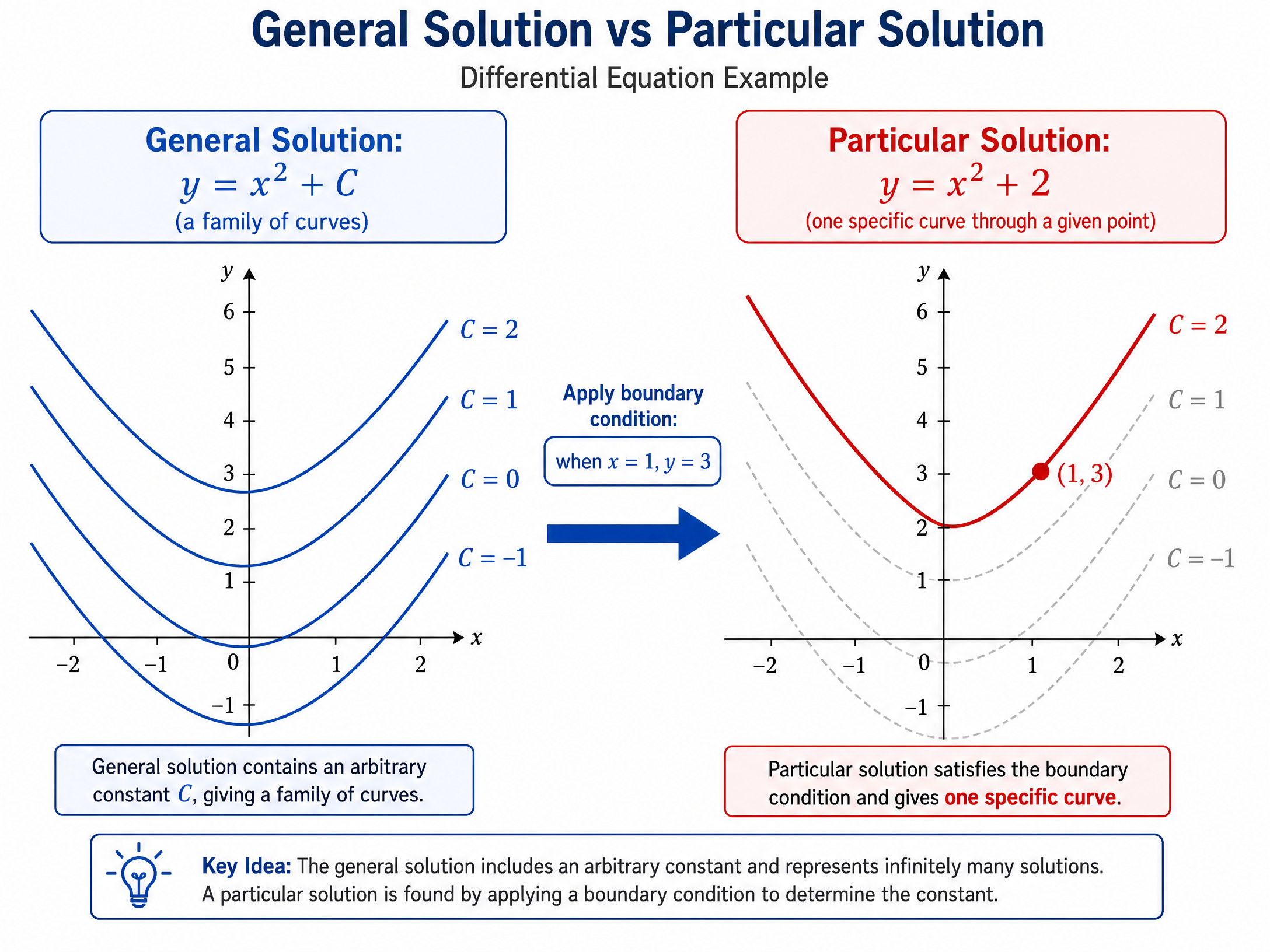
Example: If \frac{dy}{dx} = 2x, we are looking for a function whose gradient is always 2x. We know from basic integration that y = x^2 + C satisfies this condition.
Concept 2: The Separation of Variables Method
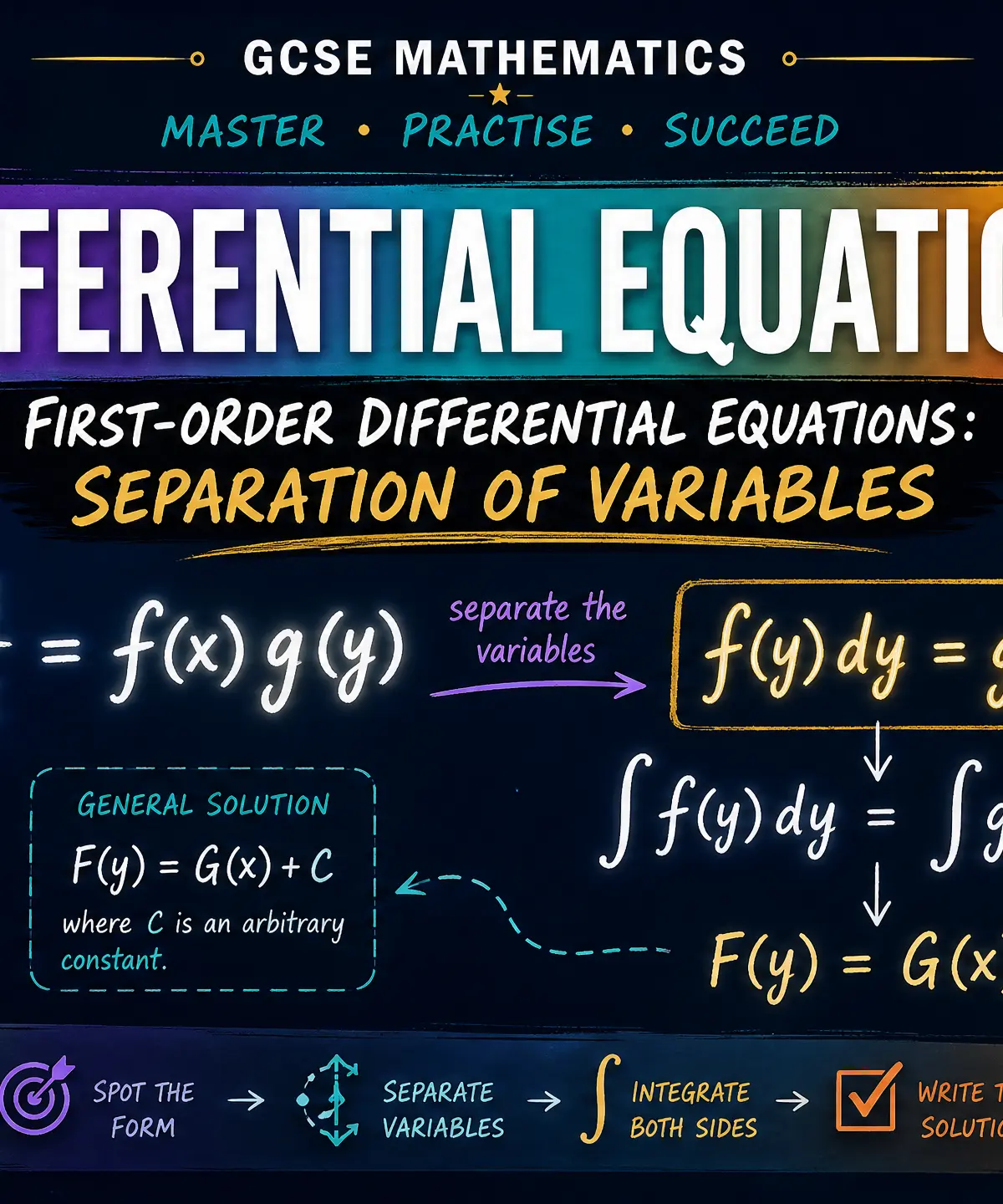
Not all differential equations can be solved easily, but if an equation can be rearranged so that all y terms (including dy) are on one side, and all x terms (including dx) are on the other, it is separable.
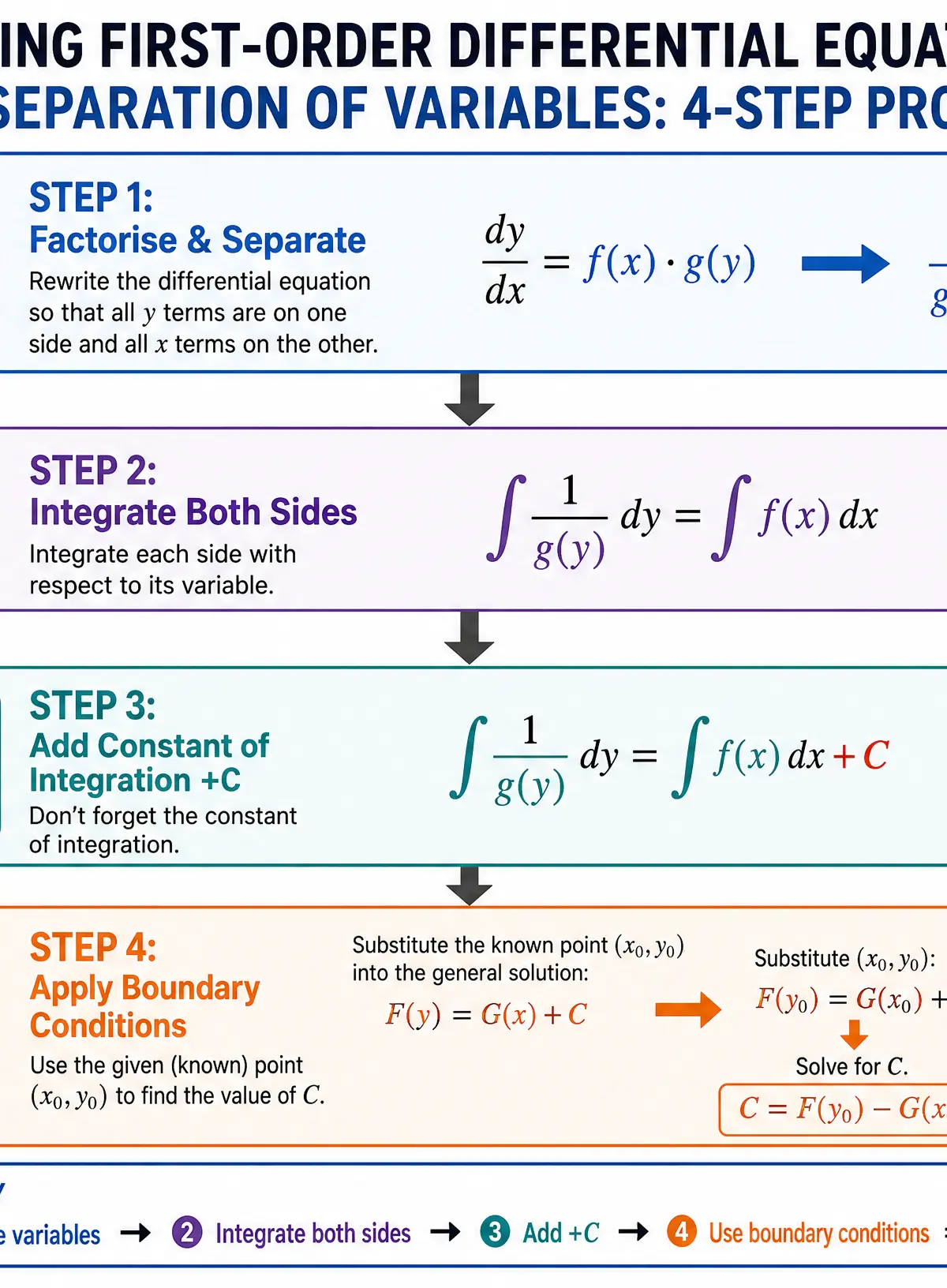
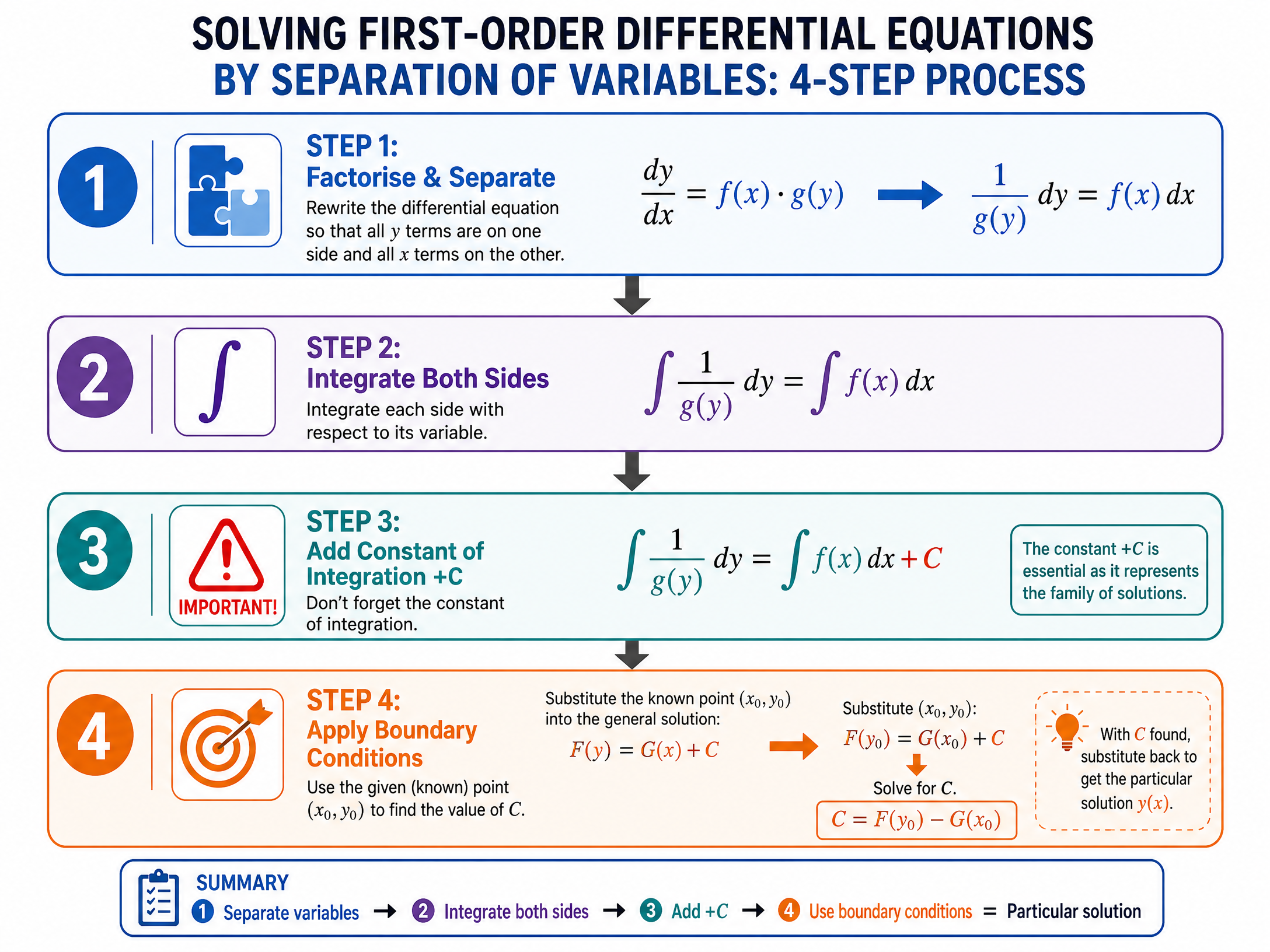
The golden rule is to look for equations in the form \frac{dy}{dx} = f(x)g(y). If it is in this form, you can separate it by dividing by g(y) and multiplying by dx:
\frac{1}{g(y)} dy = f(x) dx
Once separated, you integrate both sides. This transforms the differential equation back into an algebraic equation linking y and x.
Concept 3: Factorisation Before Separation
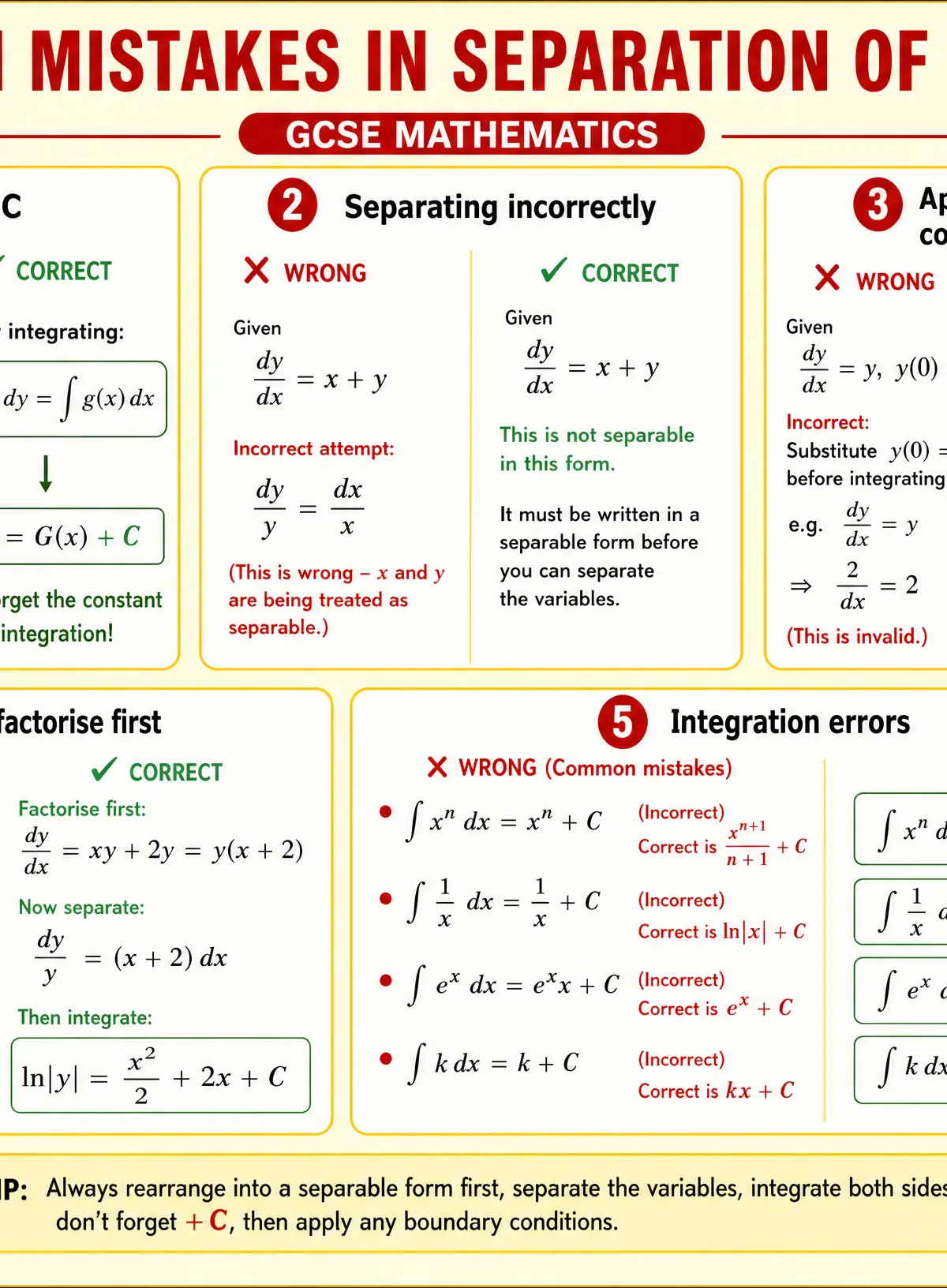
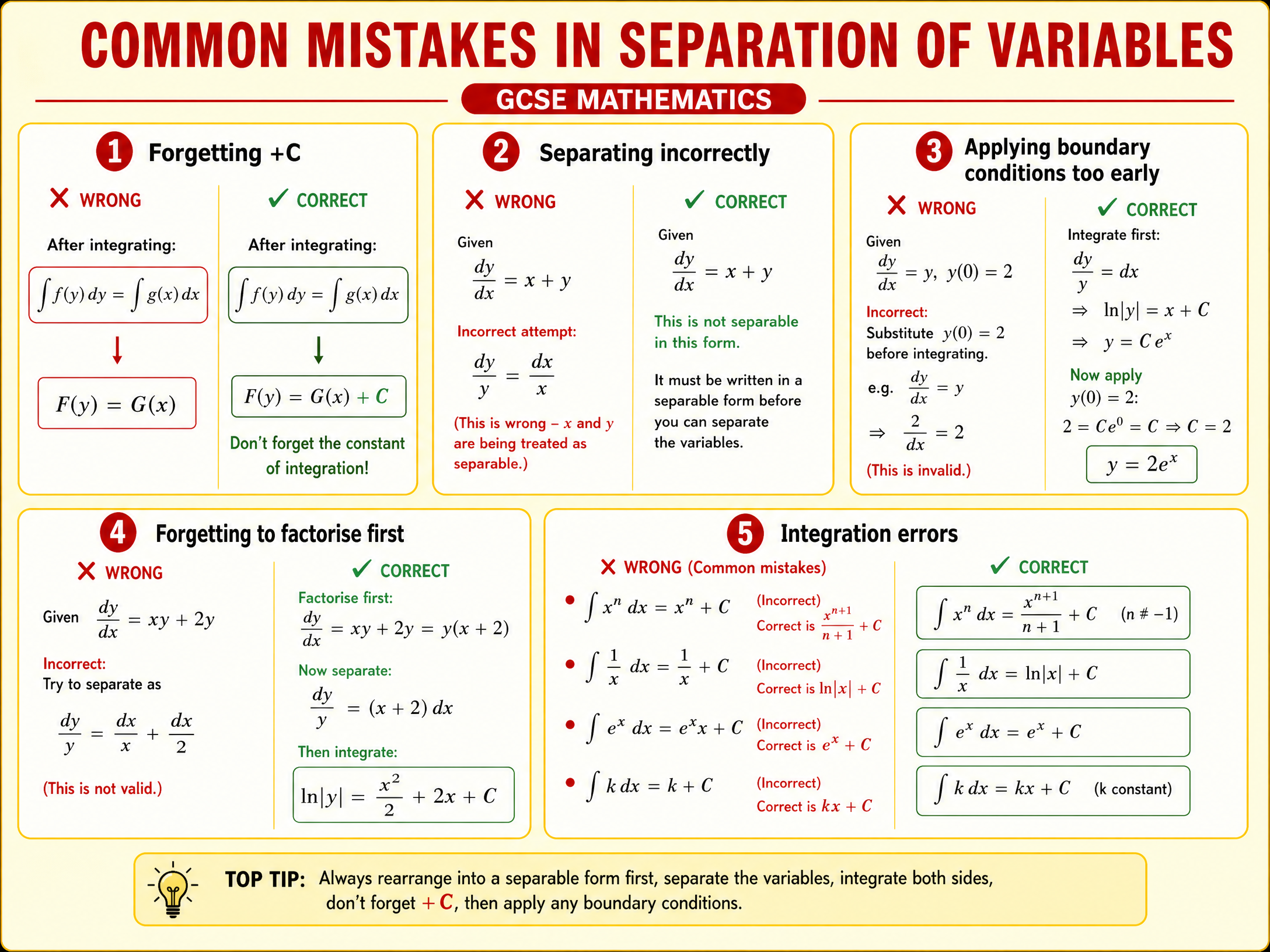
Examiners rarely give you the equation in an immediately separable form. They will often hide it by adding terms. You must factorise the expression first.
Example: \frac{dy}{dx} = xy + 3y
If you try to separate this directly, you will fail. You must spot the common factor of y on the right-hand side:
\frac{dy}{dx} = y(x + 3)
Now it is separable: \frac{1}{y} dy = (x + 3) dx.
Concept 4: General vs Particular Solutions
When you integrate, you must add a constant of integration, +C. The solution containing +C is called the General Solution. It represents a whole family of curves.
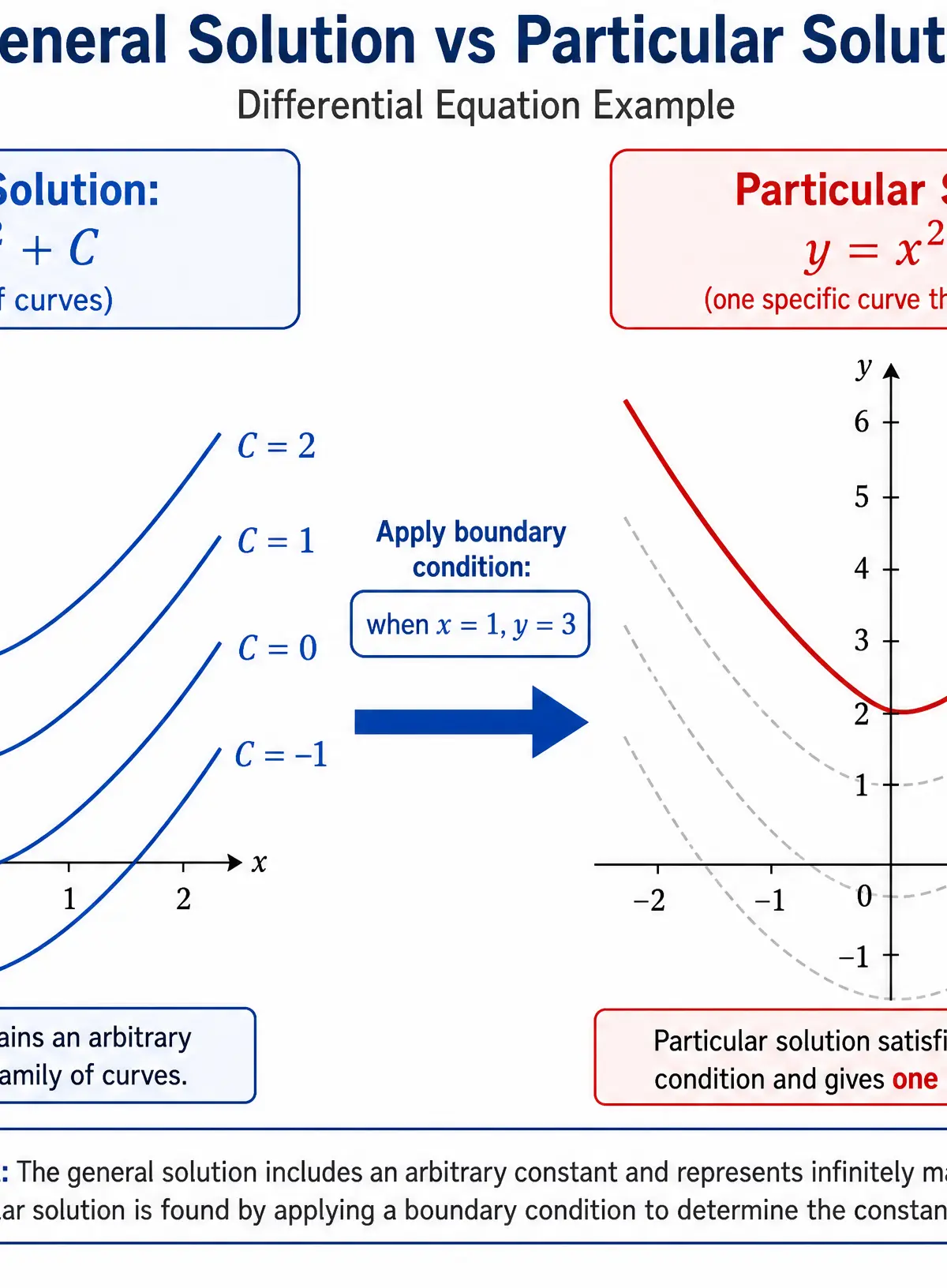
To find the Particular Solution (one specific curve), the question will provide a boundary condition (a known coordinate point, e.g., "when x=0, y=5"). You substitute these values into your general solution to calculate the exact value of C.
Mathematical/Scientific Relationships
Standard Integrals Required
You must have these memorised to successfully solve the separated equations:
- \int x^n dx = \frac{x^{n+1}}{n+1} + C (for $n
eq -1$) - $\int \frac{1}{x} dx = \ln|x| + C$
- \int e^x dx = e^x + C
- \int k dx = kx + C
Practical Applications
Differential equations are not just abstract algebra; they model reality:
- Population Growth: The rate of growth is proportional to the current population: \frac{dP}{dt} = kP. Separating variables gives P = Ae^{kt}.
- Newton's Law of Cooling: The rate of cooling is proportional to the temperature difference between the object and its surroundings: \frac{dT}{dt} = -k(T - T_{env}).
Visual Resources
3 diagrams and illustrations
Interactive Diagrams
2 interactive diagrams to visualise key concepts
Conceptual Flow Outline
Decision flowchart for solving first-order differential equations.
Conceptual Flow Outline
Step-by-step breakdown of the factorisation and separation process.
Worked Examples
3 worked examples — open one to explore the question and available guidance.
Practice Questions
Test your understanding — click to reveal model answers
Find the general solution of the differential equation \frac{dy}{dx} = \frac{2x}{y^2}. Express your answer in the form y^3 = f(x).
Hint: Multiply both sides by $y^2$ to separate the variables.
Given that \frac{dy}{dx} = x(y-2) and y=5 when x=0, find the particular solution for y in terms of x.
Hint: Divide by $(y-2)$ to separate. The integral of $\frac{1}{y-2}$ is $\ln|y-2|$.
Solve \frac{dy}{dx} = y^2 \sin(x) given that y=1 when x=0.
Hint: Write $\frac{1}{y^2}$ as $y^{-2}$ before integrating.
Find the general solution to x \frac{dy}{dx} = y + 3. Express y in terms of x.
Hint: You need to divide by $x$ and divide by $(y+3)$ to separate.
Solve \frac{dy}{dx} = x e^y + 2e^y given that y=0 when x=2.
Hint: Factorise the right-hand side first.