Pearson Edexcel · A-Level · Mathematics
Understand and use the laws of indices for all rational exponents
Mastering the Laws of Indices is essential for unlocking algebra and higher-level mathematics. This guide breaks down the five core rules—from multiplication to fractional indices—giving you the tools to simplify complex expressions and secure vital marks in your GCSE exams.
- 6 min read
- 3 worked examples
- 5 practice questions
- 6 key terms
Study Notes
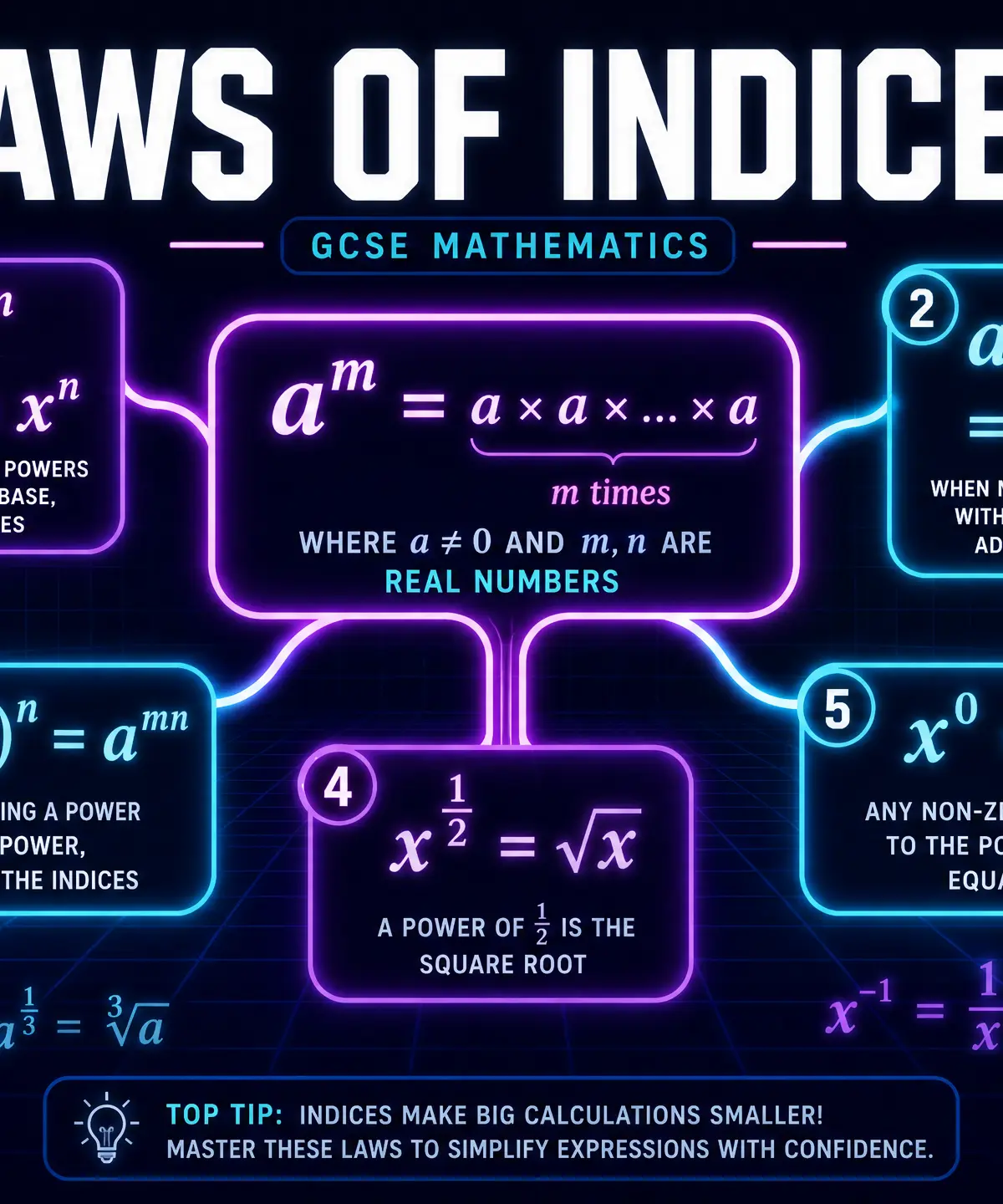
Overview
The Laws of Indices form the bedrock of algebraic manipulation in GCSE Mathematics. An index (also known as a power or exponent) tells you how many times to multiply a base number by itself. While calculating 2^3 is straightforward, exam questions will test your ability to combine, simplify, and evaluate expressions using a specific set of rules.
This topic is critical because it connects to almost every other area of the mathematics specification. You will use these laws when working with standard form, solving algebraic equations, expanding brackets, and calculating compound interest. Examiners frequently use indices to differentiate between grades, particularly with fractional and negative powers on Higher tier papers.
In this guide, we will explore the five fundamental laws, understand the logic behind them, and look at how examiners test these concepts in both numerical and algebraic contexts.
Key Concepts
Concept 1: The Multiplication Law
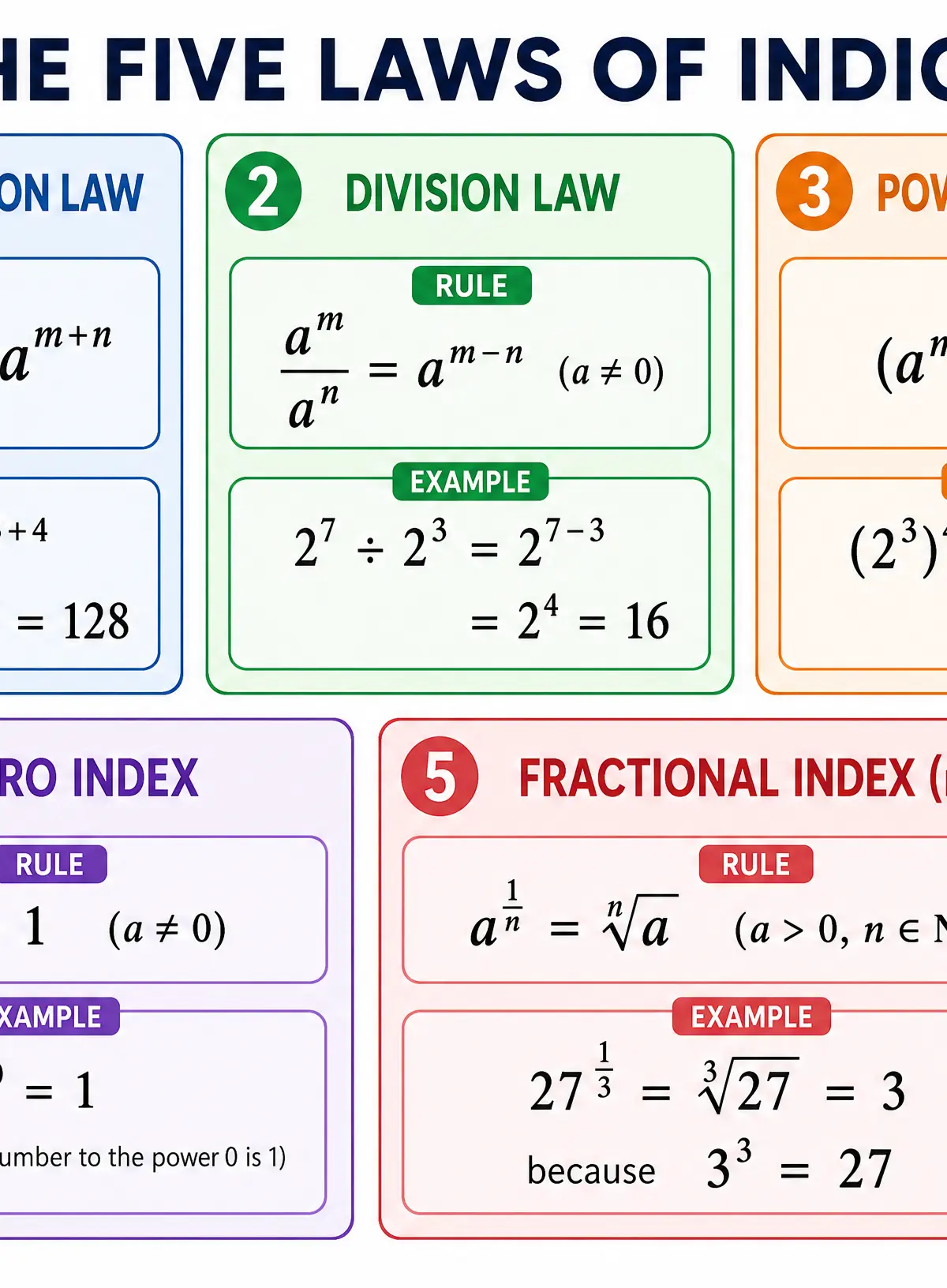
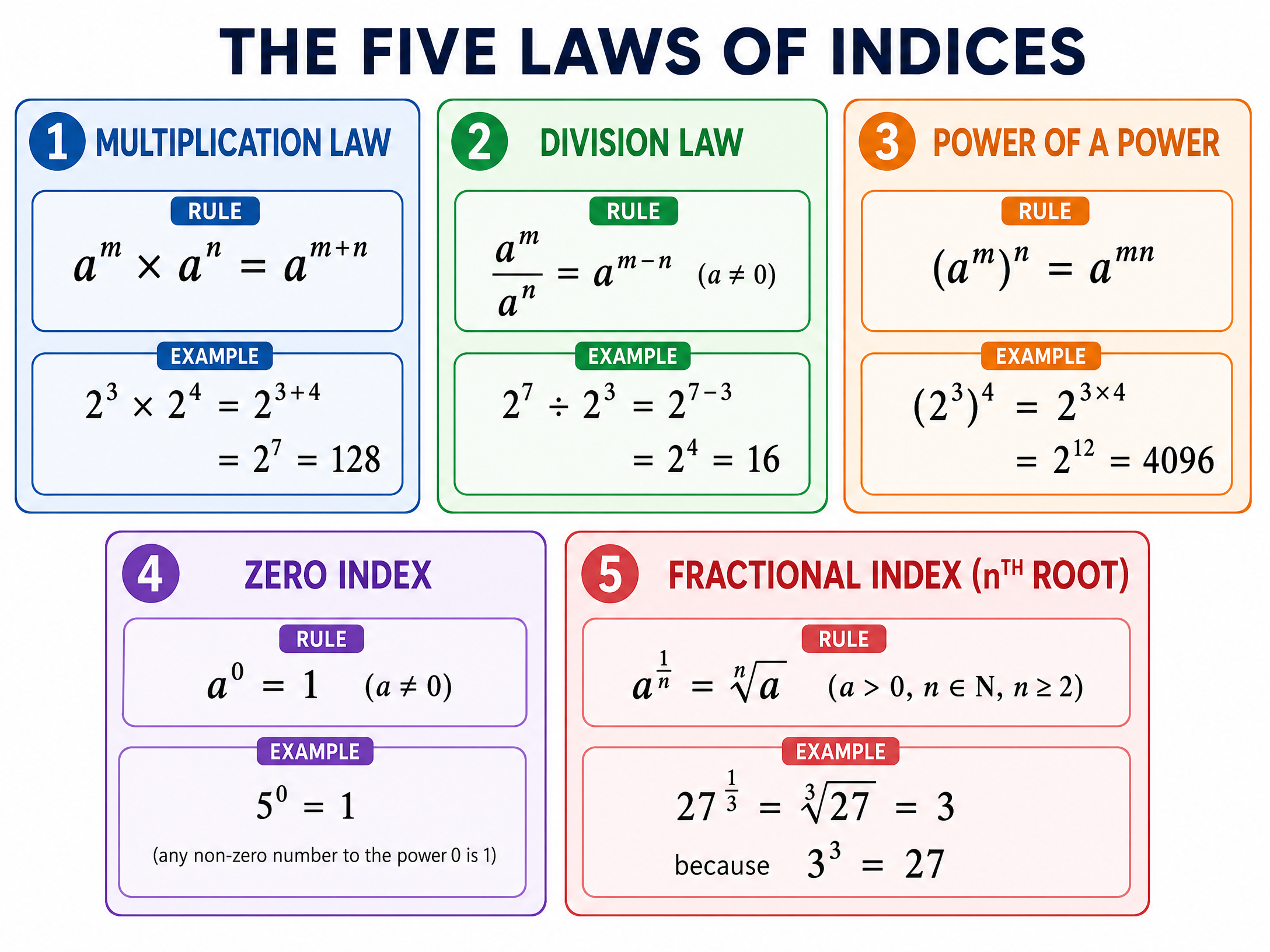
When multiplying terms that have the same base, you add the indices together.
Rule: a^m \times a^n = a^{m+n}
Why it works: If you expand 2^3 \times 2^4, you get (2 \times 2 \times 2) \times (2 \times 2 \times 2 \times 2). Count the 2s, and you have seven of them being multiplied together, which is 2^7. Adding the indices (3 + 4 = 7) is a much faster way to reach the same result.
Example: Simplify x^5 \times x^2
Answer: x^{5+2} = x^7
Concept 2: The Division Law
When dividing terms that have the same base, you subtract the indices.
Rule: a^m \div a^n = a^{m-n}
Why it works: If you have \frac{2^5}{2^3}, you can write it out as \frac{2 \times 2 \times 2 \times 2 \times 2}{2 \times 2 \times 2}. Three of the 2s on the top cancel out with the three 2s on the bottom, leaving 2 \times 2, which is 2^2. Subtracting the indices (5 - 3 = 2) gives the same result instantly.
Example: Simplify y^8 \div y^2
Answer: y^{8-2} = y^6
Concept 3: The Power of a Power Law
When an expression with an index is raised to another power, you multiply the indices together.
Rule: (a^m)^n = a^{mn}
Why it works: Consider (x^3)^2. This means x^3 \times x^3. Using the multiplication law, we add the indices: 3 + 3 = 6. Alternatively, we can just multiply the original indices: 3 \times 2 = 6, giving x^6.
Example: Simplify (p^4)^3
Answer: p^{4 \times 3} = p^{12}
Concept 4: The Zero Index
Any non-zero number or algebraic term raised to the power of zero is exactly 1.
Rule: a^0 = 1 (where $a
eq 0$)
Why it works: Let's use the division law on an expression where the numerator and denominator are identical, such as \frac{x^4}{x^4}. We know that anything divided by itself is 1. But if we apply the division law and subtract the indices, we get x^{4-4} = x^0. Therefore, x^0 must equal 1.
Example: Evaluate 17^0
Answer: 1
Concept 5: Fractional Indices (Higher Tier)
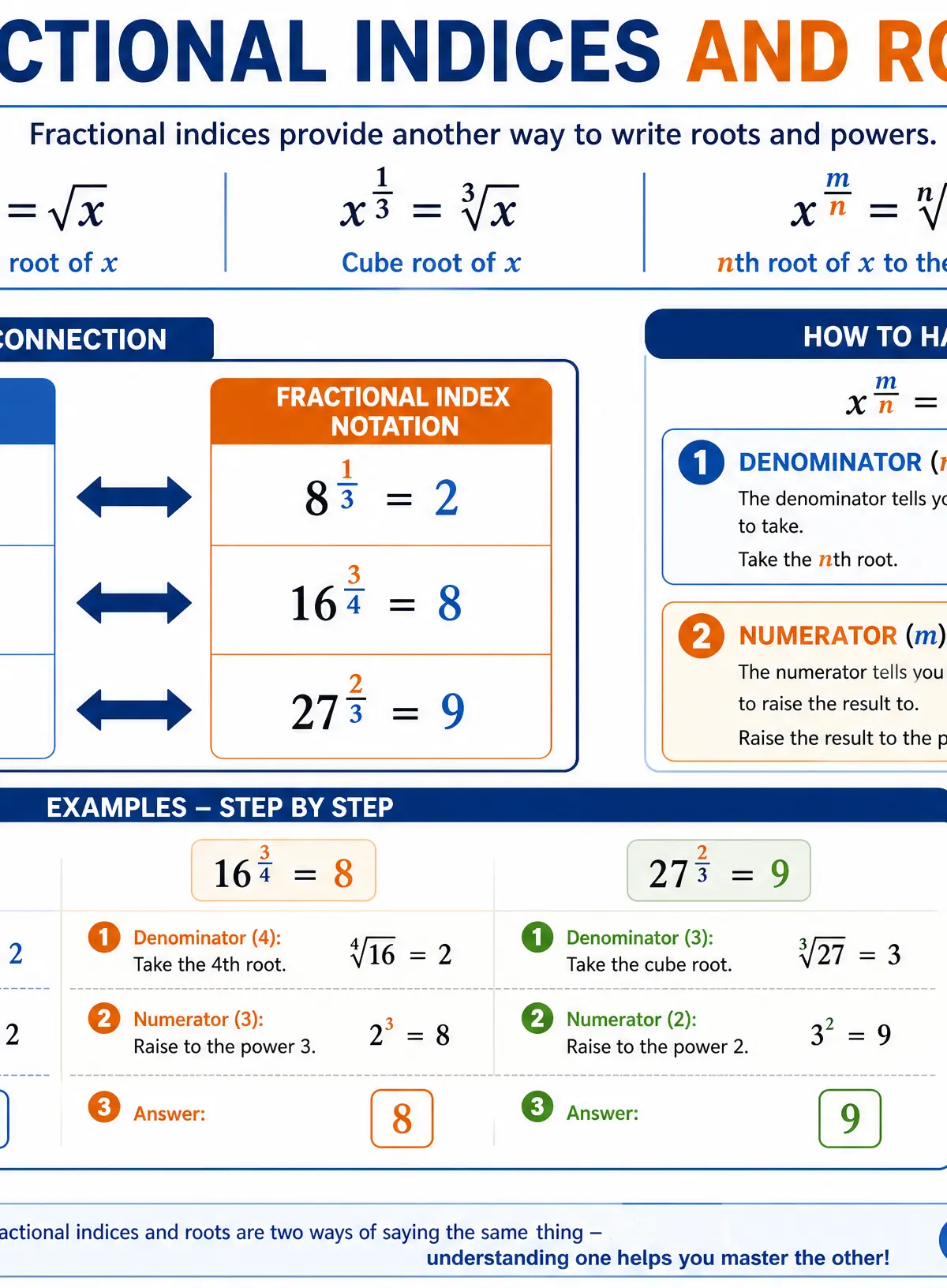
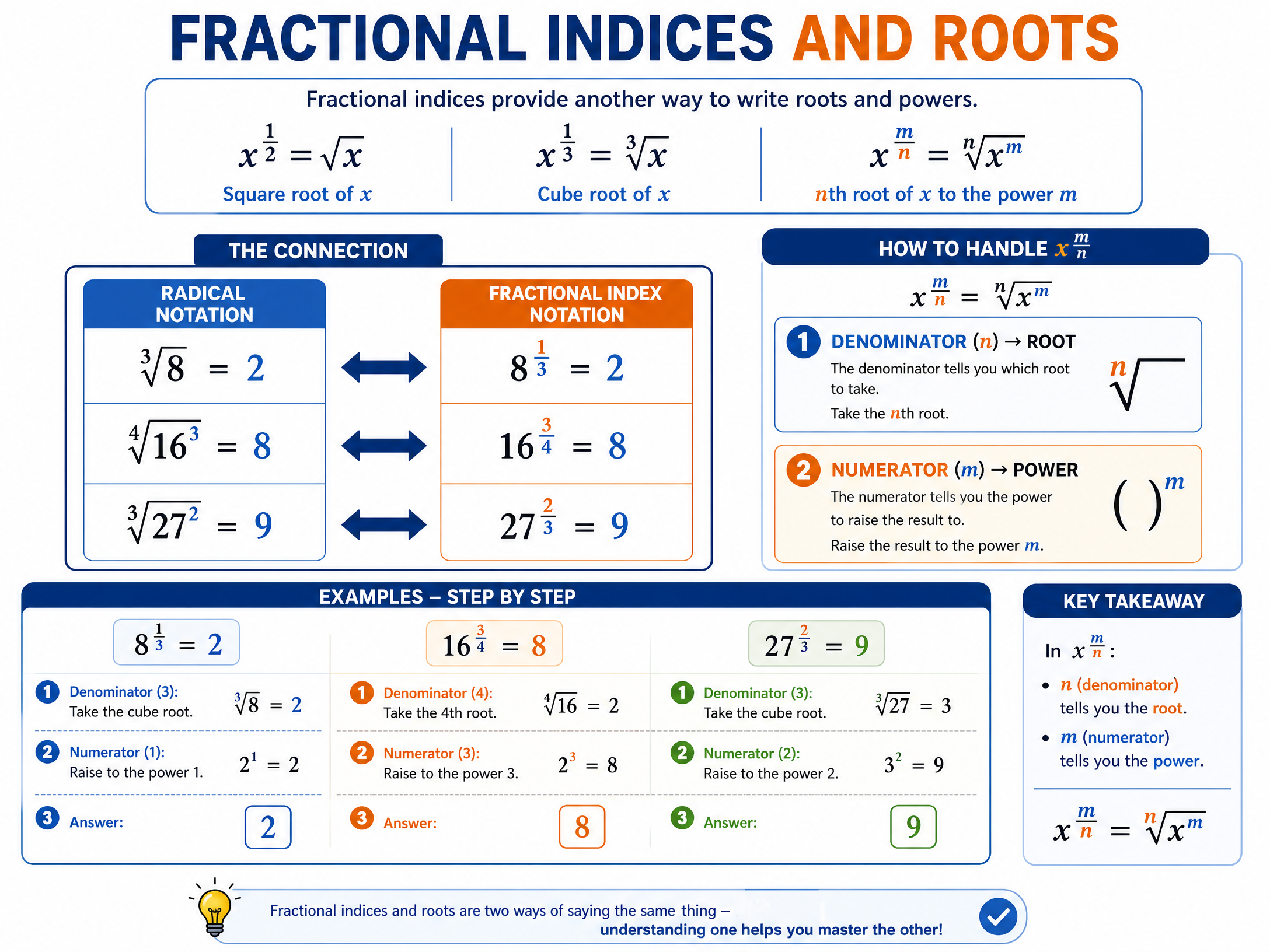
A fractional index represents a root. The denominator of the fraction tells you which root to take, and the numerator tells you what power to raise the result to.
Rule: a^{\frac{1}{n}} = \sqrt[n]{a} and a^{\frac{m}{n}} = (\sqrt[n]{a})^m
Why it works: Think about x^{\frac{1}{2}} \times x^{\frac{1}{2}}. Using the multiplication law, we add the indices: \frac{1}{2} + \frac{1}{2} = 1, giving x^1 (or just x). What number multiplied by itself gives x? The square root of x. Therefore, x^{\frac{1}{2}} must be the square root of x.
Example: Evaluate 27^{\frac{2}{3}}
Answer: Take the cube root of 27 (which is 3), then square the result (3^2 = 9).
Concept 6: Negative Indices
A negative index tells you to take the reciprocal of the positive index. It has nothing to do with making the final number negative!
Rule: a^{-n} = \frac{1}{a^n}
Why it works: Consider x^2 \div x^5. Using the division law, 2 - 5 = -3, giving x^{-3}. If we write it out as a fraction: \frac{x \times x}{x \times x \times x \times x \times x}, two x's cancel out, leaving \frac{1}{x \times x \times x}, which is \frac{1}{x^3}. Therefore, x^{-3} = \frac{1}{x^3}.
Example: Evaluate 5^{-2}
Answer: \frac{1}{5^2} = \frac{1}{25}
Audio Revision
Listen to this 8-minute podcast for a comprehensive review of the laws, common mistakes, and a quick-fire recall quiz.

Mathematical Relationships
Here is a summary of the formulas you must memorise for the exam:
- Multiplication: a^m \times a^n = a^{m+n} (Must memorise)
- Division: a^m \div a^n = a^{m-n} or \frac{a^m}{a^n} = a^{m-n} (Must memorise)
- Power of a Power: (a^m)^n = a^{mn} (Must memorise)
- Zero Index: a^0 = 1 (Must memorise)
- Negative Index: a^{-n} = \frac{1}{a^n} (Must memorise)
- Fractional Index: a^{\frac{m}{n}} = \sqrt[n]{a^m} = (\sqrt[n]{a})^m (Must memorise)
Practical Applications
Indices aren't just abstract algebra; they are essential for scientific notation (Standard Form), which is used by physicists and astronomers to write incredibly large numbers (like the mass of a star: 1.989 \times 10^{30} kg) and incredibly small numbers (like the size of an atom: 1 \times 10^{-10} m). Compound interest in finance also relies heavily on indices to calculate growth over multiple years.
Interactive Diagrams
2 interactive diagrams to visualise key concepts
Conceptual Flow Outline
Flowchart for evaluating fractional indices
Conceptual Flow Outline
Process for handling negative indices
Worked Examples
3 worked examples — open one to explore the question and available guidance.
Practice Questions
Test your understanding — click to reveal model answers
Simplify a^6 \times a^3
Hint: When multiplying with the same base, what do you do to the powers?
Simplify \frac{12p^7q^4}{3p^2q^3}
Hint: Deal with the numbers, the p's, and the q's separately.
Evaluate 25^{-\frac{1}{2}}
Hint: What does a power of 1/2 mean? And what does the negative sign tell you to do?
Write 8 \times 2^4 as a single power of 2.
Hint: You can only use index laws if the bases are the same. How can you write 8 as a power of 2?
Given that 3^x \times 9^{x+1} = 27^4, find the value of x.
Hint: Express all bases (3, 9, 27) as powers of 3 first.