Pearson Edexcel · A-Level · Mathematics
Use and manipulate surds, including rationalising the denominator
Master the art of manipulating exact values with surds. This topic is essential for securing high marks on the Higher tier paper, teaching you how to simplify expressions and rationalise denominators to achieve perfect precision in your calculations.
- 5 min read
- 3 worked examples
- 5 practice questions
- 6 key terms
Study Notes
Overview
Welcome to the study of surds, a fundamental topic in Higher tier GCSE Mathematics. Surds are irrational numbers that cannot be simplified to remove the square root (or cube root) sign, such as √2 or √3. Unlike decimals, which often require rounding and lose precision, surds represent exact values.
Understanding surds is crucial because examiners demand exact answers in geometry, trigonometry, and algebra. This topic connects deeply with Pythagoras' theorem, the quadratic formula, and algebraic expansion. In your exam, you can expect questions asking you to simplify surds, expand brackets containing surds, and rationalise denominators. Mastering these techniques will secure you vital marks and ensure your mathematical working remains perfectly precise.
Key Concepts
Concept 1: What is a Surd?
A surd is an irrational root. If you try to write it as a decimal, it goes on forever without repeating. For example, √4 is not a surd because it simplifies exactly to 2 (a rational number). However, √5 is a surd because it cannot be simplified to a neat fraction or whole number.
Why it works: We use surds to maintain 100% accuracy. If you use 1.41 instead of √2, your final answer in a multi-step calculation will be slightly wrong due to rounding errors.
Example: √16 = 4 (Not a surd). √7 = 2.64575131... (Surd).
Concept 2: Simplifying Surds
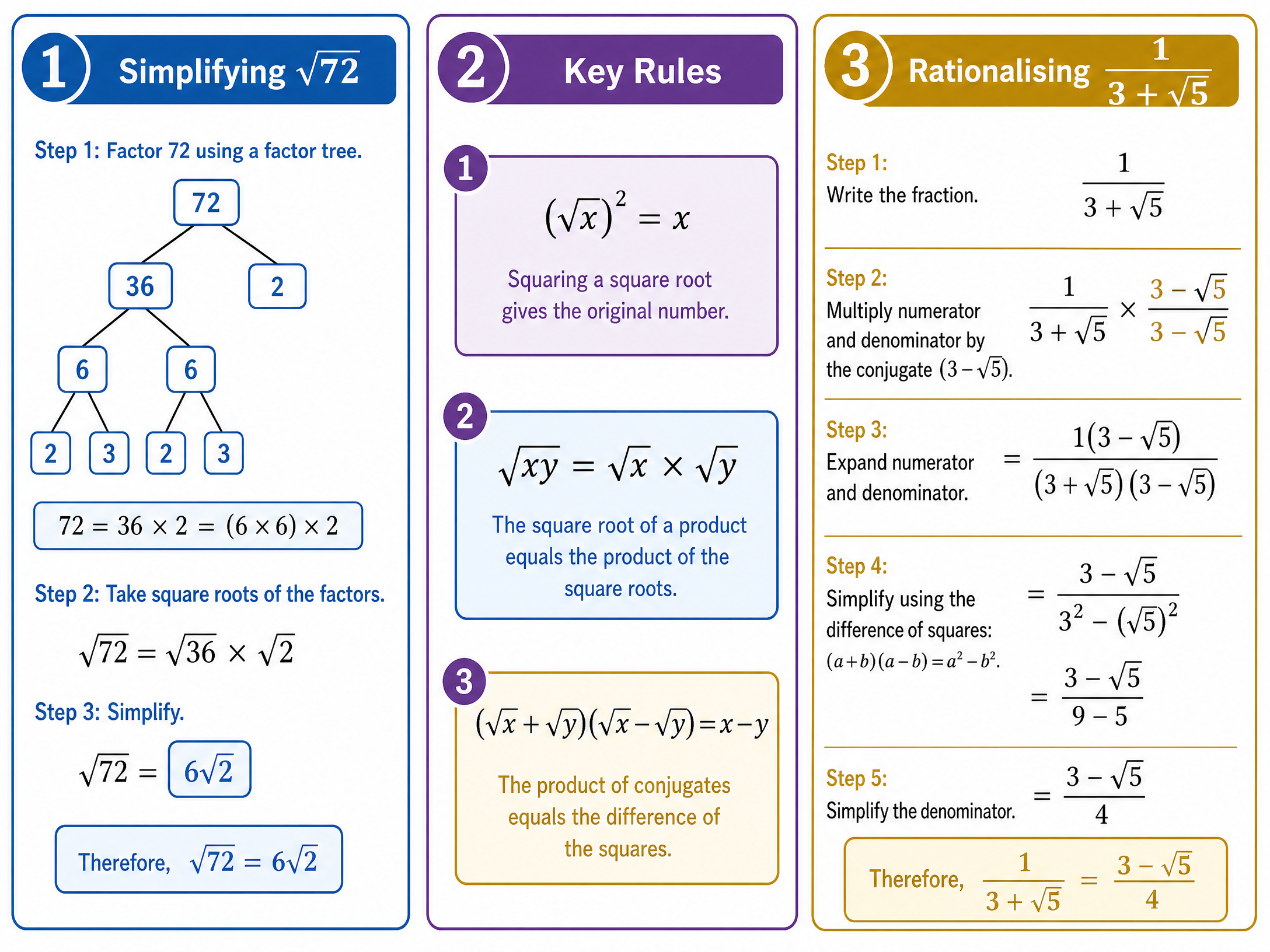
To simplify a surd, you must find the largest perfect square factor of the number under the root. You then split the root into two parts using the multiplication rule: √(xy) = √x × √y.
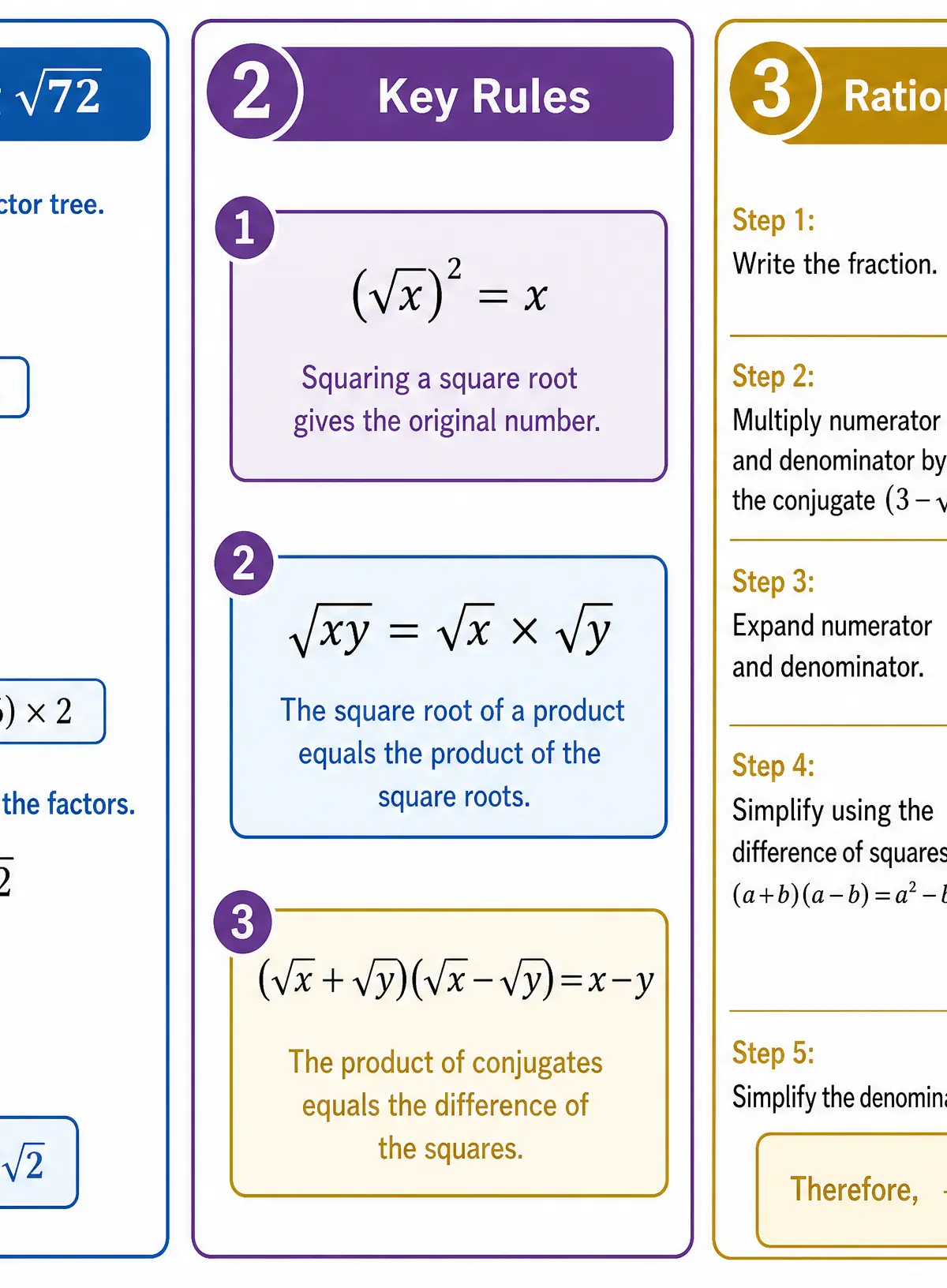
Why it works: By extracting the perfect square, we can evaluate that part of the root, leaving a smaller, simpler number under the remaining root sign. This is just like simplifying fractions to their lowest terms.
Example: Simplify √48.
- Find the largest perfect square factor of 48. The factors are 1, 2, 3, 4, 6, 8, 12, 16, 24, 48. The perfect squares are 1, 4, and 16. The largest is 16.
- Split the root: √48 = √(16 × 3)
- Apply the rule: √48 = √16 × √3
- Simplify the perfect square: √48 = 4√3
Concept 3: Adding and Subtracting Surds
You can only add or subtract surds if the number under the root sign is exactly the same. Think of the root like a variable in algebra: you can add 2x + 3x to get 5x, but you cannot add 2x + 3y. Similarly, 2√5 + 3√5 = 5√5, but √2 + √3 cannot be simplified further.
Why it works: Surds behave exactly like algebraic terms. If the roots are different, they are unlike terms.
Example: Simplify 5√2 + √8.
First, simplify √8: √8 = √(4 × 2) = 2√2.
Now add: 5√2 + 2√2 = 7√2.
Concept 4: Expanding Brackets with Surds
When multiplying brackets containing surds, use the standard algebraic expansion methods (like FOIL for double brackets). Remember that √x × √x = x.
Why it works: The distributive property of multiplication applies to real numbers, including irrational ones.
Example: Expand and simplify (3 + √2)(4 - √2).
First: 3 × 4 = 12
Outer: 3 × (-√2) = -3√2
Inner: √2 × 4 = 4√2
Last: √2 × (-√2) = -2
Combine: 12 - 3√2 + 4√2 - 2 = 10 + √2
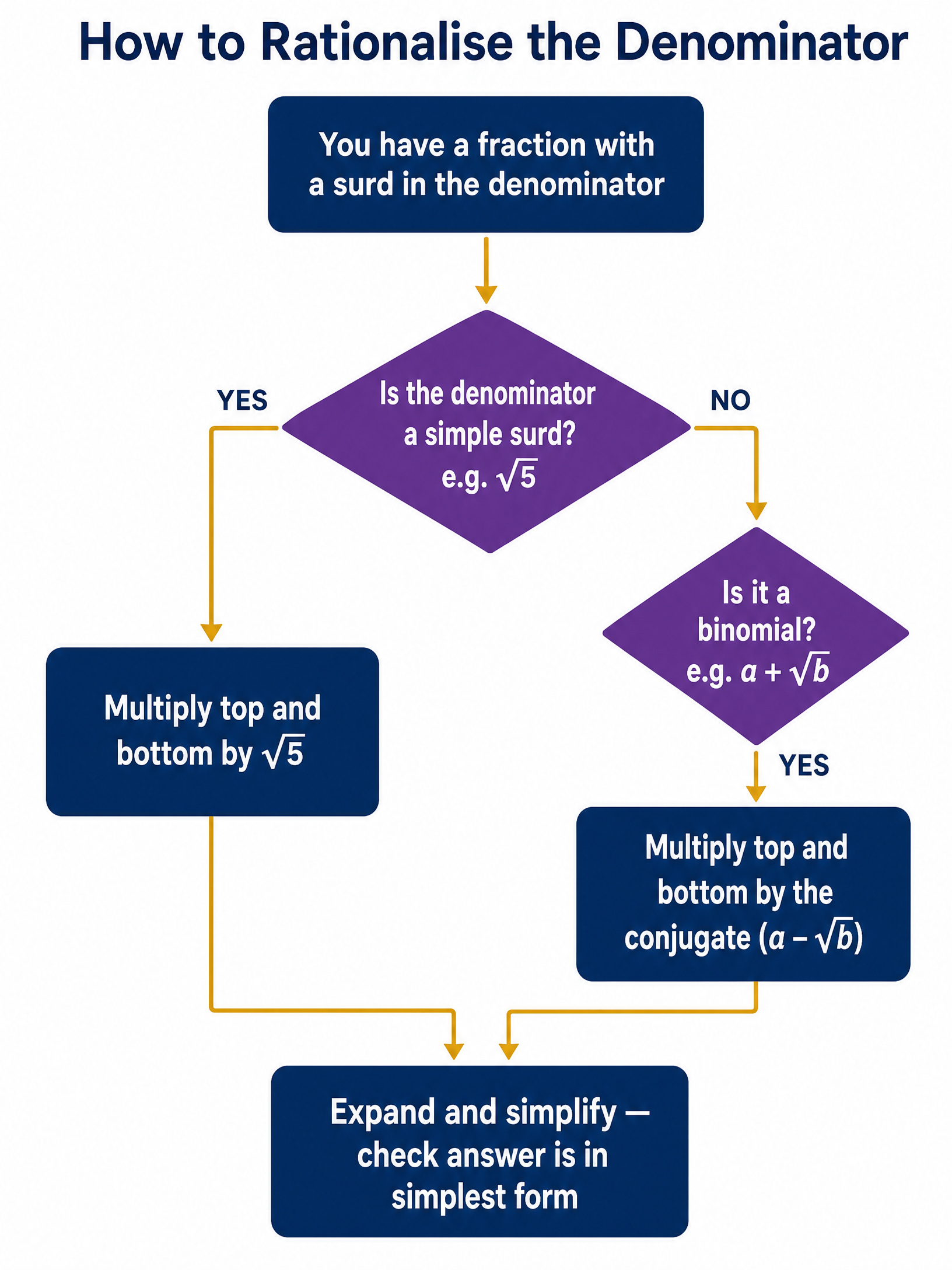
Concept 5: Rationalising the Denominator
In mathematics, it is considered 'bad grammar' to leave a surd in the denominator of a fraction. Rationalising means getting rid of the surd on the bottom.
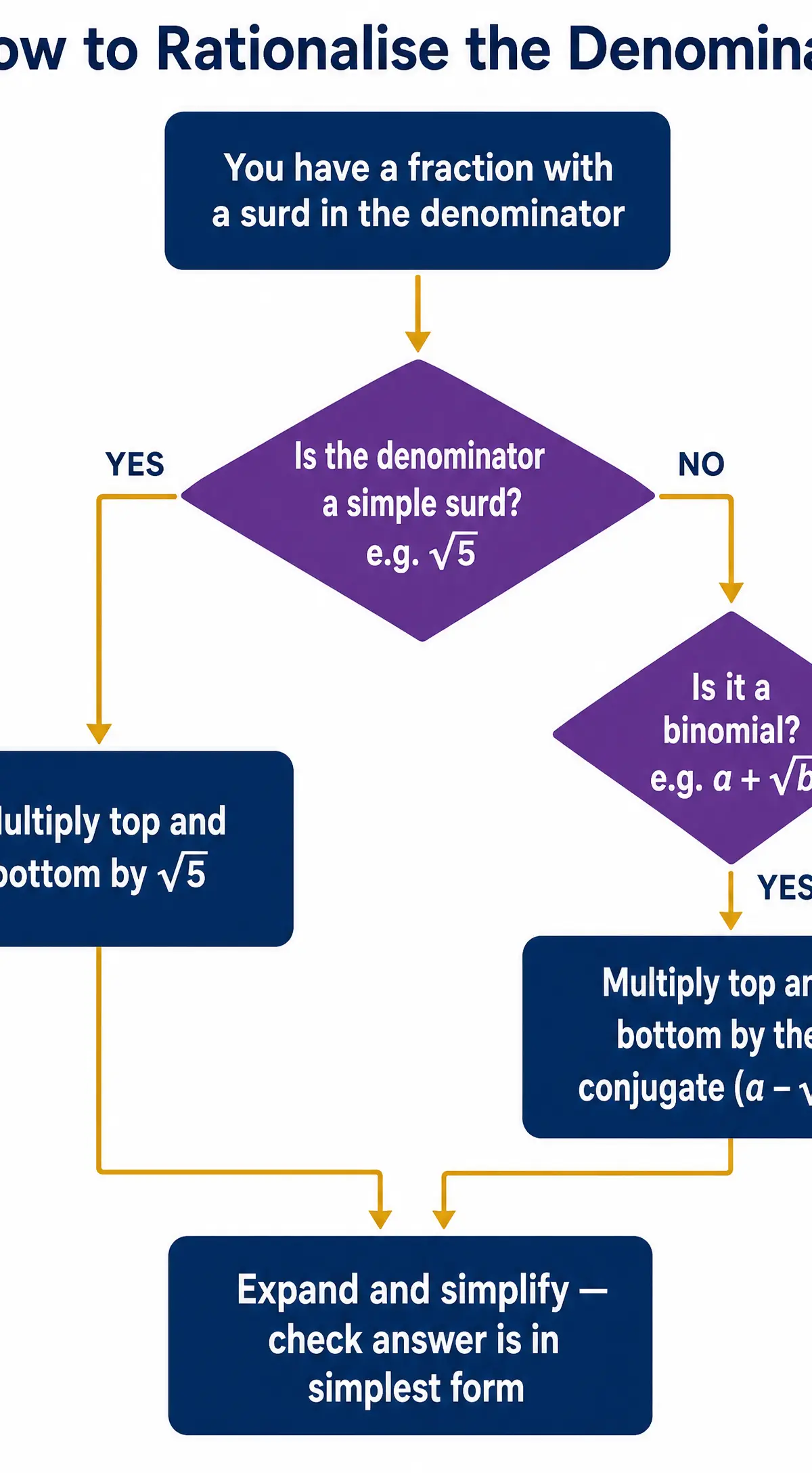
For a simple surd denominator (e.g., a/√b), multiply the numerator and the denominator by √b.
For a binomial denominator (e.g., a / (b + √c)), multiply the numerator and denominator by the conjugate (b - √c).
Why it works: Multiplying the top and bottom by the same value is equivalent to multiplying by 1, so the overall value of the fraction doesn't change. When using the conjugate, the difference of two squares (x+y)(x-y) = x² - y² ensures the middle surd terms cancel out entirely.
Example: Rationalise 1 / (3 - √5).
Multiply top and bottom by the conjugate: (3 + √5).
Numerator: 1 × (3 + √5) = 3 + √5
Denominator: (3 - √5)(3 + √5) = 3² - (√5)² = 9 - 5 = 4
Final answer: (3 + √5) / 4
Podcast Episode
Listen to our comprehensive audio guide on surds, covering everything from basic definitions to exam technique and common pitfalls.

Mathematical/Scientific Relationships
- Multiplication Rule: √(xy) = √x × √y. Used to split surds for simplification.
- Division Rule: √(x/y) = √x / √y. Used when dealing with fractions under roots.
- Squaring Rule: (√x)² = x. Squaring a square root cancels it out.
- Difference of Two Squares: (√x + √y)(√x - √y) = x - y. The essential tool for rationalising binomial denominators.
Practical Applications
Surds are not just abstract algebra; they appear constantly in real-world mathematics:
- Architecture & Engineering: When calculating diagonal lengths using Pythagoras' theorem, exact lengths are often surds. A square room of 10m × 10m has a diagonal of exactly 10√2 metres.
- Physics: The formula for the period of a pendulum T = 2π√(L/g) involves surds. Keeping exact values is critical for precise timing mechanisms.
- Computer Graphics: Rendering 3D spaces requires exact distance calculations to prevent visual glitches and texture tearing caused by floating-point rounding errors.
Visual Resources
2 diagrams and illustrations
Interactive Diagrams
2 interactive diagrams to visualise key concepts
Conceptual Flow Outline
Algorithm for simplifying any surd.
Conceptual Flow Outline
How the difference of two squares eliminates surds.
Worked Examples
3 worked examples — open one to explore the question and available guidance.
Practice Questions
Test your understanding — click to reveal model answers
Simplify √108
Hint: What is the largest square number (4, 9, 16, 25, 36...) that divides into 108?
Simplify 3√5 + √45
Hint: You cannot add them until the numbers under the roots are the same. Simplify √45 first.
Expand and simplify (5 - 2√3)(5 + 2√3)
Hint: Notice that these are conjugates. Use the difference of two squares.
Rationalise the denominator of 15 / √3
Hint: Multiply both the top and bottom by √3.
Show that (4 + √8) / (√2 - 1) can be written in the form a + b√2, where a and b are integers.
Hint: First, simplify √8. Then, rationalise the denominator by multiplying by the conjugate.