Algebra Skills: Cubic Graphs — Edexcel GCSE study guide illustration

    Algebra Skills: Cubic Graphs

    Edexcel
    GCSE
    Mathematics

    Master Edexcel GCSE Maths by conquering cubic graphs. This guide breaks down how to plot these distinctive S-shaped curves, use them to solve equations, and avoid the common pitfalls that cost candidates marks. Secure top grades by understanding the core principles of cubic functions.

    5
    Min Read
    3
    Examples
    5
    Questions
    6
    Key Terms
    🎙 Podcast Episode
    Algebra Skills: Cubic Graphs
    0:00-0:00

    Study Notes

    Header image for Edexcel GCSE Mathematics: Cubic Graphs

    Overview

    Cubic graphs represent functions where the highest power of the variable (usually x) is 3, such as y = x³ or y = 2x³ - 3x + 1. For your Edexcel GCSE Mathematics exam, a solid understanding of cubic graphs is essential as it tests a combination of skills: accurate calculation, precise plotting, and graphical interpretation. These questions are a great opportunity to demonstrate your mathematical dexterity and secure a significant number of marks. On the Foundation tier, you will typically be asked to complete a table of values and plot a given cubic function. On the Higher tier, you may also be expected to sketch cubic graphs by identifying their roots and key features without a table. This topic has strong synoptic links to solving equations and understanding transformations of graphs, making it a cornerstone of algebra.

    Key Concepts

    Concept 1: The Shape of a Cubic Curve

    The most fundamental aspect of a cubic graph is its characteristic 'S' shape. This shape arises from the nature of the cubic function. For a positive cubic function, where the x³ term is positive (e.g., y = x³), the graph starts in the bottom-left quadrant, passes through a point of inflection, and continues to the top-right quadrant. Conversely, for a negative cubic function (e.g., y = -x³), the graph is reflected in the x-axis, starting in the top-left and finishing in the bottom-right.

    Example: The graph of y = x³ passes through the origin (0,0). When x is negative, x³ is also negative. When x is positive, x³ is positive. This creates the classic S-shape.
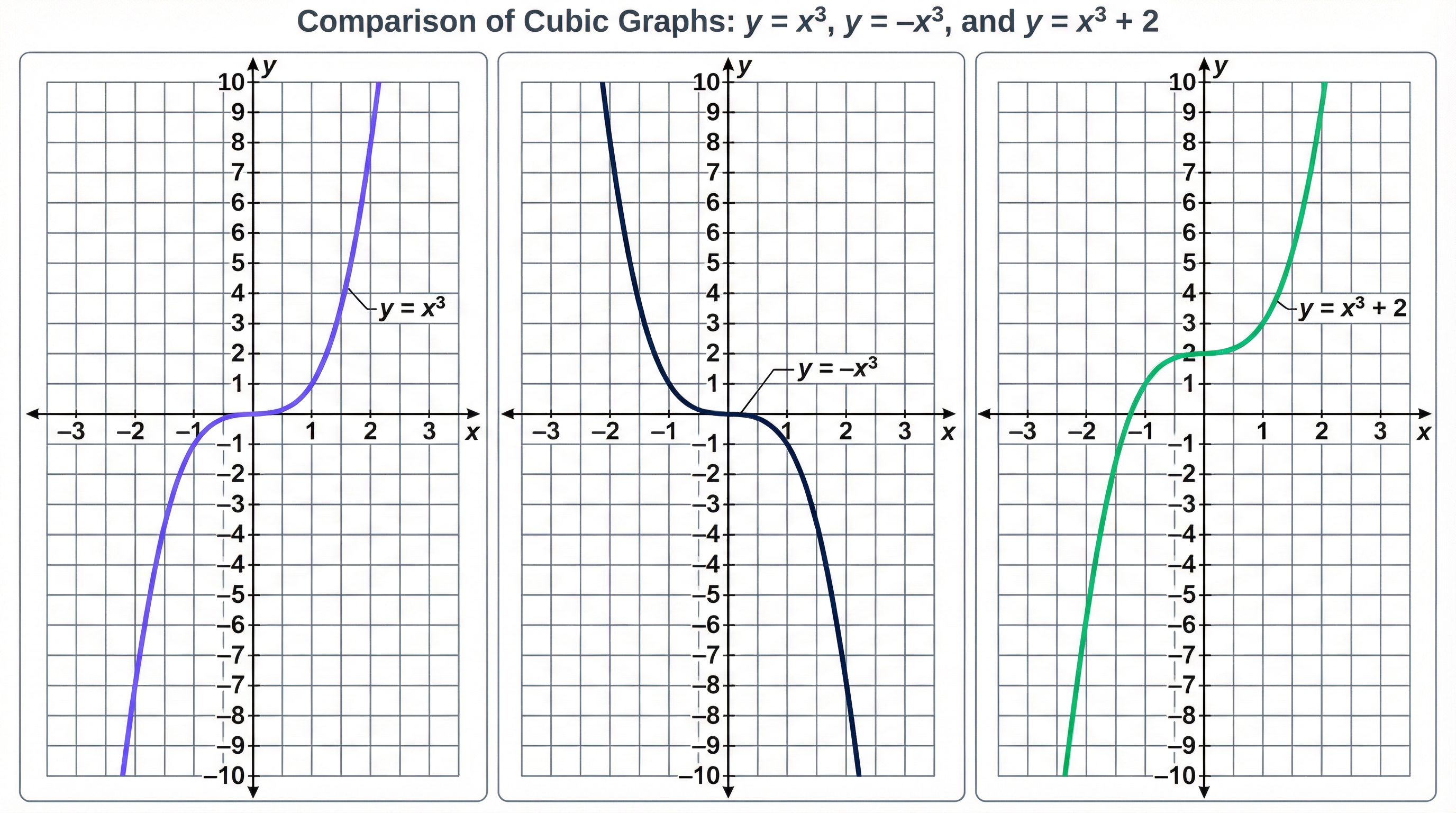
    Comparison of different cubic graph shapes and transformations.

    Concept 2: Plotting from a Table of Values

    Examiners frequently test your ability to plot a cubic graph from a given table of values. This process has three distinct stages, each typically worth one mark.

    1. Calculating y-values: You must substitute the given x-values into the cubic equation to find the corresponding y-values. Be extremely careful with negative numbers. For example, if y = x³ and x = -2, then y = (-2)³ = -8. A common error is to calculate this as 8.
    2. Plotting Points: Each (x, y) pair must be plotted accurately on the coordinate grid. Examiners allow a tolerance of ±½ a small square. Use a sharp pencil and mark each point with a neat cross or dot.
    3. Drawing the Curve: This is a crucial step. You must connect the points with a single, smooth, continuous curve. Do not use a ruler to join the points, and avoid any 'feathery' or double lines. The curve should flow naturally through the plotted points.
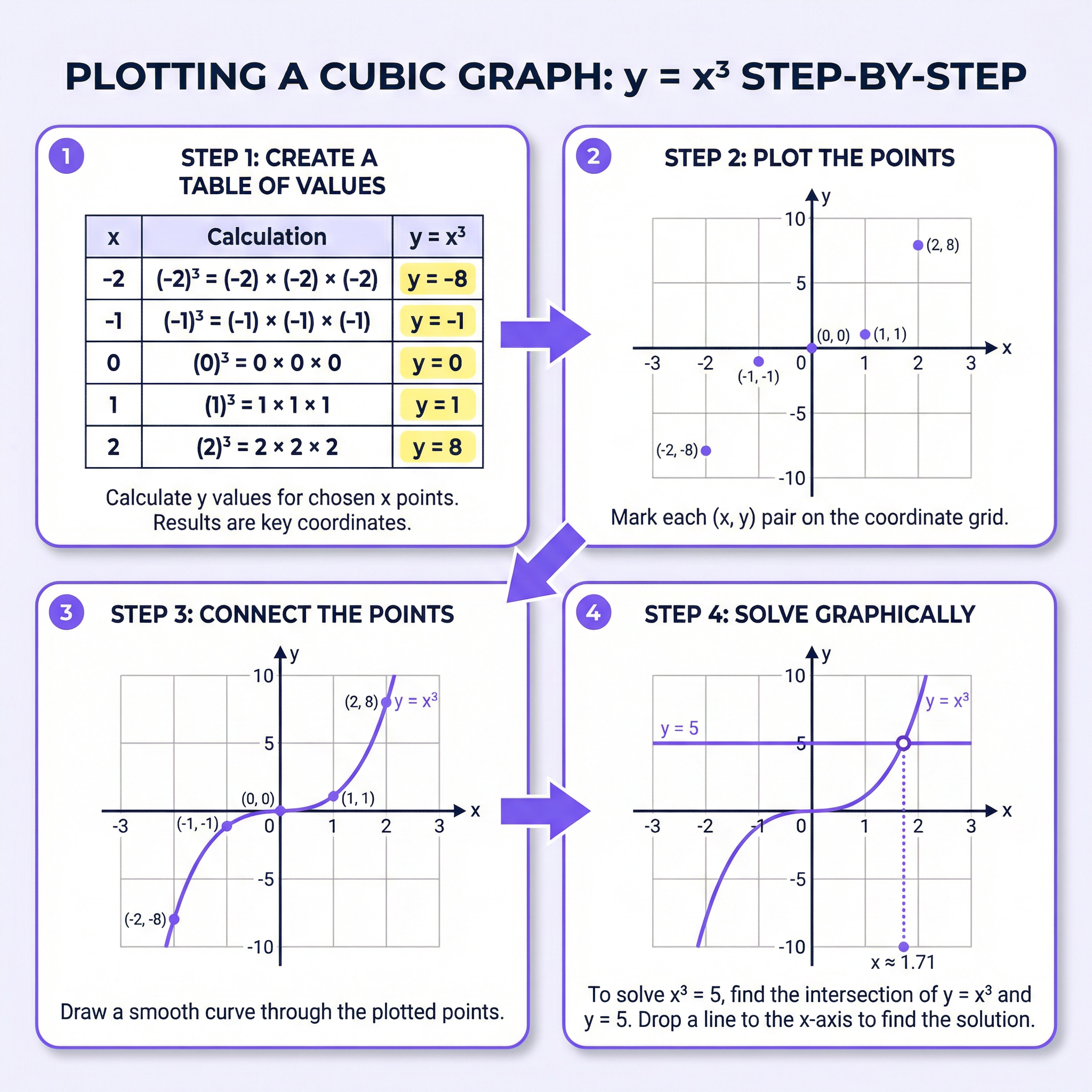
    Step-by-step guide to plotting a cubic graph from a table of values.

    Concept 3: Solving Equations Graphically

    Once you have drawn your cubic graph, you can use it to solve equations. For example, to solve the equation x³ - 2x = 3, you would draw the line y = 3 on the same axes as your graph of y = x³ - 2x. The x-coordinates of the points where the line and the curve intersect are the solutions to the equation. You must show your method clearly by drawing the horizontal line and then drawing vertical lines from the intersection points down to the x-axis.

    Mathematical/Scientific Relationships

    • General Form: The general form of a cubic function is y = ax³ + bx² + cx + d, where a, b, c, and d are constants and a ≠ 0.
    • Roots: The roots of a cubic function are the x-values where the graph crosses the x-axis (i.e., where y = 0). A cubic function can have one, two, or three real roots.
    • Y-intercept: The y-intercept is the point where the graph crosses the y-axis. This occurs when x = 0, so the y-intercept is always at the point (0, d).

    Practical Applications

    While cubic functions might seem abstract, they are used to model various real-world phenomena. In physics, they can describe the relationship between the length of a pendulum and its period. In economics, they can model cost functions, where the cost of production changes at different rates. In engineering, the bending of beams can sometimes be described by cubic equations. Understanding their shape and properties provides a powerful tool for modelling complex systems.

    Worked Examples

    3 detailed examples with solutions and examiner commentary

    Practice Questions

    Test your understanding — click to reveal model answers

    Q1

    Complete the table of values for y = x³ - 5.

    2 marks
    foundation

    Hint: Remember to cube the x-value first, then subtract 5. Be careful with the negative x-value.

    Q2

    The graph of y = x³ + 2x - 1 is drawn on a grid. Explain how you would use the graph to solve the equation x³ + 2x - 1 = 4.

    2 marks
    standard

    Hint: What line would you need to add to the graph?

    Q3

    A cubic graph has the equation y = (x+1)(x-2)(x-4). State the coordinates of the points where the graph crosses the x-axis and the y-axis.

    4 marks
    challenging

    Hint: For the x-intercepts (roots), what is the value of y? For the y-intercept, what is the value of x?

    Q4

    Look at the plotted points on a grid. Is it possible that these points lie on a cubic curve? Explain your answer.

    2 marks
    standard

    Hint: Think about the shape and turning points of a cubic curve.

    Q5

    The equation x³ - 6x = 0 has three solutions. One is x=0. Find the other two solutions.

    3 marks
    challenging

    Hint: Factorise the expression on the left-hand side.

    Key Terms

    Essential vocabulary to know

    More Mathematics Study Guides

    View all

    Geometry and Measures Skills: Volume

    Edexcel
    GCSE

    Master the essential skill of calculating volume for your Edexcel GCSE Maths exam. This guide breaks down everything from simple prisms to complex composite solids, giving you the formulas, exam techniques, and memory hooks needed to secure top marks.

    Statistics Skills: Averages (Mean, Median, Mode)

    Edexcel
    GCSE

    Master the essential Statistics skills of Mean, Median, and Mode for your Edexcel GCSE Maths exam. This guide breaks down how to calculate, interpret, and compare averages, securing you top marks on these guaranteed-to-appear questions.

    Vectors

    AQA
    GCSE

    This guide provides a comprehensive overview of Vectors for AQA GCSE Mathematics, covering everything from basic column notation to complex geometric proofs. It's designed to help you secure every possible mark by focusing on examiner expectations, common pitfalls, and powerful memory techniques.

    Powers and roots

    OCR
    GCSE

    Unlock the power of numbers! This guide demystifies powers and roots for your OCR GCSE Maths exam, showing you how to master index laws and tackle complex calculations with confidence. From basic squares to tricky fractional indices, we'll equip you with the techniques to secure every last mark.

    Vectors

    OCR
    GCSE

    Master OCR GCSE Vectors with this guide, packed with examiner tips and interactive content. We'll break down everything from basic column vectors to complex geometric proofs, showing you how to secure every mark and turn a tricky topic into one of your strengths.

    Data collection (sampling, questionnaires)

    WJEC
    GCSE

    Master WJEC GCSE Mathematics Data Collection (4.1) by learning how to design flawless questionnaires and calculate representative samples. This guide will show you how to secure every mark by avoiding common pitfalls and applying examiner-approved techniques for sampling and data presentation.