OCR · GCSE · Mathematics
Powers and roots
Unlock the power of numbers! This guide demystifies powers and roots for your OCR GCSE Maths exam, showing you how to master index laws and tackle complex calculations with confidence. From basic squares to tricky fractional indices, we'll equip you with the techniques to secure every last mark.
- 5 min read
- 3 worked examples
- 5 practice questions
Study Notes

Overview
Powers and roots, also known as indices, are a fundamental concept in mathematics that deals with repeated multiplication. At its core, this topic is about expressing large numbers in a concise format and understanding the rules that govern them. For your OCR GCSE exam, a solid grasp of powers and roots is essential, as it forms the bedrock of algebra, standard form, and even financial mathematics. Examiners frequently use this topic to test your numerical fluency and problem-solving skills, often in non-calculator papers where quick recall and precise application of rules are paramount. Expect to see questions ranging from simple evaluation of square numbers to multi-step algebraic simplifications involving negative and fractional indices. Mastering this area will not only boost your score on direct questions but also enhance your ability to handle more complex mathematical concepts across the entire specification.
Key Concepts
Concept 1: Integer Powers and Roots
An integer power (or index) tells you how many times to multiply a base number by itself. For example, in the expression 5⁴, 5 is the base and 4 is the power. This means you must calculate 5 × 5 × 5 × 5, which equals 625. A common mistake is to multiply the base by the power (5 × 4 = 20), which is incorrect and will score no marks. A root is the inverse operation. A square root (√) finds a number that, when multiplied by itself, gives the original number. For example, the square root of 49 is 7 because 7 × 7 = 49. Similarly, a cube root (³√) finds a number that, when multiplied by itself twice, gives the original. The cube root of 27 is 3 because 3 × 3 × 3 = 27.
Example: Evaluate 3⁴ and find the square root of 144.
- 3⁴ = 3 × 3 × 3 × 3 = 81
- √144 = 12 (since 12 × 12 = 144)

Concept 2: The Index Laws
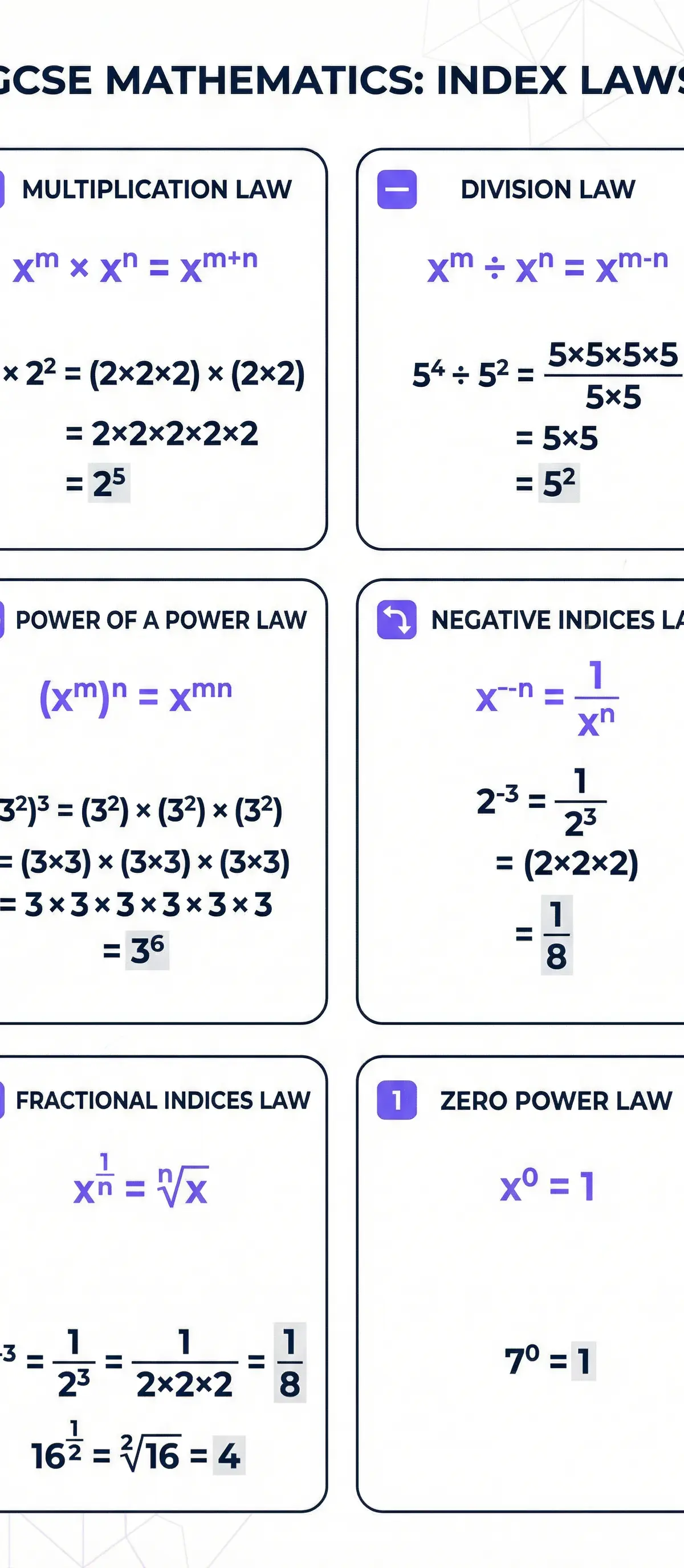
The index laws are the rules that allow you to simplify expressions involving powers. They are your toolkit for this topic. Candidates who can apply these swiftly and accurately will gain significant credit.
- Multiplication Law: When multiplying terms with the same base, you add the powers. xᵃ × xᵇ = xᵃ⁺ᵇ. For example, 2⁵ × 2³ = 2⁸.
- Division Law: When dividing terms with the same base, you subtract the powers. xᵃ ÷ xᵇ = xᵃ⁻ᵇ. For example, 7⁶ ÷ 7² = 7⁴.
- Power of a Power Law: When raising a power to another power, you multiply the powers. (xᵃ)ᵇ = xᵃᵇ. For example, (5²)³ = 5⁶.
- Zero Power Law: Any number (except 0) raised to the power of 0 is 1. x⁰ = 1. For example, 99⁰ = 1.
Concept 3: Negative and Fractional Indices (Higher Tier)
Negative and fractional indices extend the rules to more complex scenarios and are a key differentiator for Higher Tier candidates.
- Negative Indices: A negative power indicates a reciprocal. x⁻ᵃ = 1/xᵃ. To evaluate this, you 'flip' the base to make the power positive. For example, 4⁻² = 1/4² = 1/16.
- Fractional Indices: A fractional power involves a root. The denominator of the fraction tells you which root to take, and the numerator tells you which power to apply. xᵃ/ᵇ = (ᵇ√x)ᵃ. For example, to evaluate 27²/³, you first find the cube root of 27 (which is 3), and then you square the result (3² = 9). It is nearly always easier to perform the root operation before the power operation to keep the numbers smaller.

Mathematical/Scientific Relationships
The core relationships in this topic are the index laws. It is vital that candidates memorise these.
| Law Name | Formula | When to Use | Status on Formula Sheet |
|---|---|---|---|
| Multiplication Law | xᵃ × xᵇ = xᵃ⁺ᵇ | Multiplying powers with the same base | Must memorise |
| Division Law | xᵃ ÷ xᵇ = xᵃ⁻ᵇ | Dividing powers with the same base | Must memorise |
| Power of a Power Law | (xᵃ)ᵇ = xᵃᵇ | A power is raised to another power | Must memorise |
| Zero Power Law | x⁰ = 1 | A base is raised to the power of zero | Must memorise |
| Negative Index Law | x⁻ᵃ = 1/xᵃ | A base is raised to a negative power (Higher) | Must memorise |
| Fractional Index Law | xᵃ/ᵇ = (ᵇ√x)ᵃ | A base is raised to a fractional power (Higher) | Must memorise |
Practical Applications
While powers and roots can seem abstract, they have many real-world applications that make them easier to understand. For instance, standard form, which is used by scientists to write very large or very small numbers (like the distance to the sun or the size of an atom), is entirely based on powers of 10. In finance, compound interest is calculated using powers to determine how an investment grows over time. In computing, memory sizes (kilobytes, megabytes, gigabytes) are all based on powers of 2. Understanding these connections can make the topic more memorable and helps in answering applied, problem-solving (AO3) questions.
Worked Examples
3 worked examples — open one to explore the question and available guidance.
Practice Questions
Test your understanding — click to reveal model answers
Simplify 2a³b² × 4ab⁵
Hint: Multiply the numbers first, then use the multiplication index law for each variable separately.
Evaluate (5/3)⁻²
Hint: The negative power flips the entire fraction. Then apply the power to both the numerator and the denominator.
Simplify fully (64x⁶y¹⁰)^(1/2)
Hint: A power of 1/2 means square root. Apply the square root to the number and use the power of a power law on the variables.
Given that 3⁻ⁿ = 0.04, find the value of n.
Hint: First, convert the decimal 0.04 into a fraction. Then, try to express the denominator as a power of 3.
Evaluate 100^(3/2)
Hint: Root first, then power. The denominator is 2, so find the square root first.