Study Notes
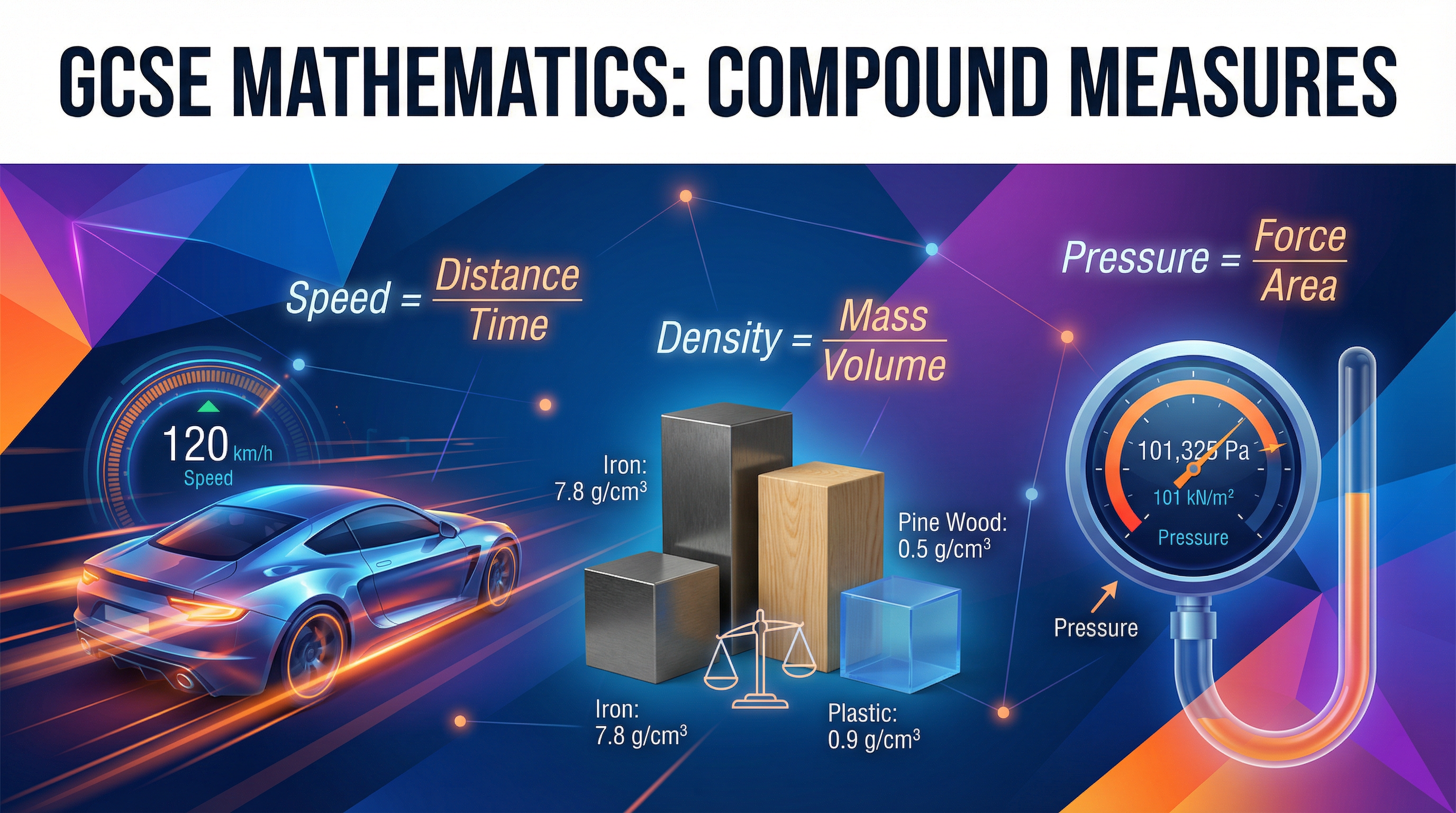
Overview
Compound measures are a cornerstone of functional mathematics, combining two or more different units to create a new, practical measurement. For your Edexcel GCSE exam, this topic (specification point 1.11) primarily focuses on Speed, Density, and Pressure. These concepts are not just abstract formulas; they are used to model real-world scenarios, from calculating journey times to understanding material properties. Examiners frequently use this topic to test your ability to rearrange formulas, convert between units (especially time), and solve multi-step problems. A typical question might ask you to compare the speeds of two different journeys or determine which of two objects is denser, requiring you to perform two sets of calculations and then make a clear, justified conclusion. Mastering this topic is crucial as it links directly to other areas of the specification, such as percentages, ratio, and algebra, making it a versatile tool in your mathematical arsenal.
Key Concepts
Concept 1: Speed
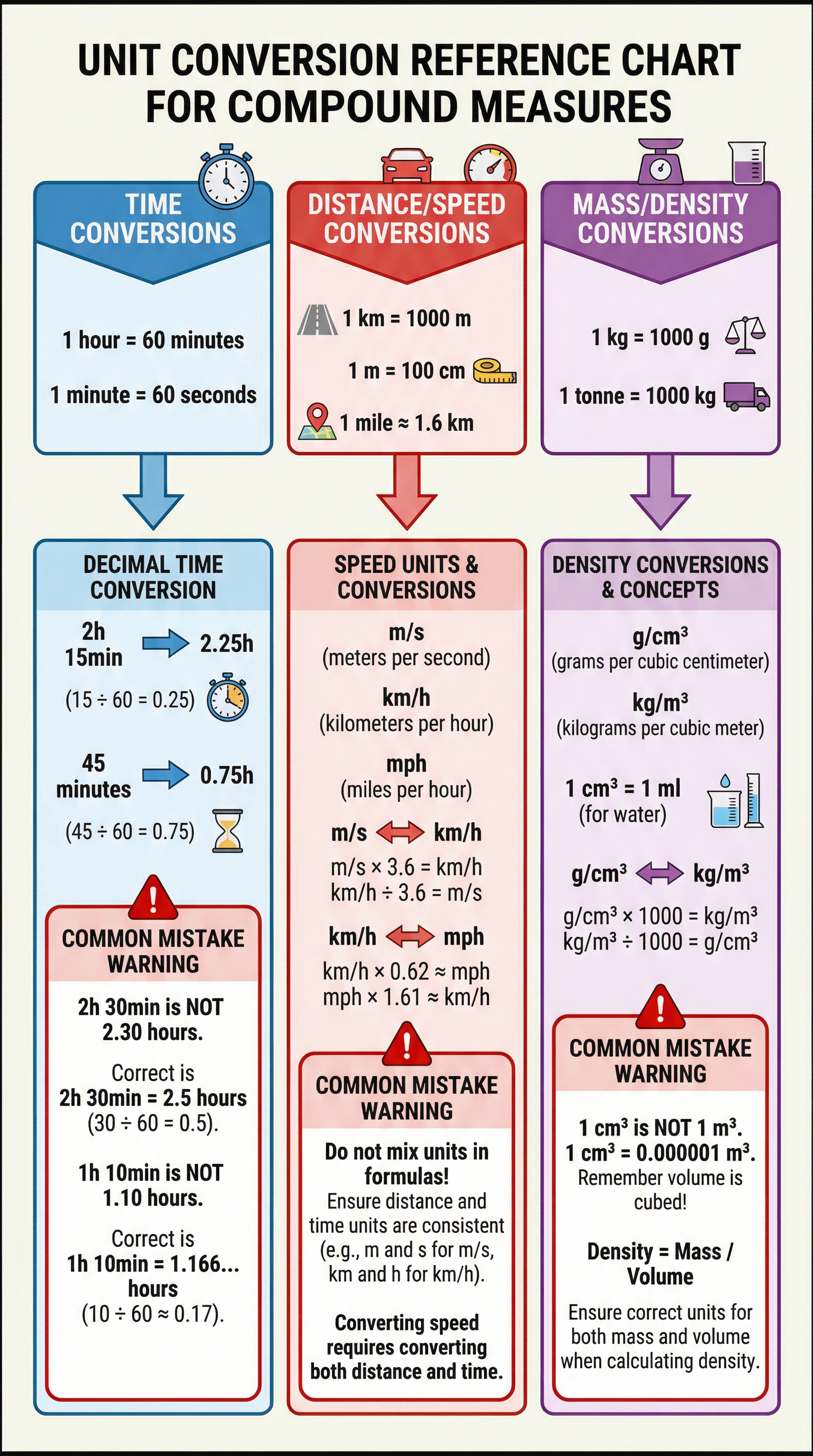
Speed is a measure of how quickly an object covers a certain distance. It is the ratio of distance to time. The key relationship is that for a constant speed, the distance travelled is directly proportional to the time taken. The fundamental skill here is not just using the formula, but being able to manipulate it to find any of the three variables: distance, speed, or time. A common pitfall for candidates is the mishandling of time units. Examiners will often present time in hours and minutes, which must be converted to a single unit (either hours as a decimal or fraction, or total minutes/seconds) before any calculation can be performed.
Example: A car travels 90 miles in 1 hour and 30 minutes. To find the average speed in miles per hour (mph), you must first convert the time. 30 minutes is half an hour, or 0.5 hours. So the total time is 1.5 hours. The speed is then calculated as Distance ÷ Time = 90 miles ÷ 1.5 hours = 60 mph.
Concept 2: Density
Density is a measure of how much "stuff" (mass) is packed into a given space (volume). It is a fundamental property of matter. A small, heavy object is very dense, while a large, light object is not. For your exam, you will be expected to calculate density given mass and volume, or rearrange the formula to find mass or volume. Questions often involve comparing the densities of two different objects, which requires careful calculation and a concluding statement. Unit consistency is paramount; if you are given a mass in kilograms and a volume in cubic centimetres, you must convert one to match the units required for the answer (e.g., g/cm³ or kg/m³).
Example: A block of metal has a mass of 500g and a volume of 50 cm³. Its density is Mass ÷ Volume = 500g ÷ 50 cm³ = 10 g/cm³.
Concept 3: Pressure
Pressure measures the amount of force applied perpendicularly to a surface, spread out over the area of that surface. A large force on a small area creates high pressure (like a sharp knife), while the same force on a large area creates low pressure (like snowshoes). The formula connects force, area, and pressure. You will need to be comfortable calculating any of these three values. Exam questions might involve calculating the pressure exerted by an object on the ground or comparing the pressure from two different scenarios.
Example: A box exerts a force of 120 Newtons on the floor. The base of the box has an area of 2 m². The pressure exerted is Force ÷ Area = 120 N ÷ 2 m² = 60 N/m² (or 60 Pascals).
Mathematical/Scientific Relationships
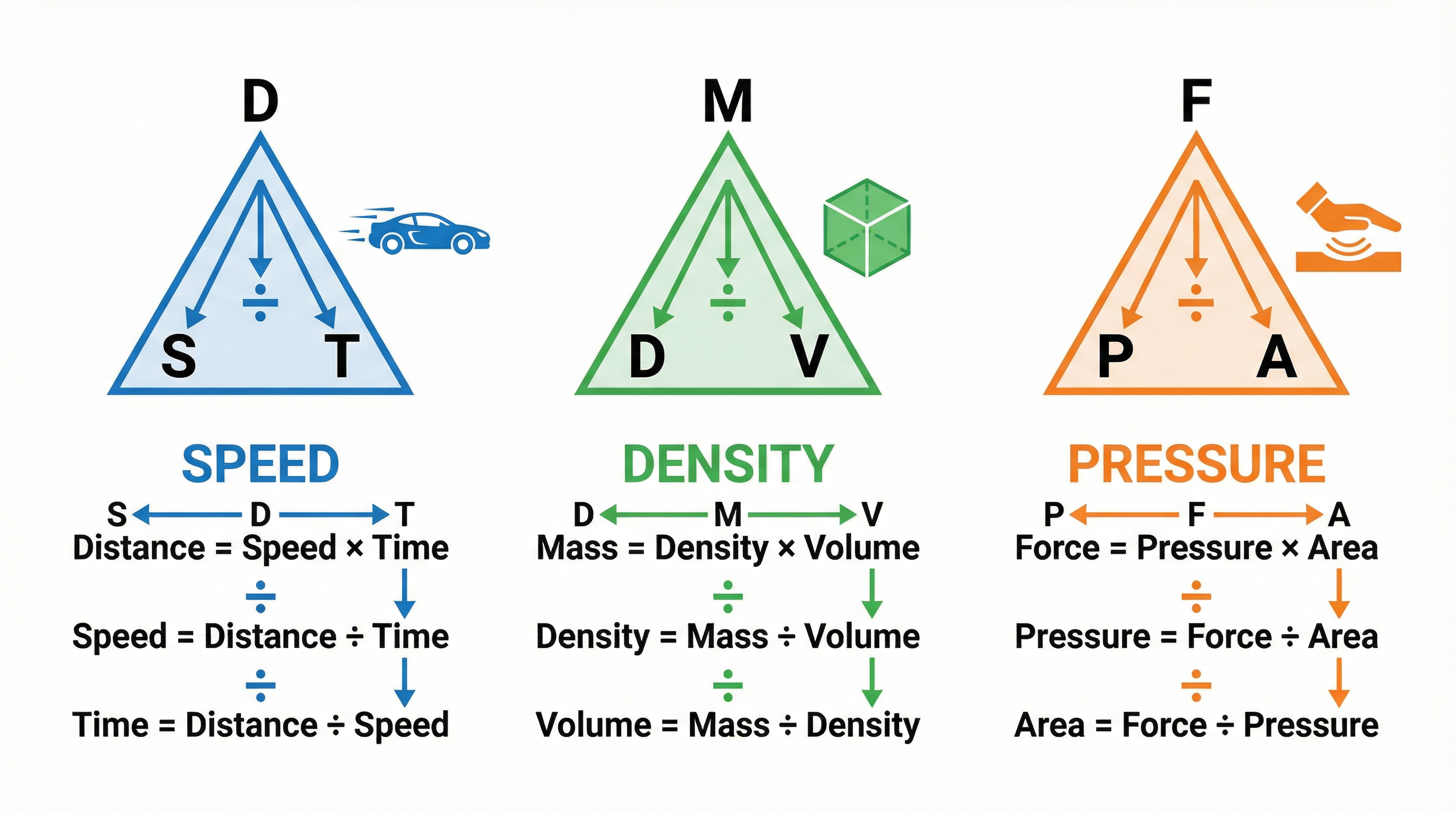
The core of this topic revolves around three key formulas. It is essential that you not only memorise them but also understand how to rearrange them. Using formula triangles is a highly effective exam technique for this.
-
Speed, Distance, Time (DST)
Speed = Distance / Time(Must memorise)Distance = Speed × Time(Must memorise)Time = Distance / Speed(Must memorise)
-
Density, Mass, Volume (DMV)
Density = Mass / Volume(Must memorise)Mass = Density × Volume(Must memorise)Volume = Mass / Density(Must memorise)
-
Pressure, Force, Area (FPA)
Pressure = Force / Area(Given on formula sheet)Force = Pressure × Area(Must memorise)Area = Force / Pressure(Must memorise)
Practical Applications
Compound measures are used constantly in the real world, which is why they are tested at GCSE.
- Speed: Used in transport for journey planning, speed limits, and calculating arrival times. It's also fundamental in physics and sports science.
- Density: Used in engineering and material science to select appropriate materials (e.g., a light but strong material for an aircraft). It's also used in shipping to determine how much cargo a ship can safely carry.
- Pressure: Used in engineering to design structures that can withstand forces (like dams or aircraft windows). It's also critical in medicine (blood pressure) and meteorology (air pressure).
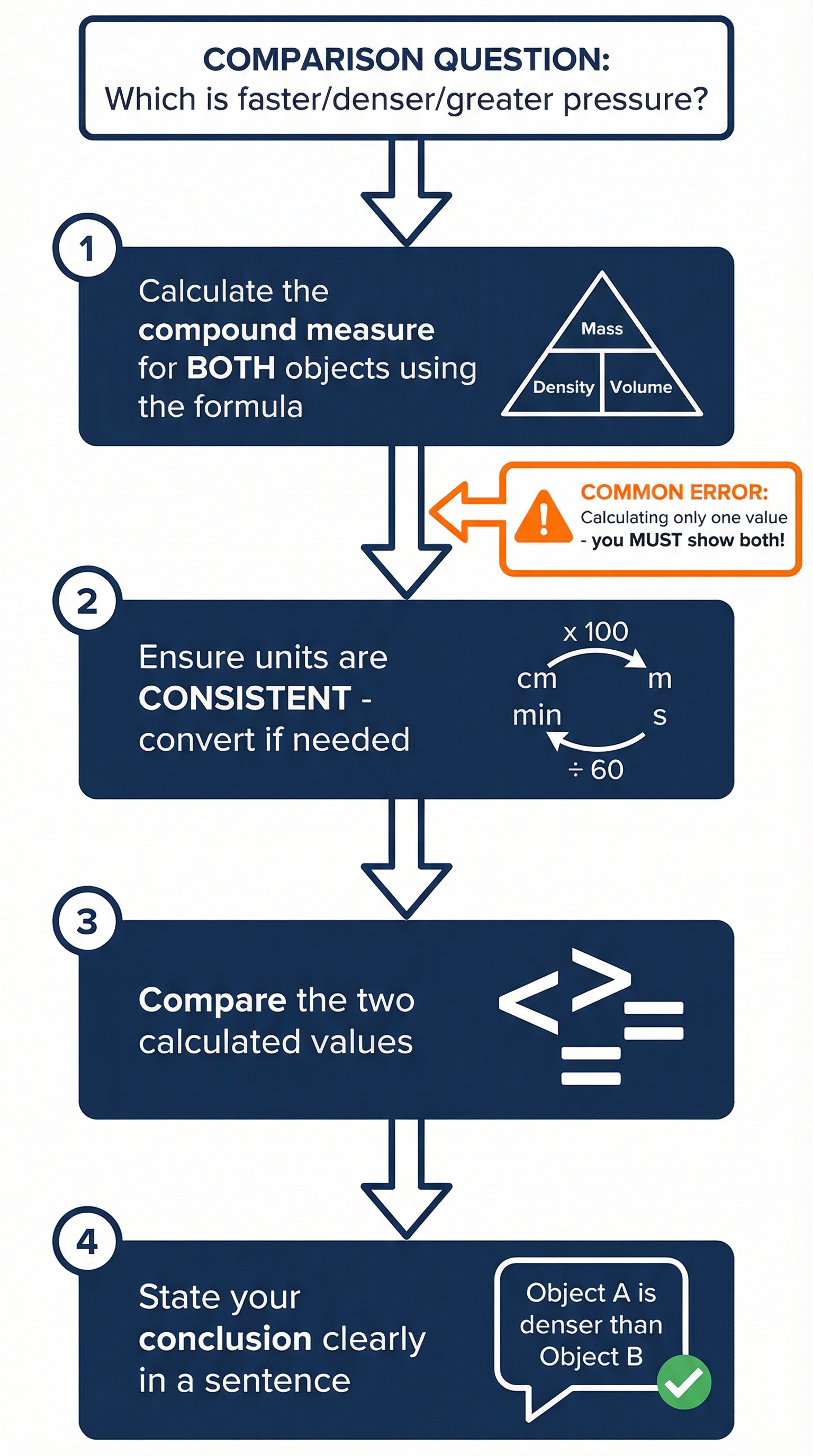
How to Approach Comparison Questions
Many higher-mark questions on this topic ask you to compare two items. For example, "Which car has the greater average speed?" or "Which block is denser?". To secure all the marks, you must follow a clear, structured method.