Pearson Edexcel · A-Level · Mathematics
Course version: 9MA0 · Version from Mar 2026
Use parametric equations in modelling in a variety of contexts.
Full specification wording
Coordinate geometry in the (x, y) plane: 3.4 Use parametric equations in modelling in a variety of contexts.
Parametric equations describe a curve by giving x and y separately in terms of a third variable, the parameter, usually t or θ.
Checked against the Pearson Edexcel 9MA0 specification (opens in a new tab) on .
- Point 4 of 4
- 4 key terms
Study notes
From the checked teaching notes for this specification point.
The idea
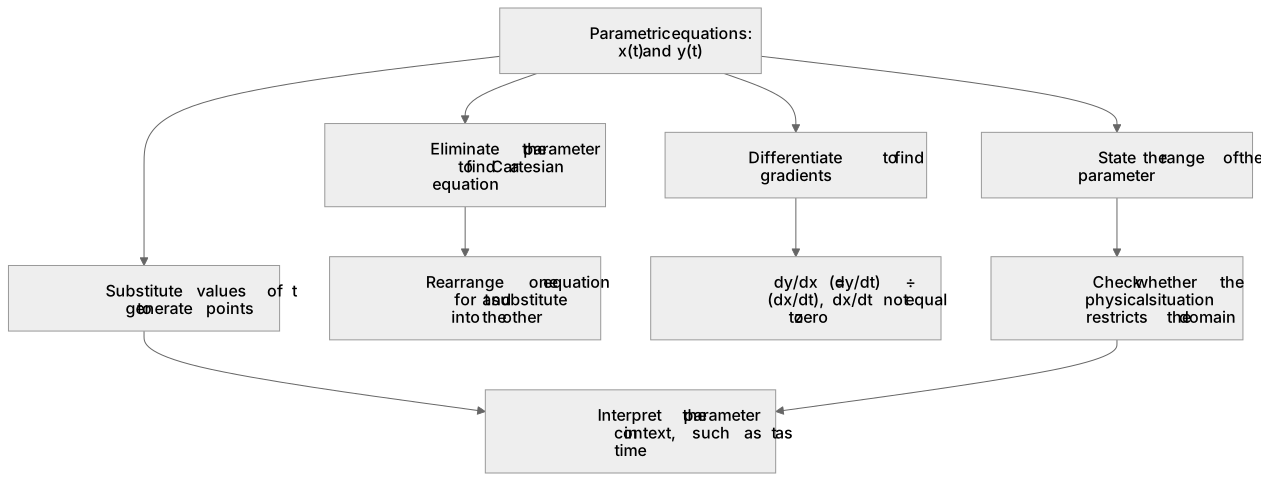
Parametric equations describe a curve by giving x and y separately in terms of a third variable, the parameter, usually t or θ. In modelling, the parameter often represents time, so x(t) and y(t) track a moving point: a ball's horizontal and vertical positions, or a robot arm's coordinates. To use them, substitute values of t to generate points, eliminate the parameter to find a Cartesian equation, and differentiate to find gradients. For example, x = 3t, y = 2t² gives y = 2x²/9 after eliminating t. Contexts include projectile paths, circular motion, and curves that are awkward as y = f(x). Always state the range of the parameter and check whether the model's domain is restricted by the physical situation.
What earns the marks
- Correctly substitutes a given parameter value into both x(t) and y(t) to obtain a coordinate pair on the modelled curve.
- Eliminates the parameter correctly, for example rearranging x = 3t to t = x/3 and substituting into y = 2t² to obtain y = 2x²/9.
- Differentiates parametric equations using dy/dx = (dy/dt) ÷ (dx/dt), with dx/dt not equal to zero, to find a gradient at a stated point.
- Interprets the parameter in context, such as identifying t as time and restricting t to t ≥ 0 where the model requires it.
- States a suitable domain or range for the parameter and explains how the physical context limits it.
Common mistakes and how to put them right
Eliminating the parameter by dividing one equation by the other without checking that the divisor is non-zero.
Put it right: Rearrange one equation for t and substitute into the other.
Forgetting to square the whole expression when substituting, for example writing y = 2x/3 instead of y = 2(x/3)².
Put it right: Apply the exponent to the entire bracket.
Ignoring the context's restriction on the parameter, such as allowing negative time.
Put it right: State the valid interval for the parameter before interpreting the model.
Exam tips
- Write the parameter value and both coordinates clearly before substituting, so arithmetic slips are easy to spot.
- When eliminating the parameter, show the rearrangement step explicitly; this earns method credit even if later algebra slips.
- Check the final Cartesian equation against one known point from the parametric form to confirm the two forms agree.
Try the lesson
The start of the Coordinate geometry in the (x, y) plane: 3.4 Use parametric equations in modelling in a variety of contexts. lesson, made from checked teaching notes for this specification point.
Have a go first
A projectile is fired from the ground. Its horizontal position x and vertical height y, in metres, after t seconds are modelled by the parametric equations x = 12t and y = 14.7t - 4.9t². Find the horizontal distance travelled by the projectile when it hits the ground.
Listen
Parametric equations describe a curve by giving x and y separately in terms of a third variable, the parameter, usually t or θ. In modelling, the parameter often represents time, so x(t) and y(t) track a moving point: a ball's horizontal and vertical positions, or a robot arm's coordinates. To use them, substitute values of t to generate points, eliminate the parameter to find a Cartesian equation, and differentiate to find gradients. For example, x = 3t, y = 2t² gives y = 2x²/9 after eliminating t. Contexts include projectile paths, circular motion, and curves that are awkward as y = f(x). Always state the range of the parameter and check whether the model's domain is restricted by the physical situation. A strong answer earns marks for these points. Correctly substitutes a given parameter value into both x(t) and y(t) to obtain a coordinate pair on the modelled curve. Eliminates the parameter correctly, for example rearranging x = 3t to t = x/3 and substituting into y = 2t² to obtain y = 2x²/9. Differentiates parametric equations using dy/dx = (dy/dt) ÷ (dx/dt), with dx/dt not equal to zero, to find a gradient at a stated point. Interprets the parameter in context, such as identifying t as time and restricting t to t ≥ 0 where the model requires it. A common slip: Eliminating the parameter by dividing one equation by the other without checking that the divisor is non-zero. Instead, rearrange one equation for t and substitute into the other. Exam tip: Write the parameter value and both coordinates clearly before substituting, so arithmetic slips are easy to spot.
See it
Key words
Say what each word means before you turn the card.
Parameter
Try answering aloud or in your head before turning the card.
Eliminating the parameter
Try answering aloud or in your head before turning the card.
Differentiation of parametric curves
Try answering aloud or in your head before turning the card.
Restricted domain
Try answering aloud or in your head before turning the card.
See every definition
- Parameter
- A third variable, usually t or θ, in terms of which x and y are given separately to describe a curve.
- Eliminating the parameter
- Rearranging one equation for the parameter and substituting into the other to find a Cartesian equation.
- Differentiation of parametric curves
- Finding a gradient using dy/dx = (dy/dt) ÷ (dx/dt), with dx/dt not equal to zero.
- Restricted domain
- A range of the parameter limited by the physical situation, such as restricting t to t ≥ 0.
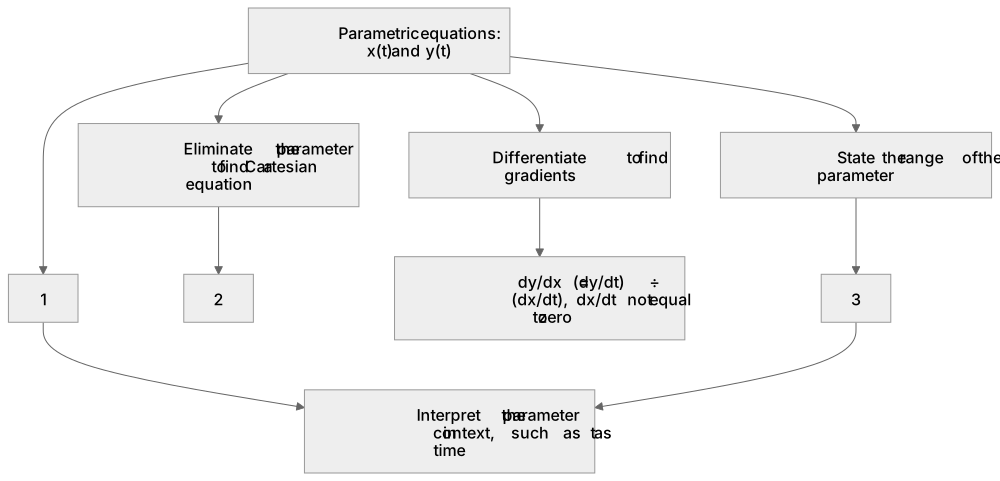
Label the diagram
Some boxes have lost their names. Pick the right name for each number.
1Box 1
2Box 2
3Box 3
There is more to this lesson
The full lesson goes on to check your understanding and help you earn the marks. Create a free account to carry on, with your progress saved.
A week of Premium from your first lesson · Then the free plan continues · No card, no charge
Test your understanding of Coordinate geometry in the (x, y) plane: 3.4 Use parametric equations in modelling in a variety of contexts.
Active recall beats re-reading. Take an instant quiz now to test what you’ve learned and lock it into long-term memory.
A week of Premium from your first lesson · Then the free plan continues · No card, no charge