Pearson Edexcel · A-Level · Mathematics
Course version: 9MA0 · Version from Mar 2026
Know that the gradient of e^(kx) is equal to k e^(kx) and hence understand…
Full specification wording
Exponentials and logarithms: 6.2 Know that the gradient of e^(kx) is equal to k e^(kx) and hence understand why the exponential model is suitable in many applications.
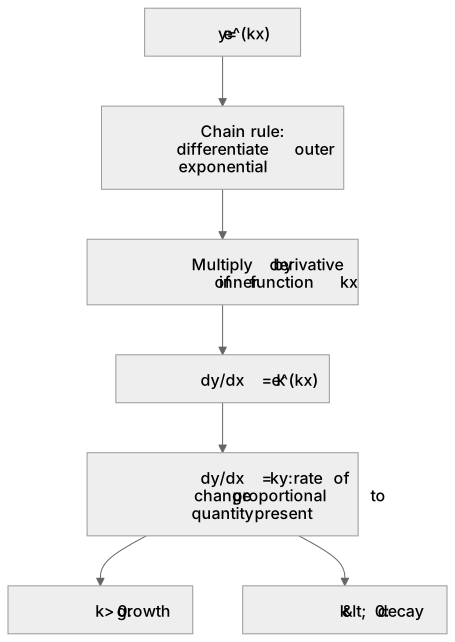
Differentiating y = e^(kx) gives dy/dx = k e^(kx): the function reproduces itself multiplied by the constant k.
Checked against the Pearson Edexcel 9MA0 specification (opens in a new tab) on .
- Point 2 of 7
- 2 key terms
Study notes
From the checked teaching notes for this specification point.
The idea
Differentiating y = e^(kx) gives dy/dx = k e^(kx): the function reproduces itself multiplied by the constant k. This follows from the chain rule, since the derivative of e^u with respect to u is e^u and u = kx has derivative k. The result means the rate of change is proportional to the current value, dy/dx = ky, which is exactly the relationship modelled by growth and decay processes such as populations, compound interest, radioactive decay and cooling. When k > 0 the quantity grows; when k < 0 it decays. You can verify the rule numerically by comparing gradients from a table of values, and you use it to find gradients, tangents and stationary behaviour of exponential curves.
What earns the marks
- States the derivative of e^(kx) as k e^(kx) and identifies k as a constant multiplier arising from the chain rule.
- Shows the chain-rule reasoning: differentiate the outer exponential, then multiply by the derivative of the inner function kx.
- Links the result to the differential equation dy/dx = ky, explaining that rate of change is proportional to the quantity present.
- Interprets the sign of k: positive k gives growth, negative k gives decay, and connects this to real contexts such as population or radioactive decay.
- Applies the rule to find gradients, equations of tangents or normals, and to locate and classify stationary points where they exist.
- Uses the rule with a composite inner function, for example differentiating e^(3x + 1) by recognising k = 3.
Common mistakes and how to put them right
Forgetting to multiply by k and writing the derivative as e^(kx).
Put it right by applying the chain rule fully so the factor k appears.
Differentiating the exponent as though it were a power of x, for example treating e^(kx) like x^n.
Put it right by keeping the exponential form unchanged.
Losing the negative sign when k is negative, which reverses growth and decay.
Put it right by substituting k carefully, for example k = −0.05 gives −0.05e^(−0.05x).
Assuming every exponential curve has a stationary point.
Put it right by noting k e^(kx) is never zero for finite x, so no turning points occur.
Exam tips
- Write down k explicitly before differentiating, especially when the exponent is a compound expression such as 4x − 7.
- If a question describes a rate proportional to the amount present, translate it immediately into dy/dx = ky and identify k from the context.
- Check the sign of your derivative against the expected growth or decay described in the question.
- When finding a tangent, evaluate both the function and its derivative at the given x-value before forming the line equation.
Try the lesson
The start of the Exponentials and logarithms: 6.2 Know that the gradient of e^(kx) is equal to k e^(kx) and hence understand why the exponential model is suitable in many applications. lesson, made from checked teaching notes for this specification point.
Have a go first
Given that y = e^(4x), what is dy/dx?
Listen
Differentiating y = e^(kx) gives dy/dx = k e^(kx): the function reproduces itself multiplied by the constant k. This follows from the chain rule, since the derivative of e^u with respect to u is e^u and u = kx has derivative k. The result means the rate of change is proportional to the current value, dy/dx = ky, which is exactly the relationship modelled by growth and decay processes such as populations, compound interest, radioactive decay and cooling. When k > 0 the quantity grows; when k < 0 it decays. You can verify the rule numerically by comparing gradients from a table of values, and you use it to find gradients, tangents and stationary behaviour of exponential curves. A strong answer earns marks for these points. States the derivative of e^(kx) as k e^(kx) and identifies k as a constant multiplier arising from the chain rule. Shows the chain-rule reasoning: differentiate the outer exponential, then multiply by the derivative of the inner function kx. Links the result to the differential equation dy/dx = ky, explaining that rate of change is proportional to the quantity present. Interprets the sign of k: positive k gives growth, negative k gives decay, and connects this to real contexts such as population or radioactive decay. A common slip: Forgetting to multiply by k and writing the derivative as e^(kx). Instead, applying the chain rule fully so the factor k appears. Exam tip: Write down k explicitly before differentiating, especially when the exponent is a compound expression such as 4x − 7.
See it
Key words
Say what each word means before you turn the card.
Differentiation of exponential functions
Try answering aloud or in your head before turning the card.
Proportional rates of change
Try answering aloud or in your head before turning the card.
See every definition
- Differentiation of exponential functions
- The gradient of e^(kx) is equal to k e^(kx), so the function reproduces itself multiplied by the constant k.
- Proportional rates of change
- The rate of change is proportional to the current value, dy/dx = ky, which is exactly the relationship modelled by growth and decay processes.
Label the diagram
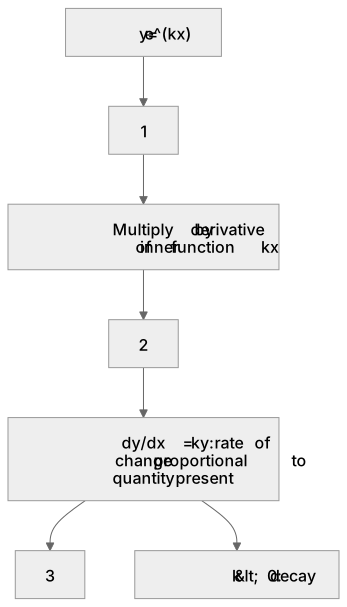
Some boxes have lost their names. Pick the right name for each number.
1Box 1
2Box 2
3Box 3
There is more to this lesson
The full lesson goes on to check your understanding and help you earn the marks. Create a free account to carry on, with your progress saved.
A week of Premium from your first lesson · Then the free plan continues · No card, no charge
Test your understanding of Exponentials and logarithms: 6.2 Know that the gradient of e^(kx) is equal to k e^(kx) and hence understand why the exponential model is suitable in many applications.
Active recall beats re-reading. Take an instant quiz now to test what you’ve learned and lock it into long-term memory.
A week of Premium from your first lesson · Then the free plan continues · No card, no charge