Pearson Edexcel · A-Level · Mathematics
Course version: 9MA0 · Version from Mar 2026
Understand the concept of a force; understand and use Newton’s first law.
Full specification wording
Forces and Newton’s laws: 8.1 Understand the concept of a force; understand and use Newton’s first law.
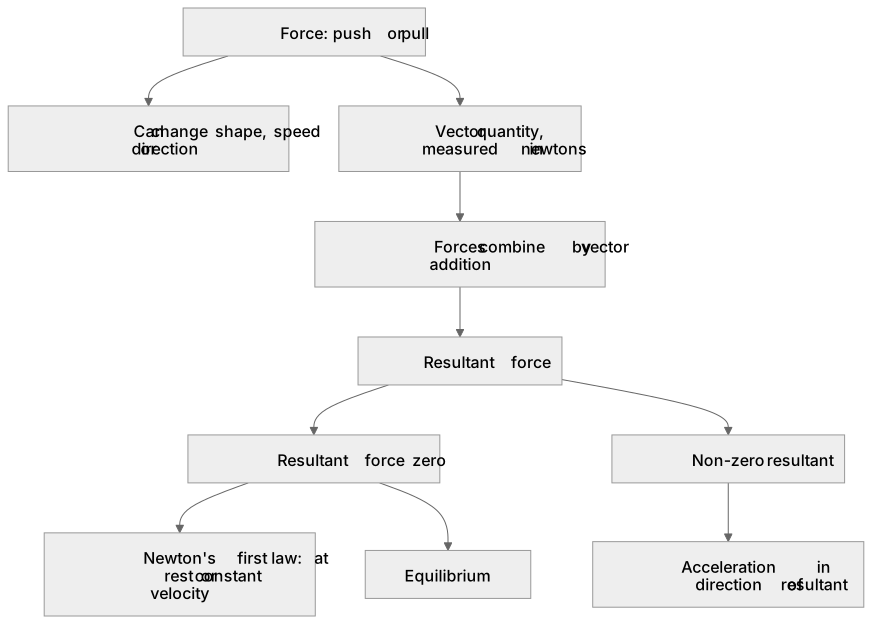
A force is a push or pull that can change an object’s shape, speed or direction, and it is a vector quantity measured in newtons.
Checked against the Pearson Edexcel 9MA0 specification (opens in a new tab) on .
- Point 1 of 6
- 4 key terms
Study notes
From the checked teaching notes for this specification point.
The idea
A force is a push or pull that can change an object’s shape, speed or direction, and it is a vector quantity measured in newtons. Forces arise from interactions such as contact, tension, weight and friction, and they combine by vector addition to give a resultant. Newton’s first law states that a body remains at rest or moves with constant velocity unless acted on by a resultant force; equivalently, a body is in equilibrium when the resultant force on it is zero. This law defines an inertial frame and explains why constant velocity, not just rest, indicates zero resultant force. In problems, resolve forces into components, sum them, and set the resultant to zero for equilibrium; a non-zero resultant produces acceleration in the direction of that resultant.
What earns the marks
- Defines force as a vector quantity that can change an object’s motion or shape, measured in newtons.
- States Newton’s first law: a body remains at rest or in uniform motion in a straight line unless acted on by a resultant force.
- Explains equilibrium as the condition of zero resultant force, covering both rest and constant velocity.
- Resolves forces into perpendicular components and sums them to find a resultant or to impose equilibrium.
- Distinguishes mass as a scalar measure of inertia from weight as the force mg acting downwards.
- Applies the law to identify forces acting on a body and to predict or explain its motion.
Common mistakes and how to put them right
Believing that a moving object must have a resultant force acting on it.
Put it right: Constant velocity means zero resultant force.
Treating force as a scalar and adding magnitudes directly.
Put it right: Add forces as vectors, using components where necessary.
Confusing mass with weight.
Put it right: Mass is measured in kilograms and weight is the force mg measured in newtons.
Exam tips
- Draw a free-body diagram showing every force acting on the object before writing equations.
- State the direction of motion and the direction of the resultant force explicitly when explaining motion.
- For equilibrium problems, resolve parallel and perpendicular to a convenient direction and set each sum to zero.
Try the lesson
The start of the Forces and Newton’s laws: 8.1 Understand the concept of a force; understand and use Newton’s first law. lesson, made from checked teaching notes for this specification point.
Have a go first
A book rests on a horizontal table and remains at rest. Which statement correctly describes the forces acting on the book?
Listen
A force is a push or pull that can change an object’s shape, speed or direction, and it is a vector quantity measured in newtons. Forces arise from interactions such as contact, tension, weight and friction, and they combine by vector addition to give a resultant. Newton’s first law states that a body remains at rest or moves with constant velocity unless acted on by a resultant force; equivalently, a body is in equilibrium when the resultant force on it is zero. This law defines an inertial frame and explains why constant velocity, not just rest, indicates zero resultant force. In problems, resolve forces into components, sum them, and set the resultant to zero for equilibrium; a non-zero resultant produces acceleration in the direction of that resultant. A strong answer earns marks for these points. Defines force as a vector quantity that can change an object’s motion or shape, measured in newtons. States Newton’s first law: a body remains at rest or in uniform motion in a straight line unless acted on by a resultant force. Explains equilibrium as the condition of zero resultant force, covering both rest and constant velocity. Resolves forces into perpendicular components and sums them to find a resultant or to impose equilibrium. A common slip: Believing that a moving object must have a resultant force acting on it. Instead, constant velocity means zero resultant force. Exam tip: Draw a free-body diagram showing every force acting on the object before writing equations.
See it
Key words
Say what each word means before you turn the card.
Force
Try answering aloud or in your head before turning the card.
Newton's first law
Try answering aloud or in your head before turning the card.
Equilibrium
Try answering aloud or in your head before turning the card.
Resultant
Try answering aloud or in your head before turning the card.
See every definition
- Force
- A push or pull that can change an object's shape, speed or direction, and a vector quantity measured in newtons.
- Newton's first law
- A body remains at rest or moves with constant velocity unless acted on by a resultant force.
- Equilibrium
- The condition of a body when the resultant force on it is zero, covering both rest and constant velocity.
- Resultant
- What forces give when they combine by vector addition, and a non-zero one produces acceleration in its direction.
Label the diagram
Some boxes have lost their names. Pick the right name for each number.
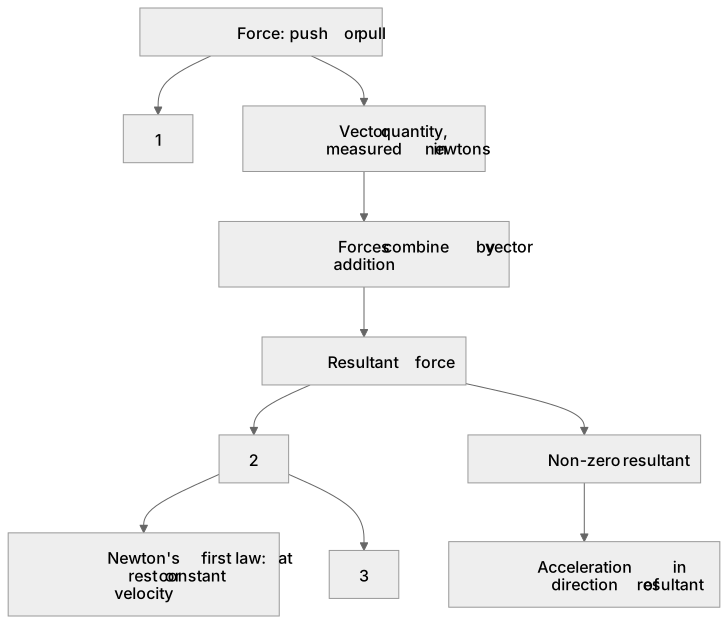
1Box 1
2Box 2
3Box 3
There is more to this lesson
The full lesson goes on to check your understanding and help you earn the marks. Create a free account to carry on, with your progress saved.
A week of Premium from your first lesson · Then the free plan continues · No card, no charge
Test your understanding of Forces and Newton’s laws: 8.1 Understand the concept of a force; understand and use Newton’s first law.
Active recall beats re-reading. Take an instant quiz now to test what you’ve learned and lock it into long-term memory.
A week of Premium from your first lesson · Then the free plan continues · No card, no charge