Pearson Edexcel · A-Level · Mathematics
Course version: 9MA0 · Version from Mar 2026
Mathematical argument, language and proof: Comprehend and critique…
Full specification wording
Overarching theme 1: Mathematical argument, language and proof: Comprehend and critique mathematical arguments, proofs and justifications of methods and formulae, including those relating to applications of mathematics.
This theme requires you to read a mathematical argument, proof or justification and judge whether it is valid, complete and correctly applied.
Checked against the Pearson Edexcel 9MA0 specification (opens in a new tab) on .
- Point 5 of 5
- 4 key terms
Study notes
From the checked teaching notes for this specification point.
The idea
This theme requires you to read a mathematical argument, proof or justification and judge whether it is valid, complete and correctly applied. Comprehension means following each step: identifying assumptions, definitions and the logical link between consecutive lines. Critique means testing that link, checking whether every case is covered, whether converses or counterexamples undermine a claim, and whether a formula's conditions of use are respected. For example, a proof that the sum of two even integers is even must define even integers as 2m and 2n, add to 2(m + n) and state that m + n is an integer. In applied contexts, you also judge whether a model's assumptions, such as constant acceleration or a normal distribution, justify the method used.
What earns the marks
- Identifies the assumptions, definitions and given information on which the argument depends.
- Checks each logical step, including whether a stated implication is valid in the direction used.
- Tests generality by considering special cases, boundary cases or a counterexample.
- Examines whether conditions attached to a formula or method are satisfied in the situation.
- Distinguishes a demonstration of a result from a complete proof covering all cases.
- Comments on the strength and limitations of a justification used in an applied context.
Common mistakes and how to put them right
Accepting a proof because the conclusion is true, rather than checking that the reasoning establishes it.
Put it right by evaluating each step independently of the result.
Treating a single verified example as proof of a general statement.
Put it right by requiring a general argument or by finding a counterexample.
Applying a formula outside its stated conditions, such as using a constant-acceleration equation when acceleration varies.
Put it right by checking the conditions before use.
Exam tips
- Underline the claim, the assumptions and the conclusion before judging the argument.
- When asked to critique, name the specific faulty step and explain why it fails, rather than saying only that it is wrong.
- Use a counterexample or boundary case to expose a gap quickly when a general proof is claimed.
Try the lesson
The start of the Overarching theme 1: Mathematical argument, language and proof: Comprehend and critique mathematical arguments, proofs and justifications of methods and formulae, including those relating to applications of mathematics. lesson, made from checked teaching notes for this specification point.
Have a go first
A student claims: "For any real number x, x^2 + 1 > 2x." Which of the following is a valid counterexample to this claim?
Listen
This theme requires you to read a mathematical argument, proof or justification and judge whether it is valid, complete and correctly applied. Comprehension means following each step: identifying assumptions, definitions and the logical link between consecutive lines. Critique means testing that link, checking whether every case is covered, whether converses or counterexamples undermine a claim, and whether a formula's conditions of use are respected. For example, a proof that the sum of two even integers is even must define even integers as 2m and 2n, add to 2(m + n) and state that m + n is an integer. In applied contexts, you also judge whether a model's assumptions, such as constant acceleration or a normal distribution, justify the method used. A strong answer earns marks for these points. Identifies the assumptions, definitions and given information on which the argument depends. Checks each logical step, including whether a stated implication is valid in the direction used. Tests generality by considering special cases, boundary cases or a counterexample. Examines whether conditions attached to a formula or method are satisfied in the situation. A common slip: Accepting a proof because the conclusion is true, rather than checking that the reasoning establishes it. Instead, evaluating each step independently of the result. Exam tip: Underline the claim, the assumptions and the conclusion before judging the argument.
See it
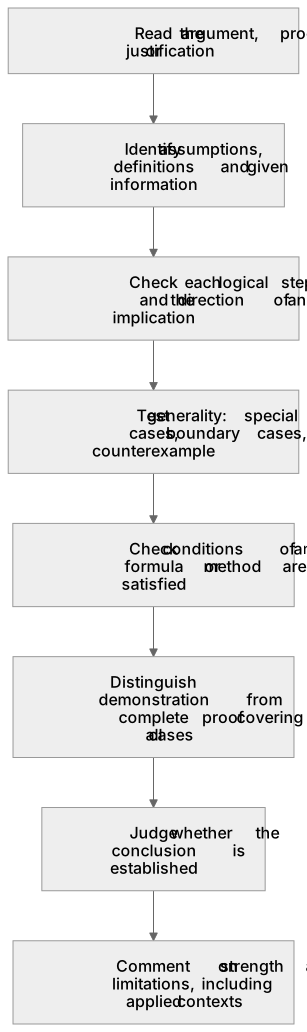
Put it in order
Put these steps in the order they happen.
- 1. Check conditions of any formula or method are satisfied
- 2. Comment on strength and limitations, including applied contexts
- 3. Distinguish demonstration from complete proof covering all cases
- 4. Read the argument, proof or justification
- 5. Identify assumptions, definitions and given information
- 6. Judge whether the conclusion is established
- 7. Check each logical step and the direction of any implication
- 8. Test generality: special cases, boundary cases, counterexample
Key words
Say what each word means before you turn the card.
Logical structure and implication
Try answering aloud or in your head before turning the card.
Proof completeness and generality
Try answering aloud or in your head before turning the card.
Conditions of use for formulae
Try answering aloud or in your head before turning the card.
Critical evaluation of applied models
Try answering aloud or in your head before turning the card.
See every definition
- Logical structure and implication
- The link between consecutive lines of an argument, which must be checked to see whether a stated implication is valid in the direction used.
- Proof completeness and generality
- Whether a justification establishes its conclusion for all required cases, tested by considering special cases, boundary cases or a counterexample.
- Conditions of use for formulae
- The stated conditions attached to a formula or method, which must be satisfied in the situation before it is applied.
- Critical evaluation of applied models
- Judging whether a model's assumptions, such as constant acceleration or a normal distribution, justify the method used, and commenting on the strength and limitations of the justification.
Label the diagram
Some boxes have lost their names. Pick the right name for each number.
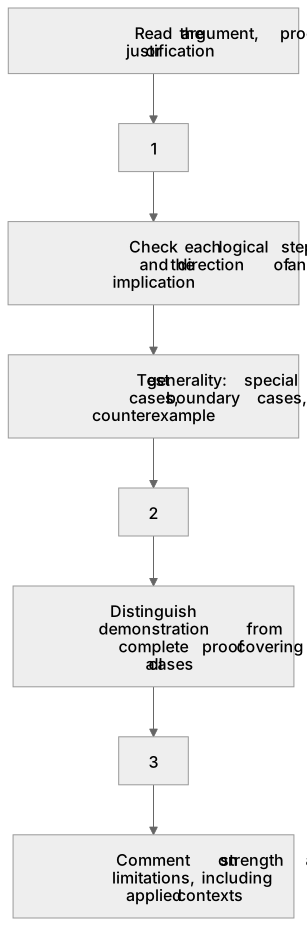
1Box 1
2Box 2
3Box 3
There is more to this lesson
The full lesson goes on to check your understanding and help you earn the marks. Create a free account to carry on, with your progress saved.
A week of Premium from your first lesson · Then the free plan continues · No card, no charge
Test your understanding of Overarching theme 1: Mathematical argument, language and proof: Comprehend and critique mathematical arguments, proofs and justifications of methods and formulae, including those relating to applications of mathematics.
Active recall beats re-reading. Take an instant quiz now to test what you’ve learned and lock it into long-term memory.
A week of Premium from your first lesson · Then the free plan continues · No card, no charge