Pearson Edexcel · A-Level · Mathematics
Course version: 9MA0 · Version from Mar 2026
Understand and use double angle formulae; use of formulae for sin(A ± B),…
Full specification wording
Trigonometry: 5.6 Understand and use double angle formulae; use of formulae for sin(A ± B), cos(A ± B), and tan(A ± B); understand geometrical proofs of these formulae. Understand and use expressions for a cos θ + b sin θ in the equivalent forms of R cos(θ ± α) or R sin(θ ± α).
Addition formulae are sin(A ± B) = sin A cos B ± cos A sin B, cos(A ± B) = cos A cos B ∓ sin A sin B, and tan(A ± B) = (tan A ± tan B)/(1 ∓ tan A tan B).
Checked against the Pearson Edexcel 9MA0 specification (opens in a new tab) on .
- Point 6 of 9
- 2 key terms
Study notes
From the checked teaching notes for this specification point.
The idea
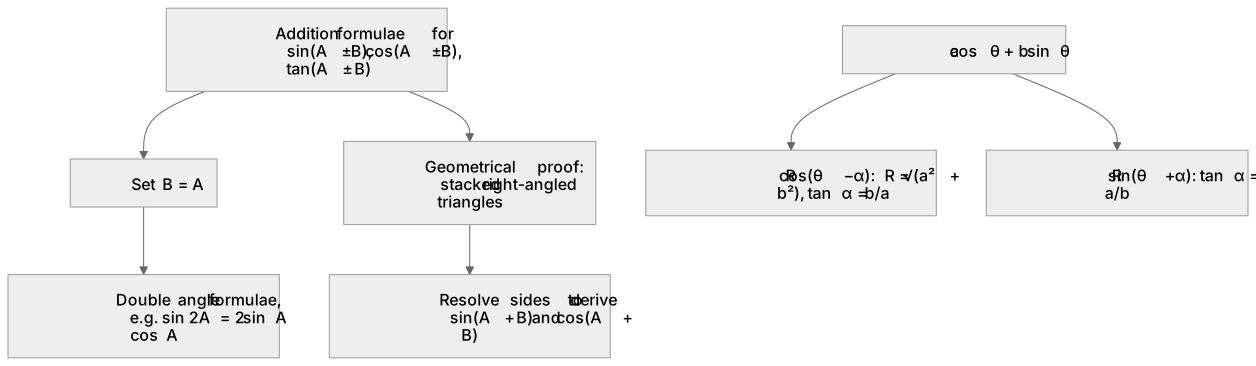
Addition formulae are sin(A ± B) = sin A cos B ± cos A sin B, cos(A ± B) = cos A cos B ∓ sin A sin B, and tan(A ± B) = (tan A ± tan B)/(1 ∓ tan A tan B). Setting B = A gives double angle results like sin 2A = 2 sin A cos A. Geometrical proofs of addition formulae use stacked right-angled triangles: a triangle with angle B sits on the hypotenuse of one with angle A. Resolving sides derives sin(A + B) and cos(A + B). The harmonic form a cos θ + b sin θ (for a, b > 0) can be expressed as R cos(θ − α) where R = √(a² + b²) and tan α = b/a, or R sin(θ + α) where tan α = a/b. For example, 3 cos θ + 4 sin θ = 5 cos(θ − 53.1°) since R = √(3²+4²) = 5 and tan α = 4/3. Other sign combinations map to R cos(θ + α) or R sin(θ − α).
What earns the marks
- Correctly state and apply the addition formulae for sin(A ± B), cos(A ± B) and tan(A ± B), including the sign changes in the cosine and tangent formulae.
- Derive the double angle formulae by substituting B = A into the addition formulae, and select the appropriate form of cos 2A for a given problem.
- Construct geometrical proofs of the addition formulae by drawing stacked right-angled triangles and resolving lengths to find sin(A + B) and cos(A + B).
- Convert a cos θ + b sin θ into R cos(θ ± α) or R sin(θ ± α) by equating coefficients, calculating R = √(a² + b²) and determining α using the correct ratio.
- Solve equations or find maxima/minima of expressions like a cos θ + b sin θ using the harmonic form.
Common mistakes and how to put them right
Writing cos(A + B) = cos A cos B + sin A sin B instead of the correct cos A cos B − sin A sin B.
Put it right: The cosine addition formula has a minus sign.
Forgetting the factor 2 in sin 2A = 2 sin A cos A, or writing sin 2A = sin A cos A; the double angle formula includes the factor 2.
When converting a cos θ + b sin θ to R sin(θ + α), using tan α = b/a instead of tan α = a/b.
Put it right: Check by expanding R sin(θ + α) and comparing coefficients.
Exam tips
- The addition formulae are given in the formula booklet, but you must know how to derive the double angle formulae from them.
- When using harmonic form, clearly show the expansion of R cos(θ ± α) or R sin(θ ± α) and equate coefficients to find R and α.
Try the lesson
The start of the Trigonometry: 5.6 Understand and use double angle formulae; use of formulae for sin(A ± B), cos(A ± B), and tan(A ± B); understand geometrical proofs of these formulae. Understand and use expressions for a cos θ + b sin θ in the equivalent forms of R cos(θ ± α) or R sin(θ ± α). lesson, made from checked teaching notes for this specification point.
Have a go first
Given that sin θ = 3/5 and θ is acute, use a double angle formula to find the exact value of sin 2θ.
Listen
Addition formulae are sin(A ± B) = sin A cos B ± cos A sin B, cos(A ± B) = cos A cos B ∓ sin A sin B, and tan(A ± B) = (tan A ± tan B)/(1 ∓ tan A tan B). Setting B = A gives double angle results like sin 2A = 2 sin A cos A. Geometrical proofs of addition formulae use stacked right-angled triangles: a triangle with angle B sits on the hypotenuse of one with angle A. Resolving sides derives sin(A + B) and cos(A + B). The harmonic form a cos θ + b sin θ (for a, b > 0) can be expressed as R cos(θ − α) where R = √(a² + b²) and tan α = b/a, or R sin(θ + α) where tan α = a/b. For example, 3 cos θ + 4 sin θ = 5 cos(θ − 53.1°) since R = √(3²+4²) = 5 and tan α = 4/3. Other sign combinations map to R cos(θ + α) or R sin(θ − α). A strong answer earns marks for these points. Correctly state and apply the addition formulae for sin(A ± B), cos(A ± B) and tan(A ± B), including the sign changes in the cosine and tangent formulae. Derive the double angle formulae by substituting B = A into the addition formulae, and select the appropriate form of cos 2A for a given problem. Construct geometrical proofs of the addition formulae by drawing stacked right-angled triangles and resolving lengths to find sin(A + B) and cos(A + B). Convert a cos θ + b sin θ into R cos(θ ± α) or R sin(θ ± α) by equating coefficients, calculating R = √(a² + b²) and determining α using the correct ratio. Exam tip: The addition formulae are given in the formula booklet, but you must know how to derive the double angle formulae from them.
See it
Key words
Say what each word means before you turn the card.
Double angle formulae
Try answering aloud or in your head before turning the card.
Geometrical proofs
Try answering aloud or in your head before turning the card.
See every definition
- Double angle formulae
- Results such as sin 2A = 2 sin A cos A, obtained by setting B = A in the addition formulae.
- Geometrical proofs
- Proofs of the addition formulae using stacked right-angled triangles, where a triangle with angle B sits on the hypotenuse of one with angle A, and resolving sides derives sin(A + B) and cos(A + B).
Label the diagram
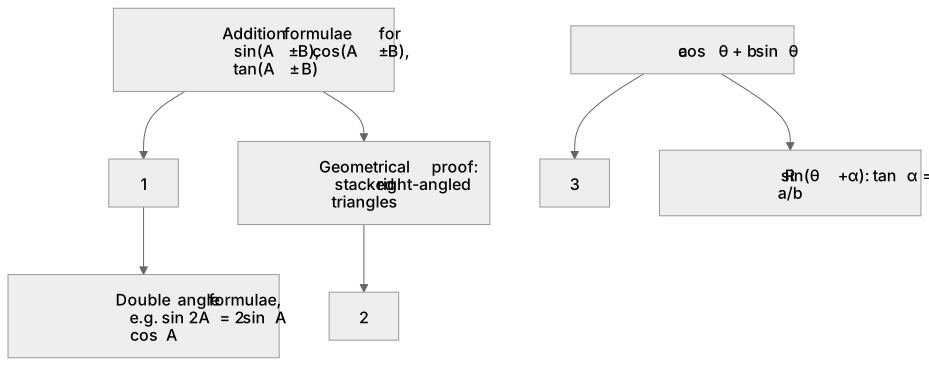
Some boxes have lost their names. Pick the right name for each number.
1Box 1
2Box 2
3Box 3
There is more to this lesson
The full lesson goes on to check your understanding and help you earn the marks. Create a free account to carry on, with your progress saved.
A week of Premium from your first lesson · Then the free plan continues · No card, no charge
Test your understanding of Trigonometry: 5.6 Understand and use double angle formulae; use of formulae for sin(A ± B), cos(A ± B), and tan(A ± B); understand geometrical proofs of these formulae. Understand and use expressions for a cos θ + b sin θ in the equivalent forms of R cos(θ ± α) or R sin(θ ± α).
Active recall beats re-reading. Take an instant quiz now to test what you’ve learned and lock it into long-term memory.
A week of Premium from your first lesson · Then the free plan continues · No card, no charge