Pearson Edexcel · A-Level · Mathematics
Course version: 9MA0 · Version from Mar 2026
Use trigonometric functions to solve problems in context, including…
Full specification wording
Trigonometry: 5.9 Use trigonometric functions to solve problems in context, including problems involving vectors, kinematics and forces.
Trigonometric functions model real-world problems involving vectors, kinematics and forces.
Checked against the Pearson Edexcel 9MA0 specification (opens in a new tab) on .
- Point 9 of 9
- 2 key terms
Study notes
From the checked teaching notes for this specification point.
The idea
Trigonometric functions model real-world problems involving vectors, kinematics and forces. In vector problems, resolve vectors into components using sine and cosine, or find angles using the cosine rule on a vector triangle. In kinematics, trigonometric equations describe projectile motion where horizontal and vertical components are analysed separately, or particles on inclined planes. For forces, resolve into perpendicular components using sine and cosine, and find resultants using vector addition or the cosine rule.
For example: A force of 10 N at 30° to the horizontal has a horizontal component of 10 cos 30° = 5√3 ≈ 8.66 N and a vertical component of 10 sin 30° = 5 N. Always draw a clear diagram, define the positive direction, and use exact values where possible.
What earns the marks
- Resolve vectors or forces into perpendicular components using trigonometric functions, choosing appropriate axes and angles.
- Use the cosine rule or sine rule on vector triangles to find angles between vectors or resultant forces.
- Set up and solve trigonometric equations that model kinematic situations, such as projectile motion or objects on an inclined plane.
- Interpret solutions in the context of the problem, including units and direction, and check for reasonableness.
- Draw clear diagrams to represent the problem, labelling forces, angles and directions.
Common mistakes and how to put them right
Using the wrong trigonometric ratio when resolving a force or vector, such as using sine instead of cosine for the adjacent component.
Put it right: Check the angle is measured from the correct axis.
Forgetting to consider the direction of forces or vectors, leading to sign errors when summing components.
Put it right: Define a positive direction and stick to it.
In kinematic problems, mixing up horizontal and vertical components, or using the same acceleration for both.
Put it right: Horizontal acceleration is often zero (ignoring air resistance) while vertical acceleration is due to gravity.
Exam tips
- Always draw a diagram and label all known and unknown quantities, including angles and directions.
- Resolve forces or vectors into components along convenient perpendicular axes, often horizontal and vertical, or parallel and perpendicular to a slope.
Try the lesson
The start of the Trigonometry: 5.9 Use trigonometric functions to solve problems in context, including problems involving vectors, kinematics and forces. lesson, made from checked teaching notes for this specification point.
Have a go first
A force of 50 N acts at 30° above the horizontal. Find the horizontal component of the force, giving your answer to 3 significant figures.
Listen
Trigonometric functions model real-world problems involving vectors, kinematics and forces. In vector problems, resolve vectors into components using sine and cosine, or find angles using the cosine rule on a vector triangle. In kinematics, trigonometric equations describe projectile motion where horizontal and vertical components are analysed separately, or particles on inclined planes. For forces, resolve into perpendicular components using sine and cosine, and find resultants using vector addition or the cosine rule. For example, a force of 10 N at 30° to the horizontal has a horizontal component of 10 cos 30° = 5√3 ≈ 8.66 N and a vertical component of 10 sin 30° = 5 N. Always draw a clear diagram, define the positive direction, and use exact values where possible. A strong answer earns marks for these points. Resolve vectors or forces into perpendicular components using trigonometric functions, choosing appropriate axes and angles. Use the cosine rule or sine rule on vector triangles to find angles between vectors or resultant forces. Set up and solve trigonometric equations that model kinematic situations, such as projectile motion or objects on an inclined plane. Interpret solutions in the context of the problem, including units and direction, and check for reasonableness. Exam tip: Always draw a diagram and label all known and unknown quantities, including angles and directions.
See it
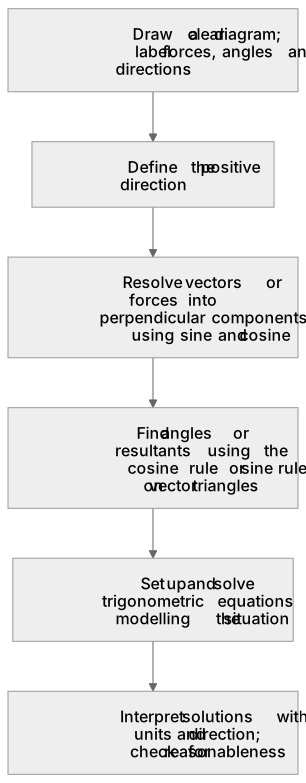
Put it in order
Put these steps in the order they happen.
- 1. Resolve vectors or forces into perpendicular components using sine and cosine
- 2. Define the positive direction
- 3. Draw a clear diagram; label forces, angles and directions
- 4. Interpret solutions with units and direction; check for reasonableness
- 5. Set up and solve trigonometric equations modelling the situation
- 6. Find angles or resultants using the cosine rule or sine rule on vector triangles
Key words
Say what each word means before you turn the card.
Resolution of forces
Try answering aloud or in your head before turning the card.
Applications of trigonometry to vectors
Try answering aloud or in your head before turning the card.
See every definition
- Resolution of forces
- Splitting a force into perpendicular components using sine and cosine, choosing appropriate axes and angles.
- Applications of trigonometry to vectors
- Resolving vectors into components using sine and cosine, or finding angles using the cosine rule on a vector triangle.
Label the diagram
Some boxes have lost their names. Pick the right name for each number.
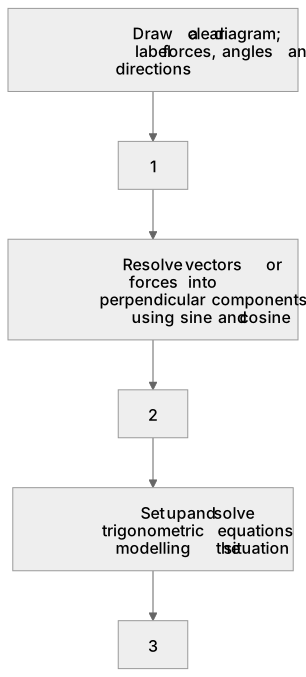
1Box 1
2Box 2
3Box 3
There is more to this lesson
The full lesson goes on to check your understanding and help you earn the marks. Create a free account to carry on, with your progress saved.
A week of Premium from your first lesson · Then the free plan continues · No card, no charge
Test your understanding of Trigonometry: 5.9 Use trigonometric functions to solve problems in context, including problems involving vectors, kinematics and forces.
Active recall beats re-reading. Take an instant quiz now to test what you’ve learned and lock it into long-term memory.
A week of Premium from your first lesson · Then the free plan continues · No card, no charge