Pearson Edexcel · GCSE · Mathematics
Course version: 1MA1 · Version from Mar 2026
Algebra - Notation, vocabulary and manipulation: know the difference between an equation and an identity; argue mathematically to show algebraic expressions are equivalent, and use algebra to support and construct arguments (Foundation tier)
Can two expressions look different but always mean the same thing? Learn to distinguish equations from identities, show equivalence through clear algebra, and build general arguments that make your reasoning visible to the examiner. This [complete JSON study guide](/home/ubuntu/study_guide_algebra/edexcel_foundation_algebra_study_guide.json) combines worked examples, diagrams, retrieval practice and a ten-minute female-tutor podcast.
- 12 min read
- 3 worked examples
- 6 practice questions
- 12 key terms
Try the lesson
The start of the Algebra - Notation, vocabulary and manipulation: know the difference between an equation and an identity; argue mathematically to show algebraic expressions are equivalent, and use algebra to support and construct arguments (Foundation tier) lesson, made from checked teaching notes for this specification point.
Have a go first
Which of these is an identity?
There is more to this lesson
The full lesson goes on to check your understanding and help you earn the marks. Create a free account to carry on, with your progress saved.
7 days Premium · Then the free plan continues · No card, no charge
Check what you remember
Read the wording for your board, then hide it and explain Expression in your own words. Rough notes are fine. This is a self-check, with no mark or grade.
Reference: Pearson Edexcel
A mathematical phrase formed from numbers, variables and operations, without an equality assertion by itself.
Study Notes
Overview
Algebra lets you explain why a result works, rather than merely check that it works once. In this topic, you will distinguish an equation that needs solving from an identity that holds for every permitted value, show that two expressions are equivalent, and construct short arguments about families of numbers. These skills help candidates earn marks for method, accuracy and clear mathematical communication.
The key question is: am I finding a value, or showing something is always true? For example, 3x + 6 = 12 asks which value makes the statement true. By contrast, 3(x + 2) ≡ 3x + 6 states that two expressions always produce the same output. Expanding brackets explains why.
Pearson Edexcel GCSE Mathematics 1MA1 covers this under Foundation specification A6. It connects to collecting terms, factorising, sequences, number properties and solving linear equations. Typical tasks ask candidates to expand and simplify, show equivalence, explain an error, or justify a statement using algebra. This guide keeps the reasoning accessible to Foundation learners, with original exam-style questions and transparent illustrative mark allocations. 1
Key Concepts
Concept 1: Read the language before choosing the method
An expression is a mathematical phrase, such as 4x + 7. It has terms but does not, by itself, assert equality. An equation states that two expressions are equal. Solving an equation means finding the value or values that make this statement true. An identity is an equality that holds for every permitted value of its variables.
Compare 4x + 7 = 19 with 4(x + 2) ≡ 4x + 8. The first gives x = 3. The second is true for x = 3, x = 0, negative values and every other real value. You demonstrate the second by expanding, not by finding one special x.
Be precise: a non-identity equation need not have exactly one solution. For instance, x + 1 = x + 2 has none. Also, the equals sign is not forbidden in identities. It simply means equal; ≡ emphasises that equality holds for all permitted values. Judge the mathematics, not just the printed symbol.
Cover and recall: explain the difference between 2(x + 5) = 2x + 10 and 2x + 10 = 16 without looking back. The first is an identity, even though it uses =. The second has solution x = 3.
Concept 2: Equivalent expressions have the same value for every input
Two expressions are equivalent when they give the same value for every permitted input. They may look different because they use different forms. The distributive law lets you change between a bracketed form and an expanded form without changing value.
Example: 3(x + 2) + 2x = 3x + 6 + 2x = 5x + 6. The first equality expands the bracket; the second collects like terms. Because these rules hold for every x, the argument establishes equivalence generally.
A rectangle provides a useful model. Three rows, each containing x tiles and two extra tiles, contain 3(x + 2) tiles altogether. Counting the x tiles and extra tiles separately gives 3x + 6. This model uses whole-number tile counts, while the distributive law itself extends to other numerical values.
In a Show that question, start with the more complicated expression and work towards the stated target. Do not begin by assuming the target equality and then write unexplained steps. Candidates should make the transformations visible so credit can be given for valid working. 2 3
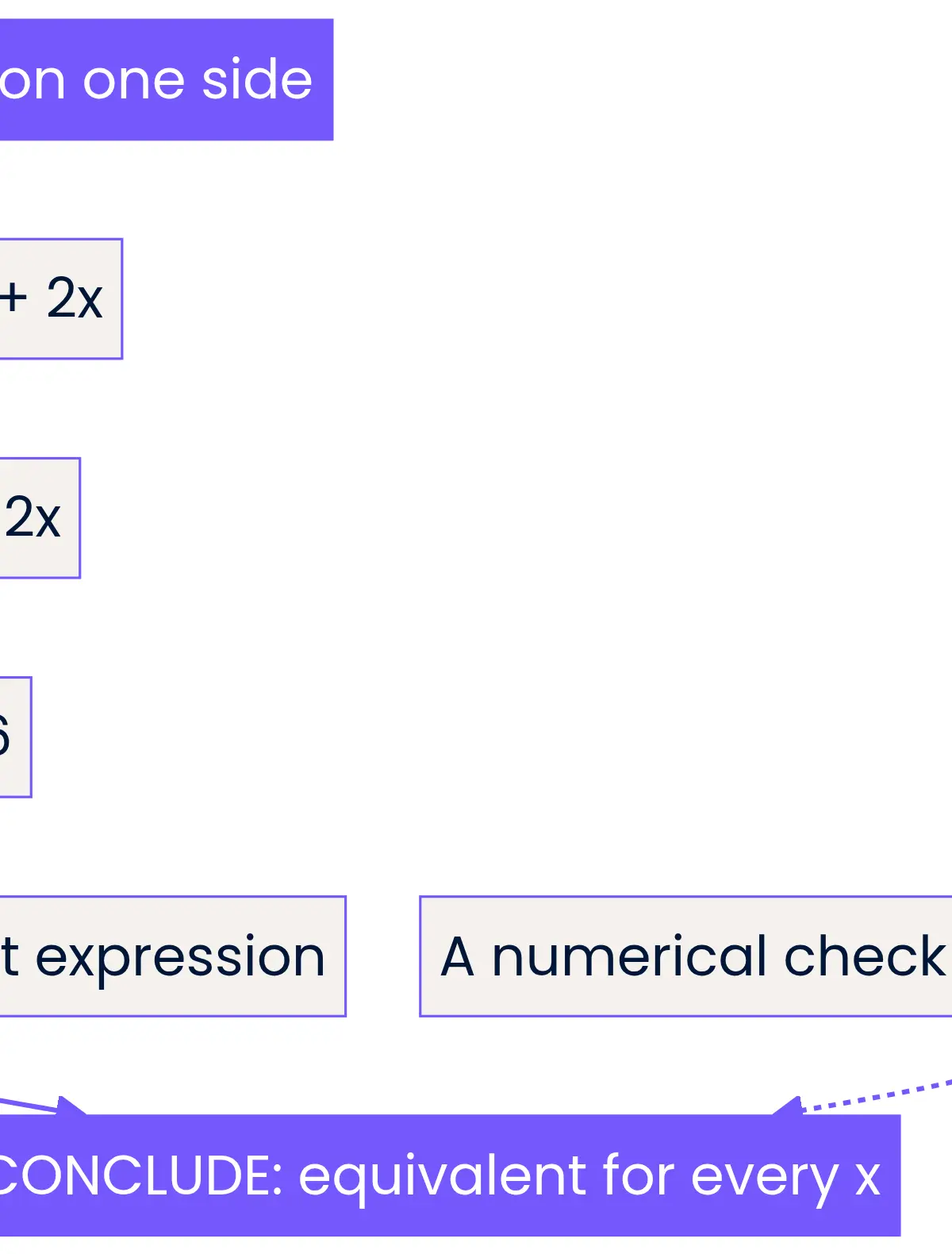
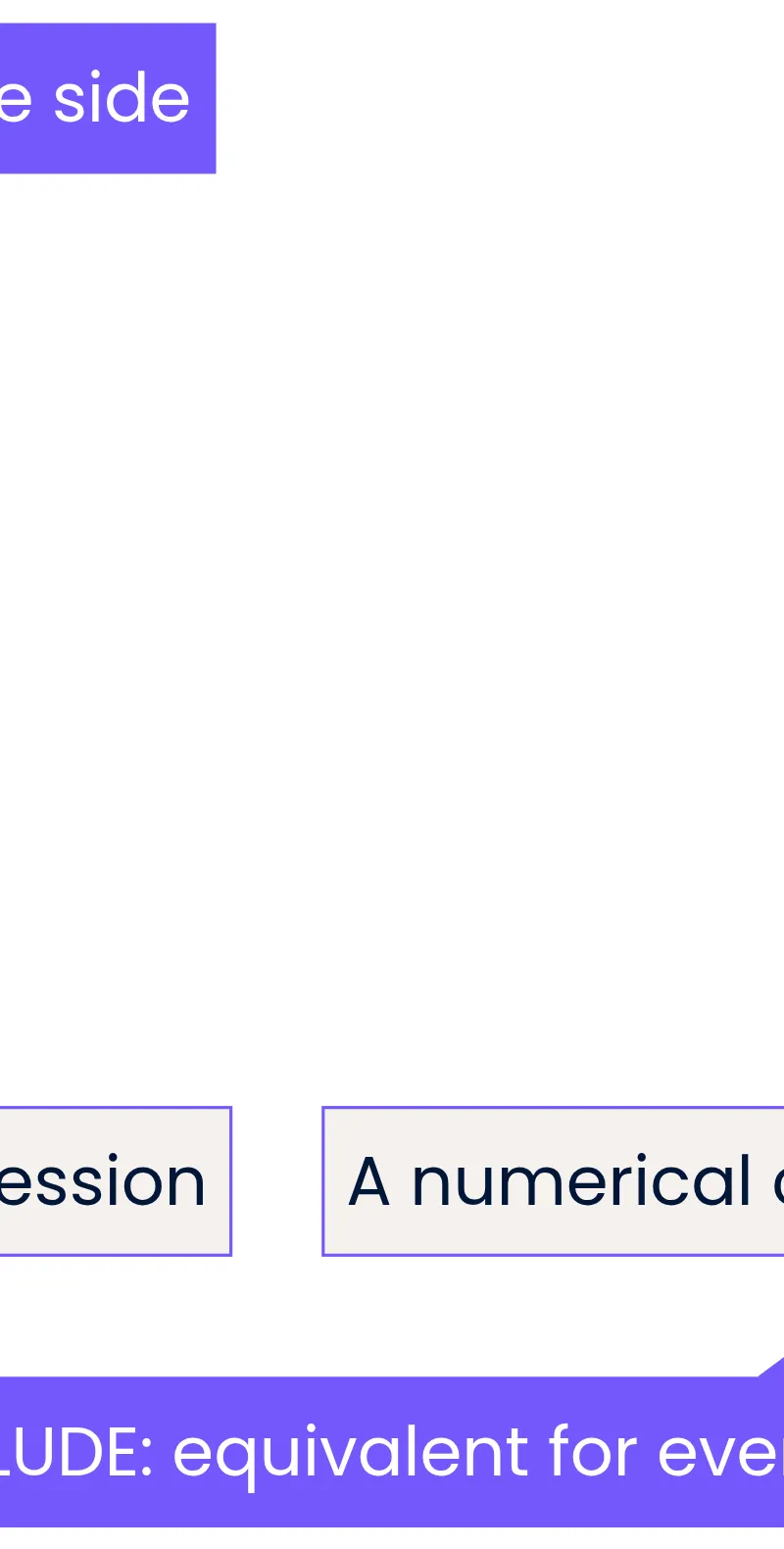
Why does this work? Each transformation changes the form, not the value. If two expressions simplify to the same form, they agree for every permitted input.
Concept 3: Expanding and collecting require careful signs
Multiply every term inside a bracket by the term outside. Thus 5(x + 3) = 5x + 15, not 5x + 3. With a negative multiplier, both signs must be handled: −2(x − 4) = −2x + 8.
Example: 2(x + 5) − 3(x − 1) = 2x + 10 − 3x + 3 = −x + 13. The subtraction means the second bracket is multiplied by −3. In particular, (−3) × (−1) = +3.
Like terms have the same variable part, including its power. You can combine 3x + 2x into 5x, but 3x + 2 stays as it is. Likewise, x² and x are not like terms. Carry the sign with each term when rearranging a sum.
An efficient check is to substitute a simple value after simplifying. At x = 0, the example gives 10 + 3 = 13, matching −x + 13. This may reveal a sign error, but it does not replace the general argument.
Cover and recall: expand −4(y − 2), then explain why the constant is positive. Answer: −4y + 8, because a negative multiplied by a negative is positive.
Concept 4: Checking examples is different from establishing an always claim
A few successful substitutions only establish equality for the values you tested. They do not establish an unbounded claim for every possible value. Two expressions may coincide at one input but disagree at another.
Example: 2x and x + 2 both equal 4 when x = 2. However, when x = 3, the first equals 6 and the second equals 5. Therefore they are not equivalent.
A counterexample is one permitted case that makes a general claim false. One counterexample disproves an always claim. By contrast, an algebraic argument using a general variable can establish the claim for every value represented by that variable.
Use numerical checks to investigate or check your working. Use a general argument when asked to show that a property always holds. If the question instead asks whether a claim is false, one clear counterexample may be sufficient, depending on its wording.
What if? A student checks ten positive values. What has the student still not shown? The claim has not been established for the untested values, including negative values when these are permitted.
Concept 5: Letters must represent the whole family of numbers
For statements about integers, begin by writing n is any integer. Integers include negative whole-valued numbers, zero and positive whole-valued numbers. If the question specifically restricts attention to positive integers, state that restriction instead.
Any even integer can be written as 2n. Any odd integer can be written as 2n + 1. Consecutive integers are n and n + 1; consecutive odd integers are 2n + 1 and 2n + 3; consecutive even integers are 2n and 2n + 2.
The same letter is useful when quantities are related. It encodes the relationship precisely. However, two arbitrary even integers need 2m and 2n, where m and n are integers that may differ. Writing both as 2n would assume the integers are equal and would not cover every pair.
Example: the sum of two arbitrary even integers is 2m + 2n = 2(m + n). Since m + n is an integer, the sum is even. This works for different even integers as well as equal ones.
Why does this matter? A general representation is what makes an argument general. Using 6 + 8 = 14 checks one pair only.
Concept 6: Display the property, then state the conclusion
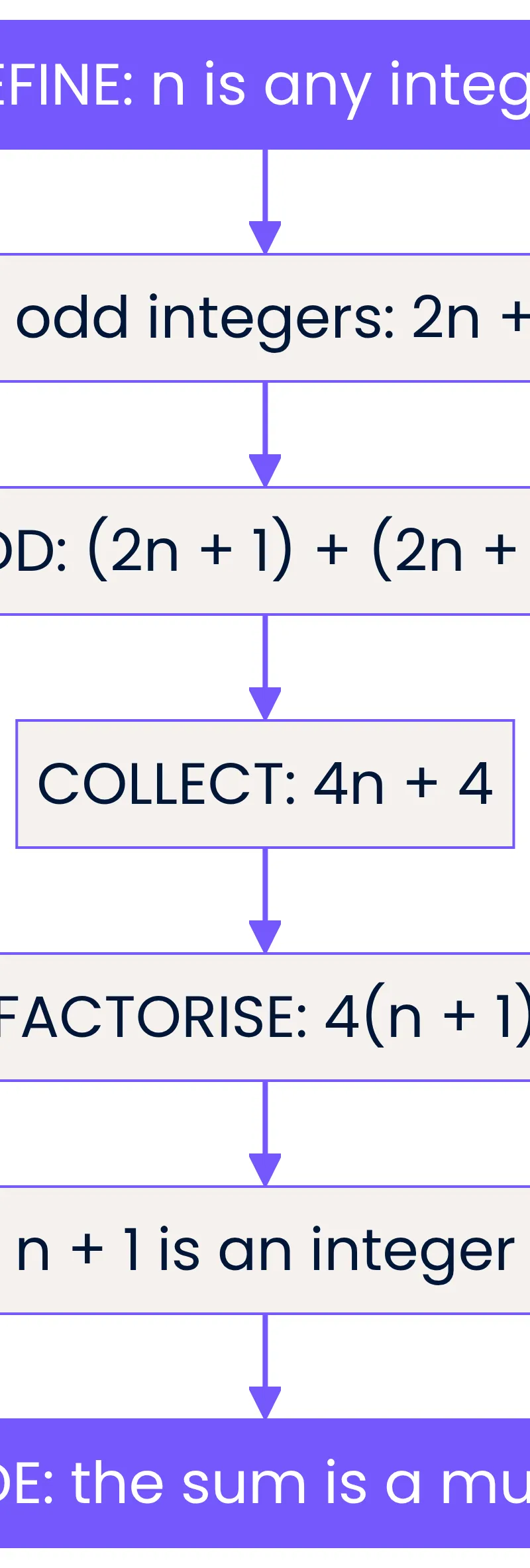
To show that an integer expression is a multiple of 4, rearrange it into 4 × an integer. A factorised form makes this structure visible. For consecutive odd integers, write the complete argument:
Let n be any integer. The integers are 2n + 1 and 2n + 3.
(2n + 1) + (2n + 3) = 4n + 4 = 4(n + 1).
Since n + 1 is an integer, the sum is a multiple of 4.
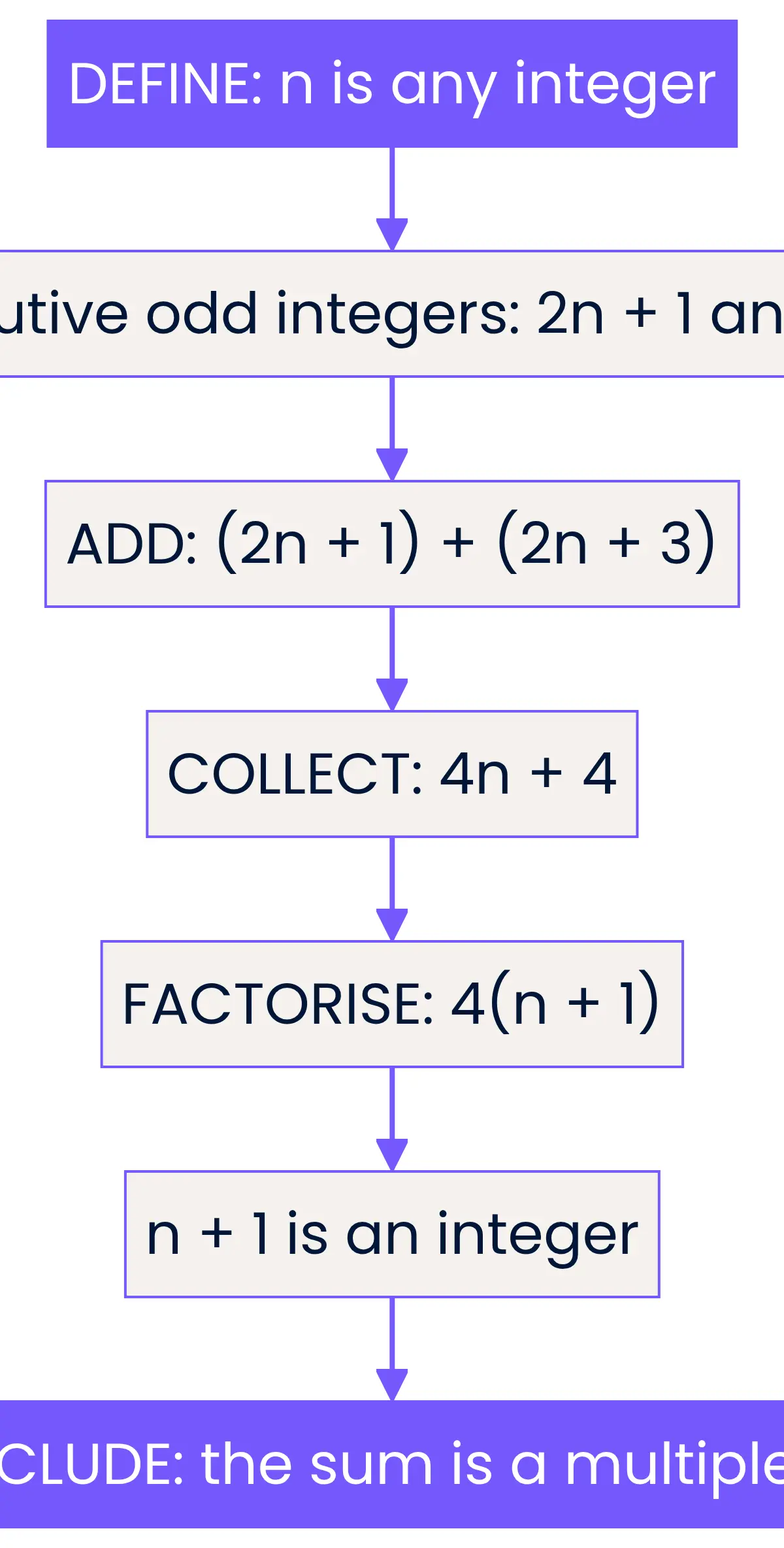
Stopping at 4n + 4 leaves the key structure less explicit. Stopping at 4(n + 1) without explaining the integer factor leaves the conclusion unstated. A strong response names both the property and the reason.
The integer condition is essential. Merely writing something as 4 times a number is insufficient: 10 = 4 × 2.5, but 10 is not an integer multiple of 4. Similarly, a factor of 2 establishes evenness only when the remaining factor is an integer.
Remember Define, Do, Display, Declare: define the letter, do the algebra, display the required factor, declare what follows. This is an answer structure, not a promise that every question awards one mark for each stage.
Mathematical/Scientific Relationships
Relationships to know
Must memorise, with understanding: the following core forms and rules are not supplied on Pearson's 2026 Foundation formula sheet. 4
- Distributive law: a(b + c) ≡ ab + ac and a(b − c) ≡ ab − ac. Here a, b and c represent numbers; multiply each bracket term by a.
- Collecting like terms: ax + bx ≡ (a + b)x and ax − bx ≡ (a − b)x. Here a and b are coefficients; x is the common variable part.
- Common-factor form: ab + ac ≡ a(b + c). This reverses expansion and displays a shared factor.
- Even and odd integers: 2n and 2n + 1, with n an integer. A multiple of a fixed positive integer k is kn.
- Consecutive forms: n, n + 1; consecutive evens 2n, 2n + 2; consecutive odds 2n + 1, 2n + 3.
- Useful derived results: (2n + 1) + (2n + 3) ≡ 4(n + 1), and n + (n + 1) ≡ 2n + 1. These show, respectively, a multiple of 4 and an odd sum. Reconstruct the arguments rather than learning unexplained strings.
Given on formula sheet: none of these core algebraic relationships. For the rectangle application below, P = 2L + 2W is also Must memorise; L and W are lengths in the same unit. Formula-sheet availability does not replace knowing how to expand, collect and justify.
Graph and data interpretation
Equivalent linear expressions produce the same straight-line graph. For y = 3(x + 2) and y = 3x + 6, algebra gives the same gradient 3 and y-intercept 6. To plot either, calculate coordinates such as (0, 6) and (1, 9), label the axes and draw the straight line through the points.
In contrast, y = 2x and y = x + 2 intersect only at (2, 4). An intersection shows agreement at that input, not equivalence. A sketch or small value table is useful evidence for investigation, but the algebraic argument establishes equality for all inputs. This links A6 to graph skills A9 and solving equations A17. 1
Practical Applications
Comparing two ways of describing a cost or perimeter
Three packs each contain x pencils and two spare pencils. The total is 3(x + 2), or equivalently 3x + 6. Here x must be a non-negative integer because it counts objects, even though the identity is valid more generally.
A rectangular display has length x + 3 cm and width x cm, with x > 0. Its perimeter is 2(x + 3) + 2x = 4x + 6 cm. One expression follows the shape; the other is quicker to calculate. Both describe the same perimeter for every permitted x. If the perimeter is given as 26 cm, solve 4x + 6 = 26 to get x = 5 cm. The identity simplifies the rule; the equation finds a particular dimension.
Pure algebra requires no units. Contextual answers may need cm or £. Keep quantities in consistent units before adding them: Must memorise, 1 m = 100 cm and £1 = 100p. Do not confuse perimeter in cm with area in cm². There is no required practical for this mathematics topic.
Foundation scope and examiner expectations
Foundation A6 includes equivalence and algebraic arguments. The Higher specification explicitly adds and proofs. The accessible integer arguments here develop Foundation reasoning; more demanding formal proofs are beyond this guide's scope. Credit depends on answering the actual question with sufficient working, not on writing the word therefore by itself. 1 2
Pearson's November 2023 Paper 3F, Question 8(c), provides a real marking example: credit is given for explaining that a proposed sequence term is even while the sequence contains odd numbers. A vague statement that the sequence goes past the value is not enough. Precision matters. 2
Listen, retrieve and check
Ten-minute podcast: 0:00 introduction; 1:00 core concepts; 6:00 exam tips; 8:00 recall quiz; 9:00 summary. Cover your notes before the quiz. Pause if you need longer to explain an answer.
After studying, reconstruct the consecutive-odd argument without looking. Check it immediately, correct the exact error, and try it again tomorrow. Next time, mix one equation to solve with one identity to show: choosing the method is part of the learning.
References
All worked and practice questions in this guide are original Pearson Edexcel-style teaching material. Their marks and breakdowns are illustrative, not official Pearson mark schemes.
Worked Examples
3 worked examples — open one to explore the question and available guidance.
Practice Questions
Try the question, then reveal an answer plan or example response
A: 6(y − 2) = 6y − 12. B: 6y − 12 = 18. STATE which equality is an identity and EXPLAIN how you know. Include why the other is not an identity. [3 marks]
Hint: Expand A and consider whether each equality is true for every y.
SHOW THAT 4(2x − 3) + x is equivalent to 9x − 12. [3 marks]
Hint: Multiply both terms in the bracket by 4, then collect the x terms.
SHOW THAT 5(x − 2) − 2(x + 1) is equivalent to 3x − 12. [3 marks]
Hint: Treat the second multiplier as −2 and carry it to both terms.
SHOW, using algebra, that the sum of two consecutive integers is odd. [4 marks]
Hint: Write the integers as n and n + 1. Look for the form 2 times an integer plus 1.
SHOW, using algebra, that the sum of any two even integers is even. The integers need not be equal or consecutive. [4 marks]
Hint: Use two letters, because the even integers can be different.
A candidate says, '2x and x + 2 are equivalent because they both equal 4 when x = 2.' GIVE a counterexample and EXPLAIN why the claim is false. [2 marks]
Hint: Choose a permitted value other than x = 2 and evaluate both expressions.
Exam technique
How to turn what you know into marks
How to approach the question
Read the command word first. Decide whether you must find a value, show equivalence, establish a general number property, or disprove a claim. For equivalence, identify the target and simplify one side towards it. For a general integer argument, define suitable letters and their domain before writing the calculation. Check whether quantities are consecutive, independent, even or odd. Treat numerical substitution as a check, not a substitute for a requested general argument.
How to structure your answer
For a short State or Give item, answer precisely without unrelated working. For a 3-mark equivalence item in this guide, show expansion, collection and an all-values conclusion. For a 4-mark general argument, show a general representation, the algebra, the displayed property and the integer-based conclusion. For the 6-mark worked item, label parts (a), (b) and (c), and answer all three. These structures explain this guide's illustrative allocations; Pearson's question-specific mark scheme always takes precedence. A correct bare answer does not normally satisfy a question that explicitly requires working.
Timing
Each Pearson Edexcel 1MA1 paper is 90 minutes for 80 marks, averaging 67.5 seconds per mark. Practise near 1 minute per mark to retain checking time: about 3 minutes for 3 marks, 4 minutes for 4 marks, and 6 minutes for a 6-mark multi-part item. These are revision targets, not fixed official question timings.
Common pitfalls
- Deciding from the symbol alone: an equality written with = can still be an identity. Ask whether it holds for every permitted input.
- Solving when asked to show equivalence: do not hunt for x. Transform one expression until it matches the target.
- Missing part of a bracket expansion: multiply the outside term by every inside term, carrying the signs.
- Collecting unlike terms: 3x + 2 is not 5x, and x² is not like x.
- Using examples as a general argument: successful substitutions only cover the tested values.
- Giving unrelated quantities the same value: represent two arbitrary even integers as 2m and 2n, not both as 2n.
- Writing consecutive odd integers as 2n + 1 and 2n + 2: consecutive odd integers differ by 2.
- Not stating the domain: use n is any integer for a claim about all integers, including negative ones.
- Stopping before the reason: after 4(n + 1), explain that n + 1 is an integer and therefore the result is a multiple of 4.
- Writing an essay for Evaluate: in mathematics this normally asks for a numerical value.
What the command words want
- Solve
- Find the value or values that satisfy the equation or inequality; identify the solution clearly.
- Expand
- Remove brackets by multiplying every inside term by the outside factor.
- Compare
- Identify the relevant similarity or difference. Equivalent expressions agree for every input; two non-equivalent expressions may agree at a particular input only.
- Explain
- Give a sentence or mathematical statement that supports the conclusion. For an identity, say that expansion gives the same expression for every permitted value.
- Justify
- Support the answer with relevant working and/or a precise written explanation.
- Describe
- Give the mathematical features of the situation, such as how a sequence changes. Use accurate terminology rather than an unrelated definition.
- Evaluate
- Find the numerical value, using substitution and the order of operations where required. This is not the generic essay instruction to consider both sides.
- Simplify
- Collect like terms or otherwise rewrite into the required simpler form. Do not introduce an equation to solve if only an expression is given.
- Factorise
- Write the expression as a product by taking out a common factor. To display a multiple of 4, reach 4 times an integer expression.
- Show/Show that
- Present the working that leads to the given result. Repeating the target or checking one example is insufficient for a requested general argument.
- Calculate/Work out
- Find the required value with appropriate working. Use a calculator only where permitted and include units for contextual quantities.
- State/Give/Write down
- Give the requested value, term or concise fact. If asked for an expression for an even integer, write 2n and make the integer condition clear where needed.
- Prove/Prove algebraically
- Give a general, complete argument; if algebraically is specified, use algebra. Higher A6 explicitly includes formal proofs, whereas this guide focuses on Foundation algebraic arguments.
Watch or listen (optional)
Test your understanding of Algebra - Notation, vocabulary and manipulation: know the difference between an equation and an identity; argue mathematically to show algebraic expressions are equivalent, and use algebra to support and construct arguments (Foundation tier)
Active recall beats re-reading. Take an instant quiz now to test what you’ve learned and lock it into long-term memory.
7 days Premium · Then the free plan continues · No card, no charge