Pearson Edexcel · GCSE · Mathematics
Course version: 1MA1 · Version from Mar 2026
Algebra - Notation, vocabulary and manipulation: simplify and manipulate algebraic expressions (including those involving surds and algebraic fractions) by: • collecting like terms • multiplying a single term over a bracket • taking out common factors • expanding products of two or more binomials • factorising quadratic expressions of the form x² + bx + c, including the difference of two squares; factorising quadratic expressions of the form ax² + bx + c • simplifying expressions involving sums, products and powers, including the laws of indices (Higher tier)
Complicated algebra becomes manageable when you spot its structure: terms to collect, factors to expand or cancel, and powers to simplify. Master Pearson Edexcel Higher-tier A4 through clear worked solutions, accurate diagrams and a ten-minute female-tutor podcast, then test whether you can reproduce each method without looking.
- 12 min read
- 6 worked examples
- 8 practice questions
- 13 key terms
Try the lesson
The start of the Algebra - Notation, vocabulary and manipulation: simplify and manipulate algebraic expressions (including those involving surds and algebraic fractions) by: • collecting like terms • multiplying a single term over a bracket • taking out common factors • expanding products of two or more binomials • factorising quadratic expressions of the form x² + bx + c, including the difference of two squares; factorising quadratic expressions of the form ax² + bx + c • simplifying expressions involving sums, products and powers, including the laws of indices (Higher tier) lesson, made from checked teaching notes for this specification point.
Have a go first
Expand and simplify (x + 5)(x − 3).
There is more to this lesson
The full lesson goes on to check your understanding and help you earn the marks. Create a free account to carry on, with your progress saved.
7 days Premium · Then the free plan continues · No card, no charge
Check what you remember
Read the wording for your board, then hide it and explain Expression in your own words. Rough notes are fine. This is a self-check, with no mark or grade.
Reference: Pearson Edexcel
A mathematical combination of numbers, variables and operations, without an equality or inequality relation asserting a statement.
Study Notes
Overview
Algebraic manipulation changes the appearance of an expression without changing its value wherever the original expression is defined. Your task is to recognise whether you are adding terms, multiplying factors or dividing, then choose a legal transformation. This guide covers Pearson Edexcel GCSE Mathematics 1MA1, A4, with supporting links to notation and vocabulary in A1/A3, indices in N7 and exact surd calculations in N8. 1 2
Strong manipulation earns direct marks in questions beginning simplify, expand and simplify or factorise fully. It also unlocks longer questions involving equations, graphs, geometric measures and proof. Candidates should show a clear sequence of equivalent expressions, not a page of disconnected calculations. An expression needs simplifying; an equation may need solving. Do not invent an equation when none is given.
The whole topic is not Higher-only. Collecting like terms, single-bracket work, common factors, two binomials, monic quadratics and the difference of squares form the shared toolkit. Higher extensions include algebraic fractions, products of more than two binomials and factorising quadratics with a leading coefficient other than one. Fractional indices and developed surd work are important Higher connections. 1 2
Assessment note: All questions and allocations created for this guide are original Edexcel-style teaching examples, not reproduced Pearson questions or official mark schemes. Published marking evidence is identified separately below.
Key Concepts
1. Read the structure: terms, factors and coefficients
In (5x^2-3x+7), there are three terms: (5x^2), (-3x) and (7). The numerical coefficient of (x) is (-3), including its sign. In (3x(x+2)), the factors are (3), (x) and ((x+2)). Terms are joined by addition or subtraction; factors are multiplied. This difference explains almost every cancellation trap.
An expression has no equality sign. An equation states that two expressions are equal for particular values; an identity holds for every permitted value. Writing (x+x=2x) describes an identity, while (x+x=10) is an equation to solve. A factorised answer is a product, not a list of possible values.
Cover and recall: In (4x(x-5)), identify the factors. In (4x^2-20x), identify the terms. Explain why both forms represent the same expression.
2. Collect like terms: match letters and powers
Like terms have identical variable parts. Thus (7x^2+3x-2x^2+5x=5x^2+8x). The coefficients combine, but the powers stay unchanged. (3xy) and (-5yx) are like terms because multiplication is commutative; their sum is (-2xy).
Think of coefficients as counts of the same algebraic object. You can combine five copies of (x^2) with two more copies of (x^2), but not with copies of (x). Do not confuse (x+x=2x) with (x\times x=x^2). Credit is given for applying the rule appropriate to the operation.
3. Expand one bracket and take out common factors
The distributive law means the outside factor multiplies every term: (-2x(3x-4)=-6x^2+8x). Write the two products before collecting anything. A minus sign before a bracket acts like multiplication by (-1): (5x-(2x-3)=5x-2x+3=3x+3).
Factorising reverses expansion. For (12x^2y-18xy^2), the greatest numerical common factor is 6, and both terms contain (xy). Therefore (12x^2y-18xy^2=6xy(2x-3y)). Divide each original term by the outside factor to find the bracket. Then expand to check. Factorise fully requires removing all available common factors, not stopping at (3xy(4x-6y)).
4. Expand two binomials and recognise squared brackets
A binomial has two terms. In ((x-3)(x+5)), each term in one bracket multiplies each term in the other:
[(x-3)(x+5)=x^2+5x-3x-15=x^2+2x-15.]
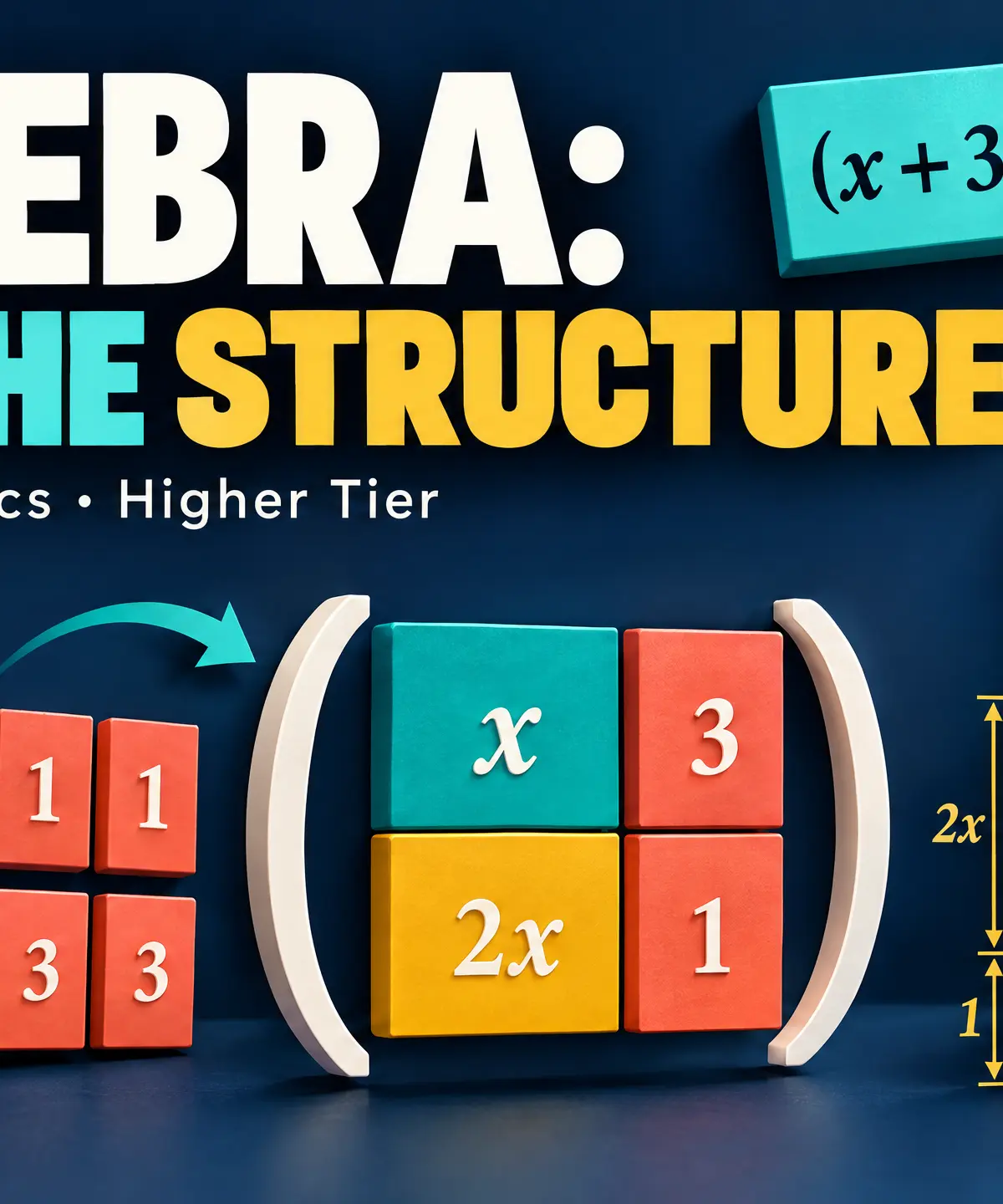
The four products are essential. In particular, ((x+3)^2=(x+3)(x+3)=x^2+6x+9), not (x^2+9). The missing (6x) comes from the two cross products. A rectangular area split into four pieces helps explain why all four contributions are needed.
5. Factorise monic quadratics and differences of squares
For (x^2+bx+c), find numbers (p,q) with (p+q=b) and (pq=c). Then (x^2+bx+c=(x+p)(x+q)). For (x^2-x-12), choose (-4) and 3, giving ((x-4)(x+3)). Their product is negative, so their signs must differ.
The difference of squares is (u^2-v^2=(u-v)(u+v)). Thus (x^2-9=(x-3)(x+3)). The cross terms cancel because their signs are opposite. Recognise squares of whole expressions too: (9x^2-25y^2=(3x-5y)(3x+5y)). A sum of squares is not this pattern: (x^2+9) does not become ((x-3)(x+3)).
6. Factorise (ax^2+bx+c): Higher extension
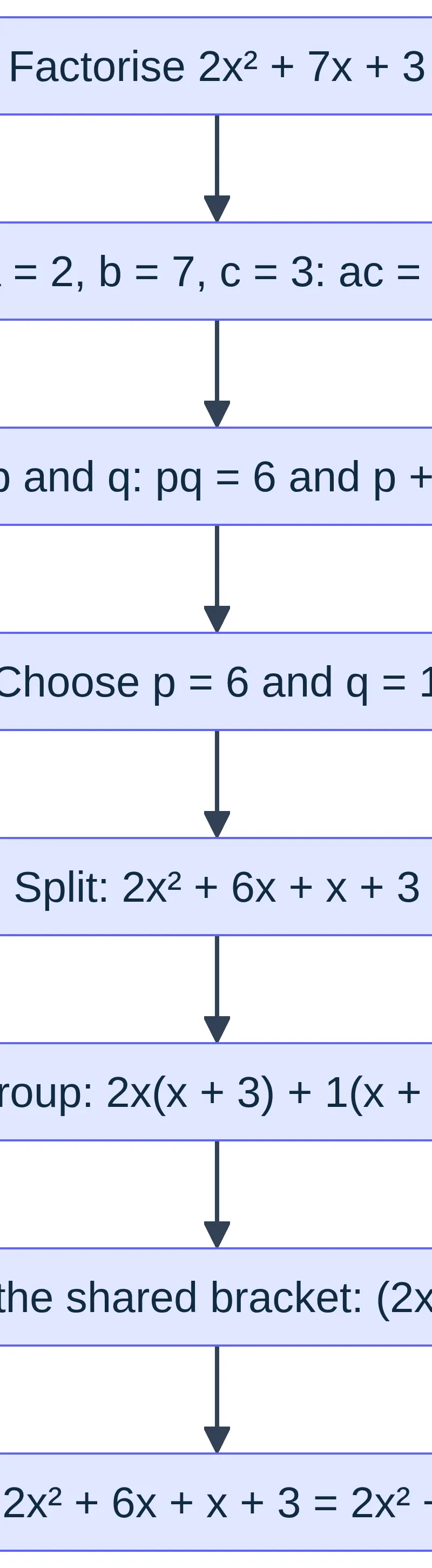
First check for a common factor. If none remains, multiply (a) by (c), then find (p,q) whose product is (ac) and whose sum is (b). Replace (bx) by (px+qx), factorise the two groups and remove their common bracket.
For (2x^2+7x+3), (ac=6) and the pair is 6 and 1:
[2x^2+6x+x+3=2x(x+3)+1(x+3)=(2x+1)(x+3).]
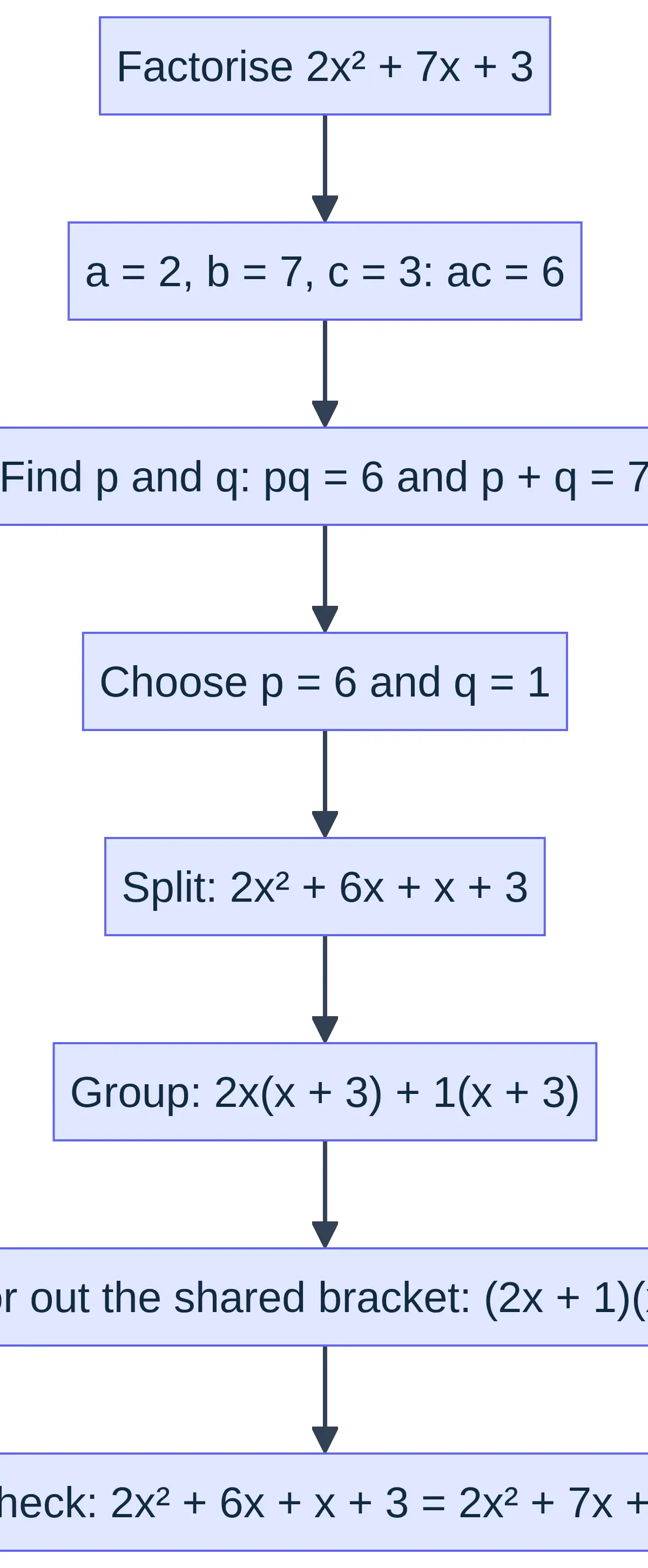
Examiner insight: The split preserves the middle term, while the product condition makes matching brackets possible. Using pairs of (c) alone ignores the leading coefficient. Check by expanding: ((2x+3)(x+1)=2x^2+5x+3), so it cannot be the answer. Not every quadratic factorises into integer-coefficient brackets; do not force an incorrect pair.
7. Expand three or more binomials: Higher extension
Multiply two brackets first and write down the intermediate quadratic. Then multiply every term of that quadratic by every term of the remaining bracket:
[(x+1)(x-2)=x^2-x-2,]
[(x^2-x-2)(x+3)=x^3+3x^2-x^2-3x-2x-6=x^3+2x^2-5x-6.]
Group matching powers only after generating all six products. The leading term must be (x^3), and the constant must be (1\times(-2)\times3=-6). These checks detect errors but do not replace a full expansion. With four brackets, multiply two pairs and then multiply the resulting quadratics. Clear intermediate working can make eligible method marks visible if later arithmetic fails.
8. Simplify algebraic fractions: Higher extension
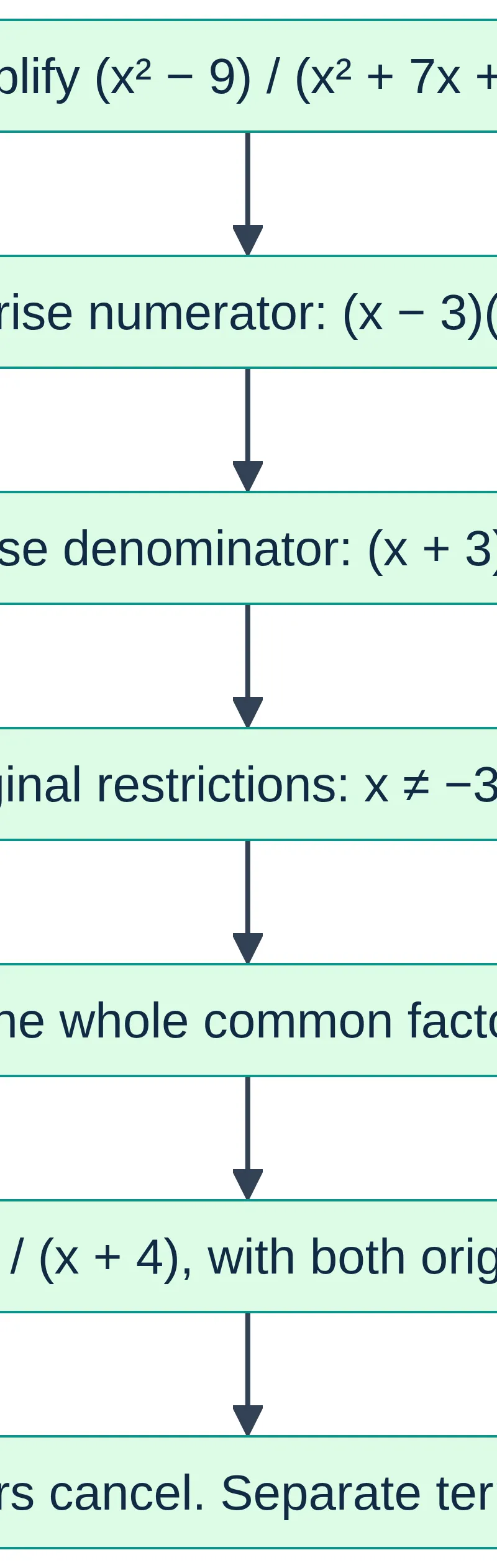
Cancellation is division by a whole common factor. Factorise numerator and denominator before cancelling:
[\frac{x^2-9}{x^2+7x+12}=\frac{(x-3)(x+3)}{(x+3)(x+4)}=\frac{x-3}{x+4}.]
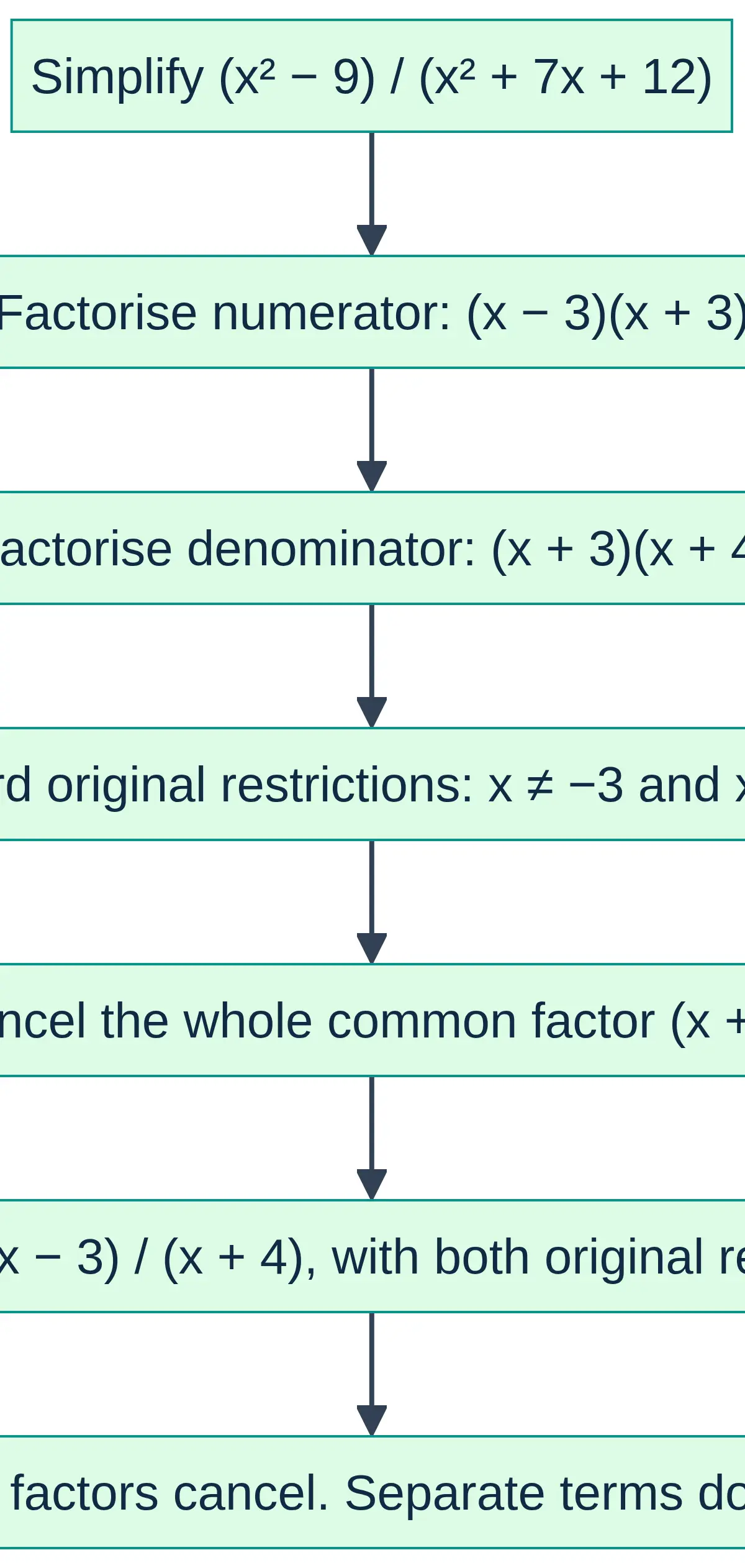
The original denominator is zero at (x=-3,-4), so both values are excluded. Cancelling ((x+3)) does not restore (x=-3). The two expressions are equivalent only on the original domain. State exclusions when requested; keep them in your reasoning even when the question only asks for a simplified expression. Do not assume every GCSE simplification question awards a separate restriction mark.
You cannot cancel part of a sum: ((x+6)/6=x/6+1), not (x+1). Why? Dividing the entire numerator by 6 divides both terms. For multiplying fractions, factorise and cancel across the combined product. For division, multiply by the reciprocal of the second fraction, which must be defined and nonzero.
9. Add or subtract algebraic fractions
Use the same rule as numerical fractions: make equivalent fractions with a common denominator. For example,
[\frac1x+\frac1{x+1}=\frac{x+1}{x(x+1)}+\frac{x}{x(x+1)}=\frac{2x+1}{x(x+1)},\quad x
e0,-1.]
Adding numerators and denominators separately is never the fraction-addition rule. When subtracting a numerator with several terms, put it in brackets before removing them. After combining, factorise and simplify if possible, retaining original restrictions. This also prepares you for equations involving algebraic fractions, although solving those equations belongs to A17/A18 rather than this guide's core manipulation task.
10. Apply index laws to the operation present
For multiplication of the same base, add indices: (x^3x^4=x^7). For division, subtract: (x^7/x^2=x^5), with (x
e0). For a power raised to another power, multiply indices: ((x^3)^2=x^6). Numerical coefficients follow their own arithmetic: ((2x^3)^2=4x^6).
Zero and negative integer powers are not automatically Higher-only. (x^0=1) for (x
e0), and (x^{-2}=1/x^2). Fractional indices are the Higher extension: (x^{1/2}=\sqrt{x}), and (x^{3/2}=(\sqrt{x}$)^3) for (x\ge0). A negative index means reciprocal, not a negative answer. No index law changes (x^3+x^4) into (x^7); addition is a different operation. 2$
11. Manipulate surds exactly: Higher number link
Extract square factors before collecting like surds: (\sqrt{12}=2\sqrt3) and (\sqrt{27}=3\sqrt3), so their sum is (5\sqrt3). Unlike surds such as (\sqrt2+\sqrt3) do not combine into one root. For multiplication, (\sqrt2\sqrt8=\sqrt{16}=4).
Expansion and factorisation still work with surds. ((\sqrt5+2)(\sqrt5-2)=5-4=1), using the difference of squares. To rationalise (1/(2+\sqrt3)), multiply numerator and denominator by (2-\sqrt3). The denominator becomes 1, giving (2-\sqrt3). This is multiplication by an exact form of 1, not changing the value. Rationalisation is supporting N8 content, not a replacement for factorising algebraic fractions.
Mathematical/Scientific Relationships
Formula status: Every manipulation rule below is Must memorise: none is supplied on Pearson's current Higher formula sheet. Pearson states the 2026 sheet is unchanged from 2025. The quadratic formula is Given on formula sheet, but solves equations under A18 and does not answer a command to factorise. 3 4
- Must memorise: (k(u+v)=ku+kv); reversing this gives (ku+kv=k(u+v)). Here (k,u,v) are numbers or algebraic expressions.
- Must memorise: ((u+v)(w+z)=uw+uz+vw+vz); ((u\pm v)^2=u^2\pm2uv+v^2); ((u-v)(u+v)=u^2-v^2).
- Must memorise: (x^2+bx+c=(x+p)(x+q)) when (p+q=b,pq=c). For (ax^2+bx+c), use (p+q=b,pq=ac) for the split, with (a
e0). - Must memorise: (a^ma^n=a^{m+n}), (a^m/a^n=a^{m-n}), ((a^m)^n=a^{mn}), ((ab)^n=a^nb^n), ((a/b)^n=a^n/b^n), (a^0=1), (a^{-n}=1/a^n), (a^{m/n}=\sqrt[n]{a^m}). Use nonzero bases for division, zero and negative powers; use positive bases when applying general fractional-power laws over the reals. Here (m,n) are indices and the root denominator (n) is a positive integer.
- Must memorise: (\sqrt{uv}=\sqrt u\sqrt v), (\sqrt{u/v}=\sqrt u/\sqrt v), and (r\sqrt u+s\sqrt u=(r+s)\sqrt u), with nonnegative radicands and (v>0) for division. Also (\sqrt{u^2}=|u|), not necessarily (u).
- Must memorise: (A/B\pm C/D=(AD\pm BC)/(BD)); ((A/B)(C/D)=AC/(BD)); ((A/B)\div(C/D)=AD/(BC)). Original denominators must be nonzero; division also requires (C
e0). Cancellation (AF/(BF)=A/B) requires (B,F
e0).
Practical Applications
A rectangle with sides ((x+3)) cm and ((x-2)) cm has area ((x+3)(x-2)=x^2+x-6) cm². In a physical rectangle, (x>2); algebraic identities and contextual restrictions are separate issues. Three dimensions produce three brackets when expressing a cuboid's volume.
Graphs provide a useful check. Factorising (x^2-x-12) reveals roots 4 and (-3) of (y=x^2-x-12). If asked to plot it, use a value table, labelled axes and a sensible consistent scale; plot coordinates accurately and draw a smooth curve. A cancellation restriction is not an intercept: simplified rational expressions still exclude points missing from the original domain.
No required practical applies. No unit conversion is needed for pure expressions. In geometry, convert lengths to a common unit before forming an expression; (1\text{ m}^2=10{,}000\text{ cm}^2), not 100 cm².
Listen, Retrieve and Check
The ten-minute female-tutor podcast has an introduction, five minutes of core concepts, two minutes of exam advice, a recall quiz and a summary. Listen with a pen. Pause before each quiz answer, then reproduce a solution without looking. Repeat after one day, three days and one week; correct mistakes before the next attempt. Re-reading alone can feel fluent without proving you can perform the method.
Published marking evidence: Summer 2023 1MA1/1H Q11 allocates two method marks and one accuracy mark for index manipulation. Q23 allocates three method marks and one accuracy mark for surd-fraction work. These demonstrate credit for eligible intermediate work, not universal allocations for this topic. 5
References
Worked Examples
6 worked examples — open one to explore the question and available guidance.
Practice Questions
Try the question, then reveal an answer plan or example response
Simplify 5x² + 3xy − 2x² + 4yx. (2 marks)
Hint: xy and yx represent the same product.
Expand and simplify −3x(2x − 5) + 2x(x + 1). (3 marks)
Hint: Multiply each outside term by both inside terms and track the negative signs.
Factorise fully (a) x² − x − 12 and (b) 9x² − 25y². (3 marks)
Hint: For (a), use a pair with negative product and sum −1. For (b), identify the two squared expressions.
Factorise fully 6x² − x − 2. Show your working. (3 marks)
Hint: ac = −12. Which two integers multiply to −12 and add to −1?
Expand and simplify (x − 1)(x + 2)(2x − 3). Show your working. (4 marks)
Hint: Expand the first two brackets, then multiply the resulting quadratic by both terms of 2x − 3.
Simplify 2/(x − 1) − 1/(x + 1). Give a single fraction and state the excluded values. Show your working. (5 marks)
Hint: Use (x − 1)(x + 1) as the common denominator and put the subtracted numerator in brackets.
Simplify (8x³y⁻²)/(2x⁻¹y). Write your answer using positive indices. Assume x and y are nonzero. (3 marks)
Hint: Subtract the entire denominator index, including its negative sign.
Expand and simplify (√5 + 2)(√5 − 2). Then simplify √45 − √20. Give exact answers. (3 marks)
Hint: Use a conjugate product for the first expression and extract square factors for the second.
Exam technique
How to turn what you know into marks
How to approach the question
Read the command word and identify the required final form. Distinguish terms from factors. Check for common factors and special patterns before calculating. For fractions, note original denominator restrictions; for division, check the divisor is defined and nonzero. Choose a staged method and show an equality chain. Check the result by expanding, checking leading and constant terms, or testing a permitted value. One successful substitution is a check, not proof of an identity.
How to structure your answer
For a short simplification, show a compact line of valid products or collected terms. For 3–4 marks, write the key intermediate step, such as a split quadratic, factorised numerator and denominator, or intermediate quadratic. For 5–6 marks, separate factorisation, common-denominator or reciprocal work, cancellation and any requested restrictions. Finish in the form requested. Do not write x = in front of an expression unless solving an equation. Pearson method, accuracy and communication marks are question-specific; this guide's allocations are illustrative.
Timing
Each 1MA1 paper has 80 marks in 90 minutes, an average of 1.125 minutes per mark, about 1 minute 8 seconds. Allow roughly 3–4 minutes for 3 marks, 4–5 minutes for 4 marks and 6–7 minutes for 6 marks. This is planning guidance, not an official question-by-question time limit; preserve time for checking.
Common pitfalls
- Cancelling a term in (x + 6)/6. Divide both terms instead: x/6 + 1.
- Omitting cross terms: (x + 3)² = x² + 6x + 9, not x² + 9.
- Using factor pairs of c rather than ac when a ≠ 1. Write ac and b before searching.
- Guessing (2x + 3)(x + 1) for 2x² + 7x + 3. Expansion exposes the wrong 5x middle term.
- Expanding three brackets in one leap. Write the first quadratic, then all six products.
- Adding denominators when adding fractions. Create equivalent fractions over a common denominator.
- Dropping a cancelled denominator exclusion. Retain the original domain.
- Treating x⁻² as −x². A negative index means reciprocal, with x nonzero.
- Treating √a + √b as √(a + b). Simplify each surd, then collect only matching roots.
- Claiming all A4 skills are Higher-only. The shared toolkit includes ordinary bracket and monic-quadratic work.
What the command words want
- Compare
- Identify the requested mathematical relationship, similarity or difference. Use equality, inequality or explicit features as appropriate.
- Explain
- Give a mathematical reason, such as 'because this value makes the original denominator zero'. Link the claim to the relevant rule.
- Describe
- State the mathematical pattern or change precisely if asked. This is not a substitute for algebraic working in an expansion question.
- Evaluate
- In Mathematics, substitute or calculate a numerical value, or carry out the stated operation. It does not mean weighing both sides of an argument.
- Simplify
- Produce an equivalent expression in its simplest requested form. Collect matching terms, apply appropriate index rules and cancel whole common factors.
- Calculate
- Show the calculation and preserve exact values when requested. Include units only when the context supplies them.
- Show that
- Derive the stated expression using a complete valid chain. Merely writing the supplied result earns no demonstration credit.
- State/Give
- Give the requested expression, value or list concisely. If restrictions are requested, list every forbidden value.
- Factorise fully
- Write a complete product. Remove common factors first, then factorise any remaining quadratic or difference of squares where possible.
- Expand and simplify
- Remove brackets by multiplying every required pair of terms, then collect like terms. Do not leave a product as the final answer.
Watch or listen (optional)
Test your understanding of Algebra - Notation, vocabulary and manipulation: simplify and manipulate algebraic expressions (including those involving surds and algebraic fractions) by: • collecting like terms • multiplying a single term over a bracket • taking out common factors • expanding products of two or more binomials • factorising quadratic expressions of the form x² + bx + c, including the difference of two squares; factorising quadratic expressions of the form ax² + bx + c • simplifying expressions involving sums, products and powers, including the laws of indices (Higher tier)
Active recall beats re-reading. Take an instant quiz now to test what you’ve learned and lock it into long-term memory.
7 days Premium · Then the free plan continues · No card, no charge