Pearson Edexcel · GCSE · Mathematics
Course version: 1MA1 · Version from Mar 2026
Algebra - Notation, vocabulary and manipulation: simplify and manipulate algebraic expressions (including those involving surds) by: • collecting like terms • multiplying a single term over a bracket • taking out common factors • expanding products of two binomials • factorising quadratic expressions of the form x² + bx + c, including the difference of two squares; • simplifying expressions involving sums, products and powers, including the laws of indices (Foundation tier)
This guide builds confident algebra manipulation, from collecting like terms through expanding, factorising and using indices. Learn to recognise the operation an Edexcel question requires, show clear working and avoid the sign errors that cost candidates marks.
- 12 min read
- 5 worked examples
- 8 practice questions
- 17 key terms
Try the lesson
The start of the Algebra - Notation, vocabulary and manipulation: simplify and manipulate algebraic expressions (including those involving surds) by: • collecting like terms • multiplying a single term over a bracket • taking out common factors • expanding products of two binomials • factorising quadratic expressions of the form x² + bx + c, including the difference of two squares; • simplifying expressions involving sums, products and powers, including the laws of indices (Foundation tier) lesson, made from checked teaching notes for this specification point.
Have a go first
Simplify 6x + 4y − 2x + 3y.
There is more to this lesson
The full lesson goes on to check your understanding and help you earn the marks. Create a free account to carry on, with your progress saved.
7 days Premium · Then the free plan continues · No card, no charge
Check what you remember
Read the wording for your board, then hide it and explain algebraic term in your own words. Rough notes are fine. This is a self-check, with no mark or grade.
Reference: Pearson Edexcel
A part of an expression separated from other parts by addition or subtraction, with its sign retained.
Study Notes
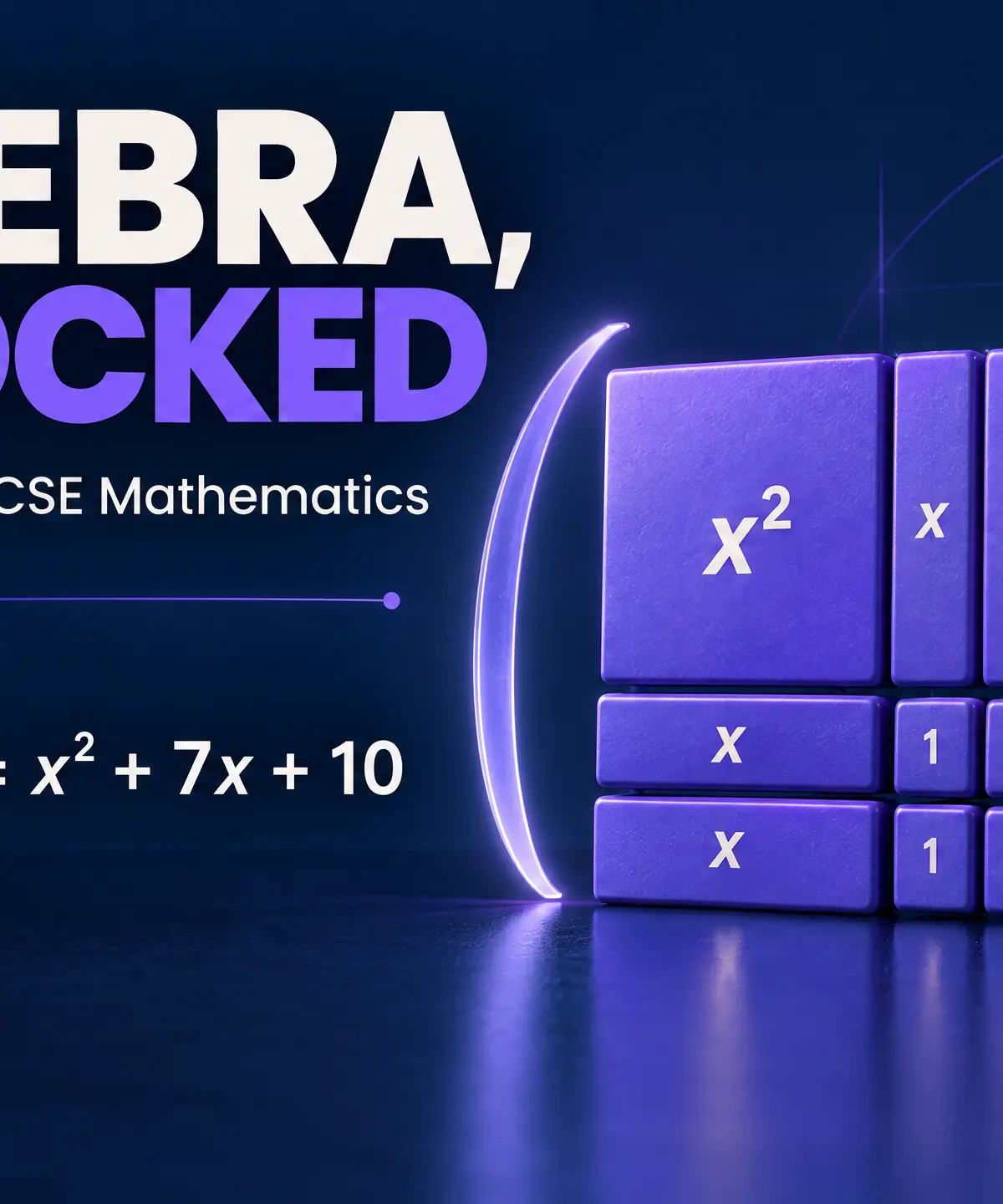
Overview
Algebra is a way of writing relationships efficiently. Letters stand for numbers, so the same rules that work with arithmetic also work with expressions such as 4x − 3 or (x + 5)(x − 2). In this topic you need to read notation accurately, collect only genuinely like terms, expand brackets without losing signs, and reverse expansion by factorising. You will also use index laws and simplify expressions containing supplied surd terms. These are not separate tricks: each one is about preserving the value of an expression while rewriting it in a more useful form.
A strong answer makes the algebra visible. Keep an equals sign for each new equivalent line, set work out clearly, and check signs before committing to a final answer. The Foundation content includes expanding two binomials, factorising x² + bx + c, difference of two squares, zero and negative powers, and manipulating expressions containing surds 2. Some techniques often associated with algebra are Higher only, so this guide labels them rather than letting them distract from the core. None of the algebra identities in this section appears on the current Foundation formula sheet, so fluent recall matters 3.
Reading Algebraic Notation
A term is a part of an expression separated by + or −. In 7x² − 3x + 5, the terms are 7x², −3x and 5. The coefficient is the numerical multiplier, so the coefficient of x² is 7 and the coefficient of x is −3. A constant has no variable, while a variable is a letter whose value can vary. A positive integer exponent, or index, tells you how many equal factors are multiplied: x² = x × x, not 2x.
Multiplication is normally compressed: 3 × x becomes 3x, a × b becomes ab, and 2(x + 4) means 2 × (x + 4). A fraction bar groups everything above and below it, so write brackets if substitution produces a negative value. The expression −x² means −(x²), whereas (−x)² = x². That small pair of brackets can change the result.
Collecting Like Terms
Like terms have exactly the same variable part, including its powers. Therefore 4x + 9x = 13x, and 6p² − 2p² = 4p². But x, x², xy and y are not like terms, so they cannot be collected. Treat −3x as a negative term from the start: 5x − 3x + 2 = 2x + 2. Numbers may be collected with numbers, such as 7 − 11 = −4, but not with variable terms.
Before collecting, simplify products. For example, 4y × 2y = 8y²: multiply the coefficients and multiply the two y factors. A quick structural check helps: your final expression must preserve the original value. Do not add exponents when terms are being added. In x² + x², the answer is 2x², not x⁴.
Cover and recall: What two features must match before terms can be collected? Give an example of two terms that use the same letter but are not like terms.
Expanding One Bracket, Including Negatives
To expand, distribute the factor outside the bracket to every term inside it. 5(2x − 3) becomes 10x − 15, because 5 × 2x = 10x and 5 × (−3) = −15. Write both products before simplifying when signs could cause an error.
A negative multiplier is especially worth slowing down for. In −3(x − 4), the products are −3x and +12, giving −3x + 12. In −(2x + 5), the hidden multiplier is −1, so the result is −2x − 5. Subtracting a bracket also changes every sign: 8 − (x − 6) = 8 − x + 6 = 14 − x. The bracket tells you that the subtraction applies to the whole expression.
Why does this work? The distributive law preserves the value of the entire bracket. Multiplying only its first term changes the expression rather than rewriting it.
Products of Two Binomials
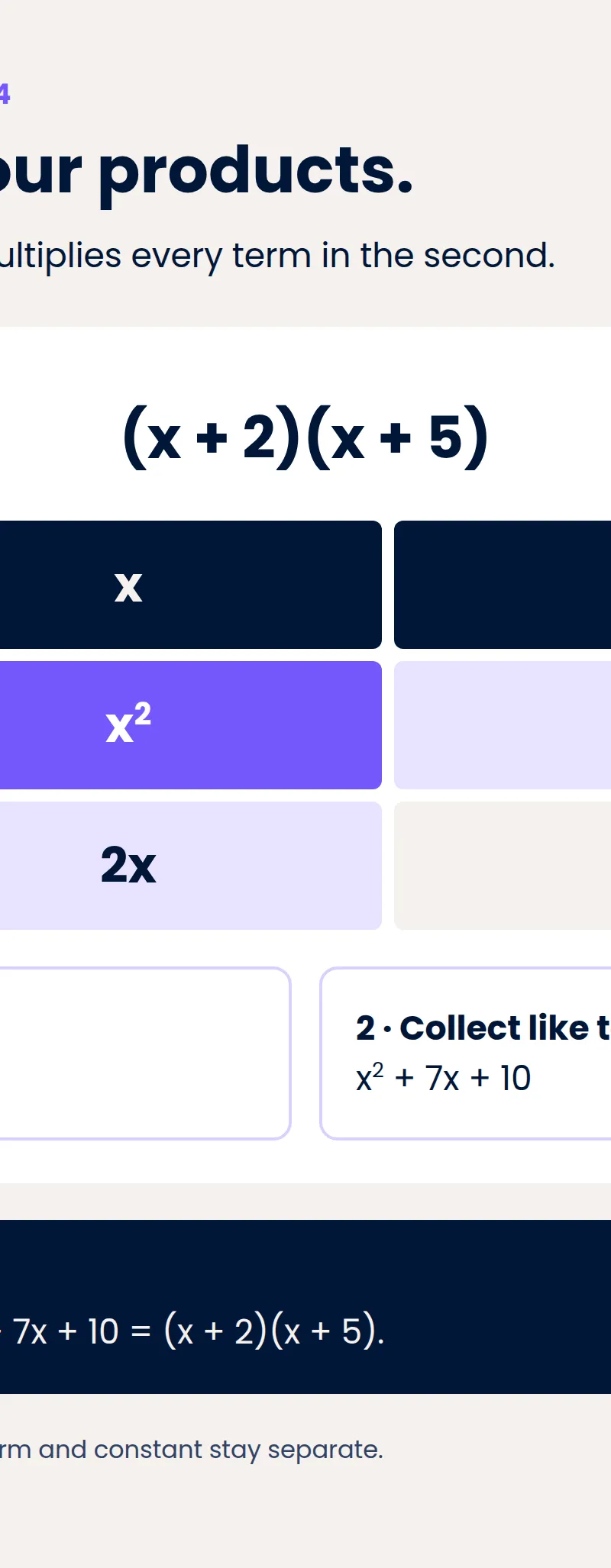
A binomial has two terms. When expanding (x + 7)(x + 3), each term in the first bracket multiplies each term in the second: x² + 3x + 7x + 21, then x² + 10x + 21. Use a grid, arrows or carefully written partial products. The method matters less than ensuring all four products appear once.
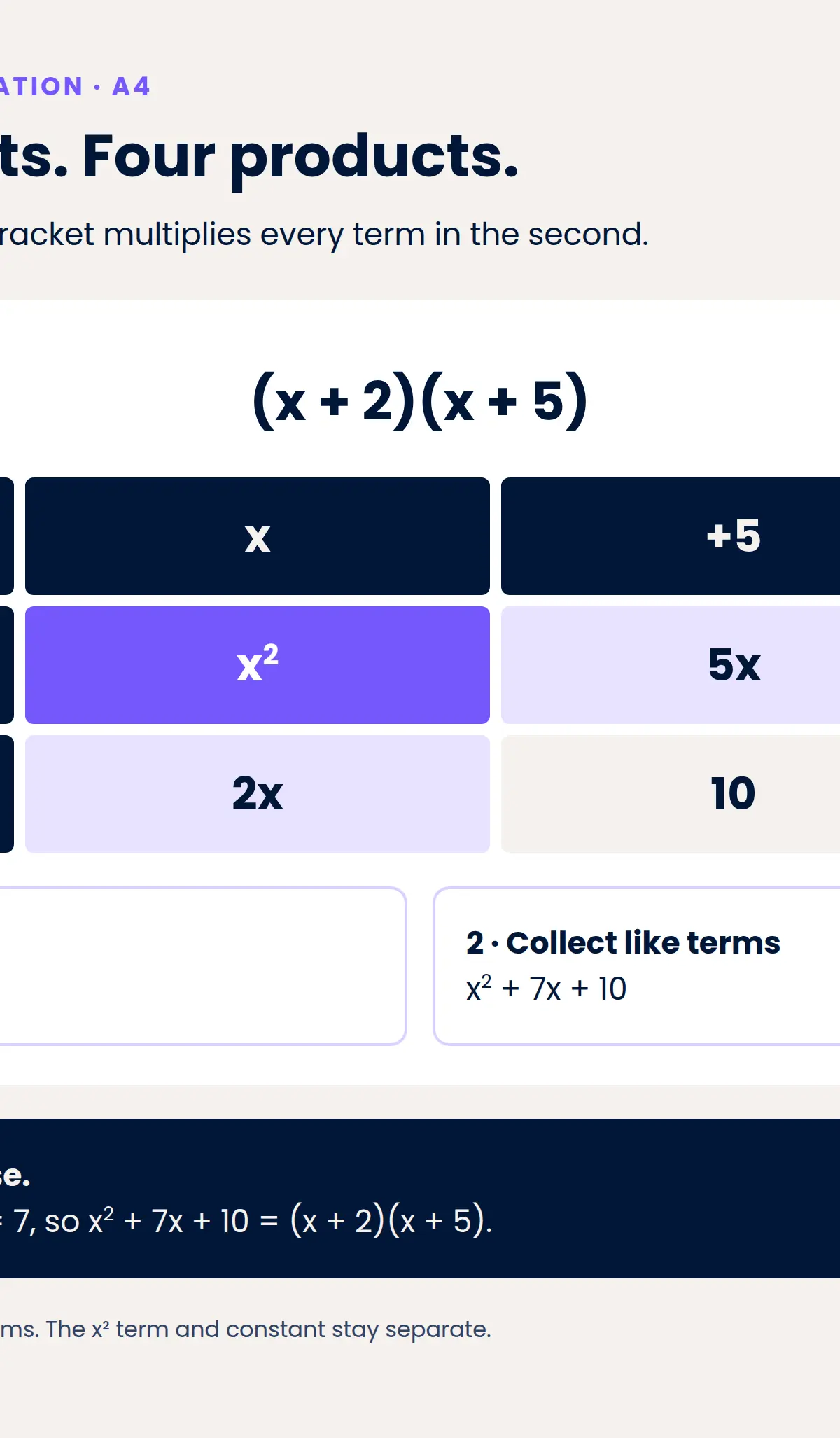
For a square, do not square the terms separately. (x + 3)² means (x + 3)(x + 3), so it expands to x² + 6x + 9. The middle term comes from two cross-products, 3x + 3x. With signs, (x − 4)(x + 2) = x² − 2x − 8; the final product has the sign of −4 × 2. As a check for brackets of the form (x + a)(x + b), the middle coefficient is the sum of the constants and the final constant is their product.
Factorising: Reversing Expansion
Factorising rewrites a sum or difference as a product. Start by asking, “What is common to every term?” For 12x + 18, the highest common factor is 6, giving 6(2x + 3). Variables can be part of the HCF: 8x²y − 12xy² has common factor 4xy, so 8x²y − 12xy² = 4xy(2x − 3y). Check by expanding your brackets back out.
For a monic quadratic, the coefficient of x² is 1. To factorise x² − 2x − 15, find two numbers that multiply to −15 and add to −2: −5 and +3. Therefore x² − 2x − 15 = (x − 5)(x + 3). The signs are decisive. If the constant is negative, one bracket number is positive and the other negative. If it is positive, the two numbers have the same sign; the middle coefficient tells you whether both are positive or both negative.
Not every quadratic has integer linear factors. If no integer pair passes both tests, do not invent a pair merely because its product is correct.
The difference of two squares has the form a² − b². It factorises as (a − b)(a + b), for example x² − 25 = (x − 5)(x + 5). First take out any common factor: 3x² − 75 = 3(x² − 25) = 3(x − 5)(x + 5). “Factorise fully” means remove all common factors and then recognise any remaining factorisable structure. A sum of two squares does not use this shortcut.
Higher-only signposts: general non-monic quadratic factorisation, algebraic fractions and products of three or more brackets are Higher content 2. Rationalising a denominator and fractional indices are also Higher. A difference of squares such as 9y² − 16 can still be recognised directly using the Foundation identity.
Indices, Including Zero and Negative Powers
A positive integer index describes repeated multiplication. Read the operation first: products and quotients of the same base use addition and subtraction of indices; a power of a power uses multiplication of indices. x³ × x⁴ = x⁷, while x³ + x⁴ cannot be combined using an index law.
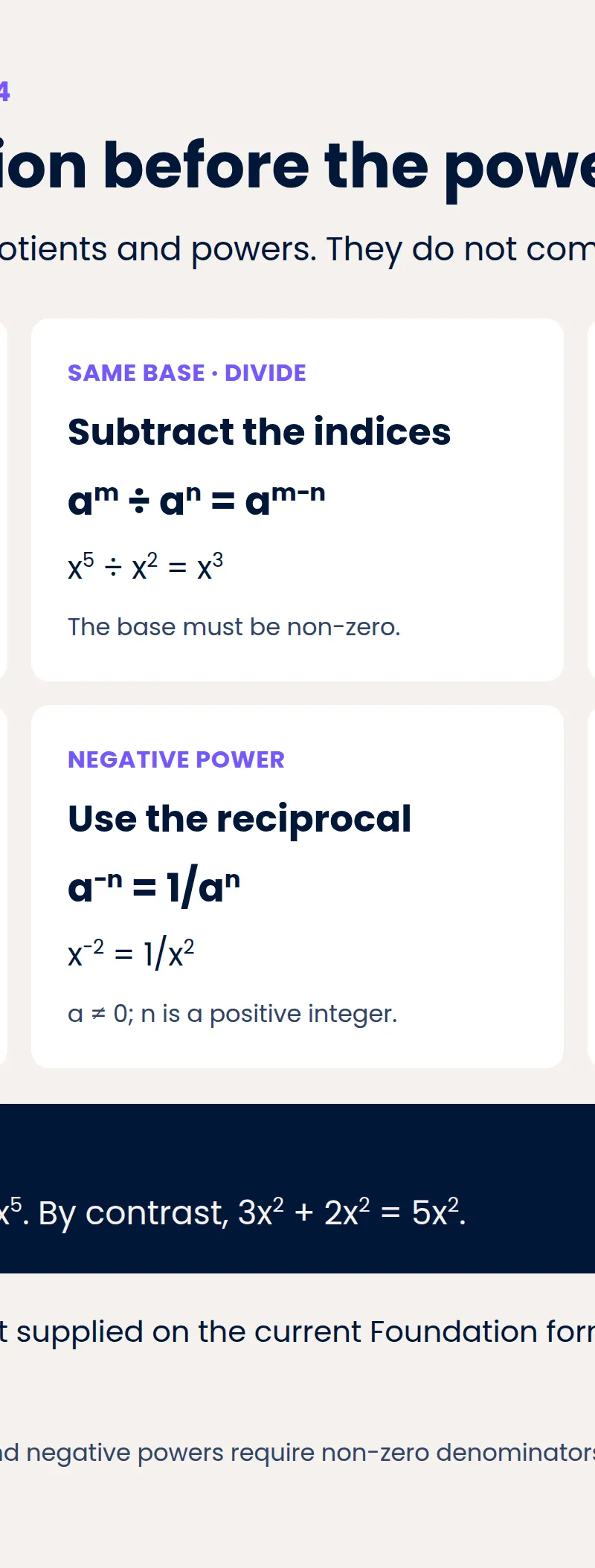
For a⁶ ÷ a², cancel two matching factors from numerator and denominator to leave a⁴, provided a ≠ 0. A zero power is 1 when the base is non-zero: 5⁰ = 1 and x⁰ = 1 for x ≠ 0. A negative power means reciprocal, so x⁻³ = 1/x³, again for x ≠ 0. It does not make the answer negative. Zero and negative indices are Foundation content 2.
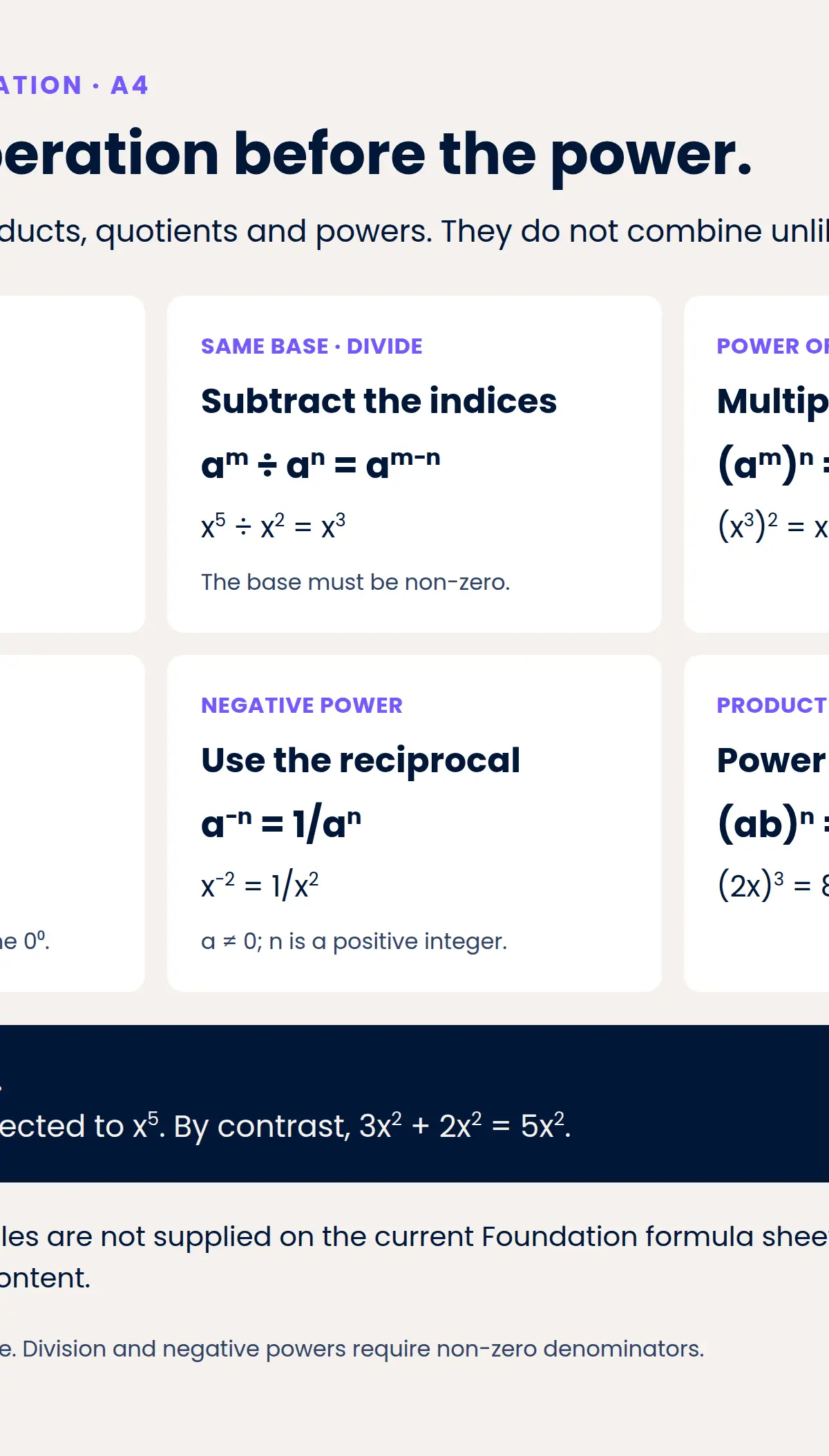
When a power is outside brackets, it acts on the entire product: (3x²)² = 9x⁴. Use brackets to make the base clear. For a quotient such as (a/b)³, both numerator and denominator are cubed, with b ≠ 0. Apply these laws with their conditions rather than learning unqualified shortcuts.
Surd Terms
A surd is an irrational root left in exact form, such as √2. At Foundation, you may simplify and manipulate expressions containing supplied surd terms. Collect only matching surds: 3√5 + 4√5 = 7√5, but √5 + √7 does not simplify to √12. This resembles collecting 3x + 4x: the common part must match. Surds are not all Higher content.
Optional Higher N8 extension: extracting square factors simplifies a surd, for example √12 = √(4 × 3) = 2√3. Rationalising denominators is Higher 1 2. When already-simplified surd terms are supplied at Foundation, concentrate on the indicated operation rather than importing an unnecessary Higher technique.
Mathematical Relationships
Every relationship below is Must memorise because it is not supplied on the current Foundation formula sheet 3. Letters represent numbers or expressions. Indices are integers in this Foundation guide. Whenever an index is zero or negative, its base must be non-zero.
- Must memorise: like-term collection.
ax + bx = (a + b)x. Hereaandbare coefficients; the variable part must match, including its powers. - Must memorise: distributive law.
a(b + c) = ab + acanda(b − c) = ab − ac. Applyato every term inside the bracket. - Must memorise: common-factor reversal.
ab + ac = a(b + c)andab − ac = a(b − c). Choose the highest common numerical and variable factor when asked to factorise fully. - Must memorise: two-binomial product.
(x + a)(x + b) = x² + (a + b)x + ab. Herexis the variable anda,bare constants, including their signs. To reverse it, find numbers whose sum is the middle coefficient and whose product is the constant. - Must memorise: square of a binomial.
(x + a)² = x² + 2ax + a². Ifais negative, the middle term is negative. - Must memorise: difference of two squares.
a² − b² = (a − b)(a + b). This is not a rule fora² + b². - Must memorise: index product and quotient.
a^m × a^n = a^(m+n)anda^m ÷ a^n = a^(m−n). The base must be the same; division requiresa ≠ 0. - Must memorise: power laws.
(a^m)^n = a^(mn),(ab)^n = a^n b^n, and(a/b)^n = a^n/b^n. The quotient requiresb ≠ 0; a negative exponent also requires a non-zero numerator base. - Must memorise: zero and negative indices.
a⁰ = 1anda⁻ⁿ = 1/aⁿ, wherea ≠ 0andnis a positive integer. - Must memorise: supplied-surds collection.
p√q + r√q = (p + r)√q. The radical part must match. Foru, v ≥ 0,√u × √v = √(uv)and(√u)² = u. Also√u / √v = √(u/v)whenv > 0. - Must memorise for the optional Higher extension:
√(k²n) = k√nfork, n ≥ 0. This permits square-factor extraction. It does not mean that√(a + b) = √a + √b, which is false in general.
Practical Applications
Algebra models relationships in geometry, finance and science. This topic has no required practical in GCSE Mathematics. In geometry, a rectangle of length (x + 3) cm and width x cm has area x(x + 3) = x² + 3x cm², with x > 0. The two expressions describe the same area: the product shows length multiplied by width, while the expansion supports further manipulation.
Keep unit conversion in its geometry context. 100 cm = 1 m, but area scales in two dimensions: 1 m² = 10,000 cm². Do not convert cm² to m² by dividing by 100. When an applied question requires a numerical answer, substitute with brackets and include the appropriate units. Pure algebraic expressions do not acquire units unless the context supplies them.
Checking an Expression
A substitution check can quickly expose an incorrect expansion. If x = 2, then (x + 3)² = 25, and x² + 6x + 9 = 4 + 12 + 9 = 25. Matching at one value is reassuring but does not prove an identity. A single mismatch disproves a claim that expressions agree for every value.
Identical expressions give the same graph for all permitted values of x. If checking with a graph, use the same axes and input values, but do not treat a few plotted points as proof. For this topic, symbolic expansion or factorisation remains the main method.
Listening Recap
The ten-minute episode follows introduction, core concepts, exam tips, recall quiz and summary. Answer the quiz aloud before the tutor gives each answer. Then close the guide and write one example of each rule from memory. Check, correct and revisit the examples tomorrow.
Published-Exam Calibration
Published allocations are specific to their questions, not universal rules. In New SAMs 3F Q2, simplifying 8x − 3x + 2x = 7x is 1 mark, and simplifying 4y × 2y = 8y² is 1 mark. In New SAMs 2F Q20, factorising 3f + 9 = 3(f + 3) is 1 mark, while factorising x² − 2x − 15 = (x − 5)(x + 3) is 2 marks. Expanding and simplifying (m + 7)(m + 3) = m² + 10m + 21 is 2 marks in New SAMs 1F Q22 / 1H Q2 2.
For June 2024 1F Q17, the 3-mark scheme awarded M1 for correct expansion to 8x − 10 or an alternative eligible first method, M1 for isolating the x terms, and A1 for 3.5 4. Visible expansion can therefore earn credit within a longer question, but no expansion line automatically earns a mark. The worked examples and practice questions in this guide are original Edexcel-style material with suggested allocations, not official Pearson mark schemes.
References
Visual Resources
2 diagrams and illustrations
Interactive Diagrams
2 interactive diagrams to visualise key concepts
Conceptual Flow Outline
Choose the operation from the command word. Factorising fully can require an HCF followed by another factorisation.
Conceptual Flow Outline
The two-number test for monic quadratics: both product and sum must match. Not every quadratic factorises over integers.
Worked Examples
5 worked examples — open one to explore the question and available guidance.
Practice Questions
Try the question, then reveal an answer plan or example response
Collect like terms and simplify. (a) 6p − 2q + 5p + 7q − 4 (b) 3√2 + 2√2. Suggested allocation: 3 marks.
Hint: Group the p-terms and q-terms separately. In (b), the radical parts match.
Expand and simplify −5(2m − 3) − 4. Suggested allocation: 2 marks.
Hint: Multiply −5 by both terms inside the bracket before collecting constants.
Factorise fully 18x²y − 12xy². Suggested allocation: 2 marks.
Hint: Find the greatest shared numerical factor and the variables present in both terms.
Expand and simplify (x + 7)(x − 4). Suggested allocation: 2 marks.
Hint: Form all four products, then collect the x-terms.
Factorise fully x² + 5x − 24. Suggested allocation: 2 marks.
Hint: Find two integers whose product is −24 and whose sum is +5.
Factorise fully 25a² − 49. Suggested allocation: 2 marks.
Hint: Write each term as a square and use A² − B² = (A − B)(A + B).
Write each answer using positive indices only. (a) 5r⁰ (b) 4s⁻² (c) (6t⁴ × t³)/(3t⁵), where r, s and t are non-zero. Suggested allocation: 4 marks.
Hint: Use a⁰ = 1 and negative indices as reciprocals. In (c), divide coefficients separately from simplifying powers.
Optional Higher-only extension: simplify √12 by extracting its square factor. Suggested allocation: 2 marks.
Hint: Use 12 = 4 × 3, then take √4 outside the radical.
Exam technique
How to turn what you know into marks
How to approach the question
Read the command word and identify the expression's structure before writing. For simplifying, look for like terms or products; for expanding, identify every multiplication across the brackets; for factorising, find an HCF first, then test for a monic quadratic or difference of squares. Write one equivalent expression per line. Expand back or substitute a simple permitted value to check when time allows.
How to structure your answer
Set algebra out vertically with aligned equals signs. Show the important transformation rather than a page of unnecessary arithmetic. A 1-mark fluency item usually needs a concise correct answer. A 2-mark manipulation item benefits from an intermediate method line and the required final form. For multipart tasks worth 3–6 marks, label each part and show its method separately. Keep a factorised answer in product form. Include units only when the context requires them.
Timing
Each Edexcel GCSE Mathematics paper is 90 minutes for 80 marks, which is 67.5 seconds per mark as a whole-paper average, not an official allowance for each question. Aim for about 1 minute per mark on routine items, move on if stuck, and reserve checking time. At that working pace, a 3-mark task takes about 3 minutes and a 6-mark multipart task about 6 minutes.
Common pitfalls
- Collecting unlike terms, such as turning x² + x into 2x². Check both letters and powers.
- Dropping a negative when expanding −3(x − 4). Calculate each signed product.
- Writing (x + 3)² as x² + 9. Rewrite it as two brackets and include both cross-products.
- Stopping at 3(x² − 25) when asked to factorise fully. Continue to 3(x − 5)(x + 5).
- Choosing a quadratic factor pair with the right product but the wrong sum. Check both.
- Using index laws across addition or treating a negative index as a negative number.
- Combining unlike surds, for example claiming √5 + √7 = √12.
- Assuming every intermediate line earns a mark. Credit depends on the question-specific scheme.
- Dividing an area in cm² by 100 rather than 10,000 when converting to m².
What the command words want
- Expand
- Remove brackets by multiplying every required pair of terms, then collect like terms.
- Compare
- Make the relevant similarity or difference explicit using values or algebraic features.
- Explain
- Give the mathematical reason, for example: 'These terms cannot be collected because their powers are different.'
- Describe
- Give a clear mathematical account of the requested feature or process.
- Evaluate
- In Mathematics, carry out the arithmetic or substitution to find a value. This does not mean weighing both sides of an argument.
- Simplify
- Rewrite in an equivalent, simpler form. Collect like terms, multiply numerical factors and apply index laws only where the bases and operations allow them.
- Work out
- Calculate or derive the answer and show the key method in a multi-step task.
- Calculate
- Use an appropriate method and show key stages before the numerical or exact result.
- Factorise
- Write the expression as a product. Check for a common factor first, then select the appropriate pattern.
- Show that
- Present a chain of correct steps leading to the stated result. Do not merely copy that result or assume the statement you are meant to establish.
- State/Give
- Provide the requested answer concisely, with correct notation and any relevant unit.
- Write down
- Give the requested value, expression or fact directly, using correct notation.
- Factorise fully
- Remove all common factors and continue until any remaining eligible structures have also been factorised.
Watch or listen (optional)
Test your understanding of Algebra - Notation, vocabulary and manipulation: simplify and manipulate algebraic expressions (including those involving surds) by: • collecting like terms • multiplying a single term over a bracket • taking out common factors • expanding products of two binomials • factorising quadratic expressions of the form x² + bx + c, including the difference of two squares; • simplifying expressions involving sums, products and powers, including the laws of indices (Foundation tier)
Active recall beats re-reading. Take an instant quiz now to test what you’ve learned and lock it into long-term memory.
7 days Premium · Then the free plan continues · No card, no charge