Pearson Edexcel · GCSE · Mathematics
Course version: 1MA1 · Version from Mar 2026
Algebra - Notation, vocabulary and manipulation: understand and use the concepts and vocabulary of expressions, equations, formulae, identities, inequalities, terms and factors
A few precise words can unlock algebra marks: learn when to simplify an expression, solve an equation or justify an identity. This guide pairs signed-term and factor examples with examiner-style commentary, retrieval practice, clear diagrams and a ten-minute female-tutor podcast for Pearson Edexcel GCSE Mathematics.
- 12 min read
- 4 worked examples
- 7 practice questions
- 12 key terms
Try the lesson
The start of the Algebra - Notation, vocabulary and manipulation: understand and use the concepts and vocabulary of expressions, equations, formulae, identities, inequalities, terms and factors lesson, made from checked teaching notes for this specification point.
Have a go first
Which of the following is a formula?
There is more to this lesson
The full lesson goes on to check your understanding and help you earn the marks. Create a free account to carry on, with your progress saved.
7 days Premium · Then the free plan continues · No card, no charge
Check what you remember
Read the wording for your board, then hide it and explain Expression in your own words. Rough notes are fine. This is a self-check, with no mark or grade.
Reference: Pearson Edexcel
A mathematical quantity formed from numbers, variables and operations, without itself stating an equality or inequality.
Study Notes
Overview
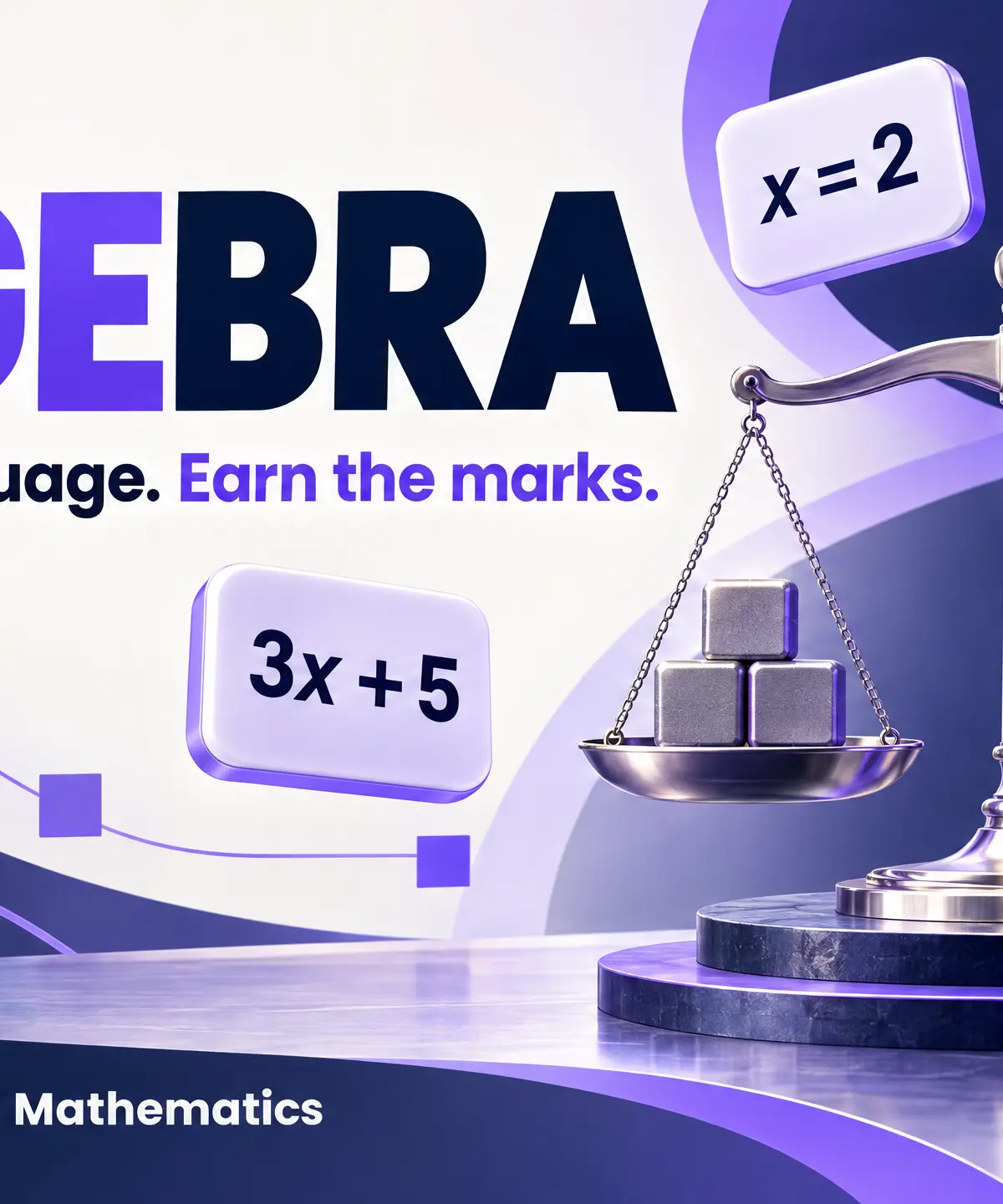
Algebra has its own language, and knowing that language tells you what an examination question is asking you to do. An expression represents a quantity; an equation states equality; a formula gives a rule connecting quantities; an identity is an equality that always holds for the allowed values; and an inequality compares quantities. Terms and factors describe how an expression is built. These distinctions help candidates choose between simplifying, substituting, solving, factorising and proving.
This guide covers Pearson Edexcel GCSE Mathematics 1MA1, A3, on both Foundation and Higher tiers. It links directly to notation in A1, substitution in A2, manipulation in A4 and reasoning in A6. No part of the core vocabulary here is Higher-only. Typical question styles include naming an algebraic object, identifying signed terms, selecting factors and explaining why two expressions are equivalent. 1
The examples and practice questions below are original Edexcel-style teaching questions, not reproduced Pearson questions. Their exact mark allocations are proposed teaching schemes. Use the worked solutions to learn what a complete answer looks like, then cover the answers and practise recalling the distinctions yourself.
Key Concepts
1. Expressions: a quantity, not a statement
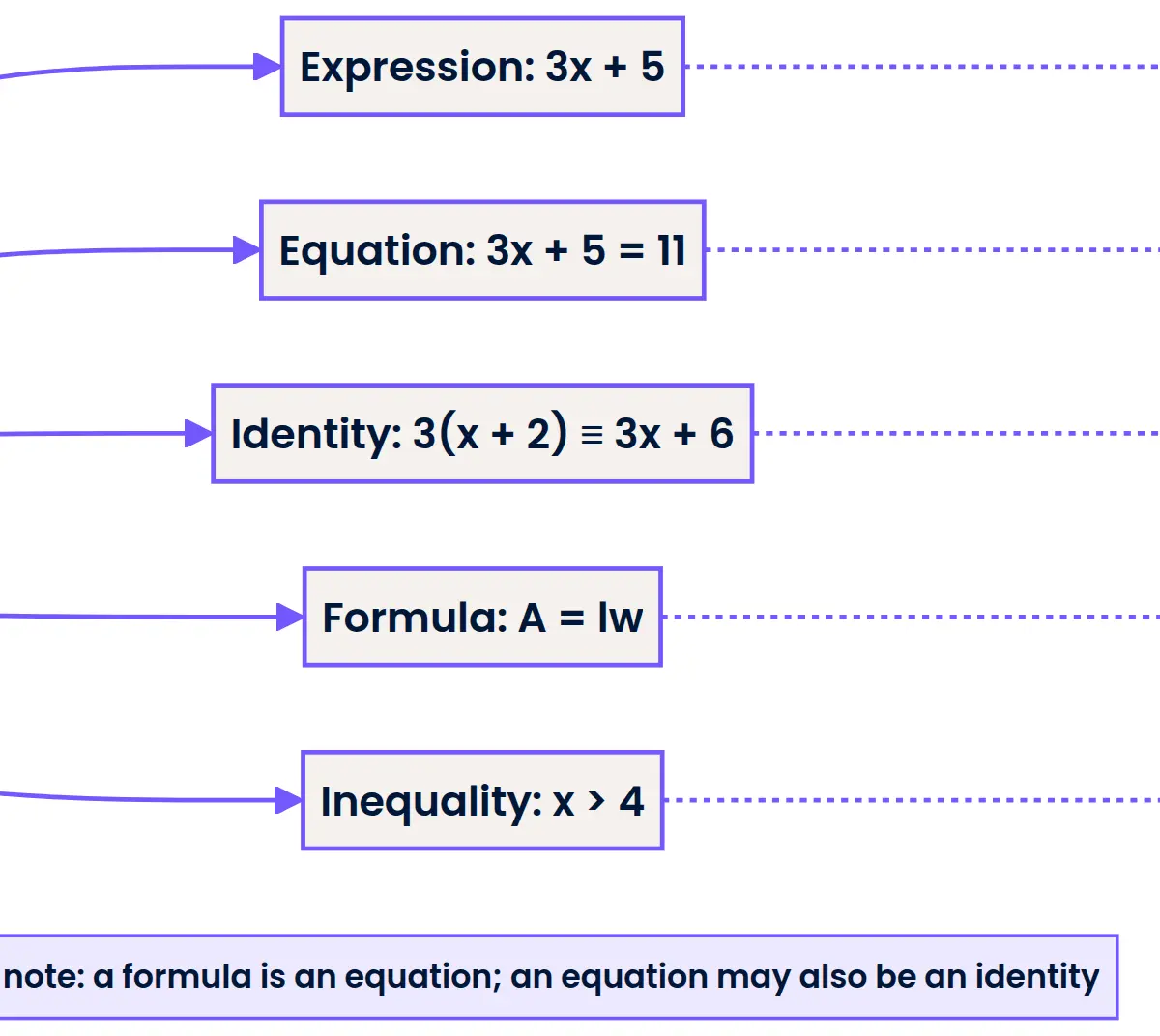
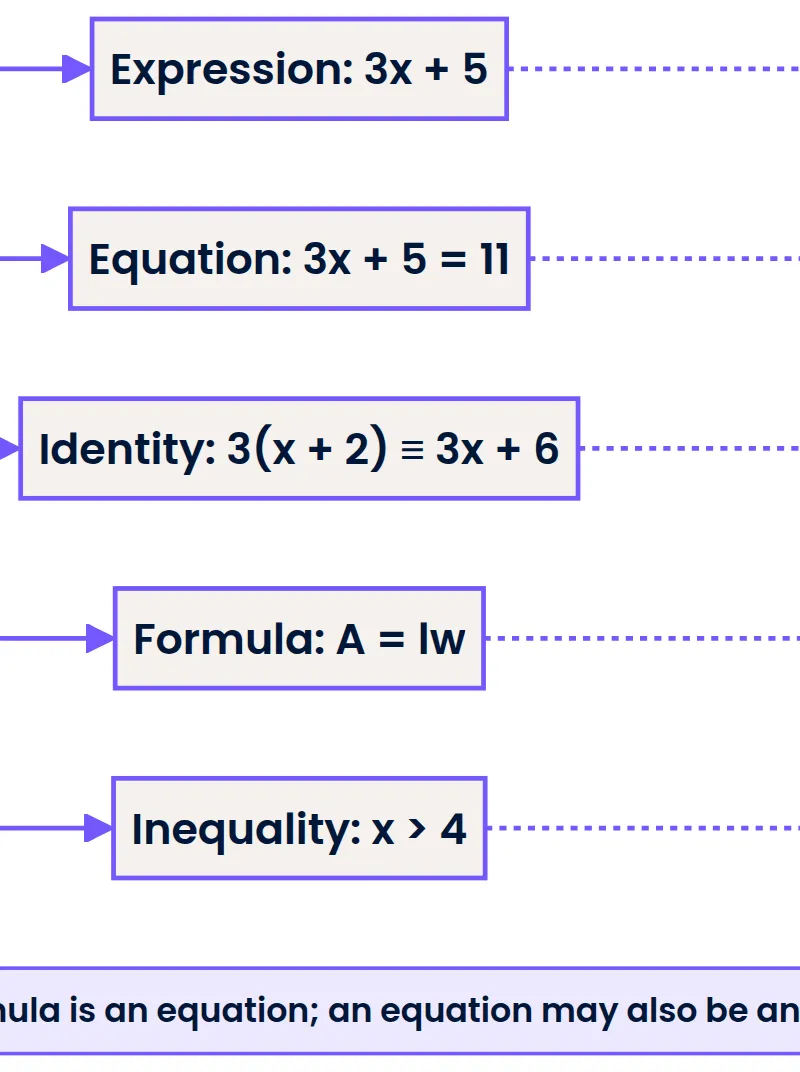
An expression combines numbers, variables and operations to represent a quantity. Examples include 3x + 5, 7, ab and (p + 2)/3. An expression does not, by itself, assert an equality or inequality. A single number or letter can also be an expression; it need not contain several terms.
For 3x + 5, the letter x represents a number, and 3x means 3 × x, not a two-digit number. If x = 2, substitution gives 3 × 2 + 5 = 11. We have evaluated the expression. We have not solved the expression, because there was no condition to satisfy.
Candidates should match the command to the task: simplify produces an equivalent expression; find the value when requires substitution. Credit is not given in our naming questions for calling an expression an equation merely because it contains a letter.
Cover and recall: What extra statement turns 3x + 5 into an equation? One answer is 3x + 5 = 11.
2. Terms: keep each sign attached
At the outermost level, terms are the parts added together in an expression. Subtraction can be read as adding a negative term. Consequently, 5x − 2y + 7 has three terms: 5x, −2y and +7. Writing 2y loses the sign and changes the expression.
A coefficient is the numerical multiplier of the variable part. The coefficient of y in −2y is −2; the coefficient of x in x is 1, and in −x it is −1. A constant term does not depend on the variables, so 7 is the constant term here.
Like terms have exactly the same variable part, including powers. Thus 3x + 2x = 5x, but 3x + 2y cannot be collected. Likewise, x and x² are not like terms.
Brackets stop the shortcut of counting every plus sign. In 3(x + 2), the entire product is one term as written, although the expression inside the brackets has two terms. After expansion, 3x + 6 has two terms. Count separators at the level the question asks you to inspect.
3. Factors: things that multiply
A factor is a quantity that multiplies another quantity to produce the quantity being considered. In 6x = 2 × 3 × x, the displayed factors are 2, 3 and x. Another valid factorisation is 6 × x; factors depend on the product representation and the question's restrictions.
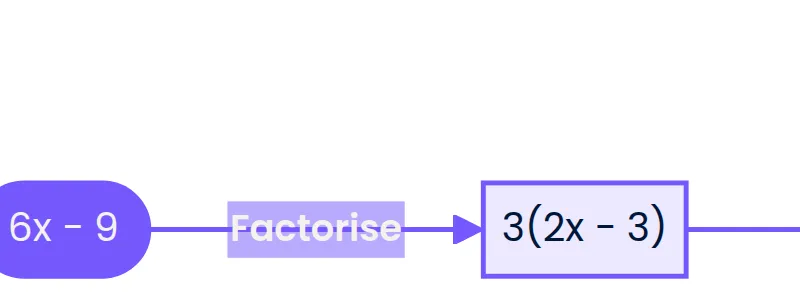
For the sum 6x − 9, 6x and −9 are its terms, not its factors. Taking out the common factor gives 6x − 9 = 3(2x − 3). In this displayed product, the factors are 3 and the whole bracket (2x − 3).
Do not attempt an unrestricted list of every algebraic factor. Questions usually ask for a common factor, the highest common factor, or the factors in a displayed product. If asked for all positive integer factors of 6, the complete list is 1, 2, 3, 6. That is a different, explicitly restricted task.
Factorising works because it reverses expansion. Expand 3(2x − 3) to check: 3 × 2x − 3 × 3 = 6x − 9.
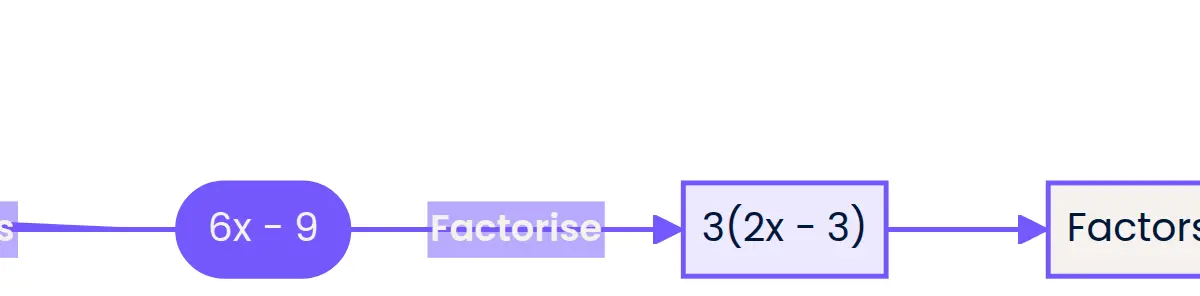
Memory hook: Terms ADD; factors MULTIPLY. Ask which operation connects the pieces before naming them.
4. Equations: equality with a condition
An equation is a statement that two expressions are equal. In 3x + 5 = 11, solving means finding every value of x that makes the statement true. Subtract 5 from both sides to obtain 3x = 6; divide both sides by 3 to obtain x = 2. Substitution checks the solution: both sides are 11.
The equals sign means that the left and right sides have the same value. It does not mean 'and then'. Avoid a false chain such as 3x + 5 = 11 = 6 = 2. Write each equivalent equation on a new line instead.
Many familiar equations are true only for particular values. However, 'an equation always has one solution' is false. x + 1 = x has no solution, while 2(x + 1) = 2x + 2 is true for every real x and therefore also expresses an identity. The defining feature of an equation is the equality statement, not its number of solutions.
5. Formulae: equations with a useful job
A formula is a rule connecting named quantities. A = lw links a rectangle's area A, length l and width w. For l = 5 cm and w = 3 cm, it gives A = 15 cm².
A formula is also an equation. These categories are not mutually exclusive: 'equation' describes the equality, while 'formula' describes its role as a general rule. When a question asks you to name the rule linking area, length and width, formula is the most specific answer. Do not explain that it cannot be an equation.
In a formula, the letters refer to quantities with an interpretation, and the rule is used within its stated context. If you know the area and length instead, you can rearrange A = lw to w = A/l, provided l is not zero. This is the link to changing the subject in A5. 1
6. Identities: true for every allowed value
An identity is an equality that holds for every allowed value of its variables. The sign ≡ is read as 'is identically equal to'. For example, 3(x + 2) ≡ 3x + 6 because distributing 3 across the bracket produces 3x + 6 for any real x.
Contrast this with 3x + 5 = 11, which holds only when x = 2. A full explanation in our two-mark teaching questions gives a valid algebraic reason and states the 'every value' conclusion. Merely writing 'it has brackets' is not a reason.
Testing two values does not prove an identity. The equality x² = x works for x = 0 and x = 1, but fails for x = 2. One failed substitution is enough to disprove an identity; any finite collection of successful tests is not, by itself, a general algebraic proof.
Use expansion, factorisation or simplification to show equivalence for all allowed inputs. For this topic's polynomial examples, every real input is allowed. Higher-only extension: when simplifying algebraic fractions under A4, preserve restrictions from the original denominator. The word 'allowed' matters because division by zero is undefined. Algebraic fractions are not needed for the core questions in this guide. 1
7. Inequalities: compare, then describe the solutions
An inequality uses <, >, ≤ or ≥ to compare quantities. x > 4 means that x is greater than 4, excluding 4. x ≥ 4 includes 4. Read the symbol from left to right rather than relying only on its shape.
For 2x + 1 < 7, subtract 1 from both sides and divide by positive 2, giving x < 3. The answer is a set of values, not just x = 3. With the additional condition x ≥ 0, the integer solutions are 0, 1, 2. Without that lower restriction, there are also infinitely many negative integer solutions.
Multiplying or dividing both sides by a negative number reverses the inequality. For example, −2x < 6 gives x > −3. This preserves order: multiplying 1 < 2 by −1 gives −1 > −2.
Cover and recall: Which endpoint is included in −1 ≤ x < 3? −1 is included; 3 is excluded.
Mathematical Relationships and Formula Status
There is no specialist formula to learn solely for A3. The following relationships support the vocabulary and examples; learn their meanings as well as their symbols.
Must memorise: ab = a × b, a² = a × a, and a/b = a ÷ b, where b ≠ 0 in the quotient. These are notation conventions, not supplied formula-sheet explanations. a² does not mean 2a.
Must memorise: a(b + c) ≡ ab + ac and a(b − c) ≡ ab − ac. These are the distributive relationships used to expand a bracket and justify the identities here. The letters represent numbers; the outside factor multiplies every term inside.
Must memorise: A = lw, and its rearrangement w = A/l for l ≠ 0. Here A is rectangle area and l, w are perpendicular side lengths. Rectangle area is not listed on the checked supplementary Foundation formulae sheet.
Given on formula sheet: A = πr² for circle area. Here r is radius, π is pi and A is area. This is a useful example of a formula, not an additional circle question to master for A3. It appears on Pearson's supplementary sheet. Pearson confirmed that the 2026 sheets were unchanged from 2025; check the published sheet for your own examination series. 3 4
Equality and inequality operations are reasoning rules to understand, not lookup formulae: perform the same valid operation on both sides; never divide by zero; reverse an inequality when multiplying or dividing by a negative number.
Practical Applications and Units
For a rectangle measuring 5 cm by 30 mm, first convert 30 mm = 3 cm, then use the formula to obtain 15 cm². Do not multiply unmatched units. Remember 1 cm = 10 mm, but 1 cm² = 100 mm², because both dimensions scale by ten. These are Must memorise unit conversions for this example.
A spending limit gives a memorable inequality: buying n identical items costing £3 each with a £12 budget gives 3n ≤ 12. Since n is a non-negative whole number, the possible values are 0, 1, 2, 3, 4. The inclusive sign allows spending exactly £12. The prices are supplied contextual information, not formulae to memorise.
There is no required practical for this mathematics topic. The practical skill is translating words into an expression or statement, then interpreting the result in context.
Number-Line and Graph Reading
For x > 4, place an open circle at 4 and indicate the values to the right. For x ≤ 4, use a filled circle and indicate values to the left. On a bounded interval, show both endpoints separately. An open circle means the boundary is excluded; a filled circle means it is included. Label the boundary values clearly.
A later graph connection is that the solution of 3x + 5 = 11 is where y = 3x + 5 and y = 11 intersect. Equivalent expressions in an identity generate the same graph on their common allowed domain. No graph plotting is needed in the core vocabulary questions below.
Turning Understanding into Marks
Pearson's actual June 2024 Paper 1F marking guidance distinguishes method marks, accuracy marks, unconditional accuracy marks and communication marks. The individual question's instructions take priority. Showing key working is a sensible strategy, especially where the command explicitly requires it; do not claim that every correct linear-equation answer automatically needs working for full marks. 2
Use the resources actively: read one concept, cover it, give your own example, then check. Complete the practice questions without viewing their model answers. Explain a wrong answer aloud before retrying it. Return tomorrow and several days later, mixing vocabulary with substitution and solving. This makes the guide a recall tool rather than a rereading exercise.
Listen and Retrieve
Play the tutor podcast, then attempt the quick-fire questions before hearing the answers. The full transcript is stored in podcast_script.
References
Worked Examples
4 worked examples — open one to explore the question and available guidance.
Practice Questions
Try the question, then reveal an answer plan or example response
Write down the mathematical name for 8p + 3.
Hint: Does it state that two quantities are equal or unequal?
For 7a − 4b + 2, (a) write down all three terms (1), (b) state the coefficient of b (1), and (c) state the constant term (1).
Hint: Rewrite subtraction as adding a negative term.
For the product 4(2x + 3), (a) write down the two displayed factors (1), and (b) expand the product (1).
Hint: One factor is the entire bracket.
(a) Solve 4x − 3 = 13. (2) (b) State whether this equality is an identity and give a reason. (1)
Hint: Use inverse operations, then ask whether the equality holds for every x.
A pupil says that x² = x is an identity because it works when x = 0 and x = 1. (a) Evaluate both sides when x = 2. (1) (b) Explain what this shows. (1) (c) Solve x² = x by factorising. (2)
Hint: For part (c), move all terms to one side, then take out x.
(a) Solve 3x − 2 ≤ 10. (2) (b) Write down all integer solutions that also satisfy x > 1. (1) (c) Describe the endpoint at x = 4 on the number-line diagram. (1)
Hint: Keep the inclusive inequality sign when dividing by a positive number.
(a) Explain why 2(3x − 1) + 4 ≡ 6x + 2. (2) (b) Factorise fully 6x + 2. (2) (c) State the two displayed factors. (1)
Hint: Expand the bracket, collect constants and then identify the common numerical factor.
Exam technique
How to turn what you know into marks
How to approach the question
Read the command word and the number of marks. Identify whether the object is a quantity, equality, general rule, all-values equality or comparison. Inspect signed terms at the outer level and factors in a product. Answer each subpart separately, show a valid algebraic step where useful, and check the final answer against the original statement. All question allocations in this guide are original teaching allocations, not official Pearson schemes.
How to structure your answer
For 1-mark naming parts, give the precise requested term. For a 2-mark identity explanation in this guide, give an algebraic transformation plus the conclusion that it holds for every allowed value. For 3–6-mark multipart questions, label each answer, retain signs and inequality endpoints, show the key operation and include units where quantities have units. The live examination mark scheme takes precedence; the number of written steps is not automatically the number of marks.
Timing
Each 1MA1 paper has 80 marks in 90 minutes: 1.125 minutes, or 67.5 seconds, per mark before checking time. Use roughly 1 minute per mark as a practical working target. Allow about 3 minutes for 3 marks, 4–4½ minutes for 4 marks and 6–7 minutes for 6 marks, adapting to difficulty. Source: official specification, reference [1] in content.
Common pitfalls
- Calling 3x + 5 an equation: it is an expression because it makes no equality statement.
- Losing a negative sign: write −2y, not 2y, as the second term of 5x − 2y.
- Calling added terms factors: factorise first if the task asks for a product.
- Treating equation, formula and identity as mutually exclusive labels: a formula is also an equation, and an all-values equality is an identity.
- Claiming two successful tests prove an identity: use a general algebraic argument.
- Assuming every equation has one solution: equations may have none, particular solutions or all allowed values.
- Counting signs inside brackets as outer term separators: inspect the stated expression level.
- Writing x = 3 as the answer to x < 3: an inequality describes a set, and its boundary may be excluded.
- Multiplying centimetres by millimetres without converting: put lengths in compatible units and give square units for area.
What the command words want
- Solve
- Find all values satisfying the equation or inequality and preserve any domain restrictions.
- Compare
- State the relevant similarity and difference. An equation and identity both express equality; an identity is true for all allowed values.
- Explain
- Give a mathematical reason using because. For an identity, show equivalence and state that it holds for every allowed value.
- Describe
- Describe the relevant mathematical feature, such as an open endpoint with values extending to the right. This is less central than solve or simplify here.
- Evaluate
- In Mathematics, evaluate means find the numerical value of an expression for given inputs, not weigh opposing arguments. Apply the mathematical meaning.
- Simplify
- Produce an equivalent expression in the requested simpler form; collect only like terms.
- Show/Prove
- Provide a visible general algebraic argument. A handful of numerical checks is not a proof of identity.
- Factorise fully
- Write a product and take out the highest common factor or complete the required factorisation.
- Calculate/Work out
- Show the substitution or calculation, use compatible units and state the answer clearly.
- State/Give/Write down
- Give the precise name, signed term, coefficient or listed value requested. Do not add contradictory alternatives.
Watch or listen (optional)
Test your understanding of Algebra - Notation, vocabulary and manipulation: understand and use the concepts and vocabulary of expressions, equations, formulae, identities, inequalities, terms and factors
Active recall beats re-reading. Take an instant quiz now to test what you’ve learned and lock it into long-term memory.
7 days Premium · Then the free plan continues · No card, no charge