Pearson Edexcel · GCSE · Mathematics
Course version: 1MA1 · Version from Mar 2026
Algebra - Notation, vocabulary and manipulation: use and interpret algebraic manipulation, including: • ab in place of a × b • 3y in place of y + y + y and 3 × y • a² in place of a × a, a³ in place of a × a × a, a²b in place of a × a × b • a/b in place of a ÷ b • coefficients written as fractions rather than as decimals • brackets
Small symbols can make a big difference: 3y is not y³, and one bracket can change the entire calculation. Learn Pearson Edexcel’s algebraic shorthand, exact fractional coefficients and grouping rules so you can secure short-question marks and avoid losing marks in longer algebra problems.
- 12 min read
- 4 worked examples
- 6 practice questions
- 12 key terms
Try the lesson
The start of the Algebra - Notation, vocabulary and manipulation: use and interpret algebraic manipulation, including: • ab in place of a × b • 3y in place of y + y + y and 3 × y • a² in place of a × a, a³ in place of a × a × a, a²b in place of a × a × b • a/b in place of a ÷ b • coefficients written as fractions rather than as decimals • brackets lesson, made from checked teaching notes for this specification point.
Have a go first
Write 5 × p × p × p in its simplest algebraic form.
There is more to this lesson
The full lesson goes on to check your understanding and help you earn the marks. Create a free account to carry on, with your progress saved.
7 days Premium · Then the free plan continues · No card, no charge
Check what you remember
Read the wording for your board, then hide it and explain Variable in your own words. Rough notes are fine. This is a self-check, with no mark or grade.
Reference: Pearson Edexcel
A symbol representing a number that can vary or whose value is not yet specified.
Study Notes
Overview
Algebra is a precise shorthand for calculations involving numbers represented by letters. This topic teaches you to read that shorthand, write it correctly and identify exactly which part of an expression an operation affects. You will distinguish a coefficient from an index, interpret products and fractions, and use brackets to keep a whole calculation together.
These are small decisions with large consequences: 3y and y³ usually give different answers, while 2(x + 5) and 2x + 5 represent different instructions. In the examination, candidates may be asked to write down an expression, simplify a product, interpret a power or explain an error. Clear notation also protects marks in substitution, equations, formulae and geometry.
Pearson Edexcel specification 1MA1, A1 covers every core skill in this guide at both Foundation and Higher tiers. Short A1 parts are often worth one mark each; longer questions combine notation with reasoning or other topics. Work through the explanations, cover the answers during recall tasks, then attempt the original exam-style questions. Treat each mistake as a clue about a rule to practise, not as a reason to memorise another isolated answer. 1 2
Your exam target
By the end, you should translate between words, full calculations and algebraic shorthand without changing the meaning. You should recognise ab, 3y, a², a³, a²b and a/b; use exact fractional coefficients; and place brackets around a whole expression when required.
Tier: all core content is Foundation and Higher. Brief connections to A2 substitution, A3 vocabulary and A4 simplification are labelled as links, not extra Higher-only requirements. Advanced algebraic-fraction manipulation and fractional indices are outside this guide. There is no required practical for this mathematics topic. 1
Marking note: the worked and practice questions below are original Edexcel-style tasks with author-designed indicative allocations, unless an official source is explicitly identified. They are not official Pearson mark schemes. Credit in a real examination depends on that question's published scheme. 3
Key Concepts
1. Letters, products and coefficients
A letter represents a number. It might stand for an unknown value, a changing quantity or a value specified elsewhere. If one notebook costs y pounds, three notebooks cost 3y pounds. You can write the correct expression before knowing the price.
In algebra, multiplication signs are normally omitted between letters: a × b = ab. Likewise, 3 × y = 3y. The numerical multiplier is the coefficient and conventionally comes first. Write 4ab, rather than ab4. Alphabetical order is a useful presentation convention, although ba and ab are mathematically equivalent.
Adjacent letters represent multiplication, not a two-digit number. In this GCSE context, ab means a multiplied by b. It does not mean a + b. Similarly, 2a means twice a, not the numeral 2 followed by a digit.
Example: 2 × a × 3 × b = 6ab. Multiply the numerical factors, then write the letter factors together. For a = 4 and b = 5, both forms give 120. That check confirms this substitution, while the multiplication rules establish the general equivalence.
Cover and recall: write 5 × p × q without multiplication signs. Then explain what its coefficient tells you.
2. Repeated addition is not repeated multiplication
The expression y + y + y is the sum of three identical terms, so it is 3y. By contrast, y × y × y is a product with three factors of y, so it is y³. The raised 3 is an index, also called an exponent. It counts repeated factors, not added copies.
Remember: addition counts copies; multiplication counts factors. With y = 2, 3y = 6 but y³ = 8. Reading the operation before shortening it prevents this common error.
A4 link: y + y + 2y = 4y because all terms have the same letter part. However, y + y² cannot be collected into 2y or y³ because the letter parts differ. You are not expected to turn every sum into one term.
Example: a² + a² = 2a², whereas a² × a² = a⁴. The first counts two copies of a². The second contains four multiplied factors of a. Only the addition example is needed to understand this contrast; broader index laws belong to A4.
3. Powers attach to a particular base
In a², the base is a: a² = a × a. Similarly, a³ = a × a × a. In a²b, only a carries the index, so a²b = a × a × b. The b appears once.
In 2a², the coefficient 2 is not squared. The calculation is 2 × a × a. In (2a)², brackets make 2a the whole base: (2a)² = (2a)(2a) = 4a². This is why bracket placement matters even when there is no addition inside.
Example: at a = 3, 2a² = 18 but (2a)² = 36. Likewise, a²b differs from (ab)²: the latter contains two factors of b and equals a²b².
For negative substitutions, use brackets: if a = −3, a² = (−3)² = 9. Do not accidentally enter −3² when you mean the square of negative three. This is an A2 substitution link, useful for checking what the base actually is.
Why question: why does (2a)² square the coefficient while 2a² does not? Name the base in each expression before answering.
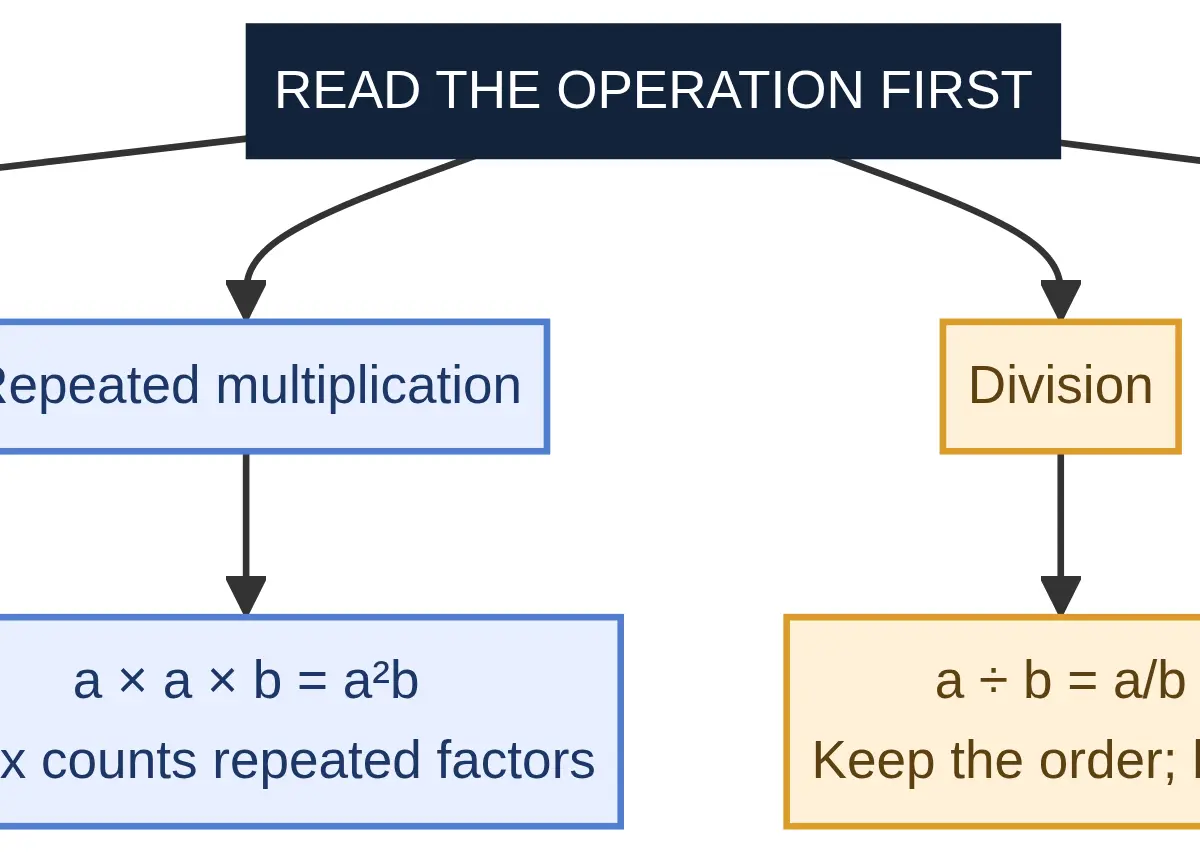
Operation first, shorthand second: addition, multiplication, division and grouping follow different rules.
4. Division and the fraction bar
Write a ÷ b as a/b, or as a stacked fraction with a above b. The numerator is the quantity being divided; the denominator is the divisor. Keep their order. The denominator must be non-zero because division by zero is undefined.
Example: if a = 12 and b = 4, a/b = 3. Reversing the fraction gives b/a = 1/3, a different result. A memory check is to read the fraction as “top divided by bottom”.
A fraction bar also groups everything above it and everything below it. The sum x + 5 divided by 2 is (x + 5)/2, not x + 5/2. In plain-text notation, keep the brackets so the numerator's scope is unambiguous. If the divisor is a sum, a divided by b + c as a whole is a/(b + c), where b + c ≠ 0.
Examiner focus: candidates must preserve the original division, including its order and grouping. A correct-looking fraction with the numerator and denominator reversed describes a different calculation.
5. Fractional coefficients keep values exact
A coefficient need not be a whole number. Three quarters of x is (3/4)x, equivalently 3x/4. One third of y is (1/3)y, equivalently y/3. The fraction multiplies the variable.
When the question requests a fractional coefficient, give one. In particular, (1/3)x is exact, whereas 0.33x uses a rounded coefficient and is not generally equal to x/3. Fractions avoid unnecessary approximation and make subsequent calculation clearer.
Do not learn the false rule that every decimal loses accuracy. The terminating decimal 0.75 is exactly 3/4, so 0.75x and (3/4)x are mathematically equivalent. The required answer form still matters: if a fractional coefficient is requested, use (3/4)x. Pearson's A1 specifically includes coefficients written as fractions rather than decimals. 1
Example: two thirds of 9 is (2/3) × 9 = 6. Algebraically, two thirds of x is (2/3)x. Write the numerical coefficient before the letter and avoid an unnecessary decimal stage.
Cover and recall: write one fifth of p and three quarters of q exactly. Identify the coefficient in each answer.
6. Brackets show the whole target of an operation
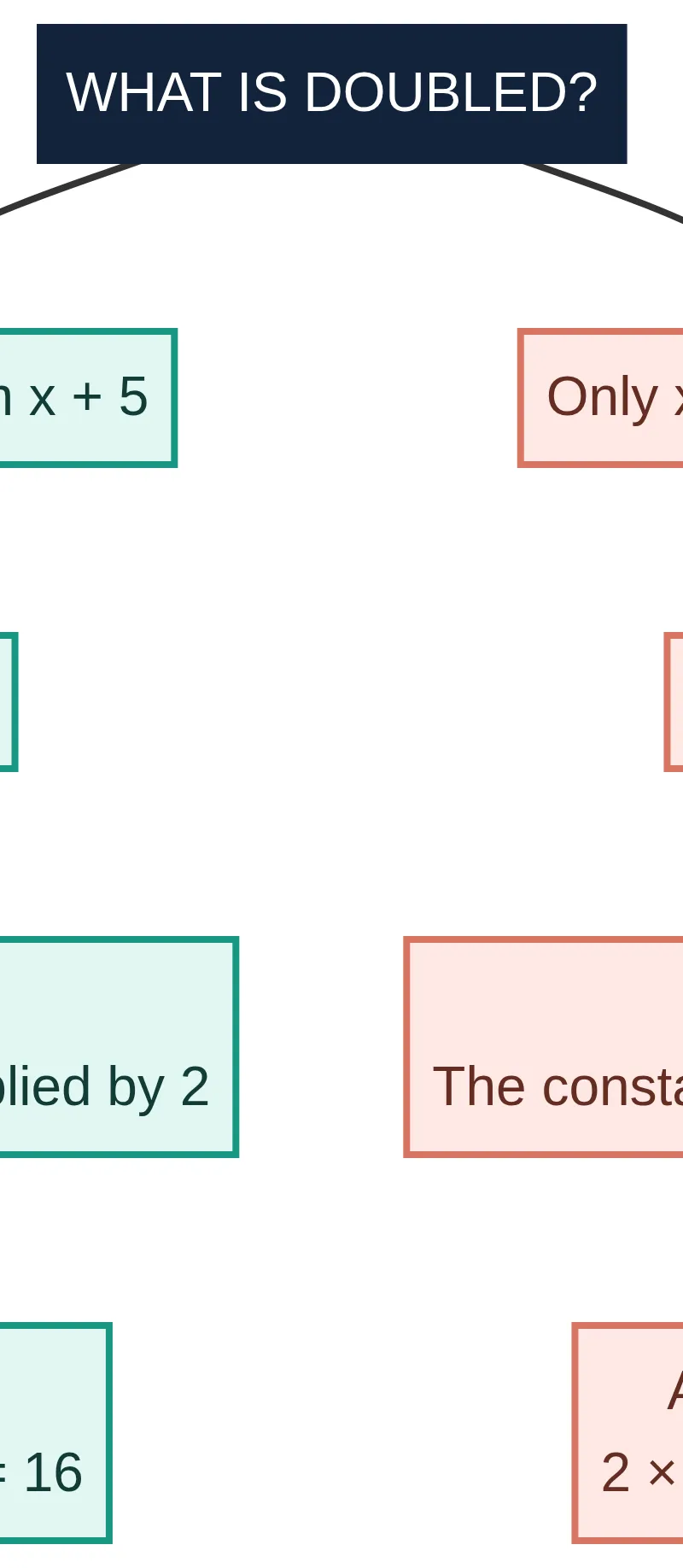
Compare “double the sum of x and five” with “double x, then add five”. The first instruction gives 2(x + 5). The second gives 2x + 5. Brackets group the sum before multiplication takes place.
A4 link: multiplying a single term over a bracket gives 2(x + 5) = 2x + 10. Both terms inside are multiplied by 2. Dropping the bracket to obtain 2x + 5 changes the operation on the constant term.
A useful image is a team inside a boundary: the outside multiplier treats every team member. The mathematical reason is the distributive law, k(u + v) = ku + kv, not simply the picture.
Example: at x = 3, 2(x + 5) = 16 and 2x + 5 = 11. Their difference is always 5 because the first expression includes ten where the second includes five. A single counterexample disproves a claim that these expressions are always equal. Matching one input would not prove equivalence for every input.
For subtraction, the same scope rule applies: 3(x − 4) = 3x − 12. Keep the negative sign attached to the term being multiplied.
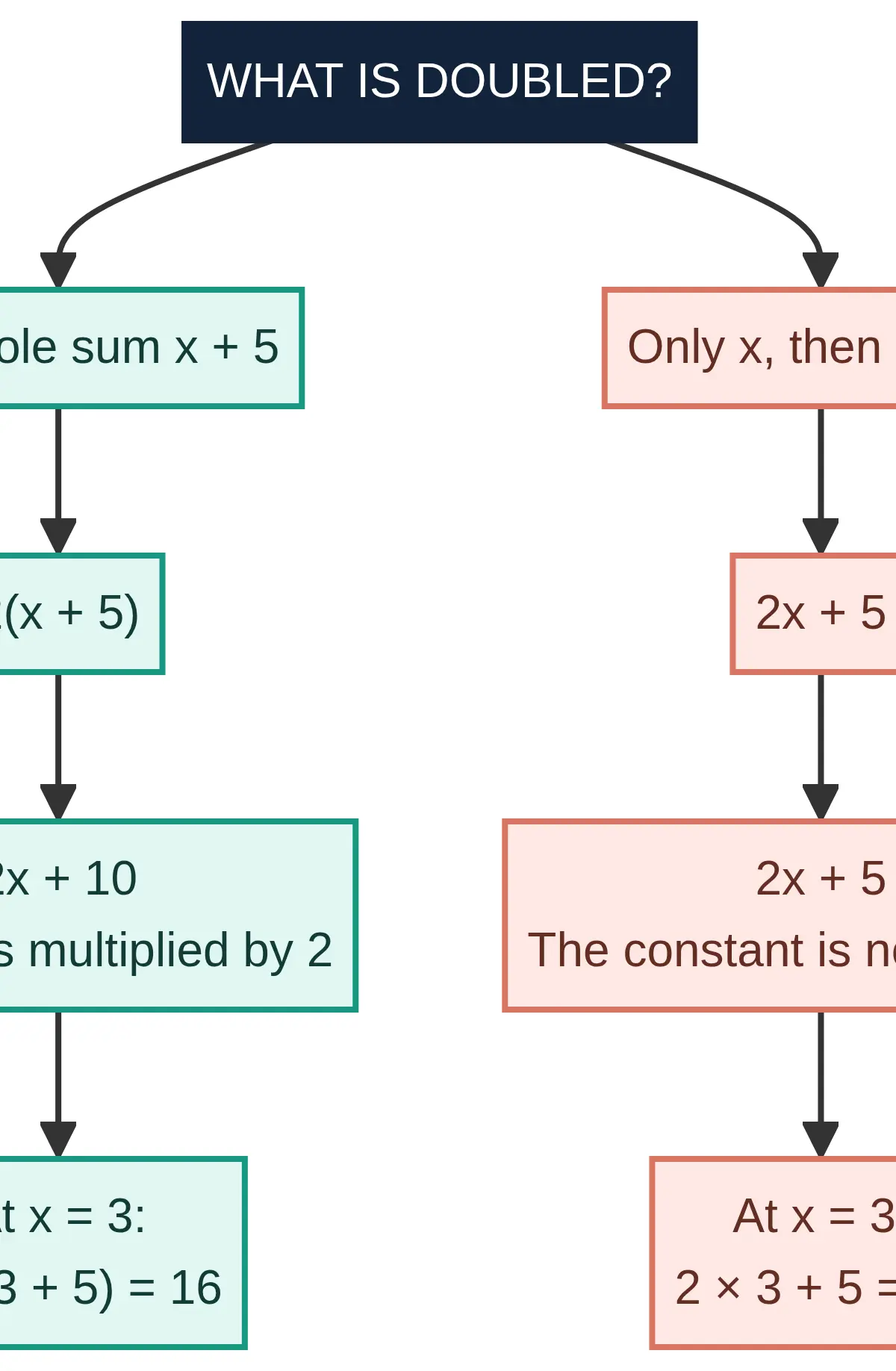
The same symbols describe different calculations when the bracket changes the scope of multiplication.
7. Expression, equation and equality
An expression is a mathematical phrase, such as 3y or 2(x + 5). An equation states that two expressions are equal, such as 3y = 12. When asked to write an expression, do not invent an equation or solve for a letter.
An equals sign asserts equal value. Use it only between equivalent expressions or correctly calculated values. A good working chain is 2 × a × 3 × b = 6 × a × b = 6ab. Do not join separate, unrelated answers with equals signs.
Examiner focus: clear working communicates what candidates mean. Writing a full product can reveal a sound interpretation, but a one-mark final-answer question does not automatically offer a separate method mark. Follow the specific command word and answer form. 3
Mathematical Relationships
These are the relationships needed for this topic. Must memorise means understand and use independently; these notation conventions are not rules supplied by a formula sheet.
Must memorise: ab = a × b; ky = k × y; y + y + y = 3y. Here a, b and y represent numbers, and k is a numerical coefficient.
Must memorise: a² = a × a; a³ = a × a × a; a²b = a × a × b. More generally, aⁿ is a product of n factors of a for a positive integer n. The base is a and the index is n.
Must memorise: a/b = a ÷ b, with b ≠ 0; (p/q)x = px/q, with q ≠ 0. The fraction p/q is the coefficient of x.
Must memorise, A4 link: k(u + v) = ku + kv and k(u − v) = ku − kv. These explain single-bracket multiplication. The comparison (ka)² = k²a² shows why a grouped coefficient is also squared.
No dedicated A1 formula is Given on formula sheet. Do not rely on an examination formula sheet to explain notation. Geometry applications below provide their formulae within the example.
Practical Applications and Cross-Topic Use
Costs and grouped purchases
If a ticket costs x pounds and a booking charge of £5 is added to each ticket, two tickets cost 2(x + 5) pounds. If instead there is one £5 charge for the entire purchase, the cost is 2x + 5 pounds. Read whether the charge is per item or per order before placing brackets.
Geometry and units
For a rectangle, area = length × width. If its sides are a cm and b cm, its area is ab cm². For a cube, volume = side × side × side: a side of a cm gives a³ cm³. The unit exponent describes the measurement type; the algebraic exponent describes repeated factors.
No special unit conversion is required for pure A1 questions. In an applied question, make units consistent before multiplying. For instance, convert 2 m to 200 cm before combining it with a length given in centimetres. Do not treat 1 m² as 100 cm²: it is 10,000 cm² because both dimensions are scaled by 100.
Graph-reading link
This topic does not require a new graph-plotting procedure. However, in y = 3x, the 3 multiplies x; it is not an index. A table gives y = 0, 3, 6 for x = 0, 1, 2. By contrast, y = x³ gives 0, 1, 8. Read the equation accurately before generating coordinates or interpreting the graph.
Listen, Retrieve and Check
Ten-minute tutor podcast: 00:00 introduction; 01:00 core concepts; 06:00 exam tips; 08:00 recall quiz; 09:00 summary. Pause the player when you need more thinking time.
Close the guide and explain the difference between 3y and y³, then between 2(x + 5) and 2x + 5. Reopen it only after committing to an answer. Check your reasoning, correct the precise rule you missed, and retry tomorrow and next week. Mix shorthand questions with a bracket or fraction question so you must choose the operation, not repeat one familiar routine.
Sources and Download
Visual Resources
2 diagrams and illustrations
Interactive Diagrams
2 interactive diagrams to visualise key concepts
Conceptual Flow Outline
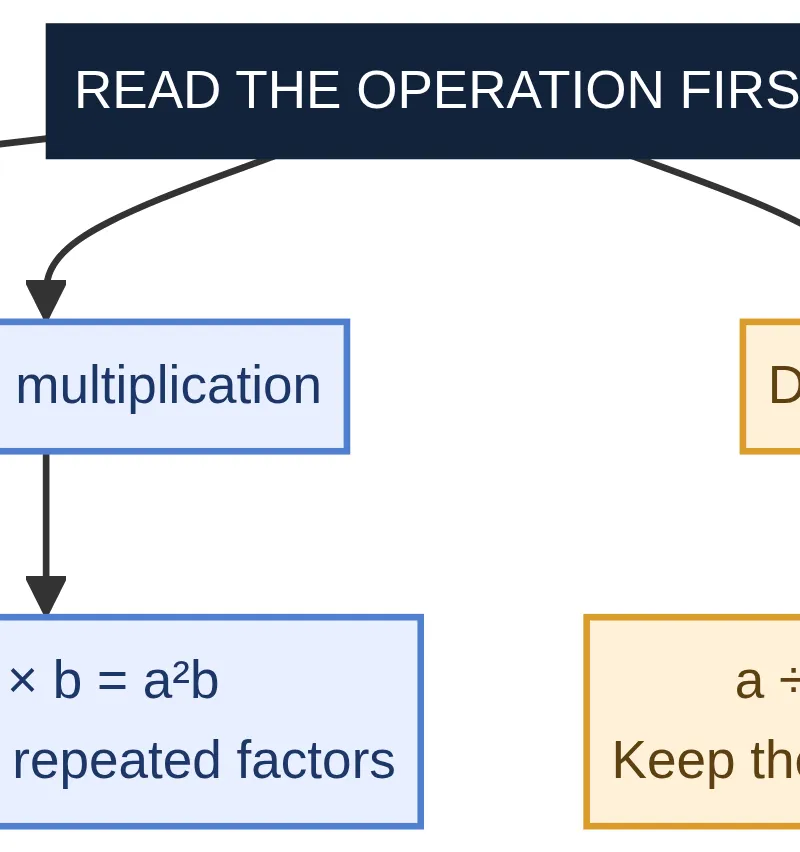
Choose shorthand by identifying the operation: addition, repeated multiplication, division or whole-expression grouping.
Conceptual Flow Outline
Compare doubling a whole sum with doubling only x; substitution at x = 3 gives 16 and 11.
Worked Examples
4 worked examples — open one to explore the question and available guidance.
Practice Questions
Try the question, then reveal an answer plan or example response
Write in standard shorthand: (a) a × b [1]; (b) y + y + y [1]; (c) a × a × a [1]. Original practice, 3 marks.
Hint: Identify whether each operation is addition or multiplication before shortening it.
Write in full using multiplication signs: (a) 5p [1]; (b) a²b [1]; (c) 2y³ [1]. Original practice, 3 marks.
Hint: Keep coefficients as multipliers and count the factors indicated by each index.
Write (a) p ÷ q as a fraction [1]; (b) two fifths of x using a fractional coefficient [1]; (c) the sum of x and 4 divided by 3 as one fraction [1]; (d) state the restriction on q [1]. Original practice, 4 marks.
Hint: A fraction bar groups its numerator. Keep the original division order.
Write an expression for (a) three times the sum of x and 4 [1]; (b) three times x, then add 4 [1]. (c) Work out both values at x = 2 [2]. Original practice, 4 marks, including an A2 link.
Hint: Decide whether the 4 belongs to the group being tripled.
A candidate claims 4a² = (4a)² for every a. (a) Write both expressions as full products [2]. (b) Work out both at a = 2 [2]. (c) Explain whether the claim is correct [1]. Original practice, 5 marks, including A2/A4 links.
Hint: Name the base in each power. One counterexample disproves an “every a” claim.
A school bag costs x pounds. A notebook costs £3. (a) Write an expression for the cost of two bags, each supplied with one notebook [1]. (b) Expand it [1]. (c) Write an expression for two bags and only one notebook [1]. (d) Work out both costs when x = 12 [2]. Original practice, 5 marks, including A2/A4 links.
Hint: Count how many notebooks are purchased in each situation.
Exam technique
How to turn what you know into marks
How to approach the question
Read the command word, then identify addition, multiplication, division or grouping. Name the base of each index. Preserve the original operation and write the requested form. Read your answer back into words; check with a numerical substitution if useful. A matching test value does not prove general equivalence.
How to structure your answer
For a one-mark write-down part, give one clear expression in the required form. For multipart tasks, label each answer. In explanations, identify the mathematical reason and support it with algebra or a counterexample. Show working whenever specifically requested and in longer calculations. One-mark notation parts do not automatically contain method marks. The allocations in original guide questions are indicative, not official Pearson schemes.
Timing
Each Pearson Edexcel paper is 90 minutes for 80 marks: 90 ÷ 80 = 1.125 minutes, or 67.5 seconds, per mark on average. For straightforward notation, aim for about 1 minute per mark: around 3 minutes for a 3-mark task and 5–6 minutes for a 5-mark task. This is a pacing guide, not an official per-question limit. Reserve time for checking.
Common pitfalls
- 3y is three added copies of y, not y³; inspect the operation.
- a³ means a × a × a, not 3a; an index counts factors.
- 2a² squares only a, whereas (2a)² squares 2a; identify the base.
- a²b squares a only; do not square b without an index or enclosing bracket.
- a ÷ b becomes a/b, not b/a; keep the order and exclude b = 0.
- 3(x + 4) expands to 3x + 12, not 3x + 4; multiply both terms.
- (x + 5)/2 divides the whole sum; x + 5/2 does not.
- 0.33x is not exactly x/3; keep exact fractional coefficients when required.
- Do not claim every decimal loses marks: 0.75 = 3/4 exactly, but a requested fraction must be given.
- An expression needs no invented equals sign or solution.
What the command words want
- Expand
- For the linked single-bracket skill, multiply the outside term by every term inside; preserve subtraction signs.
- Compare
- Identify the relevant similarity or difference mathematically, such as which base is squared; do not substitute a generic essay structure.
- Explain
- State a mathematical reason: for example, the constant is also doubled, or the two powers have different bases. “It is wrong” is insufficient.
- Evaluate
- In mathematics this normally means find a numerical value, not weigh arguments or give a judgement.
- Simplify
- Write an equivalent expression in a simpler form: combine numerical factors and repeated letter factors. Collect only like terms if that A4 skill is involved.
- Show that / Prove
- Provide a connected chain of valid mathematical steps. A numerical example alone cannot prove a claim for every possible input.
- Write an expression
- Translate the words into algebra. Use brackets for a whole group and do not invent an equation.
- Calculate / Work out
- Substitute given values carefully, show useful working and give the numerical answer. Use units in contextual questions, not in pure symbolic expressions.
- Write down / State / Give
- Give the required expression, value or restriction directly. A complete algebraic expression may be needed, not a fixed number of words.
Watch or listen (optional)
Test your understanding of Algebra - Notation, vocabulary and manipulation: use and interpret algebraic manipulation, including: • ab in place of a × b • 3y in place of y + y + y and 3 × y • a² in place of a × a, a³ in place of a × a × a, a²b in place of a × a × b • a/b in place of a ÷ b • coefficients written as fractions rather than as decimals • brackets
Active recall beats re-reading. Take an instant quiz now to test what you’ve learned and lock it into long-term memory.
7 days Premium · Then the free plan continues · No card, no charge