Pearson Edexcel · GCSE · Mathematics
Course version: 1MA1 · Version from Mar 2026
Algebra - Notation, vocabulary and manipulation: where appropriate, interpret simple expressions as functions with inputs and outputs; interpret the reverse process as the ‘inverse function’; interpret the succession of two functions as a ‘composite function’ (the use of formal function notation is expected) (Higher tier)
Function notation is a compact language for turning inputs into outputs, combining rules and undoing them. Master the order of composite functions and the algebra of inverses to tackle Pearson Edexcel GCSE Higher questions with clear working and fewer avoidable errors.
- 11 min read
- 3 worked examples
- 5 practice questions
- 9 key terms
Try the lesson
The start of the Algebra - Notation, vocabulary and manipulation: where appropriate, interpret simple expressions as functions with inputs and outputs; interpret the reverse process as the ‘inverse function’; interpret the succession of two functions as a ‘composite function’ (the use of formal function notation is expected) (Higher tier) lesson, made from checked teaching notes for this specification point.
Have a go first
Given f(x) = 4x + 1, find f⁻¹(x).
There is more to this lesson
The full lesson goes on to check your understanding and help you earn the marks. Create a free account to carry on, with your progress saved.
7 days Premium · Then the free plan continues · No card, no charge
Check what you remember
Read the wording for your board, then hide it and explain Function in your own words. Rough notes are fine. This is a self-check, with no mark or grade.
Reference: Pearson Edexcel
A rule assigning exactly one output to each permitted input.
Study Notes
Overview
A function is a rule that takes an input and produces exactly one output for each permitted input. This guide turns that familiar number-machine idea into the formal notation used in Pearson Edexcel GCSE Mathematics Higher. You will evaluate functions, combine two functions in succession, and find the inverse rule that reverses a process. These are compact algebra questions in which careful notation and a clear first substitution can make a substantial difference to the credit available.
The specification reference is 1MA1, A7. Basic input/output machines are shared with Foundation; inverse functions, composite functions and formal function notation are Higher content. Pearson's teaching guidance also connects functions to substitution, changing the subject, graphs and solving equations. Questions may ask for a single number, an expression, an unknown input, or algebra showing that a stated result is correct. 1 2
Use this guide actively: attempt each example before reading the solution, cover the key rules, then explain them aloud. The aim is not simply to recognise a worked answer. Candidates need to reproduce the correct process independently and show enough working for their understanding to be credited.
Key Concepts
1. Read function notation as input and output
For f(x) = 3x − 4, f is the function's name, x is its input, and f(x) is its output. Read f(5) as 'f of five'. It does not mean f multiplied by five. The rule says multiply the input by 3, then subtract 4.
Example: f(5) = 3 × 5 − 4 = 11. Write f(5) = 11, rather than saying only 'the answer is eleven'. When an examination answer space already supplies f(5) =, entering 11 is sufficient; repeating notation is a helpful habit, not an additional mark in itself.
Substitute the input everywhere x occurs. If h(x) = x² + 2x, then h(−3) = (−3)² + 2(−3) = 9 − 6 = 3. Brackets matter: (−3)² is 9, whereas −3² means −9 under the usual order of operations. A calculator will not repair a wrongly entered expression.
Cover and recall: What does f(−2) mean, and what is its value for f(x) = 3x − 4? Explain the notation before calculating. The answer is the output when the input is −2: −6 − 4 = −10.
2. An input can be an expression
The bracket after f can contain a number or a whole algebraic expression. Treat that expression as one package. For f(x) = 3x − 4:
**f(x + 2) = 3(x + 2) − 4 = 3x + 2.**By contrast, f(x) + 2 = (3x − 4) + 2 = 3x − 2. The first changes the input before f acts; the second changes the output afterwards. They are not interchangeable.
Similarly, f(3x) = 3(3x) − 4 = 9x − 4, but 3f(x) = 3(3x − 4) = 9x − 12. Pearson's teaching guidance explicitly includes algebraic work with expressions such as f(3x), 2f(x) and f(x) + g(x). 2
Why does this work? A function applies its rule to whatever occupies its input position. Brackets preserve the whole input during multiplication, squaring or division. Expand only after the substitution is correct.
3. Composite functions: the inside function acts first
A composite function applies two rules in succession. fg(x) means f(g(x)). Work out g first, then feed its output into f. Likewise, gf(x) means g(f(x)), so f acts first. The letter nearest x is the first machine used.
With f(x) = 3x − 4 and g(x) = x + 2:
fg(x) = f(x + 2) = 3(x + 2) − 4 = 3x + 2.
**gf(x) = g(3x − 4) = (3x − 4) + 2 = 3x − 2.**The different answers demonstrate that order matters. Do not describe fg(x) as f(x)g(x), which is a product. Also avoid saying the two orders are 'always different'. Some special pairs commute, for example two rules that each add a constant; the safe statement is that they are not generally equal.
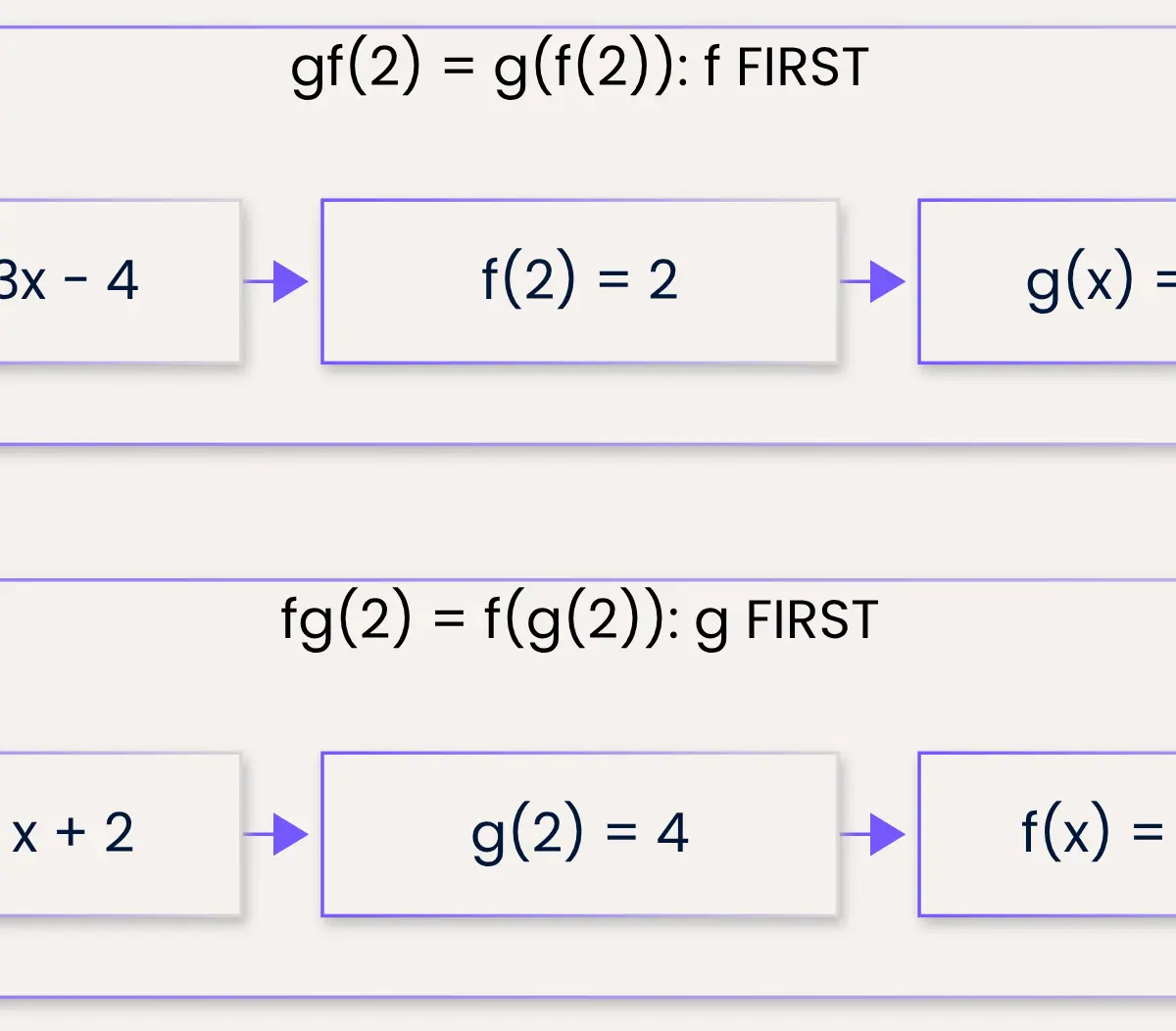
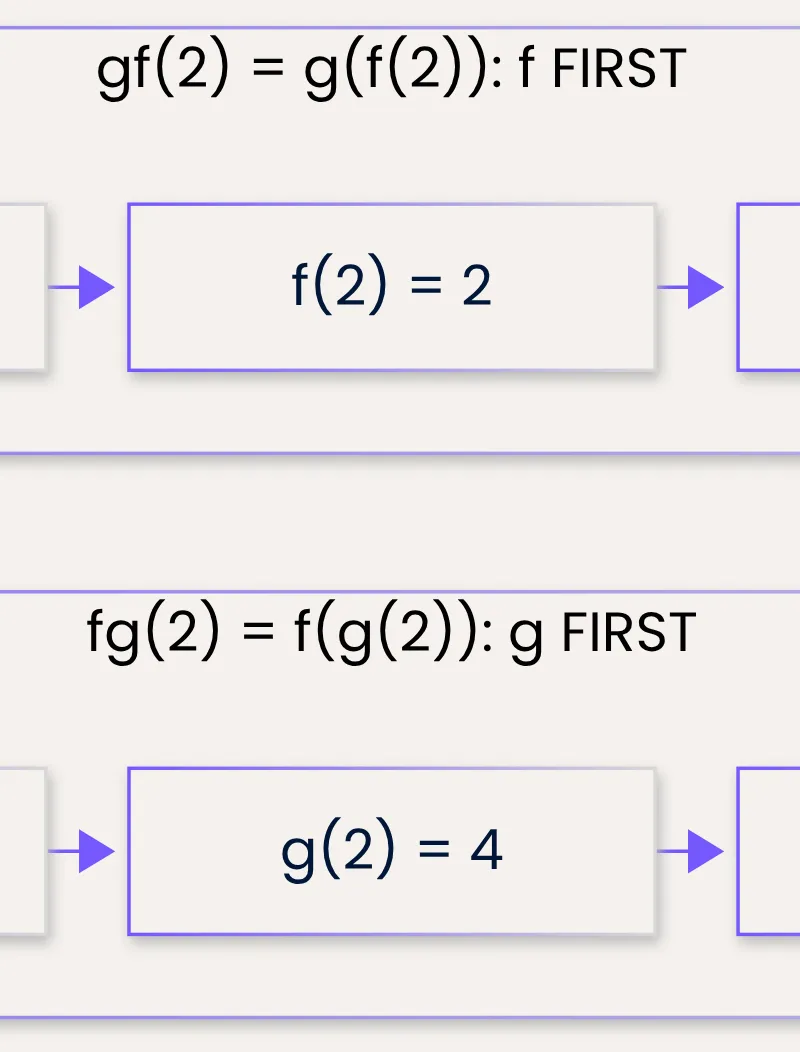
For a numerical composite, numbers are usually quickest. To find fg(2), calculate g(2) = 4, then f(4) = 8. For gf(2), calculate f(2) = 2, then g(2) = 4. Both calculations start with 2, but the routes differ.
If the inner rule is quadratic, still substitute the entire expression. For p(x) = 2x + 1 and q(x) = x² − 3, qp(x) = (2x + 1)² − 3 = 4x² + 4x − 2. Squaring a bracket produces a middle term: (2x + 1)² is not 4x² + 1.
4. Inverse functions: undo the last operation first
The inverse, written f⁻¹(x), reverses a function. The superscript −1 is part of inverse-function notation, not an instruction to take the reciprocal. For f(x) = 3x − 4, the reciprocal is 1/(3x − 4); the inverse is a different rule.
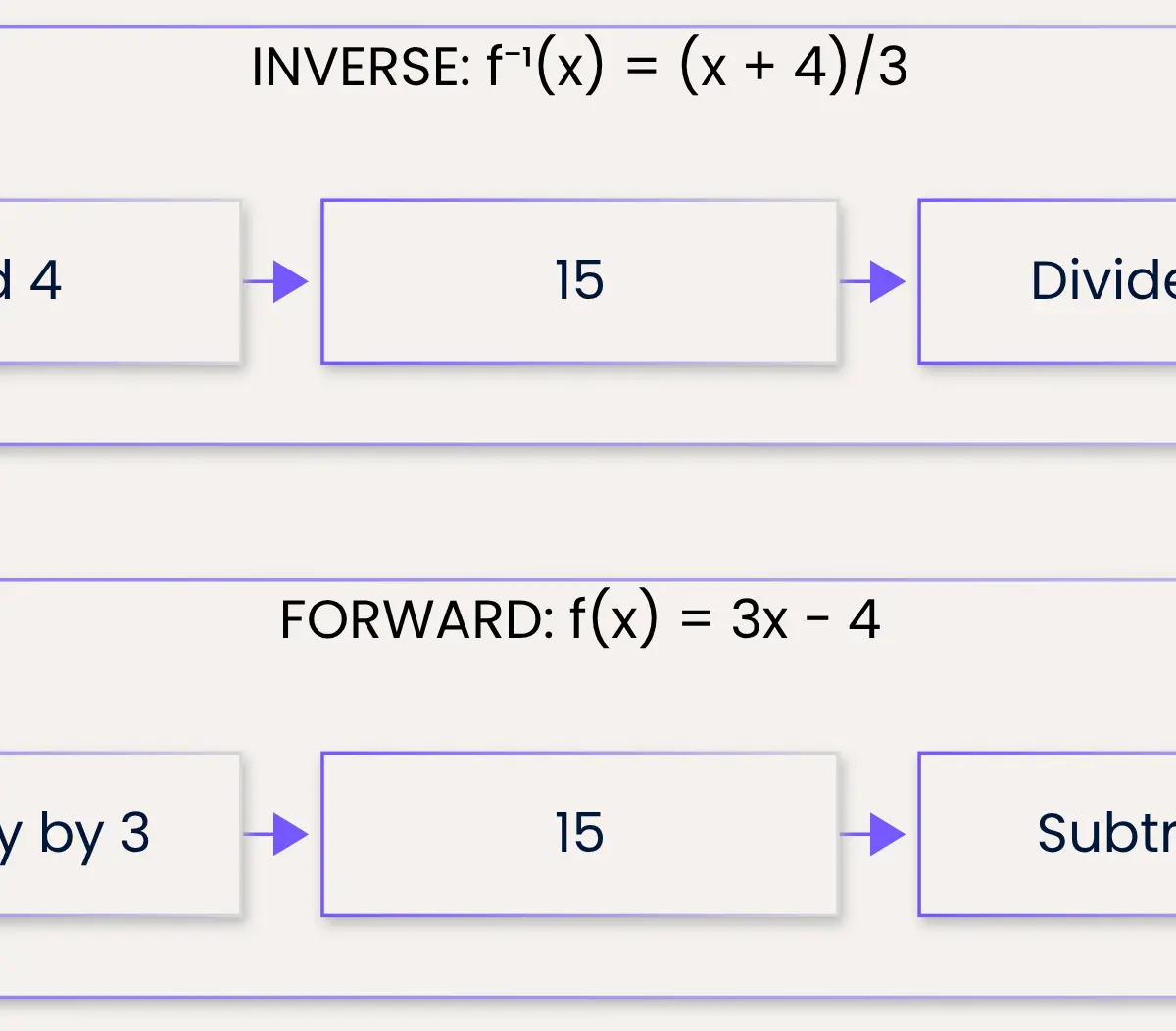
The forward process multiplies by 3 and subtracts 4. Its reverse must add 4 and then divide by 3. Two decisions matter: choose the opposite operation and reverse the order. Dividing by 3 and then adding 4 does not undo the original machine.
Algebraic method:
- Write y = 3x − 4.
- Add 4 to both sides: y + 4 = 3x.
- Divide by 3: x = (y + 4)/3.
- Swap the input/output letters: y = (x + 4)/3.
- State f⁻¹(x) = (x + 4)/3.
You may instead swap x and y at the beginning, then rearrange. Both methods are valid. Do not swap twice. The fraction bar must include the whole numerator x + 4, not just x. Writing x/3 + 4 describes the wrong inverse.
For f(x) = ax + b with a ≠ 0, the inverse is f⁻¹(x) = (x − b)/a. Negative coefficients are allowed: if r(x) = 7 − 2x, then r⁻¹(x) = (7 − x)/2.
5. Check an inverse without confusing a check with a proof
A quick numerical check catches sign and order errors. Since f(5) = 11, the inverse should send 11 back to 5: f⁻¹(11) = (11 + 4)/3 = 5. You can also start with an inverse input: f⁻¹(8) = 4 and f(4) = 8.
One successful number is not a proof that two formulas are inverses for every permitted input. For an algebraic check, substitute the whole original output into the inverse:
**f⁻¹(f(x)) = ((3x − 4) + 4)/3 = x.**In the other direction, f(f⁻¹(x)) = 3((x + 4)/3) − 4 = x. Each composition returns its starting input. Show this algebra if a question requests a general justification, rather than checking only x = 5.
A usable inverse must give one output for each permitted input. Squaring unrestricted real numbers loses the original sign: 3 and −3 both give 9. A question using a square-root inverse therefore needs an appropriate restriction, such as original inputs x ≥ 0. Linear functions with non-zero gradient avoid this difficulty. This is a helpful boundary, not a requirement to learn A-Level domain theory.
6. Solve equations involving functions
A request to find fg(x) asks for an expression. A request to solve fg(x) = 13 asks for input values. First build the correct composite, then solve the resulting equation.
For p(x) = 2x + 1 and q(x) = x² − 3, pq(x) = 2x² − 5. Solving pq(x) = 13 gives 2x² − 5 = 13, so x² = 9 and x = −3 or x = 3. Both roots are required unless the question restricts the input.
An unknown parameter works the same way. If f(x) = 4x − 1, g(x) = kx² and fg(2) = 12, then g(2) = 4k and f(4k) = 16k − 1. Therefore 16k − 1 = 12 and k = 13/16. Pearson's sample assessment question uses this exact structure with a two-mark inverse part and a two-mark parameter part. 2
7. Link functions to graphs
The graph y = f(x) records inputs horizontally and outputs vertically. To read f(2), start at x = 2, move to the curve, then read its y-coordinate. To solve f(x) = 2, start at y = 2 and read every x-coordinate where that horizontal level meets the curve.
Inverse functions swap inputs and outputs. If (5, 11) lies on y = f(x), then (11, 5) lies on y = f⁻¹(x). Their graphs are reflections in y = x, where an inverse exists with the appropriate inputs. For our example, the forward line has gradient 3 and intercept −4; the inverse line has gradient 1/3 and intercept 4/3.
When plotting, calculate several coordinate pairs, label both axes and use consistent scales. A straight-line function should be drawn with a ruler. Read estimates to the precision justified by the grid. Pearson notes that function and inverse graphs can be linked to geometrical interpretation. 2
Mathematical Relationships
Must memorise or know how to derive: f(a) is the output after substituting a into the rule. Here a represents an input value, not necessarily the coefficient used elsewhere.
Must memorise: fg(x) = f(g(x)) and gf(x) = g(f(x)). The function inside the brackets acts first.
Must memorise or derive: if f(x) = ax + b and a ≠ 0, then f⁻¹(x) = (x − b)/a. Here a is the non-zero coefficient of x and b is the constant term.
Must memorise: f⁻¹(f(x)) = x and f(f⁻¹(x)) = x for appropriate inputs; ff(x) = f(f(x)), not [f(x)]².
Must memorise: inverse graphs swap (a, b) to (b, a) and reflect in y = x. For expansion, (a + b)² = a² + 2ab + b².
Given on formula sheet: the quadratic formula x = (−b ± √(b² − 4ac))/(2a), for ax² + bx + c = 0 and a ≠ 0. It can solve a quadratic arising from a composite equation. The function, composition and inverse rules above are not supplied on Pearson's 2026 Higher formula sheet. 4
Practical Applications
Price changes make order memorable
Let d(x) = 0.8x apply a 20% discount to a price x pounds, and c(x) = x − 5 apply a £5 voucher. Then dc(50) = d(45) = £36, whereas cd(50) = c(40) = £35. Composition answers a practical question: which change happens first? The model assumes both reductions are allowed and ignores shop-specific restrictions.
Conversions and calibration use inverses
A temperature conversion F(C) = 9C/5 + 32 maps Celsius to Fahrenheit. Its inverse is C(F) = 5(F − 32)/9. It reverses both the operations and their order. This is an illustration, not an extra GCSE formula to memorise for A7. Keep the input and output units clear in contextual questions. Pure function questions normally have no units; this topic has no required practical or special unit-conversion list.
Exam Focus and Active Revision
Pearson's official Specimen Set 2, Paper 2H, question 9 allocates 1 mark to f(10), 2 marks to a linear inverse and 2 marks to showing ff(x) = 9x − 48. These are authentic question-specific allocations. Our worked and practice questions use separately labelled tutor-authored allocations. 2
Published past-paper schemes show method credit for starting an inverse rearrangement and for correct composite substitution. A correct unsimplified expression can demonstrate method, but full credit depends on the command and that question's scheme. A 'show that' response must contain the steps producing the given result. 3
Each paper lasts 90 minutes for 80 marks: 67.5 seconds per mark overall. Aim for about one minute per mark on routine parts to reserve checking time. Functions can appear on any Higher paper; practise the arithmetic without a calculator as well. 1
Listen, pause and retrieve
The ten-minute episode uses a female British tutor voice: introduction 0:00–1:00, core concepts 1:00–6:00, exam tips 6:00–8:00, quick-fire recall 8:00–9:00 and summary 9:00–10:00. Answer before the tutor does. Afterwards, close the guide and write fg(x), the inverse rule and one worked substitution from memory. Revisit with different numbers tomorrow and later in the week.
References
Visual Resources
2 diagrams and illustrations
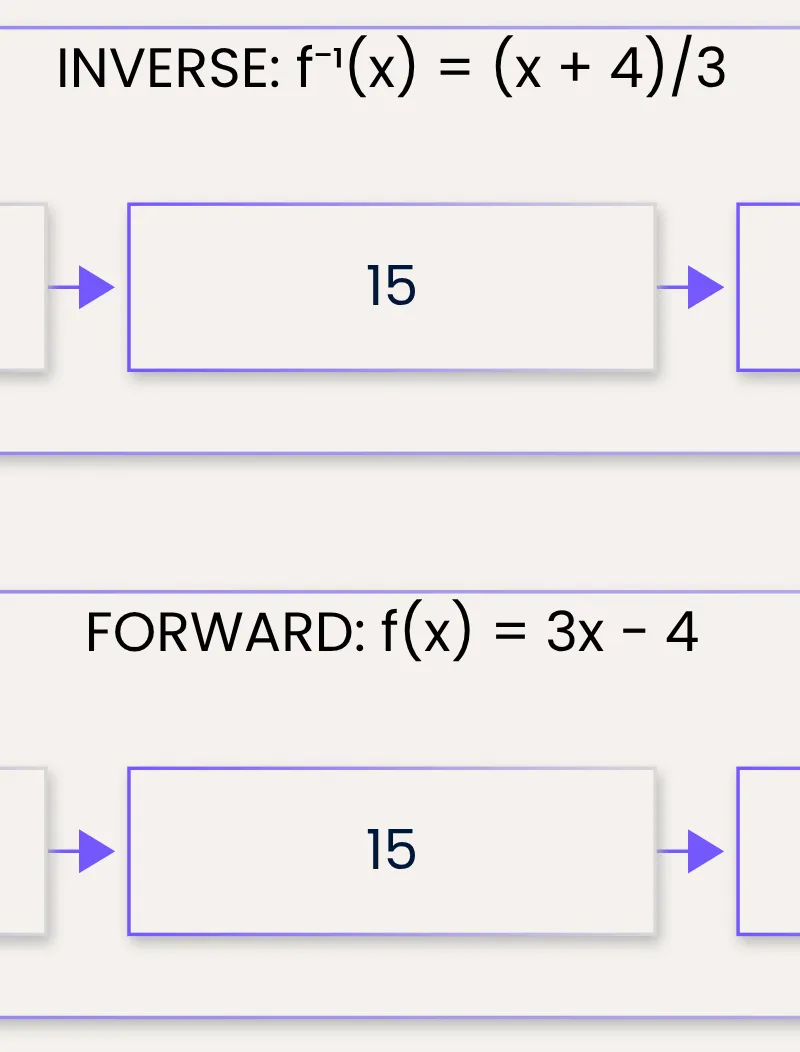
Interactive Diagrams
2 interactive diagrams to visualise key concepts
Conceptual Flow Outline
Compare fg(2) = 8 with gf(2) = 4: the inner function is applied first.
Conceptual Flow Outline
Reverse the forward machine: add 4, then divide by 3, to undo multiply by 3 then subtract 4.
Worked Examples
3 worked examples — open one to explore the question and available guidance.
Practice Questions
Try the question, then reveal an answer plan or example response
Original Edexcel-style practice, 2 marks. The function f is defined by f(x) = 3x − 4. (a) Work out f(−2). [1] (b) Work out f(3). [1]
Hint: This label means introductory difficulty within a Higher-tier guide. Replace x with the input, using brackets around a negative number.
Original Edexcel-style practice, 2 marks. f(x) = 2x + 1 and g(x) = x² − 3. Work out fg(3). Show your working.
Hint: Find g(3) first, then apply f to that number.
Original Edexcel-style practice, 4 marks. f(x) = 3x − 4 and g(x) = x + 2. (a) Find and simplify fg(x). [2] (b) Find and simplify gf(x). [2]
Hint: Write f(g(x)) and g(f(x)) separately before substituting.
Original Edexcel-style practice, 3 marks. The function r is defined by r(x) = 7 − 2x. (a) Find r⁻¹(x). [2] (b) Work out r⁻¹(13). [1]
Hint: Write y = 7 − 2x and make x the subject before swapping the letters.
Original Edexcel-style practice, 4 marks. h(x) = 2x − 3 and k(x) = x² + 2. Solve hk(x) = kh(x). Show your working.
Hint: Form both composites, set them equal, then factorise the resulting quadratic.
Exam technique
How to turn what you know into marks
How to approach the question
Identify whether the answer must be a value, an expression, an inverse rule or input solutions. Copy the function rules accurately. Rewrite fg(x) as f(g(x)); substitute the inner rule first. For an inverse, write y = f(x), rearrange for x, swap the letters once and finish in inverse notation. For an equation, form the correct expression before solving. Treat stated restrictions on inputs as part of the question.
How to structure your answer
For a 1-mark evaluation, show a compact substitution if useful and give the correct value. For a typical 2-mark inverse, show a valid rearrangement and a correct f⁻¹(x) expression. For a 2-mark composite, show the correctly substituted bracket and the requested final form. In multi-part 3–6-mark tasks, label each part and keep the two composition orders separate. M denotes method, A accuracy and B independent credit; P can denote a process and C a communication/conclusion mark in official schemes. All allocations in our worked and practice questions are tutor-authored. Official credit is question-specific; do not assume unsimplified work earns full marks.
Timing
Each Edexcel paper is 90 minutes for 80 marks, giving 1.125 minutes or 67.5 seconds per mark overall. Aim for roughly 1 minute per mark on routine function parts to reserve checking time: about 3 minutes for 3 marks and 5–6 minutes for 5 marks. These are pacing recommendations, not board-prescribed question times.
Common pitfalls
- Reading fg(x) as multiplication. Write f(g(x)), not f(x)g(x).
- Applying f first in fg(x). The inside function g acts first.
- Treating f⁻¹(x) as 1/f(x). Inverse notation means undo the rule.
- Giving x = (y + 4)/3 as the final inverse. Complete the relabelling and state f⁻¹(x) = (x + 4)/3; if the printed answer space already includes f⁻¹(x) =, enter the expression there.
- Dividing only x by 3 in (x + 4)/3. The whole numerator must be divided.
- Dropping a middle term when squaring a bracket. Expand (2x + 1)² as (2x + 1)(2x + 1).
- Reporting only the positive root. Check for both solutions when solving a quadratic, unless the input is restricted.
- Copying the result in a show-that question. Give the algebra that establishes it.
- Claiming a single numerical check proves an identity. A numerical check detects errors; a general proof needs algebra.
What the command words want
- Solve
- Find all input values satisfying the equation. Do not stop after writing the composite expression.
- Compare
- Calculate each order separately and state their relationship. A counterexample can show that the two rules are not generally equal.
- Explain
- Give a mathematical reason, such as g acts first because fg(x) = f(g(x)). Support the statement with notation or calculation.
- Describe
- If asked about a graph or mapping, state its relevant mathematical feature, such as reflection in y = x.
- Evaluate
- In a function question, evaluate means calculate the numerical value. It does not mean discuss both sides or make an essay-style judgement.
- Show that
- Begin with the definitions or left-hand expression and give valid steps leading to the supplied result. The printed result is not working.
- Express/Simplify
- Give the algebraic expression in the stated form. Expand, collect like terms or factorise as instructed.
- State/Give/Write down
- Give the requested value, expression or coordinates directly. In Mathematics, the answer need not be a word or phrase. Follow any instruction about fractions, exact values or form.
- Find/Work out/Calculate
- Calculate the requested value or algebraic expression. Show substitution and any rearrangement when there is method credit available. Include units only if the question has a context.
Watch or listen (optional)
Test your understanding of Algebra - Notation, vocabulary and manipulation: where appropriate, interpret simple expressions as functions with inputs and outputs; interpret the reverse process as the ‘inverse function’; interpret the succession of two functions as a ‘composite function’ (the use of formal function notation is expected) (Higher tier)
Active recall beats re-reading. Take an instant quiz now to test what you’ve learned and lock it into long-term memory.
7 days Premium · Then the free plan continues · No card, no charge