WJEC · A-Level · Mathematics
Algebra and Functions
Algebra and Functions is where WJEC A-Level Mathematics becomes a connected system: exact manipulation produces equations, equations produce graphs, and graphs explain the answers. Mastering these routines protects method marks across the AS Unit 1 paper and prepares you for coordinate geometry, calculus and modelling.
- 10 min read
- 3 worked examples
- 5 practice questions
- 8 key terms
Study Notes
Overview
WJEC A-Level Mathematics, 2.1.2 Algebra and Functions is the toolkit behind much of AS Pure Mathematics. It asks candidates to manipulate exact expressions, solve equations and inequalities, and translate algebra into a correct sketch. The topic is assessed in AS Unit 1: Pure Mathematics A, a 2 hour 30 minute, 120-mark calculator paper. Questions are usually structured, but a later part may deliberately combine a quadratic, a line and a graph so that candidates must decide which method earns the next mark.
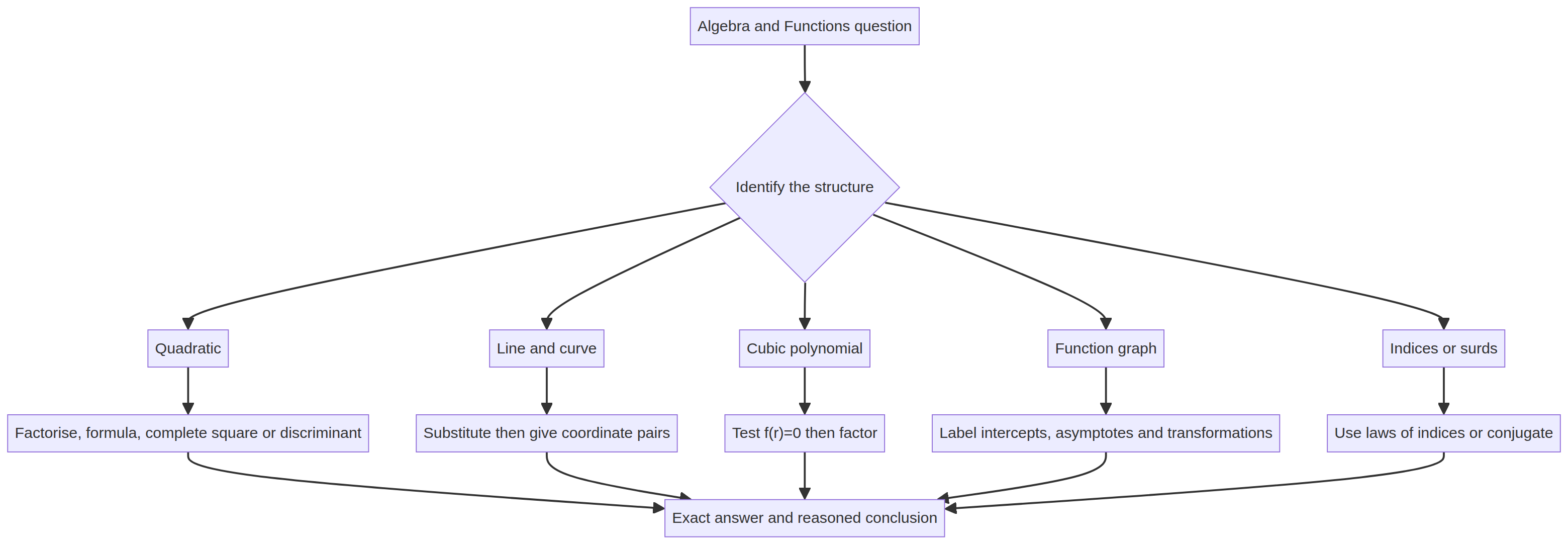
Think of the topic as a connected chain: indices and surds preserve exact value; quadratic methods reveal roots and turning points; inequalities select permitted regions; polynomials expose factors; and functions represent all of this visually. The strongest candidates do not learn isolated tricks. They ask: What structure is present? What does it mean on the graph? What exact conclusion has the command word requested? That approach protects method marks even if arithmetic goes wrong late in a solution.
Key Concepts
1. Indices and surds: exact algebra, not calculator arithmetic
Indices describe repeated multiplication, so their laws follow from counting factors:
- (a^m a^n=a^{m+n}), (a^m/a^n=a^{m-n}), and ((a^m)^n=a^{mn}).
- (a^{-n}=1/a^n). A negative index means reciprocal, not a negative answer.
- (a^{m/n}=\sqrt[n]{a^m}). For example, (x^{3/2}=(\sqrt{x})^3).
All three laws of indices are must memorise formulae in the WJEC specification. Only combine powers when the operation permits it: (x^2 imes x^3=x^5), but (x^2+x^3) cannot be simplified by adding indices.
A surd is an irrational root kept in exact form. First extract square factors: (\sqrt{72}=\sqrt{36 imes2}=6\sqrt2$). To rationalise a denominator containing one surd, multiply numerator and denominator by that surd. For a two-term denominator, multiply by the conjugate, changing only the central sign. This creates a difference of two squares: ((a+b)(a-b)=a^2-b^2). It works because the middle terms cancel. Candidates receive credit for showing the multiplier on both numerator and denominator, then simplifying precisely. Do not round to decimals unless the question explicitly asks for an approximation.$
2. Quadratic functions: roots, shape and the discriminant
A quadratic has form (y=ax^2+bx+c). Its graph is a parabola. The sign of (a) determines whether it opens upward or downward; (c) is the y-intercept. You should switch methods deliberately:
- Factorise when integer factors are visible.
- Use the quadratic formula when factorisation is inefficient. It is must memorise for WJEC: (x=(-b\pm\sqrt{b^2-4ac})/(2a)).
- Complete the square when the turning point, maximum or minimum is needed.
Completing the square rewrites (x^2-6x+5) as ((x-3)^2-4). Because a square cannot be negative, the minimum value is (-4), at (x=3). This is a powerful explanation, not merely a procedure.
The discriminant (\Delta=b^2-4ac) predicts the x-axis intersections before you solve. If (\Delta>0), there are two distinct real roots. If (\Delta=0), there is one repeated real root and the graph touches the axis. If (\Delta<0), there are no real roots. In a ‘state the nature of the roots’ question, write both the calculated discriminant and the conclusion. The examiner can then award the reasoning mark and the conclusion mark separately.
3. Simultaneous equations and inequalities: algebra with logic
A simultaneous equation is often a line meeting a curve. Substitute the linear expression into the quadratic, solve the resulting equation, then substitute each x-value back to find y. A question asking for points of intersection needs coordinate pairs, not just x-values. A repeated solution signals that the line is tangent to the curve, which can also be justified using a zero discriminant.
For inequalities, solve algebraically but interpret the answer logically. Reverse the inequality only when multiplying or dividing by a negative. With a quadratic inequality, factorise where possible, mark the roots on a number line or sketch, and decide which intervals satisfy the sign. For ((x-2)(x-4)\geq0), an upward-opening quadratic is non-negative outside the roots: (x\leq2) or (x\geq4). ‘Or’ means either interval is accepted; values between two roots use ‘and’. In set notation, ‘or’ is a union (\cup), while ‘and’ is an intersection (\cap). Strict boundaries use (<) or (>), and must be excluded from a graph.
4. Polynomials and the Factor Theorem
Before using a formal method, look for common factors, identities or grouping. The Factor Theorem says that if (f(r)=0), then ((x-r)) is a factor of (f(x)). WJEC restricts this use to cubic polynomials and solving cubic equations. Test likely integer roots, which are factors of the constant term. Once a factor is found, use algebraic division or regrouping to reduce the cubic to a quadratic. Keep the line (f(r)=0) visible: it earns the link between a numerical substitution and the factor.
A disguised quadratic may use a substitution. For (x^4-5x^2+6=0), set (u=x^2), solve (u^2-5u+6=0), then return to x. The final stage is essential: (u=2) gives (x=\pm\sqrt2), not simply (x=2).
5. Functions, curves and transformations
A function maps each allowed input to exactly one output. The domain is the permitted input set; the range is the set of outputs. When sketching, label intercepts, turning points and asymptotes before drawing the curve. For (y=a/x), the axes are vertical and horizontal asymptotes. The curve approaches them but never meets them. For (y=a/x^2), both branches have the sign of (a): above the x-axis for positive (a), below for negative (a).
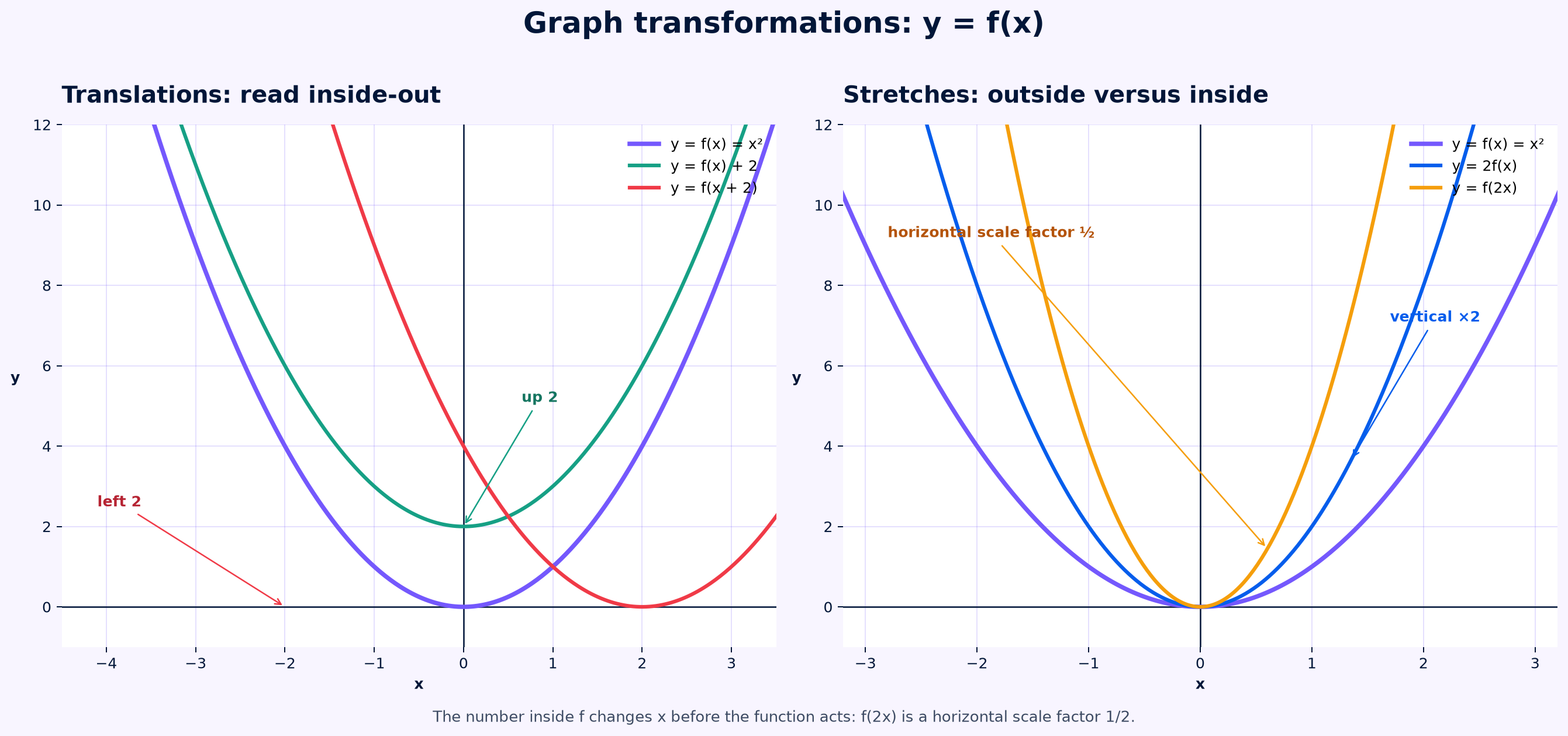
The transformations below are assessed through a sketch of (y=f(x)):
- (y=af(x)): multiply all y-values by (a), a vertical stretch of scale factor (|a|), with reflection in the x-axis if (a<0).
- (y=f(x)+a): translate the graph up (a).
- (y=f(x+a)): translate the graph left (a). The inside sign works in the opposite horizontal direction.
- (y=f(ax)): horizontal scale factor (1/a). It is a compression towards the y-axis when (a>1).
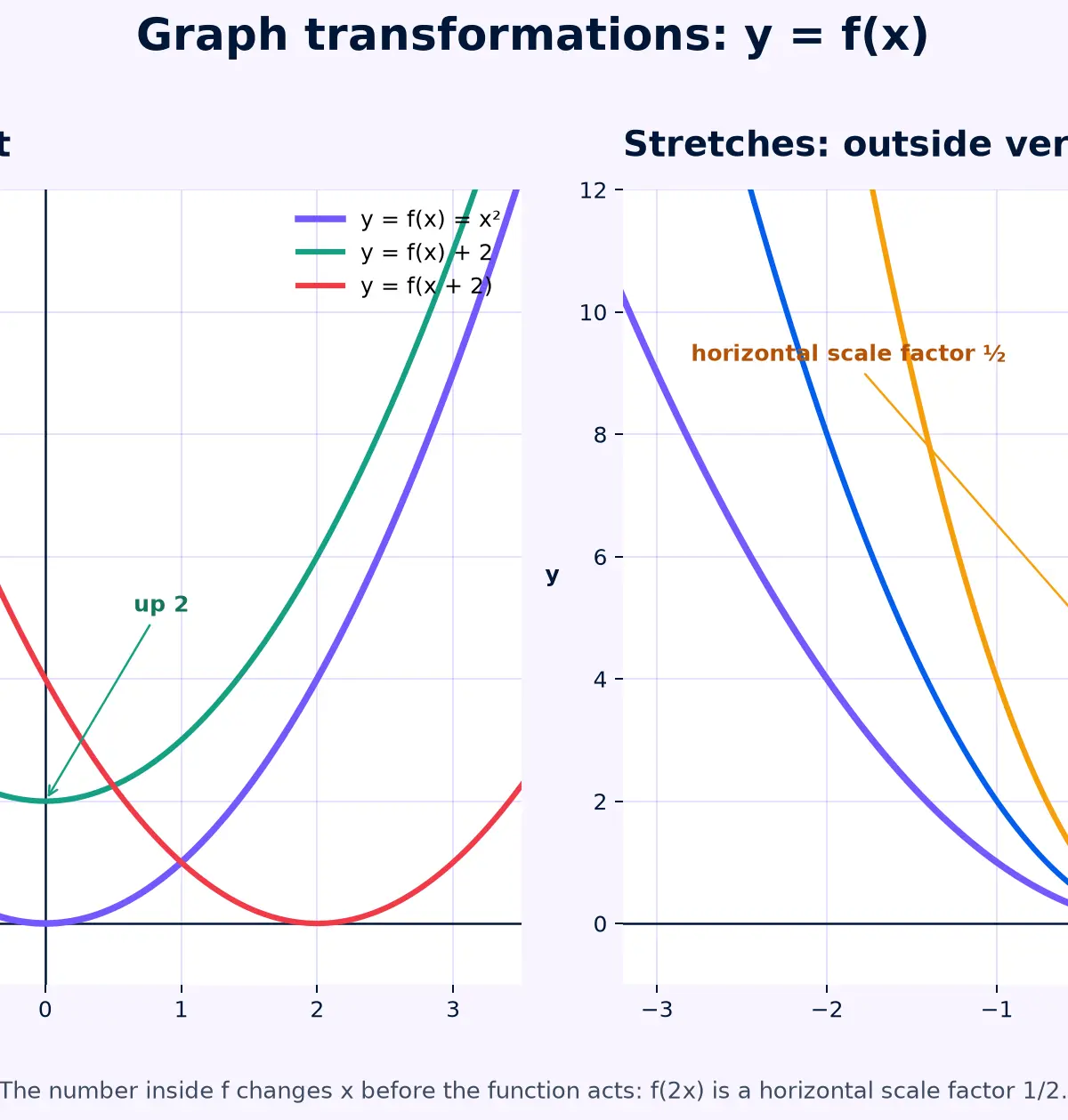
Use a known point to check an inside transformation. If ((3,5)) lies on (y=f(x)), then (f(2x)=5) when (2x=3), so ((3/2,5)) lies on (y=f(2x)). This is why the scale factor is one-half, not two.
6. Choosing a method and checking a result
Many examination questions are designed to test method selection rather than a long calculation. First standardise the expression: expand brackets only if that reveals a quadratic or polynomial; factorise only if factors will answer the question; and avoid using the quadratic formula automatically when a factorisation is immediate. For example, (x^2-7x+12=0) is best solved as ((x-3)(x-4)=0), whereas (2x^2+3x-1=0) may be faster with the formula. A calculator can check roots, but a calculator display is not a substitute for the algebraic method that earns marks.
Use reverse checks intelligently. Substitute a proposed root into the original expression, not only into a rearranged line. For a line and curve, plot or compare the number of solutions with the discriminant: two distinct x-values should give two intersections; a zero discriminant indicates tangency. For an inequality, test one value from each region separated by a root. This is especially safe when a factorised expression includes a negative leading coefficient, where relying on a remembered ‘outside’ rule can fail. In rational expressions, identify excluded values before cancelling factors. Cancelling ((x-2)) may simplify the rule, but (x=2) can remain outside the domain of the original function.
Presentation also matters. Keep equality signs truthful: write a new line when you make a new assumption or give a reason in words. Box a final answer only after checking its form. An interval question needs inequality or set notation; an intersection question needs coordinates; a transformation question needs a direction and scale factor; and a sketch needs labelled features. Candidates often know the mathematics but drop marks because their final line answers a different question from the one asked.
Mathematical Relationships and Formula Status
| Relationship | What it tells you | WJEC status |
|---|---|---|
| (a^m a^n=a^{m+n}), (a^m/a^n=a^{m-n}), ((a^m)^n=a^{mn}) | How equal bases combine under multiplication, division and powers | Must memorise |
| (a^{m/n}=\sqrt[n]{a^m}) | Links rational exponents and roots | Must memorise |
| (x=(-b\pm\sqrt{b^2-4ac})/(2a)) | Solves (ax^2+bx+c=0) | Must memorise |
| (\Delta=b^2-4ac) | Predicts the number and type of real roots | Must memorise |
| (f(r)=0\Rightarrow(x-r) ext{ is a factor}) | Tests a potential linear factor of a cubic | Must memorise |
Formula-sheet warning: WJEC Appendix B states that these formulae and identities must be usable without being provided in the examination. Build recall, rather than relying on a booklet.
Graph and Data Skills
A sketch is not an artwork. For full credit, put the algebraic evidence onto the axes: intercepts, roots, vertex, asymptotes and any symmetry. Draw asymptotes as dashed guides, not as parts of the curve. When using a graphical intersection to solve an equation, state whether the reading is exact or approximate. For a region such as (y>x+1), draw the boundary dashed because equality is excluded; shade the side that satisfies a test point such as ((0,0)).
Practical Applications
Quadratics model trajectories and optimisation, while their turning points become maxima and minima in later calculus. A line meeting a curve models break-even points, where two competing quantities are equal. Reciprocal graphs model quantities such as time for a fixed task as workers increase, and graph transformations are the mathematical language behind rescaling images and animation paths. These contexts help you choose a meaningful conclusion, but WJEC still awards marks for clear algebraic structure first.
Exam-Ready Audio Recap
Visual Resources
2 diagrams and illustrations
Interactive Diagrams
2 interactive diagrams to visualise key concepts
Conceptual Flow Outline
The discriminant converts one calculation into a precise statement about roots and graph intersections.
Conceptual Flow Outline
A transformation map showing why outside and inside changes must be read differently.
Worked Examples
3 worked examples — open one to explore the question and available guidance.
Practice Questions
Test your understanding — click to reveal model answers
Simplify (16^{3/4}). [2 marks]
Hint: Rewrite the rational index as a fourth root, then cube.
The equation (x^2+6x+k=0) has a repeated root. Find (k). [3 marks]
Hint: A repeated root means the discriminant equals zero.
Solve (x^2-5x+6<0), giving your answer as an inequality. [3 marks]
Hint: Factorise and think about where an upward-opening parabola is below the axis.
Given (f(x)=x^3-2x^2-5x+6), show that (x=1) is a root and solve (f(x)=0). [5 marks]
Hint: Evaluate f(1), then divide by x−1 or group the cubic.
The point ((4,7)) lies on (y=f(x)). State the corresponding point on (y=f(3x)-2). [3 marks]
Hint: First make the input to f equal 4, then apply the vertical translation.